PART 1
My Sister Claimed Her Daughter Was Impossible Until I Checked Our Mother’s Pharmacy
I had a quiet three-bedroom house twenty minutes from the campus. My husband passed away four years ago, my own two boys were grown and living in Ohio, and most evenings were just me and the television. I told Brenda to send Chloe over.
When Chloe pulled into my driveway that Sunday evening, she did not look difficult.
She looked exhausted. She carried two cardboard boxes and a plastic laundry basket full of textbooks and secondhand sweaters. Her shoulders were hunched, and the first thing she said when I opened the front door was, “I promise I won’t be loud, Aunt Karen.”
She wasn’t loud. In fact, for the first two months, she was almost invisible.
Chloe attended morning classes, studied at the kitchen table until four, and then put on her non-slip shoes to work the closing shift at a diner near the bypass. She came home around eleven at night, took off her shoes on the back mat so she wouldn’t wake me, and ate leftover casserole straight from the refrigerator container. If I left a dirty spoon in the sink before bed, it was washed, dried, and put away by six in the morning.
Around the middle of November, I noticed she was skipping meals when she was home.
She was buying store-brand instant noodles by the flat, and when her old winter coat tore at the pocket seam, she patched it with black electrical tape instead of buying a new needle and thread.
She worked thirty-two hours a week at nine dollars an hour plus tips. That wasn’t a fortune, but it was enough for a girl living rent-free to buy groceries and put gas in a ten-year-old Civic.
One Tuesday evening after dinner, I sat down across from her at the table while she was doing accounting homework.
“Chloe,” I said gently. “You haven’t bought any meat for your lunches in three weeks. You’re losing weight, honey. Where is your money going?”
She looked down at her spiral notebook. Her thumb kept rubbing the spiral wire until her skin turned red.
“I have expenses,” she muttered.
“What expenses? Your tuition was covered by the state grant, and I told you that your room and food here are free.”
She hesitated for a long time. Then she swallowed hard and said, “Mom says I owe rent for my old room.”
I stared at her. “You haven’t lived in Brenda’s house since August. Why would you pay rent on an empty room?”
“She said she held the room for me in case I failed out,” Chloe said, her voice barely audible. “She said it cost her four hundred dollars a month just to keep it waiting.”
I was furious. Brenda owned her home outright after our parents helped her with the deed twelve years ago. There was no mortgage, and an empty bedroom didn’t consume heat or electricity on its own.
“You’re not paying her another dime,” I said firmly. “I’m calling her right now.”
Chloe reached across the table and grabbed my wrist. Her fingers were trembling.
“Please don’t, Aunt Karen,” she whispered. “That’s not the real reason. If you call her, she’ll stop.”
“Stop what?”
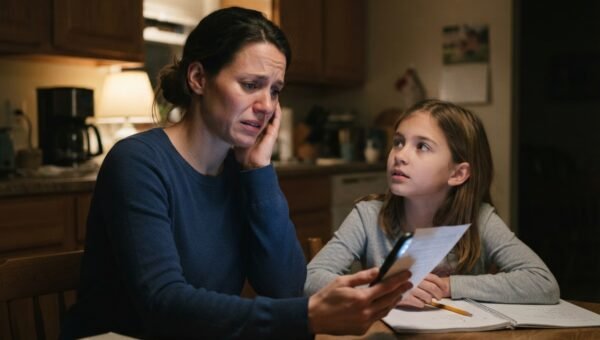
Chloe pulled her phone out of her pocket, unlocked the screen, and slid it toward me.
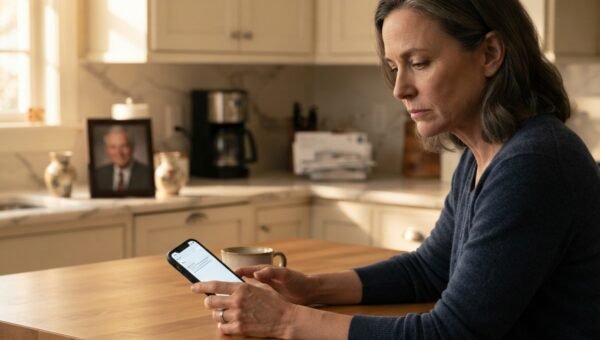
There were dozens of text messages from Brenda dating back to September. None of them mentioned an empty room.
One message from three weeks earlier read: *Your shift money cleared today. I need $380 by Friday or I am not picking up Grandma’s heart pills. If she has another stroke because you’re selfish, that is on you.*
Another from the previous Friday said: *You have until noon. The copay went up. Do not make your grandmother suffer because you want to play college girl.*
My stomach dropped. Our mother was seventy-eight, living in an assisted living apartment six miles away, and her heart condition required two expensive daily medications. Brenda was our mother’s local healthcare proxy because Brenda lived five minutes from the facility. Every month, Brenda collected fifty dollars from me and forty from our brother in Denver, claiming the supplemental insurance didn’t cover the full cost.
Now I was looking at proof that Brenda had been taking almost every dollar my nineteen-year-old niece earned by threatening to let our mother die without her medicine.
“I gave her everything I made last week,” Chloe said, looking at the floor. “I had twenty-two dollars left for gas.”
“Get your coat,” I told her.
“Where are we going?”
“We’re going to Mom’s pharmacy.”
It was eight in the evening, and the drive-thru window at the pharmacy on Elm Street was still open. I walked into the lobby instead. The head pharmacist, Frank, had been filling prescriptions for my family since our father was alive. He knew my mother’s file by heart.
I pulled out my checkbook and set it on the counter.
“Frank,” I said, trying to keep my hands steady. “I need to pay whatever outstanding balance is on my mother, Evelyn Miller’s, prescriptions. Whatever is owed for this month, or past months, put it on this check.”
Frank frowned. He tapped at his keyboard for a few seconds, adjusted his glasses, and looked at me over the counter.
“Karen, what are you talking about?” he asked.
“Brenda’s been paying out of pocket for Mom’s heart medicine,” I explained. “The copays Chloe and Brenda have been covering. I’m taking care of it tonight.”
Frank shook his head slowly. “Karen, Evelyn was switched to the state senior prescription assistance program two years ago when her supplemental tier changed. Her medication has been fully covered for two years. There is no copay. Her balance has been zero dollars and zero cents every single month.”
I walked back out to the parking lot. The cold air hit my face, but my head was burning.
I got into the driver’s seat of my car, looked over at Chloe, whose eyes were wide with worry, and dialed Brenda’s cell phone.
She picked up on the third ring. Her voice was light, breezy, and completely relaxed.
“Hey, Karen! What’s going on?”
I gripped the steering wheel with my left hand and held the phone tight against my ear.
“I’m standing at Mom’s pharmacy,” I said.
The line went completely silent.
PART 2
“Brenda?” I said into the quiet phone. “Did you hear me?”
A sharp exhale came through the speaker. When Brenda spoke again, her cheerful tone was gone. It was replaced by that thin, brittle edge she always used when she was backed into a corner.
“What were you doing at the pharmacy, Karen? That’s none of your business. I handle Mom’s medical care.”
“Frank handles Mom’s prescriptions,” I said. My voice was very steady, which surprised me. “And Frank just told me that Mom hasn’t had a copay in twenty-four months. Not one penny. So where did the four hundred dollars Chloe sent you on Friday go? Where did the money our brother sent you go?”
“You don’t understand how much it costs to drive back and forth to that facility,” Brenda snapped, her voice rising fast. “Gas isn’t free! My time isn’t free! Chloe was living under my roof for nineteen years eating my food, and she owes this family!”
“You threatened to withhold our mother’s heart pills from a nineteen-year-old girl,” I said. “You told her Mom would have a stroke if she didn’t hand over her diner tips.”
Chloe sat beside me in the passenger seat, staring straight ahead through the windshield, her hands clamped tightly between her knees. She was shaking so hard her teeth were clicking together.
“Chloe is a liar and a sneak,” Brenda hissed. “She went behind my back to you, didn’t she? I knew she would. She’s been poisoning everyone against me. If you believe her over your own sister, that’s your problem. Put her on the phone right now.”
“She is not speaking to you,” I said.
“Put my daughter on the phone, Karen! I am her mother!”
“You’re not getting another cent from her,” I said. “And you’re not getting another dime from me or David. Tomorrow morning, I am going to the assisted living office, and I’m going to Mom’s doctor. We are taking your name off every single record.”
“You can’t do that!” she screamed. “I have the proxy!”
I hung up.
My hand was shaking as I lowered the phone into my lap. Inside the car, the only sound was the heater blowing against our feet.
“She’s going to hate me forever,” Chloe whispered.
“She doesn’t hate you, honey,” I said, putting my arm across the seat and pulling her shoulder toward me. “She used you. There is a very big difference, and it stops tonight.”
We drove back to my house in silence. Chloe went straight to her room, and for the next hour, Brenda blew up my phone. She sent seven text messages calling me self-righteous and accusing me of tearing the family apart. Then she sent three messages to Chloe threatening to report her Civic as stolen because Brenda’s name was still listed as a co-owner on the title.
That was when I realized how deep the hooks went. Brenda had made sure that every piece of Chloe’s life had strings attached. The car, the checking account, the college financial aid forms. If Brenda wanted to make trouble, she had the paperwork to do it.
I sat at my kitchen table until two in the morning with a yellow legal pad. I wrote down every date from the text messages Chloe had shown me. In three months, Chloe had transferred exactly $1,460 to Brenda’s bank account through an instant payment app. On top of that, David and I had been sending Brenda ninety dollars combined every month for two years for those fake copays. That was another $2,160.
Brenda hadn’t just bullied her child. She had built a small business out of our mother’s illness.
The next morning, I woke Chloe up at seven.
“First stop is the bank,” I told her over oatmeal. “You are opening a new account at a credit union where Brenda has never set foot. Second stop is the DMV. We are going to find out what it takes to get her name off your title.”
Chloe looked down at her bowl, stirring the oats. “Aunt Karen, the car was a gift from Grandpa before he died. He put Mom on the title because I was only seventeen. Mom has the actual pink slip in her lockbox.”
“Then we will deal with that too,” I said. “Eat your breakfast.”
At nine, we met with the branch manager at the county credit union. We opened an account in Chloe’s name alone. Chloe transferred the remaining twenty-two dollars from her old account and shut it down.
At ten-thirty, we arrived at the administration office of Meadow View Assisted Living.
Our mother was sitting in the dayroom finishing a crossword puzzle when we walked by the glass doors. She looked small in her knit cardigan, but she smiled and waved her pen at us. I blew her a kiss, but I didn’t stop. I walked straight into the office of the administrator, a woman named Sarah Jenkins who had worked there for a decade.
“Karen,” Sarah said, standing up from her desk with a warm smile. “Good to see you. How is Evelyn doing this week?”
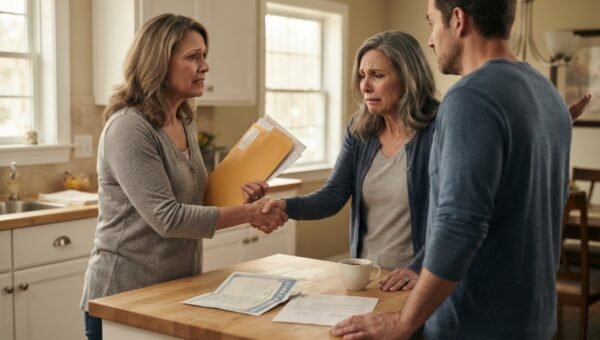
“Mom is fine,” I said, closing the office door behind Chloe and me. “But we have a serious issue regarding her financial and medical representation. And I need you to show me the billing file.”
PART 3
Sarah’s smile faded. She looked from me to Chloe’s pale face and immediately gestured to the chairs.
“What happened?” Sarah asked.
“My sister Brenda has been collecting money from the family claiming that Mom’s medications require cash out-of-pocket payments,” I said plainly. “Frank at the pharmacy confirmed last night that Mom’s meds have been fully covered by the state plan for two years.”
Sarah sighed and rubbed her forehead. She didn’t look shocked; she looked tired.
“Karen,” Sarah said quietly, “we had a question about Brenda’s management three months ago. Evelyn’s personal needs allowance—the small stipend left over from her pension after facility rent—has been disappearing the day it hits the account. Brenda set up direct withdrawal for it.”
“How much?” I asked.
“One hundred and forty dollars a month. Brenda told us she was using it to buy Evelyn special diabetic shoes and clothes. But when the aides asked Evelyn about new shoes, she said she hadn’t gotten any.”
I felt a tight knot harden in my chest. Brenda hadn’t just stolen from her working daughter and her siblings. She was siphoning forty dollars a week from an old woman with bad knees who lived on crossword puzzles and daytime game shows.
“I have our brother David on speakerphone right now,” I said, dialing his number and setting my phone on Sarah’s desk.
David picked up on the second ring from his office in Denver. Within ten minutes, David heard the entire story. He didn’t yell. David was an engineer; when he got angry, his voice got flat and icy.
“I have our mother’s original power of attorney documents in my safe,” David said over the speaker. “Dad made Brenda the primary because she lived five minutes away, but I am listed as the alternate, and you are listed second. If two of us sign an affidavit of financial misconduct, the facility can freeze Brenda’s access immediately.”
“Do it today,” I told him. “Scan it and email it directly to Sarah.”
“I’ll have it over in twenty minutes,” David said. “And Karen? Tell Chloe she’s not paying another dime of that car. I’ll pay off whatever balance is left on the note if Brenda tries to hold the lien.”
“There is no note,” Chloe spoke up into the phone, her voice shaking slightly. “Grandpa paid cash. Mom just kept the paper.”
“Then she has no legal debt on it,” David said. “She’s just holding paper.”
We left the administrator’s office an hour later. Brenda’s access to Mom’s personal account was frozen. The facility removed her from the visitor notification list for medical decisions, replacing her with me.
When we walked back through the lobby, my phone buzzed. It was a picture sent from Brenda.
It was a photograph of the hood of Chloe’s Civic, taken from Brenda’s front porch. Brenda had driven over to my house while we were at the assisted living center, found the car parked in my driveway, and had a tow truck hooked up to the front axle.
The text below it read: *The car is in my name. I am taking what is mine. You can tell your lawyer about it.*
I didn’t panic. I turned to Chloe. “Call the diner. Tell them you’re going to be ten minutes late for your shift today.”
“What are we going to do?” Chloe asked, tears finally spilling down her cheeks. “She took my car, Aunt Karen. How am I going to get to class?”
“Get in,” I said, opening the passenger door of my sedan.
We drove straight to Brenda’s house on Maple Lane.
When we pulled into the gravel drive, the tow truck was still there. The driver was filling out a clipboard, and Brenda was standing on her front steps in her pink robe, holding a mug of coffee. When she saw my car, she took a slow sip and smiled. It was the same smug smile she used to make when we were girls and she broke my mother’s dishes and blamed it on the dog.
I stepped out of the car. I didn’t yell. I walked right up to the tow truck driver.
“Sir,” I said, loud enough for Brenda to hear across the lawn. “Who authorized this tow?”
The driver looked up, annoyed. “The registered co-owner on the registration slip.”
“Did she show you the probate distribution order?” I asked.
The driver stopped his pen. “What?”
“This vehicle belonged to Arthur Miller,” I said, keeping my eyes fixed on Brenda’s porch. “When he passed away, the vehicle was willed to his granddaughter, Chloe Miller. My sister Brenda was added as an adult custodian because Chloe was a minor. Chloe turned nineteen six months ago. If you move that car off this property without the probate release, you are participating in the illegal seizure of an estate asset. And I have the probate case number right here.”
I didn’t have the probate number memorized, but my father’s estate had gone through the county court three years ago, and I had the attorney’s card in my purse.
The tow truck driver looked at Brenda. “Ma’am? Is this an estate dispute?”
Brenda’s smile vanished. “It’s my name on the title! Show him the title!”
“I don’t tow cars in family estate fights,” the driver said flatly. He unhooked the winch cable from Chloe’s bumper with a loud metallic clatter. “That’s a civil matter. You owe me eighty-five dollars for the dispatch fee.”
“I am not paying you eighty-five dollars!” Brenda shrieked. “You do your job!”
“Then you can argue with dispatch,” the driver said, climbing back into his cab and slamming the door.
Brenda stood on the steps, her mug trembling in her hand.
I walked halfway up the walkway, stopped near the hydrangeas, and looked up at her.
“David has already filed the affidavit with Meadow View,” I said. “Your access to Mom’s accounts is canceled. Her medical files are transferred to me. And if you ever send Chloe another message threatening Mom’s medicine, I am taking those printouts to the county prosecutor’s office for elder fraud and extortion.”
Brenda’s mouth opened, but no sound came out. For the first time in my life, she had run out of words.
“You’re a monster,” Brenda finally choked out, tears of pure rage pooling in her eyes. “I gave my life for this family. I took care of Mom while you lived your easy life across town!”
“Mom’s pills were free, Brenda,” I said. “And Chloe earned every single dollar you stole from her.”
I turned my back on her and walked back to my car.
ENDING
We didn’t go to court. People always assume family fights like this end in front of a judge with gavels banging, but in real life, people like Brenda usually shrink when the spotlight gets too bright.
David and I gave her a simple choice through our father’s old probate lawyer: sign over the full title of the Civic to Chloe and repay the $1,460 she had extorted from her daughter, or we would file a formal complaint with the Department of Social Services for elder financial abuse.
Two weeks later, an envelope arrived at my house. Inside was the signed vehicle title transferring sole ownership to Chloe, along with a cashier’s check for $1,460 made out to Chloe Miller. There was no letter. There was no apology.
Chloe used half that money to replace all four bald tires on her Civic and put the rest into a savings account that nobody else could touch.
Brenda stopped coming to family gatherings. She didn’t visit our mother for Thanksgiving, and she didn’t call on Christmas. When our mother asked why Brenda was so busy, David and I simply told her that Brenda had taken on extra work out of town. There was no reason to break an old woman’s heart with the ugly truth when her days were already short and quiet.
Chloe stayed in my spare bedroom for the spring semester, and then through the summer.
She finished her associate degree in medical billing two years later. On the morning of her graduation, she came into the kitchen carrying a small white box wrapped in blue ribbon. She set it next to my coffee mug.
“What’s this?” I asked.
“Open it,” she said.
Inside was a spare key to her car, attached to a brand-new metal keychain that read: *Paid in Full.*
“You don’t owe me anything, Chloe,” I told her, looking up at her face. She wasn’t hunched over anymore. Her shoulders were straight, and she had color in her cheeks.
“I know,” she smiled, leaning down to kiss my cheek before grabbing her gown off the back of the chair. “That’s why I’m giving it to you.”