PART 1
My husband, Greg, and I had one silly rule for forty years of marriage: never go to bed angry. We kept it through unpaid dental bills, leaky roofs, and the lean years when our daughter, Chloe, was little and we were clipping coupons just to put meat on the table. If an argument flared up, one of us would eventually give in, or make a pot of decaf, or just sit on the edge of the bed until we talked it down to something manageable.
Then last Thursday happened.
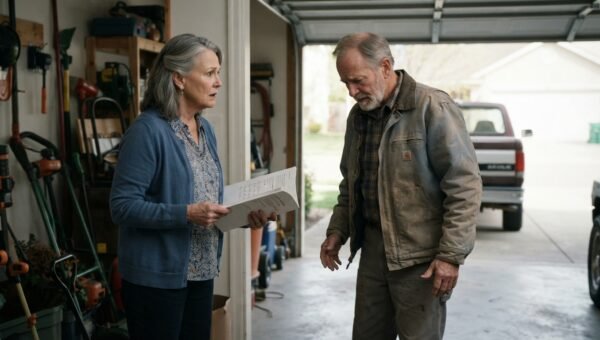
We had been sitting in the kitchen around eight in the evening. The dinner dishes were drying in the rack, and Greg pushed a stack of printed real estate listings across the yellow laminate table. He told me he wanted to sell our three-bedroom colonial in Lansing and buy a small place an hour south in Jackson, just five minutes away from Chloe and her family.
I looked at him like he had lost his mind. We had paid our mortgage off two years ago. We had put forty years of our sweat into this ground. My hydrangea bushes lined the porch, my sister lived four streets away, and all my doctor appointments were right here. I told him straight out that Chloe had a busy life, a husband, two kids in elementary school, and a full-time job. She did not need her aging parents parked right down the road, and I had zero desire to pack up forty years of memories into cardboard boxes just to sit in an unfamiliar suburb.
Greg usually backed off when I set my heels in, but that night he pushed hard. His jaw tightened, and his voice went sharp in a way I had not heard in years. He said our house was too big, the stairs were already bothering my knees, and staying here was pure stubborn pride. I snapped back, asking him when he had turned into such a quitter, and that was the end of it.
He didn’t make decaf. He didn’t sit down. He took his pillow into the front guest room and pulled the door shut without another word.
I lay in our master bedroom staring at the ceiling fan, waiting for the doorknob to turn, but the house stayed dead silent. Somewhere around midnight, exhaustion finally pulled me under.
At 2:15 a.m., a distinct click woke me up. It was the latch on the heavy front door falling into place.
I threw off the quilt and hurried down the hall in my bare feet. The guest room door was wide open, the bed unmade and empty. I stepped to the living room window and parted the sheer curtain just in time to see the red taillights of his Buick LeSabre disappearing down the street.
I grabbed my cell phone and dialed him right away. It rang four times and rolled straight to voicemail. I left a furious message telling him he was being ridiculous and demanding that he turn that car around and come home.
I didn’t sleep another wink. I sat on the sofa watching the driveway, expecting him to pull in once he cooled down. By 6:00 a.m., the sun was creeping through the blinds, and the empty driveway was still bare concrete. His phone went straight to voicemail on the first ring, which meant he had switched it off.
Panic completely swallowed my anger. Greg was sixty-six years old, took blood pressure medication every morning with his coffee, and had never pulled a stunt like this in his entire adult life.
At 6:30, I couldn’t bear the silence anymore. I called Chloe.
When she answered, her voice sounded groggy and thick with sleep. I started spilling words all over each other, telling her that her father and I had an argument about moving, that he had packed up and left in the middle of the night, and that he wasn’t answering his phone.
The line went completely dead. Not disconnected, just pure, hollow quiet.
“Chloe?” I said, my hand shaking against the receiver. “Did you hear me? Your father is gone.”
She stayed quiet for what felt like two whole minutes before letting out a slow, trembling breath.
“Mom,” she whispered. “Dad came down here last Tuesday.”
“What do you mean he came down there? He told me he was running errands in town.”
“He drove down while Mark was at work and the kids were at school,” Chloe said. Her voice broke slightly on the edges. “He handed me an envelope. He made me put it in our fireproof safe. He looked at me, Mom, and he told me not to open it, and not to call you, unless he vanished overnight and didn’t come back by morning.”
The floor felt like it dropped right out from beneath my slippers. My chest went tight, every muscle freezing in place.
“What is in that envelope, Chloe?”
“I don’t know,” she cried. “He made me swear on the kids that I wouldn’t touch it unless this exact morning happened. Mom, you need to drive down here right now.”
I didn’t bother changing out of my flannel pajama pants or brushing my hair. I grabbed my purse, slipped my winter coat on over my robe, stepped into my slip-on sneakers, and ran out to my sedan.
The forty-five-minute drive down the highway was a blur of gray morning fog and racing thoughts. My mind spun through every terrible scenario imaginable. Had he been hiding a secret gambling debt? Was he having an affair after four decades of marriage? Was he running away from us?
When I pulled up Chloe’s driveway, she was already standing on the front porch with her arms wrapped tightly around herself. She brought me straight into her kitchen and pulled a heavy manila envelope from her kitchen drawer. It had my name written across the front in Greg’s neat, slanted handwriting.
With trembling fingers, I tore the flap open.
Two things fell out onto the table.
The first was a small, brass house key. It had a yellow plastic tag looped through the top with the number 412 written in black permanent marker. I didn’t recognize the cut or the shape; it didn’t belong to any lock on our home, our garage, or our storage shed.
The second was a folded piece of lined notebook paper.
I unfolded it, my vision swimming as I stared down at his handwriting:
“Margaret, before you think the absolute worst of me, go here first. 412 Maple Street, Apartment 2B, over in Albion. Don’t call the police. Use the key, go inside, and look on the kitchen counter. Everything will make sense, but only if you see it yourself.”
PART 2
Chloe reached across the table and grabbed my hand. Her fingers were ice-cold. “Mom, Albion is twenty minutes east of here. What does Dad have in an apartment in Albion?”
I couldn’t answer her. My stomach was churning with a sick, oily dread. Albion was a quiet, working-class college town we rarely had reason to visit. For him to have a key to an apartment there meant he had been paying rent, signing a lease, or visiting someone without my knowledge. A secret apartment only ever meant one of two things: a woman, or a second life funded by money stolen from our household.
“I’m coming with you,” Chloe said, reaching for her car keys.
“No,” I told her, my voice firmer than I actually felt. “Mark is getting the kids ready for school. Stay here with them. If your dad is doing what I think he might be doing, I don’t want you standing in the middle of it.”
She argued, but I stood up, took the brass key, and folded the note into my coat pocket.
The drive to Albion felt endless. Every billboard on Interstate 94 seemed to mock me. Forty years. We had scraped together down payments, nursed each other through flu seasons, buried our parents, and walked our daughter down the aisle. How could a man live alongside you in the same bed, eat your roast chicken on Sunday nights, and keep a set of keys to a whole different door?
I found Maple Street easily enough. It was an older residential block lined with mature oaks and two-story brick four-plexes. Number 412 sat near the corner, a weathered red-brick building with concrete steps leading up to a shared front door. The exterior door was unlocked.
I stepped into the dim, carpeted hallway. The smell hit me immediately: lemon floor wax and old radiator heat. I walked up the narrow stairs to the second floor and stopped in front of the door marked 2B.
My hand shook so badly that the brass key scraped against the brass plate three times before sliding into the cylinder. The tumbler turned with a clean, well-oiled click.
I pushed the door open, bracing myself for the sight of someone else’s furniture, perfume, or another woman standing in the entryway.
Instead, the apartment was dead silent.
It was completely empty. There were no couches, no rugs, no television, and no curtains on the windows. Morning sunlight poured across bare hardwood floors that smelled freshly sanded.
In the center of the small kitchen, sitting on a brand-new laminate countertop, were three neatly organized items: a thick accordion folder, a white cardboard box from a local pharmacy, and a second handwritten letter.
I walked over, my sneakers squeaking against the clean floorboards. My eyes landed on the pharmacy box first. Printed on the prescription label was Greg’s name, followed by a medication I had never seen in our bathroom cabinet: Donepezil, ten milligrams.
My knees gave way. I had worked as an administrative assistant at an outpatient clinic for twelve years before retiring. I knew exactly what that medication was used for. It was prescribed for the symptoms of mild to moderate dementia caused by Alzheimer’s disease.
My hands trembled so violently I could barely open the second letter.
“Margaret,” it began, his familiar handwriting looking noticeably shakier than the note he had left with Chloe. “If you are reading this, it means I broke our rule and didn’t have the guts to stay until morning. I am so sorry. Six months ago, I got lost driving home from the hardware store on Cedar Street. A route I have driven ten thousand times, and I sat at the intersection for forty minutes with tears running down my face because I couldn’t remember which way our house was.
“I went to a neurologist in Ann Arbor without telling you. I paid the co-pays out of my personal checking account from my old consulting scraps so you wouldn’t see the charges on our shared statement. Two months ago, the tests confirmed early-onset Alzheimer’s.
“The fight we had last night about moving to Jackson wasn’t about Chloe’s convenience, Margaret. It was about you. In a few years, I won’t be able to shovel our long driveway. I won’t be able to help you down our steep basement stairs when the furnace acts up. And soon enough, you are going to be carrying the weight of a sick husband entirely on your own. I wanted us five minutes from Chloe because I knew you would need her to help you lift me, feed me, and keep an eye on me when my mind is completely gone.”
A tear hit the paper, smearing the blue ballpoint ink.
“This apartment belongs to my old union buddy, Pete,” the letter continued. “He bought the four-plex to flip it, and he let me rent this unit month-to-month for next to nothing so I had a quiet place to organize everything before I dropped this bomb on you. Everything you need is in the accordion folder. Every bank account, the deed to the Lansing house, the pension transfer forms, the medical power of attorney already drawn up by a lawyer, and my advance healthcare directive. I didn’t run away to abandon you. I ran because I couldn’t bear to look in your eyes and see the moment you realized your husband was slipping away. I am sitting at the diner by the old train depot down the street. Whenever you’re ready, come find me.”
PART 3
I collapsed against the counter, clutching the letter to my chest as quiet, choking sobs tore through my throat.
All the burning anger that had kept my spine stiff for the past eight hours drained away, leaving a hollow, aching sadness in its place. He hadn’t bought a secret love nest. He hadn’t run off to start a new life. He had been carrying the terrifying reality of his own fading mind entirely in secret, desperately trying to build a safety net for me before his memory collapsed completely.
I wiped my face with the sleeve of my robe, picked up the accordion folder, and locked the apartment door behind me.
The diner near the old Albion train depot was a small, brick diner with neon signs in the front windows. I parked right out front. Through the window, in the second booth on the left, I saw the back of his gray head. He was wearing his faded green barn jacket, staring down into an untouched mug of black coffee.
I pushed the door open, the little brass bell chiming overhead.
Greg flinched and turned around. When his eyes met mine, he looked smaller than I had ever seen him. His face was pale, his shoulders hunched, and his eyes were rimmed in red. He looked like a man waiting for a blow he couldn’t deflect.
I didn’t say a single word. I walked down the narrow aisle between the vinyl booths, slid into the bench opposite him, and laid my palms flat over his cold, calloused hands.
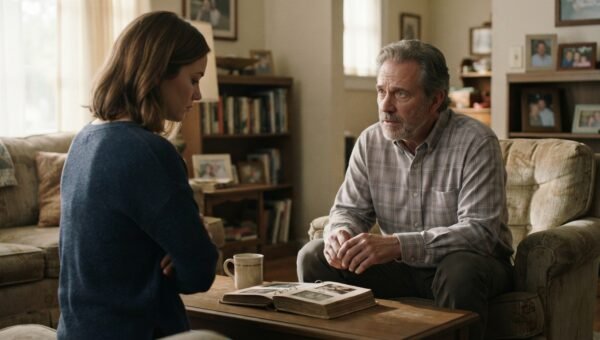
He looked down at our hands, his chin trembling. “Margaret, I messed this up so bad. I should have told you back in May.”
“Why didn’t you, Greg?” My voice came out cracked and thick. “Forty years. We promised we would carry whatever came along together. Did you really think you were protecting me by hiding this?”
“I was terrified,” he whispered, a tear finally spilling over his gray eyelashes and cutting down his cheek. “You love that house in Lansing. You love your garden. You’re finally resting after years of working your fingers to the bone. If I told you, I knew you would drop everything and turn into my full-time nurse. I wanted to get the logistics handled first. I wanted to make sure you had Chloe right next door before the bad days started.”
“You silly, stubborn man,” I said, squeezing his fingers until my knuckles turned white. “You think having you lose your mind all alone in an empty apartment is easier for me than packing some boxes? You think staying in a big empty house matters more to me than my husband?”
He broke down right there in the diner booth, hiding his face in his hands while his shoulders shook. I reached across the table, pulled his hands away from his face, and held them tight against my cheeks.
“We have had forty good years,” I told him, looking straight into his eyes so he couldn’t look away. “And we are going to fight for every good day we have left. Together. But you never walk out of our house in the dark again. Do you understand me? You don’t get to carry this by yourself.”
He nodded, swallowing hard, and managed a small, watery smile. “I promise, Margaret. No more secrets.”
I picked up my phone from my purse and dialed Chloe. The moment she picked up, I told her everything. She wept openly on the other end of the line, alternating between being furious at her father for keeping it hidden and begging us to come straight back to her house.
ENDING
We didn’t go back to Lansing right away. Greg and I spent the rest of that morning sitting in the diner, going through the folder paper by paper.
He had done everything with the quiet, meticulous precision that had defined his entire life as a machinist. The medical power of attorney named me primary and Chloe secondary. His pension forms were already filed to ensure maximum spousal continuation benefits. He had even made a spreadsheet of every monthly utility bill, password, and property tax due date so I wouldn’t have to scramble to find them. He had been preparing for his own mental decline as if it were simply another maintenance project on an old engine.
By noon, we were back at Chloe’s kitchen table. When Greg walked through her back door, our daughter threw her arms around his neck and didn’t let go for a solid five minutes. We cried together, we passed around a box of tissues, and then, because life doesn’t stop even when your heart is breaking, we sat down and made a practical plan.
The house in Lansing went on the market three weeks later.
Leaving it wasn’t easy. The day the moving truck pulled out of the driveway, I stood by my hydrangea bushes and cried for the memories of my younger years. But my anger was entirely gone. When I looked at Greg standing by the car holding the keys, I didn’t see an old man trying to take my home away. I saw a man who loved me enough to endure absolute terror in secret just to make sure I wouldn’t be left alone in the dark.
We bought a small, single-story ranch home in Jackson, three blocks from Chloe’s elementary school. There are no stairs for my knees or his future unsteady steps. The yard is small enough that our grandson can mow it on Saturday mornings, and Chloe walks over every Tuesday and Thursday with dinner.
Greg has good days and bad days now. Some mornings, he wakes up sharp as a tack, reads the newspaper, and does the crossword puzzle with his morning coffee. Other days, he asks me three times in an hour what day of the week it is, or stares out the window trying to place a neighbor’s face.
We don’t know exactly how many clear months or years the medication will buy us. The doctors are honest, and we don’t live in denial. But every single evening, when we turn off the bedside lamp, we reach across the mattress until our hands find each other.
We still have our rule. We don’t go to bed angry, and we don’t go to bed hiding. Whatever pieces of tomorrow slip away into the fog, we face them side by side, exactly where we have always belonged.