PART 1
My mother worked thirty-two years at a regional telephone company, and she was proud of her pension. It was not a fortune, but it was three thousand two hundred dollars every single month, plus her Social Security. For a seventy-four-year-old woman living in a modest two-bedroom garden apartment in Canton, Ohio, it should have been more than enough.
Then she had a mild ischemic stroke two summers ago. Her speech slurred for about three weeks, and her right hand shook when she tried to lift a water glass.
The doctors said she would regain most of her independence with therapy, but she needed help managing the paperwork while she recovered. My brother, Kevin, lived seven miles from her. I lived ninety miles south in Columbus.
“I’ll take point on the bills, Karen,” Kevin told me in the hospital waiting room. “You have two kids in high school and your own job. It doesn’t make sense for you to drive up Route 71 every weekend just to balance her checkbook.”
I believed him. He was forty-six, two years younger than me, and ran an auto repair garage with his wife, Brenda. I felt relieved, even grateful, that he was stepping up. Within three weeks of Mom coming home, Kevin had her sign financial power-of-attorney papers. Or at least, that was what he told me.
The trouble started quietly that winter. Whenever I drove up on Sundays to see Mom, she seemed smaller.
One afternoon in January, I noticed the soles of her walking sneakers were completely split, taped across the toe with gray electrical tape.
“Mom, what happened to your shoes?” I asked, kneeling by her recliner.
She pulled her feet back under her blanket. “Oh, nothing. They’re just worn. Kevin said we have to be careful for a while.”
“Careful with what?”
“The money,” she said, looking down at her hands. “I asked him if I could get twenty dollars to walk over to Rita’s salon for a wash and set, and he told me her rates went up and we couldn’t spare it. He said my copays from the rehabilitation hospital were eating up the whole pension.”
That did not sit right with me. Mom had Medicare supplement Plan G. Her hospital stays and physical therapy had been nearly one hundred percent covered after her small yearly deductible.
That night, I called Kevin from my kitchen. “Kevin, why is Mom wearing taped shoes? Why can’t she get her hair done?”
“Her therapy copays added up, Karen,” he snapped, his voice tight over the line. “There were out-of-network specialist fees from the neurology group. I’m handling it. You don’t see the mail every day, so quit second-guessing me from Columbus.”
I let it drop because I hated arguing, and I assumed he had seen bills I had not. That was my mistake. I wanted to believe my brother was an honest man because admitting the alternative meant acknowledging how badly I had failed our mother.
Three months later, on a Tuesday morning in April, an automated email notification pinged my phone.
Years ago, when Mom first set up online access for her checking account at First Buckeye Bank, I had helped her register it using my email address as the recovery contact. Kevin had changed the primary mailing address to his own house, but whoever managed the online profile forgot to clear out the secondary notification address.
The alert showed a wire transfer: $9,800.00 withdrawn from Mom’s primary checking account, sent directly to Lakeview Marine Sales.
Kevin did not own a boat. But Brenda did. Two summers earlier, she had inherited an older twenty-four-foot pontoon boat from her uncle, and she spent every weekend bragging on social media about taking it out on Buckeye Lake.
I printed the notification, drove straight to the branch, and asked for the last four months of statements. Because I had originally been listed as an emergency contact, the branch manager agreed to print copies of Mom’s recent activity directly for her.
I sat in my parked car in the bank lot and turned the pages. Mom’s account was down to four hundred and twelve dollars. There was an eight-hundred-dollar withdrawal at an ATM three blocks from Kevin’s garage. There were five separate payments to a credit card company, totaling six thousand dollars. And then the wire for $9,800.
I drove the twenty minutes to Mom’s apartment without calling ahead. When I walked in, she was sitting in her chair, heating up a can of generic tomato soup on a small hot plate because Kevin had told her the electric stove used too much power.
I laid the statements on the table beside her Bible. “Mom, did Kevin talk to you about any of this?”
She put on her reading glasses, squinting at the bold numbers. Her fingers began to tremble. “Nine thousand dollars? Karen, I haven’t spent nine thousand dollars on anything in twenty years. I never signed any of this.”
“He told me you gave him full power of attorney,” I said.
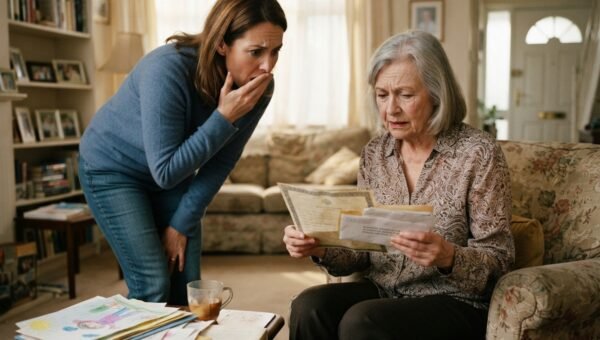
Mom shook her head slowly. She leaned over the side of her chair, slid open the bottom drawer of the end table, and pulled out a blue folder. Inside was a three-page document titled Durable General Power of Attorney.
I turned to the final page. At the bottom was my mother’s name, typed in clean letters. Above it was a scrawled signature in black ink. But the loops were wrong. Mom had written in beautiful, slanted Palmer cursive her entire life, even after the stroke. The signature on the paper was stiff, halting, and ended with a heavy downward slash Mom never used.
Below the signature was a purple notary stamp for a woman named Sandra Coleman, with a commission date in Stark County.
I pulled out my phone, took a clear picture of the signature and the stamp, and looked up the notary’s public registration number. Her office was listed at a title agency on Market Avenue. I dialed the number.
A woman answered on the third ring. “Coleman Title, Sandra speaking.”
“Sandra, my name is Karen Miller,” I said, my voice shaking despite my best efforts to keep steady. “My mother is Evelyn Miller. I’m looking at a power of attorney document with your notary seal on it, dated August twelfth of last year.”
There was a pause. “Hold on. Let me pull my logbook from last August.”
I waited while papers shuffled on the other end of the line.
Five minutes later, Sandra spoke into the receiver. “Mrs. Miller? I have my official notary journal open right in front of me. On August twelfth, I notarized a title transfer for a utility trailer. I have no entry in my log for an Evelyn Miller, and I did not sign that document.”
PART 2
The room felt very small and very cold. Mom was watching my face, her hands gripped tightly in her lap.
“Sandra,” I said into the phone, “are you telling me that’s not your signature either?”
“It’s my old stamp,” Sandra answered, her tone sharp and alarmed. “My office had a break-in eighteen months ago. We reported two notary seals and a check binder stolen to the Canton police. I had my commission re-issued with a new seal design that September. Whoever stamped that document used a voided seal, and that signature next to it is a crude forgery of my name.”
She gave me the police report number from the break-in right over the phone and told me she would email a certified statement confirming the fraud before the end of the business day.
I ended the call and looked at my mother.
“He stole from me, didn’t he?” she asked. Her voice was barely above a whisper. It was not anger in her eyes; it was the quiet, hollow grief of a mother realizing her own child had looked at her vulnerability and seen an opportunity.
“Yes, Mom,” I said. “He did.”
I did not call Kevin right away. I had spent forty-eight years watching him talk his way out of trouble by yelling over people, confusing the facts, and turning himself into the victim. If I called him in a rage, he would move whatever was left in the accounts or claim Mom had given him verbal permission.
Instead, I took Mom directly down to First Buckeye Bank.
We sat in the office of Mr. Henderson, the branch manager. Mom presented her state ID, and I showed him the forged document along with the police incident report number Sandra Coleman had given me. Mr. Henderson made two phone calls, reviewed the original signature card Mom had signed when she opened her account in 1994, and compared it to the power-of-attorney paperwork Kevin had filed eight months earlier.
The difference was obvious to anyone who looked at them side by side.
“This account is frozen immediately,” Mr. Henderson said. “All online credentials and debit cards issued under this power of attorney are revoked as of this minute. We are opening a brand-new account for Mrs. Miller that only she has access to.”
Mom transferred her remaining balance and her direct-deposit routing into the new account. Then I had her sign a formal revocation notice, which Mr. Henderson notarized properly at his desk.
By three o’clock that afternoon, we had visited the Social Security office and Mom’s pension administrator to ensure future checks landed in the new account.
At four-fifteen, my phone rang. The screen showed Kevin’s name.
I answered and put it on speaker so Mom could hear.
“Karen, what the hell did you do at the bank?” Kevin was shouting before I could even say hello. “I just went to pay the technician at my shop with the debit card and it was declined. Then I called the branch and they told me my access was canceled due to irregularities. Are you meddling in Mom’s business again?”
“I’m sitting at Mom’s kitchen table, Kevin,” I said. “And the $9,800 wire to Lakeview Marine Sales is sitting right here in front of us.”
PART 3
The line went dead silent. The bluster vanished from his voice, replaced by a defensive, clipped edge.
“That was an investment,” he muttered. “Brenda needed a new inboard motor and rigging for the pontoon so we could rent it out on weekends. We were going to put half the rental income right back into Mom’s account. It was a business move to help her.”
“You bought a marine motor for your wife’s boat using Mom’s pension while Mom was taping her shoes together,” I said.
“She doesn’t need new shoes! She barely walks around the block!” he shouted. “Do you have any idea how much time I spent driving over there, bringing her groceries, checking her furnace? You sit down in Columbus living your comfortable life while I’m the one stuck dealing with an aging parent. I deserved compensation for my time!”
“Kevin,” Mom’s voice broke in. It was thin, but clear.
He stopped talking. He had not expected her to be on the phone.
“Mom,” he said, trying to soften his tone. “Mom, you know I love you. Karen is blowing this out of proportion. She’s trying to turn you against me.”
“I saw the paper, Kevin,” Mom said. “You wrote my name on that legal form. You brought a fake stamp into it. You took my pension and you told me I couldn’t have twenty dollars for a haircut.”
“Mom, Brenda had bills at the shop—”
“You stole from your own mother,” she said, and then she reached over and tapped the red button on my screen, ending the call herself.
Twenty minutes later, Kevin showed up at her apartment.
He did not knock softly. He hammered on the door, then let himself in with his key. Brenda was right behind him, wearing oversized sunglasses and carrying an expensive leather handbag.
“We need to talk about this right now,” Kevin said, stepping into the living room. “If the bank files a suspicious activity report on that power of attorney, it affects my commercial credit. It affects my garage.”
“Then you should have thought about your garage before you committed forgery,” I said, standing between them and Mom’s chair.
Brenda crossed her arms. “Look, Karen, nobody was trying to hurt Evelyn. We had cash-flow problems during the winter. We were always going to pay it back once the boating season started and the charter rentals kicked in. You’re making a family matter into a federal case.”
“It is not a family matter,” I said. “It is grand theft. The transfer was $9,800. The total missing over the last seven months is twenty-four thousand three hundred dollars. I have the bank records right here.”
Brenda turned red. “You can’t prove Kevin forged that. Evelyn probably forgot she authorized it. Her memory isn’t what it used to be after the stroke.”
Mom stood up from her chair. She was unsteady, but she stood tall, holding the armrest with her left hand.
“My memory is fine, Brenda,” Mom said, looking her daughter-in-law directly in the eye. “I remember every dollar I worked for at the phone company. I remember forty years of night shifts and split shifts. And I know Sandra Coleman’s notary stamp was reported stolen to the Canton police eighteen months ago.”
Kevin’s face drained of color. He looked from Mom to me, realizing for the first time that we had already talked to the notary and had the police file.
“What do you want?” Kevin asked quietly.
“I want every cent back,” Mom said. “Or I hand this file to the prosecutor’s office by nine o’clock tomorrow morning.”
ENDING
Kevin did not go to jail, but he did not get away clean either.
He knew that if the county prosecutor took the case, his commercial business license would be revoked, and Brenda’s boat would be seized as an asset purchased with stolen funds.
Two days later, Brenda signed over the title of the pontoon boat to Lakeview Marine Sales for a quick dealer buyback. It brought sixteen thousand dollars. Kevin emptied his shop’s reserve savings account to cover the remaining balance. On Friday morning, a certified cashier’s check for twenty-four thousand three hundred dollars was deposited back into Mom’s new account at First Buckeye Bank.
Once the check cleared, Mom signed an agreement not to pursue criminal charges, provided Kevin had no further contact with her finances.
The money was back, but the family was not. Kevin stopped calling. He told our cousins that I had poisoned Mom’s mind and forced him to sell Brenda’s boat out of jealousy. He did not come to Thanksgiving, and he did not send a card on Mom’s seventy-fifth birthday.
I gave up my commute from Columbus. In June, my husband and I helped Mom pack up her garden apartment in Canton. We moved her down to a bright, single-story duplex three miles from our house in Westerville.
Last Saturday, I took Mom to a small shoe store near the town square. She sat in the low leather chair while the clerk measured her feet, laughing a little when he told her she had been wearing a half-size too small for years. She picked out two pairs: sturdy black walking shoes and a pair of soft navy loafers.
Afterward, we walked next door to a local salon. Mom sat in the swivel chair with a plastic cape around her shoulders, chatting with the stylist while the warm water rinsed the gray suds from her hair.
When the stylist finished and handed her the bill, Mom did not look at me to see if we could afford it. She reached into her purse, pulled out twenty-five dollars from her own wallet, and laid it on the counter with a five-dollar tip.
She caught my eye in the mirror and smiled. It was a small, quiet smile, but her shoulders were straight, and she was carrying her own weight again.