PART 1
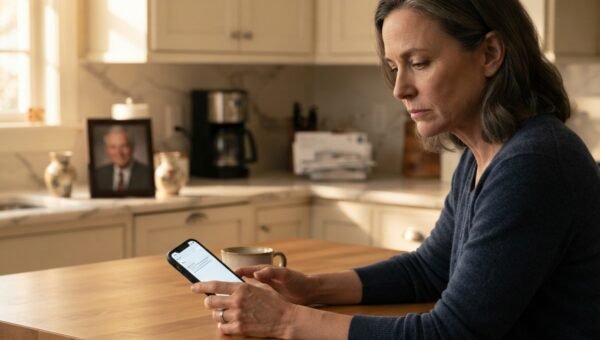
The envelope arrived on a rainy Tuesday in October, addressed to my mother at my home. Mom had been gone for four years, resting beside Dad at Oakridge Cemetery, so seeing the official seal of the Social Security Administration printed in black ink made my stomach drop.
I opened it at the kitchen counter, expecting a clerical error or an automated survey. Instead, the notice stated that direct deposit payments had continued uninterrupted into a regional credit union account.
Every single month, precisely $1,907 had been sent out. It had gone on for 48 months. The grand total printed on the paper was $91,536.
I called the number on the letter immediately. A woman in the fraud division told me that someone had updated Mom’s file three months after the funeral. That person had submitted a form claiming Mom was alive, homebound, and suffering from advanced dementia, along with a signed physician statement requesting that the checks be redirected to an account under the control of her primary caregiver.
The account belonged to my younger brother, Kevin.
I could not catch my breath. For the last two years of Mom’s life, I was the one who slept on a foldout cot in her living room. I was the one who crushed her pills into applesauce, bathed her when she could no longer stand, and paid for her adult diapers and groceries out of my own modest savings.
Kevin lived twenty minutes away in a rented townhouse. During those final two years, he visited Mom exactly twice, once on Christmas afternoon for twenty minutes to pick up a batch of homemade fudge, and once when she entered hospice care.
I did not call Kevin that afternoon. I wanted to see his face.
Thanksgiving was three weeks away, and tradition dictated that Kevin came to my house. When Thursday arrived, he walked through my front door carrying a store-bought pecan pie. He sat at the head of the dining table, laughing and pouring gravy over his potatoes. We carved the turkey like nothing was wrong.
When the table cleared and we were carrying dishes to the sink, I slid the federal letter across the granite island.
Kevin glanced at the total. He did not blink. He set his coffee cup down and shrugged.
“I earned it,” he said, wiping a crumb from the corner of his mouth. “I took care of her.”
I looked at him, my voice shaking with rage. “You didn’t visit her the last two years, Kevin.
I cleaned her sores. I paid her bills. You left me completely alone.”
“You did what you wanted to do,” Kevin replied smoothly. “Mom promised me that money years ago to make up for what she spent on your college. It is family business. Drop it, Sarah, or you will regret it.”
He walked out my front door, leaving the pecan pie sitting unopened on the side table.
The next morning, I drove down to the federal building in town and filed a formal report for identity theft and benefit fraud.
Ten days later, a special investigator named Agent Miller knocked on my door. He was a quiet man in a charcoal suit, carrying a thick manila folder. He sat at my kitchen table, took out a tape recorder, and laid three photocopied documents in front of me.
“Your brother isn’t the only name on the forged documents,” Agent Miller said, tapping a red pen on the bottom line of the medical certification form. “Someone co-signed the medical form. Someone who attended your mother’s funeral.”
My hands started shaking as I leaned forward to read the signature.
The co-signer was my younger sister, Brenda.
PART 2
Brenda’s handwriting was unmistakable. She always looped her capital letters with an exaggerated flare, a habit left over from her high school calligraphy phase. Underneath the doctor’s fake stamp, on the line marked “Authorized Witness and Family Representative,” Brenda had signed her full legal name.
“Are you sure about this?” I asked, looking up at Agent Miller.
“She used her legal name, her former address, and a notary stamp from the dental clinic where she worked as a receptionist in 2022,” Agent Miller said. “Federal audits do not run on guesses, Mrs. Collins. The money was routed to a joint account opened under Kevin’s name, but twenty percent of every deposit was wired automatically to your sister’s checking account. Exactly $381.40 every month.”
I sat back against the wooden chair. Four years ago, Brenda had wept openly in the front row of Mom’s funeral. She had held my hand, telling everyone who would listen that I was a saint for sacrificing my health to keep Mom out of a nursing home. When Mom’s tiny estate paid out $4,200 after final burial expenses, Brenda had complained that it barely covered her travel costs from Ohio.
Yet all along, Brenda and Kevin had been dividing Mom’s pension check between them.
“Has either of them been contacted?” I asked.
“Not yet,” Agent Miller replied. “We verify the family timeline first. Since you reported the discrepancy, you are not a suspect. But this is a federal felony involving over ninety thousand dollars. If you speak to them, do not warn them. It could interfere with a criminal referral.”
After Agent Miller left, I could not sleep. I walked through the quiet house, touching the wooden banister Mom used to lean on. The betrayal felt heavy and ugly. Kevin was always reckless with money, chasing failed business ideas and leasing sports cars he could not afford. But Brenda had always played the peacemaker.
Two days later, Brenda called me. Her tone was bright, almost cheerful.
“Hey, Sarah. Kevin called me yesterday. He said you were acting crazy on Thanksgiving, throwing papers around. What is going on?”
I stood by the kitchen window, staring at the barren maple tree in the yard. “Did Kevin tell you what the paper was?”
“He said it was some old mail from Social Security,” Brenda said casually. “He said you were threatening to get lawyers involved over Mom’s old accounts. Sarah, it has been four years. Why are you digging up the past? You are going to tear this family apart over pennies.”
“It isn’t pennies, Brenda. It is $91,536.”
The line went silent. I could hear the faint hum of traffic through Brenda’s phone.
“I don’t know what you are talking about,” she said, her voice dropping an octave.
“I saw your signature,” I said quietly. “Agent Miller was at my house on Tuesday. He showed me the medical statement from the clinic where you worked. You signed as the authorized witness. Kevin got the bulk of it, and you took $381 every month.”
“Sarah, listen to me,” Brenda began, her breath quickening. “Kevin was going to lose his house back then. He came to me in tears. He said the state owed Mom that money anyway, and that it would only sit in a government fund. He promised me he would stop the payments after six months. I only signed it to help him get caught up on his mortgage.”
“You let it run for four years,” I said. “Forty-eight months.”
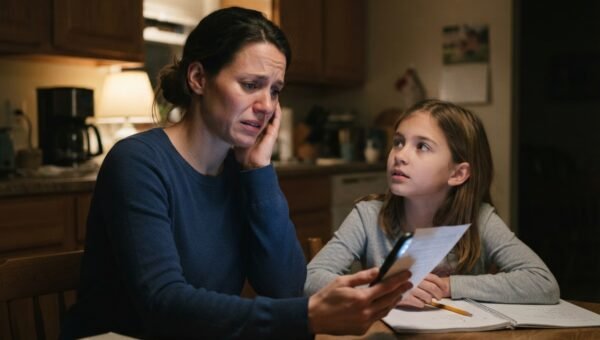
“I tried to make him stop!” she cried out. “He told me if I went to the authorities, he would tell them I planned the whole thing. I was trapped! You have to call that investigator back and tell him you made a mistake. If I get charged with a felony, I lose my job. Tom will divorce me. Sarah, please, we are sisters.”
“You sat at my kitchen table during the wake,” I told her, my chest tightening. “You watched me count change to buy Mom’s gravestone marker, and you said nothing.”
“You don’t understand what my life was like,” she sobbed.
“I understand that you stole our dead mother’s name,” I said, and hung up the phone.
PART 3
An hour later, Kevin banged on my front door. He did not ring the bell. He pounded with his fist until the glass rattled in the frame.
I kept the deadbolt locked and cracked the window beside the porch.
“Open the door, Sarah!” Kevin shouted. His face was red, and he held his phone in his right hand. “Brenda just called me hysterical. What did you tell the feds?”
“I gave them the truth,” I said through the screen. “You need to leave my porch.”
“Are you out of your mind?” Kevin lowered his voice, stepping closer to the screen. “Do you think they will just take the money back? They will put us in prison! You are going to put your own brother behind bars over money the government didn’t even miss for four years?”
“It wasn’t your money, Kevin.”
“Mom owed me!” he yelled, slamming his hand against the porch rail. “She gave you her house!”
The truth slipped out, raw and bitter. “Mom didn’t give me this house. I bought out her mortgage in 2018 so the bank wouldn’t foreclose on her while she was sick. I made payments on this house every month while I was lifting her out of bed. You never paid a single dime.”
“She loved you more,” Kevin said, his voice turning into an ugly sneer. “You always had to be the good daughter. The martyr. Well, congratulations. You killed Mom by keeping her in this drafty place instead of putting her in a home, and now you want to ruin Brenda and me.”
Hearing him blame Mom’s passing broke whatever lingering pity I had left in me. I looked straight at him.
“Agent Miller told me not to speak with you,” I said in a calm, steady voice. “I am calling the local sheriff’s department right now to report you for trespassing. You have two minutes to get in your car.”
Kevin cursed at me, kicked the bottom rail of the porch, and walked down the driveway. His tires squealed as he backed out into the street.
The federal legal process did not move fast, but it moved with crushing certainty. Over the following six months, Agent Miller built the indictment. The paper trail was impossible to contest. The credit union records showed direct wire transfers from Kevin’s account to Brenda’s account every month on the third. The doctor whose signature appeared on the incapacitation note gave a sworn statement confirming he had never treated our mother and that the clinic stamp had been stolen from the reception desk during Brenda’s employment.
In May, federal prosecutors formally charged Kevin and Brenda with conspiracy to commit mail fraud, theft of government property, and aggravated identity theft.
Because Kevin had prior financial judgments against him and showed no remorse, the judge gave him very little leeway. Brenda hired a public defender and agreed to plead guilty to a lesser charge of misprision of a felony in exchange for testifying against Kevin if the case went to trial.
Faced with Brenda’s cooperation, Kevin folded. He took a plea deal in late autumn.
The sentencing took place in the federal district court. I sat three rows back in the gallery, wearing the simple black coat I had worn to Mom’s burial.
Kevin stood before the judge in a rented gray suit. His shoulders were slumped, and he never once turned around to look at me. The judge sentenced him to twenty-four months in a federal correctional facility and ordered full restitution of the entire $91,536.
Brenda received three years of probation, six months of home confinement, and was ordered to repay the $18,307.20 she had personally received into her bank account. She lost her job at the clinic the day the charges were officially filed.
ENDING
When the hearing was over, the courtroom emptied quickly. Brenda stood in the hallway with her coat folded over her arm, her eyes swollen and red. Her husband, Tom, stood ten feet away, staring at the marble floor, refusing to speak to anyone.
Brenda took two steps toward me. “Sarah,” she whispered.
I stopped. For a moment, I saw the little girl who used to share a bedroom with me under the eaves of our old house, the girl who used to trade hair ribbons with me before school.
“I don’t hate you, Brenda,” I said softly. “But I will never trust you again.”
She opened her mouth to argue, but no words came out. She lowered her head and turned away, following her husband toward the elevators.
I drove home through the quiet countryside. The winter chill had settled over the fields, leaving the grass pale and brittle under a gray sky.
When I got back to the house, I walked into Mom’s old room. I had turned it into a sewing room two years ago, but her old pine sewing chest still stood in the corner by the window. I opened the bottom drawer and pulled out the small metal tin where Mom kept her favorite things: Dad’s wedding band, our baby teeth, and a photograph of the three of us kids taken at the county fair when Kevin was seven and Brenda was five. We were all sitting on a red tractor, smiling into the summer sun.
I looked at their young faces for a long time. Then I put the photograph back in the tin, closed the lid, and locked the drawer.
The house was completely quiet, and for the first time in four years, the silence felt clean.