PART 1
My mother skipped my college graduation because my sister’s dog had a grooming appointment she claimed she could not move.
I was twenty-two that morning, sitting in the fourth row of folding chairs on the football field with an empty seat beside my aunt. When I walked across the stage to take my diploma in business administration, I looked up into the bleachers where the family section was supposed to be.
My sister, Chloe, was twenty-four then, living in a townhome my mother helped furnish, and her miniature poodle had a 10:00 AM wash and trim. My mother had texted me at eight that morning: “Traffic across the county line will make it impossible to do both. You know how nervous Chloe gets when Toby is overdue for his cut. Send pictures of your cap.”
I did not send pictures. I bought myself a cup of diner coffee on the drive back to my shared apartment, put my black polyester gown in a trash bag for goodwill, and stopped expecting much after that.
For twelve years, that boundary kept my life steady. I married a good man named David, had my daughter, Maya, and built a quiet life in a split-level house forty miles away from both of them. My mother, Helen, visited maybe four times in that entire decade, usually on her way to Chloe’s house to watch the dog while Chloe took weekend trips to the coast.
Whenever Helen did call, it was to tell me about Chloe’s promotions, Chloe’s new kitchen backsplash, or how much Chloe needed help managing the three-bedroom ranch house they had bought together six years ago.
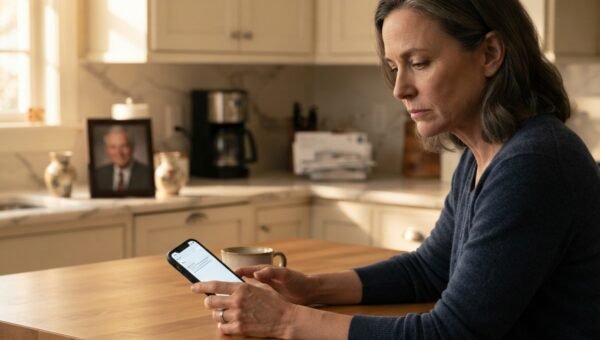
Then, on a Tuesday evening two weeks ago, my phone rang while David was working late and Maya was sitting at the kitchen table finishing her fifth-grade social studies worksheet.
“Audrey,” Helen said, her voice trembling before I could even clear my throat. “Chloe sold the house. The moving truck came yesterday morning, and she’s already on the road to Raleigh.”
I wiped down the kitchen counter with a damp sponge. “What do you mean she sold the house? Where are you?”
“I’m at a motel near the interstate,” she cried, her breathing thin and rattling through the speaker. “The closing happened three weeks ago. She told me the buyers wanted a delayed possession, but then yesterday she packed her SUV and said her new place only has one bedroom and an office for her remote work.
She said she forgot to include a room for me in the Raleigh lease. Audrey, I have two suitcases and four cardboard boxes. I need to come stay in your guest room. I need you to come get me.”
I held the sponge against the granite. Twelve years of silence, twelve years of missed birthdays, missed school plays, and that empty folding chair on the football field pressed down on my chest.
“Mom,” I said, keeping my voice level. “I need time to think about this. David and I have a routine, and Maya has school. We can’t just take in another person overnight.”
The trembling in her voice vanished, replaced by an instant, familiar snap. “You need time? Your own mother is sitting in a motel room with an ice bucket and a broken television, and you need time? You’re still holding grudges over things from when you were a girl. You’ve always been cold, Audrey. You’ve always kept score.”
Before I could answer, Maya looked up from her notebook. She had been listening with her pencil resting between her fingers.
She looked at my phone, then looked straight into my eyes.
“Mom,” Maya asked clearly, “is this the grandma who didn’t come when you got your diploma?”
The silence on the other end of the line was absolute. Helen didn’t breathe. She didn’t argue. She simply hung up, the sharp click cutting off the hum of the motel room behind her.
I thought that was the end of it. I thought my mother would find another relative to shame into helping her. But at eleven that night, my phone buzzed with an incoming photo text from Chloe.
Underneath the picture of a legal paper with a county clerk stamp, Chloe had typed four words: “She brought this on herself.”
I zoomed in on the document. It was not a lease. It was a quitclaim deed dated eight months ago, transferring Helen’s fifty-percent ownership of their ranch house directly to Chloe for zero dollars. And pinned beneath the notary seal was a handwritten addendum that turned my stomach cold.
PART 2
The document on my screen was stamped by our county recorder’s office in late October of last year.
At the bottom of the page, Helen’s signature was shaky and uneven, but it was unmistakably hers. She had signed away her half of the property she and Chloe had purchased together. But it was the typed provision stapled to the back page that made my hands shake against the counter.
It was an informal personal agreement, drafted without an attorney and witnessed by a local notary at a shipping store. It stated that in exchange for deeding her full share of the property to Chloe, Chloe agreed to pay off Helen’s $42,000 credit card debt and allow Helen to reside in the home “until such time as the primary owner relocates or liquidates the asset.”
Chloe had not forgotten to include a bedroom for our mother in Raleigh. Chloe had followed the exact letter of the paper Helen had signed. Helen had traded the roof over her head to wipe out secret debt, giving Chloe complete legal authority to sell the house and pocket every cent of the equity without owing Helen a single square foot of living space.
I texted Chloe back immediately: “Did you sell that house knowing Mom had nowhere to go?”
Five minutes later, Chloe responded: “She ran up $42,000 on store cards and home shopping channels in two years, Audrey. Collection agencies were sending certified letters to the front porch every week. I took out a personal loan to clear her name so the county wouldn’t place a lien on the deed, and she signed the house over so I could recover my money when I sold. I cleared $110,000 after paying off the mortgage and my personal loan. She had eight months to find an independent living apartment. Instead, she spent every dime of her monthly Social Security checks buying porcelain figurines and ordering custom clothes for Toby. I gave her three weeks notice. She chose to ignore it because she assumed you would take her in. Don’t make me the villain here.”
I sat at the dark dining table long after David came home and went to bed.
Helen had not called me because she was a helpless, abandoned elder caught off guard by a cruel daughter. She had called me because her calculated safety net had dissolved, and she wanted to use guilt to force her way into my home while hiding the fact that she had handed Chloe a six-figure asset and left herself destitute.
The next morning, Helen called again. Her tone was completely different. The anger from the night before was gone, replaced by a frail, sweet voice that sounded like an imitation of a mother she had never actually been.
“Audrey, sweetheart,” she whispered. “I’m sorry about yesterday. I was hysterical. You know how my nerves get. I checked out of the motel because it was eighty dollars a night and I can’t afford that. I’m sitting in the diner next door having tea. Can David come get me with his truck? My boxes won’t fit in your sedan.”
“Mom,” I said, looking out the kitchen window at Maya catching the yellow school bus at the corner. “Chloe sent me the quitclaim deed.”
A long, suffocating pause stretched over the call.
“She had no right to show you private business,” Helen said, her voice dropping into a hard, flat register.
“You signed away your home to pay off forty-two thousand dollars in retail debt, and then you let Chloe walk away with the rest of the equity,” I said. “You didn’t get abandoned. You made a financial deal with your favorite child, lost, and now you want me to absorb the cost of your retirement.”
“I have five hundred dollars in my checking account!” Helen shouted into the receiver, abandoning every trace of frailty. “I am seventy-one years old! Do you expect me to sleep in my car because Chloe cheated me?”
“You didn’t care where I slept when I had nothing,” I told her quietly. “And you didn’t care about being in this family until Chloe locked her front door.”
“I am your mother,” she hissed. “God will judge you for how you treat me.”
“Then let Him judge me,” I said. “Meet me at the diner in two hours. We are going to a bank, and then we are going to county senior services. But you are not bringing those cardboard boxes to my house.”
PART 3
When I walked into the highway diner off Route 4, Helen was sitting in a vinyl booth near the restrooms.
She looked older than she had two years ago, but the silver hair was neatly curled, and she was wearing a pastel cardigan with a silk scarf tied around her neck. At her feet were two scuffed floral suitcases and three taped boxes from a local liquor store. She looked up at me with red-rimmed eyes, expecting me to rush forward, apologize, and pick up her bags.
I didn’t reach for the luggage. I sat down on the cracked bench opposite her and placed an envelope on the table.
“You have two choices today,” I said, keeping my hands resting flat on the laminate. “I will pay for one week at an extended-stay hotel down the road that has a kitchenette. While you are there, I will take you to the county housing authority to submit an expedited application for income-restricted senior housing. Your Social Security check is $1,420 a month. That is enough to cover a subsidized one-bedroom apartment if you stop spending outside your means.”
Helen stared at the envelope, her lips trembling with rage rather than sorrow. “A subsidized project? You want to put your mother in a state-run home while you and David live in a four-bedroom house with an empty guest room?”
“The guest room is Maya’s playroom,” I answered. “And more importantly, you have never respected my boundaries or my home. If you move in with us, you will run up debt, you will pit me against David, and you will expect me to serve you while you complain that I am not Chloe. That will not happen under my roof.”
“Chloe stole my house!” Helen cried, turning heads at the surrounding booths. “She promised me she wouldn’t sell until next year!”
“You signed a paper saying she could sell whenever she chose to relocate,” I reminded her. “You traded your independence to cover forty-two thousand dollars of debt you hid from everyone. You made that choice because you believed Chloe would always prioritize you. You gambled on her, Mom. And you lost.”
“And what if I refuse your hotel?” Helen demanded, crossing her arms over her chest. “What if I just sit here?”
“Then I will get back in my car and go home,” I said evenly. “You will be on your own with five hundred dollars. I am offering you a bridge to an independent life, not a free ride to treat me like a backup plan.”
She glared at me for two full minutes. She waited for me to soften. She waited for the little girl who used to beg for her approval to flinch and give in.
I didn’t blink. I didn’t raise my voice. I just sat there, anchored by the memory of walking across that sunbaked football field twelve years ago, realizing that my mother’s absence had already freed me from needing her approval.
Finally, she snatched the envelope off the table.
“Get my boxes,” she muttered, refusing to look at me. “The motel check-in is at two.”
We spent the afternoon driving in near-silence. I paid for seven nights at the extended-stay facility, carried her three liquor boxes up the exterior staircase, and set them by the small laminate dining table in the room. Then I drove her to the county municipal building.
We sat in plastic chairs under fluorescent lights for three hours, filling out paperwork for emergency senior housing assistance and Medicaid secondary support. When the intake worker asked if she had any current assets, Helen had to speak the truth aloud for the record: no real estate, no vehicle, no savings, and only five hundred dollars in cash.
Watching her write those numbers down was not satisfying. It was simply heavy. She had spent decades sacrificing her dignity and her relationship with me to keep Chloe happy, only to end up sitting in a government waiting room with a ballpoint pen chained to a counter.
ENDING
Three days later, Helen received a placement on the priority waiting list for a county-managed senior building six miles from her motel.
A unit opened up sooner than expected, a small ground-floor studio with a single window facing a courtyard of gravel and marigolds. I helped her move her two suitcases and her boxes into the apartment the following Tuesday. David came with me, carrying in a small microwave and a set of basic kitchen cookware we purchased for her.
Helen did not say thank you. As we set the boxes on the linoleum floor, she looked around the small room and sighed.
“Chloe told me her new townhome has granite counters and an attached two-car garage,” she said, running a finger along the edge of the cheap laminate counter. “She said the community pool is heated.”
David looked at me, his jaw tightening, but I simply shook my head at him.
“Chloe is three hundred miles away, Mom,” I said. “And she isn’t paying your rent.”
I laid a spare key to the apartment on the kitchen counter next to her medication bottles. Beside it, I left a notebook with the local bus schedule and the contact number for the senior center’s shuttle service.
“Your rent here is four hundred and ten dollars a month,” I told her. “Your check leaves you with a thousand dollars for food, utilities, and medicine. If you manage it carefully, you will never have to beg anyone for a place to live again.”
She stood in the center of the bare room, looking smaller than she ever had, but her chin remained stubborn. “Are you coming by on Sunday?”
“No,” I answered honestly. “David and I are taking Maya to the state park for her science project. I will call you next Thursday to see how your grocery delivery went.”
She looked at the door, her eyes flickering with that old, familiar indignation. “You really never forgave me, did you?”
I stood by the doorway, looking back at her. For twelve years, I thought my anger was about an empty chair at a graduation or an excuse about a dog. But looking at her in that small, quiet room, I realized the truth was much simpler. She had spent my entire life teaching me that I was on my own, and all I had done was finally learn the lesson.
“I forgave you a long time ago, Mom,” I said. “I just stopped waiting for you to change.”
I closed the door behind me and walked down the quiet hallway into the afternoon sun. When I got home, Maya was at the kitchen table, her colored pencils spread across the wood, working on a drawing of a mountain range.
I hung my keys on the hook by the door, walked over, and pulled out the chair beside her. When she smiled up at me and asked me to help her shade the trees, I stayed right where I was.