PART 1
I was seventeen years old in the spring of 1962, sitting in a cold room in a Catholic charity hospital in Ohio, holding an eight-pound baby girl.
Back then, if an unmarried teenage girl got pregnant, the world treated it like a scandal that had to be wiped away as quietly and quickly as possible. My parents were decent churchgoing people, but they were terrified of what the neighbors would think.
My father would not look at me for six months. My mother took me to stay with an aunt three counties away until the baby came.
There was never any family discussion about keeping her. In 1962, I did not have a driver’s license, I did not have a high school diploma, and I certainly did not have money. The hospital social worker told me, in a very calm, polished voice, that signing the papers was the greatest act of love a young girl could perform. She said my child would go to an established couple with a house, a steady income, and two parents.
They gave me forty-eight hours with her. Just two days. I remember the smell of her skin, like warm milk and laundry starch, and the heavy weight of her head in the crook of my elbow. I did not have the authority to legally put a name on her birth certificate, but while I held her against my chest in that quiet corner of the ward, I whispered a name into her ear. I named her Hope.
When the nurse came in on the third morning, she did not look me in the eye. She just reached down and lifted the blanket out of my arms. I signed the paperwork with a hand shaking so badly that my signature looked like bird scratches. Then I went home, finished high school, and lived my life.
I went on to marry a good man named Thomas in 1968. We had two sons, built a life, bought a home, and watched our boys grow up and start families of their own. Thomas passed away five years ago from congestive heart failure. Through all those decades, through birthdays, anniversaries, and holidays, not a single day went by where I did not think about that baby girl. Every year on April 14th, I bought a small pink rose, put it in a drinking glass on my kitchen windowsill, and said a silent prayer for Hope.
Then, four weeks ago, on a Tuesday morning around ten o’clock, my home telephone rang.
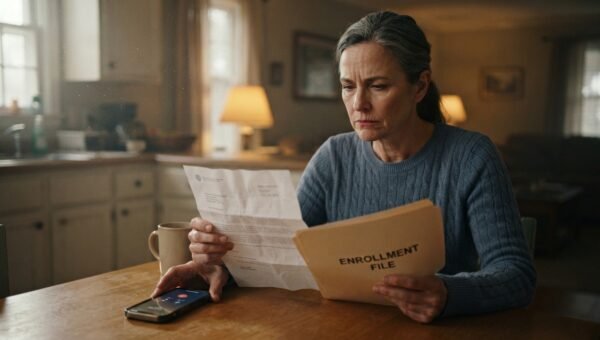
I was standing by the sink rinsing out coffee cups. The machine picked it up after four rings because my knees were stiff and I was slow getting across the linoleum. When I hit the replay button, the voice coming out of the little speaker stopped me cold.
“Hello, Mrs. Gable. My name is Karen Brooks. I am a confidential intermediary working with the state vital statistics registry. I am trying to reach Evelyn Gable regarding an adoption inquiry from 1962. Please call me back at this number when you have a quiet moment.”
My heart hammered so hard against my ribs that I had to sit down on the nearest kitchen stool. My fingers shook just like they had on that hospital bed sixty-two years ago. I sat staring at the yellow sticky pad where I had jotted the number, unable to breathe evenly for nearly an hour.
When I finally dialed, my voice was barely a whisper.
“Mrs. Gable?” Karen Brooks said gently. “Thank you for calling back. I know this is a tremendous shock. But I have some news for you. An adult adoptee filed a request to unseal non-identifying background records several years ago. With the recent state law changes, her file was fully matched with your original surrender file.”
I gripped the edge of the kitchen table. “Is she… is she alive?”
“She is alive,” Karen said softly. “Her name is Margaret. She is sixty-two years old. She recently retired from a long career as a pediatric nurse. She is married, with three grown children and seven grandchildren.”
My grandchildren. Seven human beings walking around on this earth carrying my blood, none of whom I had ever seen.
I began to cry, silent tears that ran down into the corners of my mouth.
“There is something else,” Karen continued, her tone turning warm and measured. “Before Margaret agreed to let me reach out directly, she gave me a handwritten note. She asked that if I ever located you, I read you the first sentence before you made any decisions about exchanging contact information. She wanted you to hear it first.”
“Please,” I choked out. “Read it.”
Karen took a slow, audible breath over the receiver. Then, across sixty-two years of silence, a message from my lost daughter came through the line:
“Tell her I was never angry. Tell her I named my own daughter Hope.”
PART 2
The phone slipped out of my hand and hit the linoleum floor with a sharp plastic clatter.
I dropped to my knees to pick it up, sobbing so hard that my chest ached. She had named her daughter Hope. All those years, I had thought the name was a private secret, a ghost I carried alone in my heart.
“Mrs. Gable? Are you there?” Karen’s voice crackled through the receiver.
I pulled the handset back to my ear with both hands. “I am here,” I gasped. “I am here. Please tell me what to do. What happens now?”
Karen explained the procedure. Because both of us were consenting adults, the agency had a protocol to protect both sides. We could exchange letters through the registry first, or, if we both signed the mutual consent waiver, we could share phone numbers and addresses immediately.
“I don’t need a letter,” I told her plainly. “I am eighty years old. I have waited sixty-two years. Give her my number. Give her whatever she needs.”
Two days later, on Thursday afternoon, my phone rang again.
I picked it up on the very first ring.
“Hello?” I said.
A woman’s voice answered, rich and slightly husky, with an Ohio cadence that felt so familiar it made my throat close up. “Is this Evelyn?”
“Yes,” I said. “Yes, it is.”
There was a pause, a long intake of breath, and then she said, “Hello, Mama.”
I had not heard those words directed at me by that voice in my entire life. We spent three hours on the phone that afternoon. Margaret told me about the couple who had adopted her, Arthur and Clara Miller. They had been loving, steady, decent people who gave her a wonderful childhood in a small town outside Columbus. They had both passed away in their eighties, loved and cared for until the end.
“They never lied to me,” Margaret told me. “From the time I was a little girl, Mom Clara told me that the woman who gave birth to me loved me so much that she made the hardest choice in the world to keep me safe. But when I had my own first child in 1985, a little girl, I looked at her in the recovery room and I knew what that sacrifice must have felt like. That was the day I named her Hope. I told my husband that day, ‘Somewhere out there, my mother has a heart full of hope, and I want to honor her.'”
We talked about everything. She told me about her thirty-four years working night shifts on the pediatric floor. She told me about her husband, David, a retired high school history teacher. She described her children: Brian, who worked in banking; Hope, who was a middle school science teacher; and young Clara, named after her adoptive mother, who was a physical therapist.
Then came the hardest question, the one I had dreaded for six decades.
“Why did you leave me, Evelyn?” Margaret asked quietly. There was no bitterness in her tone, only an honest, gentle curiosity. “I know it was the sixties, but I need to hear it from you.”
I sat in my chair and told her the plain truth. I told her about being seventeen, about my father’s silence, about the cold room, and how my mother had stood outside the hospital door while a social worker handed me a pen. I told her that I had begged my parents to let me keep her, and how they had told me I would ruin her future before it even started.
“I signed the paper because I was a terrified child who believed the grown-ups knew better,” I told her, my voice cracking. “And I have regretted giving you up every single morning since.”
“You were seventeen,” Margaret said softly through the line. “You were just a baby yourself. You don’t have to carry that regret anymore. I had a good life, Evelyn. A really good life.”
Before we hung up, Margaret asked if she could drive down the following Saturday. She lived four hours away. She said she wanted to come alone first, just the two of us, before introducing the rest of the family.
I spent Friday cleaning every corner of my small house. I washed the lace curtains in the living room, baked a fresh apple pie, and ironed the blouse Thomas had always liked best. But underneath the excitement was a quiet, gnawing fear. What if, when she looked at me in person, she saw only an old stranger? What if the reality of sixty-two lost years was too heavy to carry across a kitchen table?
PART 3
Saturday morning arrived gray and crisp. I sat in my front armchair by the bay window starting at nine, watching every car that turned down our quiet residential street.
At exactly ten-thirty, a dark blue sedan pulled into my driveway.
A tall woman with silver-streaked hair got out of the driver’s side. She wore a simple navy cardigan and jeans, and when she turned toward the house, my breath caught in my throat. She had my cheekbones. She had the exact shape of my nose, and she walked with that slight tilt of the left shoulder that my sister and I had both inherited from our grandmother.
I opened the front door before she even reached the top porch step.
We stood three feet apart on the wooden boards of my porch, looking at each other. Neither of us spoke for several seconds. Her eyes filled with tears, and they were the same hazel-green as mine.
“You look just like me,” Margaret whispered.
I did not say anything. I just reached out, pulled her into my arms, and held her.
Her head rested on my shoulder, fitting into the hollow of my neck in a way that felt entirely natural, like a lock clicking into place after sixty-two years. We stood on the porch in the cool autumn air and wept together. When we finally went inside, I served the pie, but neither of us touched our plates. We sat across from each other holding hands across the table.
She brought a thick photo album with her. Page by page, she showed me the sixty-two years I had missed. There was a photograph of her as a toddler sitting on a tricycle; a shot of her eighth-grade graduation in a white ruffled dress; her nursing school portrait; her wedding day in 1984, radiant in ivory lace; and pictures of her three children at every stage of their lives.
“This is Hope,” Margaret said, pointing to a photograph of a woman in her late thirties with a warm, wide smile and dark brown curls. “She knows all about today. She wanted to come, but I told her we needed this time first. She asked me to give you this.”
Margaret reached into her purse and handed me a small silver locket on a delicate chain. Inside was a tiny photograph of a seven-year-old girl with bright green eyes and two missing front teeth.
“That is little Evelyn,” Margaret said gently. “Hope’s youngest daughter. My granddaughter. She was named after the mother I never knew.”
I held the locket against my chest, unable to speak. The names had traveled back and forth across generations, crossing through all the silence and all the legal files, tying us together even when the state had tried to erase the connection completely.
We spent five hours looking at photos, sharing family histories, and comparing little quirks. We both take our coffee black with half a teaspoon of sugar. We both have an allergy to wool. We both tend to tap our fingers when we are thinking hard.
Before she left that evening, Margaret took my hand in hers. “Next month is Thanksgiving,” she said. “The kids are all coming to our house. The grandchildren will be there. We want you at our table, Evelyn. Not as a secret, and not as an afterthought. As my mother.”
ENDING
Last week, my son David and his wife drove me to Margaret’s home for Thanksgiving dinner.
I was nervous the entire drive. My sons had known about their older sister for years. I had told them the truth when Thomas and I sat them down as young men, because I did not believe in keeping secrets from my children. They had always been supportive, but meeting an entire branch of a family grown in secret for six decades was daunting for all of us.
When the front door opened, the house smelled of roasted turkey, sage dressing, and warm bread. Before I could even take off my coat, a woman stepped forward from the hallway. She looked so much like the photograph in the album that I knew her instantly.
“Grandma Evelyn?” she said.
It was Hope.
Behind her stood two tall young men and a flurry of children running across the hardwood floors with juice boxes and toys. A little girl with dark pigtails and hazel eyes peeked out from behind Hope’s apron strings, holding a plush bear.
Hope took my hands and leaned down to kiss my cheek. “Thank you for giving my mother life,” she said softly. “And thank you for giving me my name.”
Then she turned and coaxed the little girl forward. “Evelyn, come say hello to your great-grandmother.”
The little girl looked up at me with curious, bright eyes. She reached out and touched the silver ring on my finger, then gave me a shy, small smile. I knelt down as best as my old joints would allow and wrapped my arms around her.
Later that afternoon, after dinner was finished and the dishes were stacked in the sink, I sat on Margaret’s living room sofa with a cup of black coffee. Margaret sat to my left, her arm linked through mine. Across the room, my son David was talking to Margaret’s son Brian about lawn mowers and high school football, laughing like they had grown up in the same neighborhood.
On the mantelpiece above the fireplace, Margaret had placed a framed black-and-white photograph of her adoptive parents, Arthur and Clara, looking proud and happy. Right next to it, framed in matching wood, was a photo of Thomas and me taken on our twenty-fifth anniversary. Two families, two completely different paths, standing side by side without shame or competition.
For sixty-two years, I carried an empty space in my chest that nothing could ever quite fill. I had spent six decades wondering if my baby had lived, if she had been loved, or if she had grown up hating the girl who gave her away.
Now, sitting in a warm room surrounded by the laughter of grandchildren and great-grandchildren, I looked out the front window at the Ohio trees against the afternoon sky. The silence was finally over. The grief was still a part of my story, but it was no longer the end of it.
I was not just a signature on an old hospital form anymore. I was a mother, a grandmother, and a great-grandmother, finally home where I belonged.