PART 1
My father looked at my swollen stomach in May of 1974 and told me plain: “No bastard under my roof.”
I was seventeen years old, terrified of the kitchen table, and five weeks from giving birth. When July 12 arrived, they took her before I could even see the color of her hair. A county worker slid three carbon-copy forms across a metal desk, and I signed every line while clutching a cheap vinyl purse that held exactly $27, two bus tokens, and a stick of spearmint gum.
That was my whole net worth. I never got to hold her. On the state records, they wrote down Baby Girl Flores, using my maiden name, until a family from three counties over took her home.
Life moved along the way it always does. I married an auto mechanic named Dale eight years later. Dale was a decent man, quiet and steady, but we never had children of our own. Dale passed in 2018 from his lungs, leaving me the small brick bungalow on Elm Street, his tools, and a quiet house that smelled like floor wax and coffee.
Every single July 12 for fifty-two years, I did the exact same foolish thing. I stood at my stove, mixed up a two-layer chocolate cake from scratch with heavy fudge frosting, and lit one yellow candle. I never blew the candle out; I let it gutter down into the icing. Dale used to sit on the porch while I did it, never asking questions because he knew it was the one door in my mind he was not allowed to open.
When the candle died, I cut one slice, set it on a saucer, and threw the rest in the garbage bag out back. Nobody ever ate a single bite.
Then last Wednesday, the wind kicked up hard before an afternoon thunderstorm.
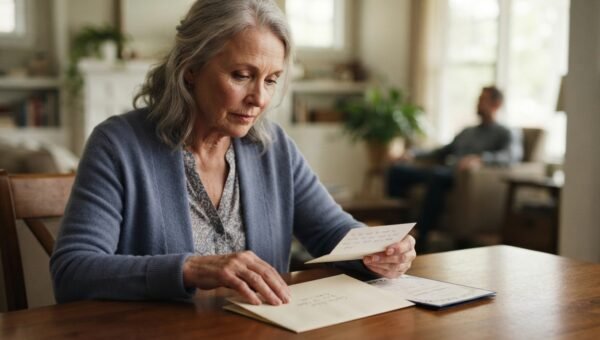
I went out to shake the grit off my coco-fiber porch mat, and a slip of yellow thermal paper fluttered against my ankle. It was a receipt from Miller’s Bakery, six blocks down on Maple Avenue. The address printed near the customer name was 418 Elm, which was two doors down from me, but the wind had dragged it under my step.
I smoothed the crumpled paper against my thigh, ready to toss it into the porch trash can, when my eye caught the custom order line printed in faded purple ink:
“Round double chocolate, fudge icing. Piping: Birthday cake for Baby Girl Flores, 52.”
I did not scream. I did not faint. I let out a dry, cracked laugh that sounded like paper tearing in an empty yard.
It made no sense. Flores was my maiden name, but I had gone by Mrs. Warren for over forty years. And fifty-two was the exact number of years since that county hospital room.
I tucked the receipt into my apron pocket and walked to the edge of the sidewalk. Miller’s Bakery was an easy six-block stroll. I could see the red awning if I walked past the corner mailbox. But my knees felt like wet sand. Fifty-two years of silence builds a wall you cannot easily climb over on a Wednesday afternoon. I went back inside, latched the screen door, and sat in Dale’s old recliner until the sun dropped.
The next morning, at seven sharp, the metal flap of my mailbox clattered against the porch post.
The postal carrier never came before noon. I pulled the front door open, half expecting to see a neighborhood dog or a flyer for lawn service.
Instead, tucked neatly inside the black tin box was a folded, washed-out piece of flannel. It was a faded pink hospital receiving blanket with frayed cotton edges. Pinned to the center with a brass safety pin was a torn sheet of lined notebook paper.
The handwriting was round and hurried, written in blue ballpoint pen:
“If you are the woman who left this with me, my mother wants to meet you. She is sitting in the booth at Miller’s.”
PART 2
I took the blanket out of the box with two hands.
It was thin enough that I could see the grain of the porch floor through the cloth. In the bottom corner, faded almost to gray by five decades of laundry detergent, was a small black stamp from St. Jude’s County Hospital. It was the only thing the nurse had let me touch before they rolled the plastic bassinet down the hall. I had pressed my face into it for five minutes in 1974, cried until the cotton was soaked, and shoved it down into the bassinet beside her feet when the social worker walked in.
I had spent fifty-two years telling myself that child went to a different world, maybe out of state, maybe raised by rich folks who gave her piano lessons and never mentioned a girl named Flores.
My hands shook so hard I dropped the brass pin into the hydrangea bush beside the porch steps. I did not stop to hunt for it. I did not change out of my faded blue house dress or put on lipstick. I folded the pink cloth into a square, tucked it inside my cardigan pocket, and walked out the gate.
The six blocks down Maple Avenue felt longer than the thirty years I spent working behind the register at the hardware store. The morning air was warm and sticky. When I reached the corner of Fourth, my chest grew tight, but I kept my eyes pinned to the red canvas awning of Miller’s Bakery.
I pushed the glass door open. The little brass bell above the door jingled, loud and cheerful. The smell of sugar, vanilla, and warm dough hit me right away.
Behind the counter, young Mrs. Miller was boxing crullers for a man in work boots. But over in the far corner booth, beneath the front display window, sat two women.
One of them was in her late twenties, wearing dark scrubs and white sneakers, tapping a pair of car keys against the laminate table. Next to her, by the window glass, sat an older woman with salt-and-pepper hair cut short at the jaw. She had dark, heavy eyebrows, high cheekbones, and the exact same narrow bridge of the nose I see every morning in my bathroom mirror.
She was looking down at a white bakery box sitting between them on the table.
As soon as my sneakers squeaked on the linoleum, the younger woman looked up. She nudged her mother’s arm with an elbow.
The woman by the window turned her head. When our eyes met, neither of us said a word. She did not smile, and she did not cry. She just leaned back against the red vinyl booth cushion, let out a slow breath through her nose, and reached down into her canvas bag.
She pulled out a yellowed slip of paper and laid it flat next to the bakery box.
I took three slow steps toward the booth. My legs felt hollow.
“You found the note,” the younger girl said quietly. She had a soft, cautious voice. “I was afraid you would throw the receipt away. I dropped it on purpose when I walked past your house yesterday, but the wind blew it under the mat.”
The older woman looked up at me. Her eyes were deep brown, lined with dark circles, but steady as stone.
“Sit down, please,” she said.
PART 3
I slid onto the vinyl bench across from them. The wood frame creaked under my weight. My knees bumped the metal pedestal under the table.
“My name is Elena,” the woman said. Her voice was slightly raspy, the voice of someone who worked hard and did not waste words. “This is my daughter, Sofia. Sofia is a nurse over at county.”
I pulled the folded pink square from my sweater pocket and placed it beside the salt shaker. Elena’s eyes dropped to the cloth, and for the first time, her chin gave a tiny tremor.
“My adoptive parents were Arthur and Clara Henderson,” Elena said, keeping her hands resting flat on the table. “Good people. Arthur worked the rail yard. Clara took in sewing. They never hid the fact that I was adopted. When Clara died two years ago, I had to clean out her lockbox in the closet.”
Elena tapped the yellow paper she had pulled from her bag. It was not a court record. It was a single handwritten receipt on lined paper, dated July 14, 1974.
“Clara kept this,” Elena said. “It was from my grandfather. Your father.”
My mouth went completely dry. “My father?”
“Arthur paid him five hundred dollars in cash outside the county courthouse steps,” Elena said, her voice dropping lower so the baker would not hear. “Your father told Arthur that if he gave him the money, he would make sure the birth mother never tried to find the baby. Arthur thought it was an informal adoption fee for your expenses. But on the back, your father wrote his own address and signed his name: Hector Flores. And at the bottom, he wrote, ‘She got twenty-seven dollars for the bus. Don’t let her near my house.'”
The air went right out of me.
Fifty-two years. For fifty-two years, I thought my father had forced me to give her up out of strict religion and family pride. I had spent half a century carrying the shame of bringing disgrace into his home, believing he was harsh because I had sinned.
He had sold her off the courthouse steps for five hundred dollars while I sat in the bus depot with twenty-seven dollars in my purse, wondering if I had enough to buy a sandwich before the night bus to my aunt’s house in Joplin.
“Why the cake?” I whispered, my voice barely reaching across the table. “Why did you order that cake with my name?”
Sofia reached over and covered her mother’s hand.
“Mom and I moved to this town eight months ago when I took the hospital job,” Sofia said. “We knew Hector Flores was long dead, but county land records showed his old property on Elm Street passed to a woman named Warren. Clara’s notes had your maiden name. Mom walked past your house last month and saw you sitting on the porch. She knew your face immediately. But she was terrified you would shut the door in her face. She thought maybe you took the money with him.”
“I never saw a nickel,” I said. The words came out hard and clear, stripped of any polite edge. “I thought of you every single day of my life. Every July twelfth, I made a chocolate cake and threw it in the trash because I could not bear to put a fork in it alone.”
Elena did not look away. She stared at me, looking at my graying hair, my rough hands, the cheap plastic buttons on my sweater. Then she reached out, untied the thin red bakery twine from around the white cardboard box, and lifted the lid.
Inside sat a round chocolate cake with dark fudge frosting. Across the top, piped in neat white letters, it read:
Happy 52nd Birthday to Us.
“I ordered two,” Elena said, a tiny, crooked smile finally touching the corner of her mouth. “Sofia dropped the first receipt near your walk on purpose. When you didn’t come yesterday, I sent her back with the blanket Clara gave me on my sixteenth birthday. I told her if that didn’t bring you down the street, I would leave you in peace.”
ENDING
The bakery bell chimed again as two men walked in for coffee, but the corner booth was completely quiet.
Sofia pulled a small metal pocketknife from her scrub pocket, wiped the clean blade with a paper napkin, and cut the cake right down the center. She slid a thick slice onto a bakery wax sheet and pushed it across the table to me.
I picked up the plastic fork with fingers that had lost their tremble.
The chocolate was rich and sweet, exactly like the frosting I had stirred on my own stove through decades of empty July afternoons. I ate the first bite slowly, looking at the woman sitting across from me. She had my hands, right down to the wide thumbs and the small freckle on the left wrist.
We stayed in that corner booth until the bakery clock struck ten.
There was no shouting, no wild crying, and no grand speeches about making up for half a century of lost time. You cannot glue fifty-two years back together with an hour of talking. But Elena told me about the rail yard where she grew up, her thirty years running a small dry-cleaning counter, and how Sofia had put herself through nursing school working nights at a diner. In return, I told her about Dale, his quiet ways, and how he had spent forty years pretending not to notice the smell of chocolate every July.
When we stood up, Elena picked up the faded pink blanket from the table. She folded it twice, took my hand, and pressed the soft flannel back into my palm.
“Keep it,” she said. “I know where you live now.”
I walked the six blocks home with the blanket tucked inside my coat and half of a chocolate cake in a white cardboard box under my arm. The Elm Street house was still quiet when I unlocked the front door, but the rooms did not feel quite so hollow.
I set the box on the kitchen counter, put the blanket on Dale’s empty chair, and left the front porch door wide open to catch the breeze.