PART 1
My son Julian looked me in the eye at my kitchen table four years ago and told me he was going to be dropped from his senior classes if he couldn’t clear his balance. He said the bursar office gave him five days to come up with $12,000.
My husband David had died two years before that, leaving behind a small union life insurance payout and a mortgage I was barely managing on my wages from the county health clinic.
The only cushion I had in the world was an IRA account worth a little over $12,400. It was supposed to sit there until I turned sixty-five. Julian held my hands, swore he would pay back every single dollar the minute he landed a job after graduation, and promised he would never ask me for another dime. I went to the bank the next morning, took the early withdrawal penalty, and handed him a cashier’s check made out to the state university.
After that, graduation never seemed to come. Whenever I asked him about his diploma, he gave me long, exhausting stories about missing lab credits, administrative holds, and professors who lost his final papers. For four years, he stayed in a rental duplex forty miles away in the college town. He kept calling on the first of the month, sounding tired and desperate.
“Mom, my shift got cut at the warehouse,” he would tell me. “I just need $350 or my landlord is putting a notice on my door.”
I cut back on everything. I stopped buying fresh meat at the grocery store, turned my thermostat down to sixty degrees all winter, and picked up weekend intake shifts at the clinic.
I sent him $300 here, $400 there, convinced I was keeping my boy off the street while he tried to finish his education.
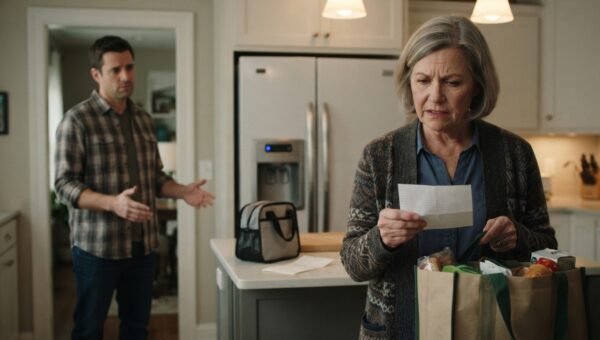
Then on a Tuesday afternoon in early May, a window envelope from the university arrived in my mailbox. It had Julian’s name on it, but it had been routed to my street address because he had never updated his primary contact card with the registrar. I figured it was another bill or a collection notice.
Instead, it was an alumni giving brochure tucked inside an official record confirmation. The letter congratulated him on the two-year anniversary of completing his Bachelor of Science in Business Administration.
I sat in my hallway for ten minutes looking at the gold seal on the letterhead. His degree had been conferred twenty-four months ago.
Julian had called me three weeks earlier claiming he was studying for midterms and needed $280 for a textbook access code.
I had sent it to him through my phone while standing in the break room at work.
I didn’t call him right away. My hands were shaking too hard, and I knew if I heard his voice make up another smooth excuse, I might convince myself the letter was a clerical mistake. I got into my ten-year-old sedan, backed out of the driveway, and drove the forty miles north to the university campus.
The administration building smelled like old floor wax and paper. The girl at the registrar counter typed his student number into her computer, looked at the monitor, and nodded.
“Yes, ma’am,” she said. “Julian Miller graduated magna cum laude two springs ago. The diploma was mailed to an apartment on Elm Street.”
“And his balance?” I asked. “Did he owe twelve thousand dollars before he could walk?”
She frowned and pointed me down the hall to the bursar office.
When I sat across from the financial clerk, an older woman with reading glasses on a silver chain, she pulled up Julian’s full billing ledger. She scrolled through four years of records, then turned her screen slightly away from me.
“Mrs. Miller, your son’s tuition was fully funded by the State Public Service Grant and his father’s transit memorial scholarship,” she said quietly. “Those funds posted at the start of every single semester.”
“What about my check?” I asked. “I brought in a cashier’s check for $12,000 four years ago.”
The clerk hesitated. She tapped her keyboard, looked around the quiet office, and clicked print on her machine. When the sheet came out, she slid it across the counter.
There was my $12,000 payment, logged in on a Thursday morning. And right below it, dated five days later, was an overpayment refund check issued directly to Julian Miller for the exact same amount.
He had deposited my retirement check into the university account just long enough for the school to cut him a personal refund check because his tuition was already paid in full.
I walked out of the building into the midday sun. My chest felt hollow. I pulled out my phone, dialed Julian’s number, and waited for him to pick up so I could ask him how he slept at night.
The phone rang four times. Then a woman’s voice answered, breathless and bright over the sound of a crowd talking in an echoey hall.
“Julian’s phone,” she said.
“Where is my son?” I asked.
“Oh, hi! He can’t talk right now,” the woman said, laughing a little as music started playing in the background. “He’s at the ceremony.”
PART 2
The noise behind her grew louder, full of organ music and chattering voices.
“What ceremony?” I asked.
“The graduate commencement at Greer Hall,” she said, raising her voice to be heard. “Julian’s getting his master’s hood today. He left his phone in my purse while they line up. Are you his aunt from Ohio?”
I stood on the concrete walkway outside the administration building with the printed bursar ledger gripped in my fingers. “No,” I said. “I’m his mother.”
There was a sudden pause on the line. The casual warmth dropped right out of her voice.
“His mother?” she asked slowly. “Julian told me his mother passed away when he was in high school.”
The air went completely still around me. The campus lawn was covered in green grass, young students were walking by with backpacks, and across the quad, a bronze bell began tolling from the tower. David had died in an intensive care room with tubes in his chest while Julian stood on one side of the bed and I stood on the other. I had washed Julian’s clothes, packed his lunch, paid his car insurance, and emptied my future into his hands. And he had buried me in conversation to a girl who held his phone.
“I am standing outside the bursar building,” I said. My voice was low and completely steady. “I will be at Greer Hall in five minutes.”
I hung up before she could answer.
Greer Hall was a red brick auditorium at the north end of campus. As I walked across the lawn, I looked down at the second sheet the clerk had handed me. It showed every payment, every credit, and every refund check. Over the last four years, Julian had not only pocketed my $12,000 retirement money. He had also received a $1,800 monthly living stipend from the graduate school for working as a teaching assistant.
He didn’t have a landlord threatening to evict him. He wasn’t skipping meals. He hadn’t needed my $350 rent checks or my $280 textbook money. He had taken them because he knew I would give them up without an argument. Whenever I sent fifty dollars, I had pictured him eating dry cereal in an unheated room. In reality, he was living comfortably on a double income, using his widowed mother as an extra line of pocket cash.
The lobby of Greer Hall was packed with families holding bouquets of flowers and programs printed on glossy paper. People were dressed in suits and spring dresses, laughing and taking photos in front of university banners.
A young woman in a yellow sundress was standing near the auditorium doors, looking frantically at every woman who walked through the entrance. When our eyes met, she stopped. I must have looked like Julian around the mouth and eyes, because she walked straight toward me.
“Mrs. Miller?” she whispered.
“I’m Helen,” I said.
Her face had no color left in it. Her name was Clara. She had been dating Julian for two years, ever since he started his graduate fellowship. She lived with him in an off-campus townhouse with granite countertops and two parking spots.
“He told me his dad died, and that his mom had passed away from cancer two years later,” Clara said. Her voice was shaking so hard she had to grip her purse with both hands. “He said he had no family left. He said he worked three jobs to pay his own way through his undergraduate degree.”
“My husband David died of a heart attack six years ago,” I told her. “I have worked forty hours a week at the county clinic ever since. Four years ago, Julian told me he was getting thrown out of school for non-payment, and I cashed out the only retirement fund I had to give him $12,000.”
Clara looked down at the floor, then covered her mouth. “He bought a used Audi four years ago,” she said, barely loud enough for me to hear over the organ music. “He told me he bought it with savings from an internship.”
“He bought it with my pension,” I said.
The heavy double doors of the auditorium swung open. The crowd inside rose to its feet, and the processional march began to play.
PART 3
I didn’t make a scene in the lobby. I didn’t push through the doors, and I didn’t yell. I took a seat on a wooden bench near the main exit and waited. Clara sat two feet away from me in total silence. She didn’t go inside to watch him walk across the stage. She stared at the carpet, clutching her program, occasionally looking over at me with eyes full of misery and disbelief.
An hour and twenty minutes later, the doors opened again. The auditorium emptied out into the wide lobby, filling the room with loud laughter, clapping, and the rustle of black nylon gowns.
Julian came out near the middle of the crowd. He was taller than most of the men around him, broad-shouldered like his father, wearing a black cap and a dark blue master’s hood draped over his shoulders. He was smiling, looking around the room for Clara, holding his leather diploma folder in his left hand.
When he spotted Clara standing near the exit, his smile grew wider. Then he saw me standing right beside her.
His footsteps slowed down. His smile didn’t just fade; it vanished so completely that his face looked slack. The people behind him bumped into his shoulder, apologized, and walked around him, but Julian stayed rooted to the floor tiles.
He walked over slowly, like a man walking toward a cliff edge.
“Mom?” he whispered.
“Congratulations on your second degree, Julian,” I said.
His eyes darted to Clara, then down to the folded paper in my hand, then back to my face. “Mom, what are you doing here? Why didn’t you tell me you were coming?”
“I didn’t know you had a graduation today,” I said. “I didn’t know you had one two years ago, either.”
He reached out a hand toward my arm, but I stepped back.
“Mom, let me explain,” he started, his voice dropping into that familiar, soothing tone he had used at my kitchen table for years. “It wasn’t like that. Things got complicated with my program. I had to stay enrolled, and the paperwork was a mess. I was going to tell you as soon as I finished this ceremony.”
“The bursar gave me your file, Julian,” I said, holding out the printed ledger.
He didn’t take the paper. He didn’t even look down at it. He already knew what was on it.
“Your tuition was free,” I said. “Your father’s transit union paid your bills. You took my $12,000 cashier’s check, waited five days for the school to cut a refund check, and put my retirement into your bank account. And for the last two years, while you were collecting a graduate stipend and living in a townhouse, you called me every month to tell me you were about to be evicted.”
A few parents nearby turned their heads. Julian’s face turned a dark, blotchy red.
“Mom, keep your voice down,” he hissed, glancing around the room. “Please. Not here.”
“I am keeping my voice down,” I said. “I haven’t shouted once. I didn’t shout when I worked Saturdays on my feet to send you $350 for rent. I didn’t shout when I turned off the heat in my house all winter so you could buy groceries. You let me freeze in David’s house while you told this girl I was dead.”
Clara took a step back from him. “Julian,” she said, her voice trembling. “Did you really tell me your mother was dead?”
He turned to her, his hands raised in panic. “Clara, please. She doesn’t understand how the financial aid worked. It was an emergency fund. I was going to pay her back.”
“You weren’t going to pay me back,” I said. “You were going to let me work at that clinic until I dropped dead at my desk, because as long as I thought you were struggling, you knew I would never ask for that money.”
I took his cell phone out of Clara’s hands and set it on the table next to the programs. Then I laid the financial aid statement right beside it.
“You owe me $12,000 for the check you stole,” I said. “And you owe me $6,400 for the rent payments you took under false pretenses over the last twenty-four months. That is $18,400.”
“Mom, I don’t have that kind of money sitting in an account,” he whispered, his voice cracking with desperation.
“You have a master’s degree, a clean car, and a job lined up,” I said. “You will set up an automatic bank transfer for $400 on the first of every month, starting June first. If that transfer fails even one time, I will walk into the county prosecutor’s office with this ledger and every cancelled check I have kept in my cedar chest.”
“You’re my mother,” he said. His voice was raw now, angry and cornered. “You would do that to your own son?”
“My son died when he told people I was in a cemetery,” I said.
ENDING
Clara didn’t wait for him. She handed him his car keys, turned around, and walked through the heavy glass doors into the afternoon parking lot without saying another word.
Julian stood by the auditorium doors in his black gown and velvet hood, clutching his diploma cylinder against his side. Other graduates were hugging their parents and laughing around him, but nobody came near our corner of the lobby. He looked small in that expensive robe, like a child who had been caught stealing change from an open purse.
I turned around, pushed the exit door open, and walked back down the hill to my car.
The drive home was quiet. For the first time in four years, my phone didn’t buzz with a desperate text message about an electric bill or an overdue rent notice. When I pulled into my driveway, the small wooden house looked just as it always had, with the porch paint peeling a little around the steps and David’s wind chimes hanging from the eaves.
I walked inside, sat down at the kitchen table, and took out my checkbook.
On the first of June, my bank alert went off on my counter. Exactly $400 had been transferred into my checking account from an external account under Julian’s name. There was no note attached, no text message, and no phone call.
Another $400 landed on July first. Another on August first.
He has not called me to ask how my garden is doing. He didn’t call on my birthday in July, and I didn’t reach out to him when the fall semester started back up. The money arrives quietly every thirty days, cold and mechanical, like a bill sent to an office.
Sometimes late in the evening, I sit in David’s old recliner by the front window with a cup of tea. The house is still colder than it used to be, but yesterday I called the fuel company and ordered a full tank of heating oil for the coming winter. I paid for it using the checking account where his monthly transfer cleared.
I used to think my job as a mother was to give away every piece of myself until there was nothing left to take. I thought that was what love looked like after a husband died and left an empty house behind.
Now, I look at the bank statements stacked neatly on my kitchen counter. Every line is accounted for, down to the exact dollar. I am going to get my retirement back, one month at a time, and for the first time in four years, I sleep through the night without worrying about who is going to pay the rent.