PART 1
When my son Dustin told me his girlfriend was pregnant, he was seventeen years old. I stood in our kitchen, handed him two hundred dollars from my grocery envelope, and told him, “Not under my roof. You want to be a man, be one.”
I honestly thought I was teaching him something about responsibility. I convinced myself that within forty-eight hours, after sleeping in his beat-up Chevy or realizing how fast two hundred dollars disappears, he would walk back through the front door, apologize, and ask for help on my terms.
He did not come back. He went up to his room, packed a single canvas duffel bag, zipped his jacket against the October chill, and walked out into the pouring rain.
That was in the fall of 2009.
Months turned into seasons, and seasons turned into years. He never called. He changed his prepaid phone number within a week. I told the women in my Sunday school class that he had moved out west for construction work and was doing just fine. I told my sister that Dustin was stubborn, but he would come around once he realized how good he had it at home. It was easier to tell those small, neat lies than to sit with the truth of what I had done on a Tuesday night over two hundred-dollar bills.
Sixteen years went by like water running through an open hand.
I retired from the county billing office. My husband had passed five years before Dustin left, leaving the three-bedroom split-level too quiet, too clean, and completely empty.
To fill the blank hours, I threw myself into church volunteer work. Every Tuesday morning at eleven, I stood behind the stainless steel counter at the Grace Fellowship food pantry, ladling split pea or chicken noodle soup into heavy paper bowls, nodding politely, and feeling quietly satisfied with my own Christian charity.
Last Tuesday started like every other. The damp November air crept through the double glass doors of the fellowship hall. A line of about thirty people shuffled past the steam tables, clutching red plastic meal trays.
I ladled out broth, handed off a bowl, and looked up at the next person in line.
The ladle stopped moving in my hand.
The man standing on the other side of the sneeze guard was wearing an oversized gray work jacket with frayed cuffs. He was thin, the skin pulled tight across his cheekbones, his brown hair streaked with dull gray at the temples.
A toddler in a faded red fleece jacket sat balanced on his left hip, sucking on a thumb. Gripping the hem of his dirty work coat with both hands was a girl no older than six, wearing boots two sizes too big.
It was Dustin.
My throat closed completely. Sixteen years of silence, and my boy was standing under fluorescent church lights, waiting for a bowl of vegetable soup.
His eyes lifted from the steam table to my face. The color drained from his jaw, but he did not run. He did not yell. He looked down at the toddler on his hip, then glanced at the girl clutching his coat.
He leaned across the counter just an inch and spoke in a voice kept low and flat, so the little ones would not hear the tremor in it.
“Mom,” he said. “I just need three bowls.”
PART 2
I filled three bowls until the soup nearly spilled over the paper rims.
My hands shook so hard the metal ladle banged against the side of the pot with a hollow clatter that made the church lady next to me glance over.
Dustin balanced the bowls on a single tray, guided his little girl by the shoulder, and carried his boy toward a folding table in the far corner, near the coat racks.
I did not finish my shift. I took off my plastic apron, handed my hairnet to the kitchen coordinator, and told her I felt dizzy. I walked over to that corner table with a pitcher of water and two extra plastic spoons in my apron pocket.
Dustin was blowing on a spoonful of broth, patiently feeding the boy on his lap. The little girl was dipping saltine crackers into her bowl, eating quietly and quickly, the way hungry children eat when they know food does not last forever.
“Dustin,” I whispered, pulling out the metal folding chair across from him.
He did not look up right away. He fed the toddler another small bite. “This is Maya,” he said quietly, nodding toward the girl. “And this is Toby. Maya, Toby, this is Mrs. Miller.”
Not Mom. Mrs. Miller.
The words hit harder than any slap. “Dustin, please,” I said. “Where is Sarah? The baby from back then?”
“Sarah died eight years ago,” he said, his voice completely level. “Cancer. Our son from back then, Tyler, he is sixteen now. He is at school. He thinks I am at a job interview.”
He set the plastic spoon down on the paper tray. His knuckles were raw and cracked from cold weather and heavy labor.
“I lost my framing job two weeks ago when the contractor went under without paying the crew,” Dustin said. He looked directly at me then, his brown eyes tired and clear. “The landlord gave us until Friday. We have twenty-two dollars left. I came here because this pantry gives out the five-day emergency grocery box, and I heard Grace Fellowship had warm lunch today. I did not know you worked here.”
“Dustin, I live four miles from here,” I said, leaning across the table. “You could have come to my door. You could have called.”
Dustin gave a short, bitter shake of his head. “To tell you what? That you were right? That two hundred dollars was what my life with my son was worth to you? You told me not to come back unless I was a man. I kept your two hundred in my pocket for three months before I spent it on Tyler’s formula. I promised myself I would starve before I asked you for another dime.”
PART 3
He began wiping Toby’s chin with a paper napkin, preparing to stand up and leave. He had his dignity, even while sitting in a church basement with three dollars in his pocket and two hungry kids.
“Wait,” I said. I reached across the table and caught the cuff of his worn jacket. “Dustin, do not walk away from me again.”
“I am not walking away from you,” he said softly, looking around to make sure the children were not alarmed. “You walked away from me when I was seventeen years old and terrified. You cared more about what people at this church would say about your teenage son having a baby than whether that baby had a roof.”
He was entirely right. For sixteen years, I had blamed his stubbornness. I had told myself that he chose to stay gone, that his pride kept him away. But sitting across from him, watching his worn cuffs and the hollows in his cheeks, the excuse fell apart. I had chosen my pride over my boy. I had chosen my spotless reputation over my grandson’s first months of life.
I took my hands off his sleeve.
“I have five thousand dollars in savings, Dustin,” I said, keeping my voice steady. “And the house on Oak Street has three empty bedrooms. I am not asking you to forgive me. I am not asking you to call me Mom. But those children need a warm bed tonight, and Tyler needs to come home from school to a place that will not lock him out on Friday.”
Dustin stared down at the table. Maya finished her soup and rested her chin on her hands, watching her father’s face. She knew something heavy was happening, even if she did not understand the words.
“I will pay rent,” Dustin said, his jaw tightening. “As soon as I pick up work on the county line next Monday, I will pay you room and board. Every cent.”
“You will not pay me a dime,” I told him. “You will put every dollar you make into an account for your family. If you want to hold me accountable, hold me accountable inside my own house where I can look at what I caused every single day.”
He sat silent for a long minute. The hall hummed with the sound of scraping chairs and quiet chatter from the lunch crowd. Finally, Dustin reached out and touched Maya’s shoulder.
“Pack your crackers in your pocket, sweetie,” he said to her. Then he looked at me. “My car is parked down the street. It has two bald tires and half a tank.”
“Follow my car,” I said.
ENDING
We loaded Dustin’s beat-up station wagon into my driveway that afternoon. Tyler arrived at four o’clock, brought by a classmate’s mother. When the boy walked through the front door, tall and lanky with Dustin’s dark hair and shy grin, my breath caught. He looked so much like Dustin did at seventeen that for a second, the years seemed to fold in on themselves.
Dustin showed them the upstairs bedrooms. The rooms had been dusted once a month for sixteen years, waiting for someone who was never supposed to return.
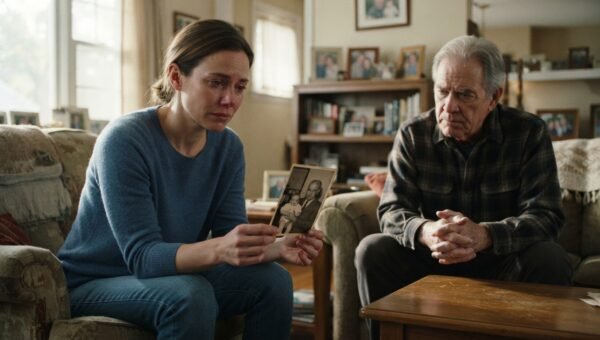
That night, Dustin sat at the end of the dining room table while the three kids watched a movie in the living room. On the wooden table between us, he laid down an old, creased piece of paper. It was a receipts ledger he had kept in his wallet: odd jobs, tire replacements, rent payments, doctor bills for Sarah, all written in pencil.
“I never owed anyone a dollar I didn’t pay back,” he told me quietly.
“I know,” I said.
Forgiveness does not arrive like a sudden blessing. It moves slow, like winter thawing into spring. Dustin still calls me Mother when the kids are around, and only rarely Mom when we are alone in the kitchen folding laundry. Tyler asks polite questions about my late husband, his grandfather, whom he only knows from framed photos in the hall.
Yesterday was Tuesday.
I went back to Grace Fellowship at eleven o’clock. I put on my hairnet and plastic apron, took the metal ladle, and stood behind the soup counter. But when I looked out at the people shuffling through the line, waiting with their red plastic trays, I did not feel good about myself anymore.
I just felt grateful that after sixteen years of closed doors, grace had decided to stand in line and wait for me.