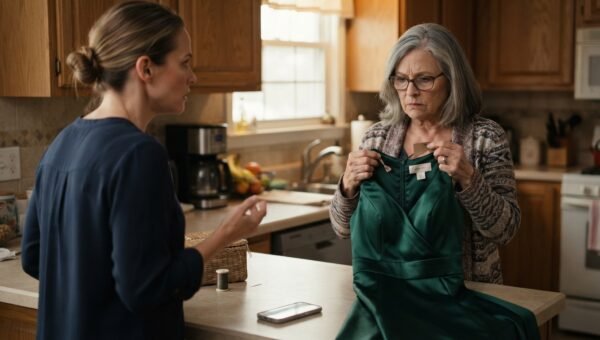
The kettle on the back burner was whistling a thin, high note that always made my teeth ache. I was standing right there with a wet dishcloth in my hand, wiping down the yellow laminate counter for the third time that morning, when the front gravel crunched under the tires of the estate lawyer’s sedan. I did not even look out the window. I already knew whose car it was.
Mr. Henderson was never late for anything in the thirty years he had practiced law in our county, and he was pulling into the drive at exactly ten o’clock, just like he said he would on the phone yesterday afternoon.
I tossed the damp rag into the sink and wiped my palms down the front of my apron. The house was too quiet. Without the sound of my mother’s breathing coming through the monitor from the back bedroom, the high ceilings just seemed to echo every little scrape of my shoes on the linoleum. She had passed away three weeks ago on a Tuesday morning at 4:15, right after the last dose of morphine took the edge off her pain. We had lived together in this old four-bedroom house for four years straight ever since the doctors found the spots on her liver and told us both that treatment was just about buying time.
My cousin Wesley was already sitting on the front porch when Mr. Henderson walked up the wooden steps. Wesley looked too neat for a morning when we were supposed to be reading a dead woman’s last wishes. He had on a clean blue button-down shirt with the sleeves rolled up just enough to show his silver watch, and his hair was combed flat. He gave me that soft, sympathetic look he had been wearing ever since the funeral, the one that always made the hair on the back of my neck stand up.
“You holding up okay, mymin?” Wesley asked as I opened the front door to let the lawyer in. He reached out and gave my shoulder a quick, heavy squeeze.
“I am fine, Wesley,” I said, stepping back to let Mr. Henderson brush past us with his leather briefcase tucked under his arm. “Let us just get this over with.”
We sat around the heavy oak dining table where my mother had rolled out pie dough every Sunday of my childhood.
Mr. Henderson settled into the high-backed chair at the head of the table, clicking the brass latches of his briefcase open with a sharp snap. He did not waste time with small talk. He adjusted his wire-rimmed glasses, pulled out three folded sheets of thick cream-colored paper, and looked back and forth between the two of us.
“Your mother left very specific instructions, as you both know,” Mr. Henderson said, his voice dry and flat like old parchment. He cleared his throat and started reading through the paragraphs about the car, the modest savings account meant to cover the funeral expenses, and the personal items divided between various aunts and cousins. Then he hit the part about the house. I already knew what was coming, because Wesley had let it slip twice at the hospital while bringing up coffee cups, but hearing it read out loud in that formal room still felt like a physical blow to my chest.
“To my beloved nephew, Wesley Vance, I leave the primary residential property located at Four Hundred Pine Street, in its entirety,” Mr. Henderson read, never looking up. “To my daughter, mymin, who has been my steadfast companion through these long years, I leave my deepest gratitude and the contents of the kitchen envelope.”
Wesley tried to look surprised, but his mouth twitched at the corners in a way that gave him away instantly. He leaned back in his chair and crossed his arms over his chest. “I honestly thought she was going to split it down the middle between us, Mr. Henderson,” Wesley said, shaking his head with a little sigh that sounded entirely fake. “mymin took such good care of her. I feel almost guilty taking the whole place.”
“Don’t worry about it, Wesley,” I said, staring hard at the grain of the oak table. “Mom made her choice.”
Nobody said anything for a second, and honestly that felt worse than the shouting we never did. I expected Mr. Henderson to pack up his papers and leave us to divide the silverware, but he just reached back into his briefcase and pulled out a small, manila envelope about the size of a postcard. It was sealed tight across the flap with clear plastic packing tape, and my mother’s shaky, cursive handwriting was scrawled across the front in thick black ink.
“She told me to hand this directly to you before I left, mymin,” Mr. Henderson said, sliding the small envelope across the wood until it stopped right in front of my hands. “She said you were to open it alone, in the house, after we finished.”
Wesley leaned forward, his eyes darting toward the envelope. “What is that? Another addendum? I thought we went through all the paperwork last week.”
“It is a personal matter between a mother and her daughter, Wesley,” Mr. Henderson said sharply, packing his other documents away with a definitive snap of his briefcase. “Now, if you both will excuse me, I have a probate filing to finish down at the courthouse before noon.”
After the lawyer left, Wesley stayed for another ten minutes, walking around the living room and running his hand along the mantelpiece like he was already measuring for new paint. He told me he would give me until the end of the weekend to get my things packed and moved out into the small rental apartment I had put a deposit on last month. I did not argue with him. I just nodded and watched him let himself out the front door, his car doors slamming shut with a heavy, confident thud as he backed down the driveway.
When the dust from his tires settled, I walked back into the kitchen. The house was dead silent except for the hum of the refrigerator. I sat down at the table and picked up the small manila envelope. The tape was old and yellowed at the edges. I slid my thumb under the flap and ripped it open.
Inside was a single folded index card with a recipe written on it in faded blue ink for lemon pie, and taped right to the bottom of the card with a piece of yellowed Scotch tape was an old brass skeleton key. At the very bottom of the card, below the instructions for whipping egg whites, my mother had written three short lines in her neatest handwriting.
*Kitchen only.*
*Use the key where we kept the flour.*
*Do not let Wesley see what is behind it.*
I sat there for a long time staring at those words. My mother had not baked a lemon pie in three years, not since her hands started shaking too badly to manage the pastry dough. But the flour bin had stayed right where it always was, tucked into the lower corner of the built-in pantry beside the stove.
I stood up from the table, my knees popping in the quiet room, and walked over to the pantry door. The hinges creaked softly as I pulled it open. The shelves were mostly empty now except for a few cans of soup and some old spice jars we never used. Down at the very bottom, sitting on the wide wooden floorboards, was the heavy white enamel flour bin with its chipped lid and the little tin scoop hanging from the side handle.
I grabbed the wire handles of the bin and hauled it out into the middle of the kitchen floor. It was heavy, weighted down by ten pounds of old unbleached flour my mother insisted on buying from the mill down in Portland. I dumped the flour into a large mixing bowl, wiped my hands on my apron, and knelt down on the cold linoleum to look into the dark corner where the bin had sat for forty years.
There was nothing there at first glance, just the painted pine baseboard and the dark shadow cast by the lower shelf. But when I reached my hand back into the corner and pressed my fingers against the vertical paneling, the wood gave a little click. It was not a wall at all. It was a flush access door, painted the exact same cream color as the rest of the kitchen trim so nobody would ever notice the seam.
I slid my fingernails into the tiny gap along the side and pulled. The wooden panel swung open on small brass hinges that had been oiled recently enough not to squeak.
Inside the dark cavity behind the wall was a flat metal security box, the kind people buy at the hardware store for twenty dollars and hide in the back of a closet. The little brass key taped to my mother’s lemon pie recipe matched the padlock hanging from the front latch. My hands were shaking so badly I dropped the key twice before I managed to get it into the slot and turn it until the shackle popped open with a dry *clack*.
I lifted the lid. The box was packed tight with thick manila folders, all of them labeled with dates going back four years.
I pulled out the top folder and flipped it open on the kitchen floor. Inside were monthly bank statements from the credit union down on Main Street, where my mother had kept her modest retirement savings and the money from selling the small family woodlot back when my father died. Paperclipped to each statement were duplicate withdrawal slips, filled out in neat, careful handwriting.
I turned to the first slip dated three years ago. The amount was $1,200. Then another one for $850 six weeks later. Then $2,400 right around the time my mother started her second round of chemotherapy. Month after month, year after year, money had been leaking out of her accounts in chunks large enough to pay for a new car or a down payment on a boat.
And at the bottom of every single withdrawal slip, right on the signature line where it said *Account Holder Authorization*, was my mother’s name. But it was not her handwriting. The loops were too round, the capital *M* too sharp. It was Wesley’s signature, disguised with a shaky hand to look like an old woman’s feeble scrawl.
I sat there on the kitchen floor with the cold linoleum pressing through my jeans and the smell of old paper rising up from the metal box. The numbers kept adding up in my head until they hit over sixty thousand dollars. That was the money my mother had saved for her final care, the money she had set aside so I wouldn’t have to scramble for rent when she was gone. Wesley had been draining her accounts every single month while he sat at our kitchen table eating my tuna salad sandwiches and telling me how worried he was about her health.
Three days later, I was sitting across the mahogany desk in Mr. Henderson’s private office with the metal box open between us. The lawyer did not say a word for nearly five minutes as he turned over the bank statements, comparing Wesley’s known signature on a receipt from the county tax office with the forged withdrawal slips from the credit union. His face went dark, the skin around his mouth tightening into hard, gray lines.
“Your mother brought me a copy of the first statement six months ago,” Mr. Henderson said quietly, taking off his glasses and rubbing the bridge of his nose. “She wanted to go straight to the police then and there. But she was weak, mymin. The cancer had gotten into her bones, and she knew a public investigation, the depositions, the court dates, the scandal with her sister’s side of the family… it would have killed her before the trial even started.”
“So she gave him the house,” I said, the realization hitting me like a cold wave. “She knew he wanted the property more than anything else. She used it as bait.”
“She called it her final judgment,” Mr. Henderson said, looking out his office window toward the courthouse square. “She knew Wesley was too greedy to look any deeper once he got the deed. She signed a new will leaving him the house so he would stop looking for the rest of the money, and she hid the proof where she knew only you would ever look after she was gone. She didn’t want a fight while she was alive. She wanted a reckoning after she was out of reach.”
Wesley called me that evening while I was packing up my mother’s winter coats in the hallway closet. His voice sounded different than it had on the porch, high and tight and pushed right to the edge of panic.
“mymin, Mr. Henderson’s office just called me,” Wesley said without even saying hello. “They’re freezing the deed transfer. They’re talking about an audit and local detectives. What the hell did you find in that kitchen?”
I held the phone a few inches away from my ear, listening to him breathe hard through the receiver. I didn’t yell at him. I didn’t bring up the hospital coffee or the sandwiches or the way he used to pat my shoulder and tell me I was a good daughter for staying home.
“You should have left the flour alone, Wesley,” I said.
“mymin, listen to me, we can talk about this like family,” his voice cracked on the last word, the big confident cousin routine evaporating into thin air the second he realized the trap had closed. “Your mother wasn’t thinking straight at the end. You know how the medication makes them confused. We can sort this out without lawyers involved.”
“The papers are already on Mr. Henderson’s desk,” I told him, and my voice didn’t shake at all. “The police have copies of the withdrawal slips with your handwriting on them. They’ll be at the house tomorrow morning to serve the papers.”
I hung up the phone before he could answer, dropping it onto the hall table right beside the brass key.
The next morning, the sun came up over the Oregon hills clear and cold, burning the mist off the grass in the backyard. The house was finally quiet, not with the heavy silence of death, but with the clean, empty hush of a place that belonged to me again. The state investigators had already come and gone, taking the metal box and the bank records with them, leaving behind a stack of official seals on the front door that kept Wesley off the property for good.
I walked into the kitchen and set the old white flour bin back in its corner against the baseboard, leaving the little metal access door open just an inch so the wood could breathe. Then I turned on the oven, pulled out the mixing bowl from the top shelf, and started cutting cold butter into a pile of flour, just like my mother taught me, waiting for the crust to chill.