PART 1
Two days before she passed away in hospice, my mother pressed a brass key into my palm and closed my fingers over it. She looked toward the hallway door to make sure we were alone. “Don’t tell your brother,” she whispered. Her voice was barely more than dry paper, but her grip was firm. “First National Bank. Box 319. Go after I am gone.”
My brother Kevin had managed her life for the last seven years.
He lived four miles down the road from her brick ranch in Canton, Ohio, while I lived two hours away in Columbus with my own family. Whenever I offered to help with her groceries or look at her bills, Kevin waved me off. He told me he had everything handled and that Mom got confused easily. I believed him because it was easier to believe my older brother was being a good son than to question why Mom grew quieter every year.
The morning after the funeral, I drove straight to First National Bank on Market Avenue. The vault manager walked me into the narrow viewing booth and left me with the long metal drawer.
Inside sat three bundles of hundred-dollar bills banded with bank paper, totaling $93,000 cash. Next to the money lay a silver USB drive and a single sheet of lined notebook paper written in my mother’s shaky, familiar handwriting.
“Your brother takes my Social Security,” the note read. “$1,400 a month. 7 years. $117,600. He has power of attorney. I signed it when I could still think clearly.”
My hands shook as I folded the paper into my purse. I carried the cash and the drive out to my sedan, locking the doors before I even started the engine. When I reached my kitchen table in Columbus, I plugged the drive into my laptop. The root directory held two folders. The first was labeled “Statements.” I clicked through seven years of checking account records showing my mother’s monthly $1,400 federal deposit arriving on the third of each month, followed within forty-eight hours by an automatic transfer into Kevin’s personal account.
Then I opened the second folder, labeled “House.” Inside were digital photos of a cedar lake cabin in Carroll County, a place Kevin had never once mentioned. Below the photos was a scanned PDF of a deed dated three years ago, registered entirely in Kevin’s name, financed with a cashier’s check drawn directly against Mom’s home equity line.
Right under the deed sat the last file: a life insurance application for $250,000 on my mother’s life. The sole beneficiary listed was Kevin. The policy had been taken out exactly three weeks before she died, complete with an electronic signature stamped while she was already bedridden on heavy pain medication.
PART 2
I printed every single page and laid them across my kitchen counter. The total was staggering. Between the $117,600 in intercepted Social Security, the equity drained for the lake cabin, and the secret insurance policy, Kevin had treated our mother like an ATM while she slowly faded away.
The $93,000 in the safe deposit box was the only money she had managed to protect. On the back of the notebook page, I noticed a smaller line of writing at the bottom: “Saved from my old savings bonds he forgot about. Use this to stop him.”
My phone rang while I was reading that sentence. Kevin’s name showed on the screen.
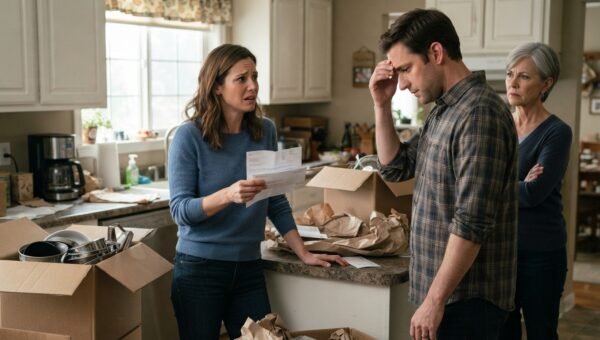
“Hey,” he said, sounding hurried. “Mom’s lawyer called me. We need to file probate on the house by Friday. Did you take any of her personal papers from the nightstand before the cleaners got there?”
“Just a few photo albums,” I said, keeping my voice even. My stomach tightened, but I did not waver. “Why do you ask?”
“Nothing,” he said. “Just trying to get her affairs wrapped up. Don’t worry about any of the paperwork. You know how complicated estates can get, and since I have the power of attorney, I can sign off on everything.”
“Power of attorney ends at death, Kevin,” I said quietly.
There was a five-second pause on the line. “I know how the law works, Sarah. I took care of her for seven years while you stayed down in Columbus. Just let me handle it.”
He hung up. I did not call back. Instead, I drove down to High Street the next morning and sat in the office of an estate litigation attorney named Arthur Vance. I handed him the USB drive, the printouts, and the handwritten note.
Vance spent twenty minutes reviewing the bank records and the insurance policy. Then he leaned back in his leather chair. “A power of attorney gives someone a fiduciary duty. Using her Social Security and her home equity to buy personal real estate in his own name is textbook breach of fiduciary duty and financial exploitation of an elder. As for the life insurance policy, if she was on hospice and lacked capacity three weeks ago, that application is fraudulent.”
“What do we do?” I asked.
“We file for an emergency temporary restraining order freezing the insurance payout and placing a lis pendens on the lake cabin so he cannot sell it,” Vance said. “Then we open probate with you as administrator.”
PART 3
Two days later, Vance filed the emergency motion in Stark County Probate Court. The judge signed an order freezing all insurance disbursements pending a hearing on undue influence and lack of capacity. A formal notice of the filing was served on Kevin at his office on Thursday afternoon.
Twenty minutes after service, Kevin was banging on my front door in Columbus.
I opened the door, but I kept the screen latched. Kevin was red-faced, holding the legal summons in his fist.
“What is this garbage?” he shouted, stepping onto the porch mat. “You hired a lawyer against your own brother? After everything I sacrificed for her?”
“You didn’t sacrifice,” I said, looking him dead in the eye. “You took $1,400 every month for seven years. That was her food and her supplemental care money. You used her house equity to buy a cabin at Atwood Lake, and then you took out a quarter-million-dollar insurance policy when she couldn’t even remember the nurse’s name.”
His mouth opened, then snapped shut. He looked around the quiet suburban street, realizing the neighbors across the yard could hear him.
“She wanted me to have that cabin,” he stammered, lowering his voice. “I took care of her every day. Do you know how hard it was to change her sheets and sit with her through the night?”
“You hired aides with her money to change those sheets,” I said. “And she left me the bank key, Kevin. Box 319. She kept the receipts you didn’t know about.”
Hearing the box number drained the anger straight out of him. His shoulders dropped. He knew right then that she had planned this while sitting in her recliner, watching him manage her life into the ground.
“Sarah, please,” he said, his tone turning into an uncomfortable plea. “If this goes in front of a judge, it ruins my credit. It ruins my license. We can settle this between us.”
“You will talk to my attorney,” I said, and closed the solid wooden door.
ENDING
We did not end up going to a full trial. When Vance subpoenaed the hospice nursing logs, the medical charts proved our mother was heavily medicated with liquid morphine on the exact afternoon the electronic insurance application was submitted. The insurance company rescinded the policy immediately, returning the single premium payment to the estate.
Faced with potential criminal referral for elder exploitation, Kevin signed a comprehensive settlement agreement four months later. He surrendered the Atwood Lake cabin deed to our mother’s estate. The property was sold for $215,000, and those proceeds, combined with the $93,000 she had hidden in Box 319, fully restored her estate. After attorney fees and settling her remaining medical debts, the balance was split according to her original will from twenty years ago, before Kevin ever touched her accounts.
Kevin stopped speaking to me the day the settlement papers were signed at the courthouse. He skipped our family’s Thanksgiving gathering and told our cousins I was greedy. I did not bother defending myself to them. The truth was written clearly in seven years of bank stamps.
Last weekend, I drove back up to Canton to clean out her safe deposit box and close the account at First National. The bank officer handed me the empty metal tray, and I returned the brass key to the counter.
Before I left, I sat in my car in the parking lot and took out the small piece of notebook paper one last time. My mother had been trapped in her own home, frail and quiet, but she had not been powerless. She had known exactly what she was doing when she handed me that key. I slipped the note into my glove compartment, turned the ignition, and drove home.