PART 1
The cedar cabin on Miller Ridge had stood empty for nine months, smelling of dust, pine pitch, and old mothballs. My stepbrother, Gary, had called me three weeks after the headstone was set, his voice brisk and impatient over the phone line. He wanted the property listed, sold, and divided before the first heavy frost of autumn. According to him, keeping up the property taxes and insurance on a place nobody used was throwing good money after bad.
I agreed to drive up from Knoxville to help sort through Mom’s remaining personal items, expecting to pack up a few porcelain knickknacks, bundle some winter quilts, and clear out the pantry.
Mom had lived there alone for twelve years after my stepfather passed away. The place was cluttered in the way old mountain homes get, packed with canning jars, stacks of local newspapers, and heavy oak furniture that would cost more to haul away than anyone would pay for it at a yard sale. Gary didn’t come with me on the first day. He had business in Chattanooga, or so he said, leaving me a heavy brass key ring and a yellow sticky note with instructions to throw away anything that looked like junk.
I started in the back bedroom, the one Mom had used after her knees got too bad for the stairs. Her cedar chest was tucked into the closet, smelling sweetly of shavings.
Inside were spare pillowcases, her baptismal certificate, and a stack of old photograph albums with black paper pages. I carried the chest out to the dining room table, sitting down in the slant of afternoon light to sort through the memories. Most of the pictures were ordinary snapshots of family holidays, blurry shots of Thanksgiving turkeys, and pictures of Gary standing proudly beside his first rusted-out pickup truck.
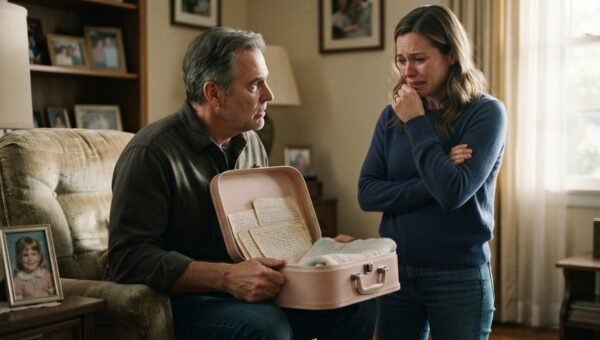
It was near the bottom of the stack that I found something out of place. It wasn’t in an album at all, but tucked inside the back cover of a 1984 seed catalog. It was a small, cream-colored envelope with no return address, sealed with aged glue that had turned yellow and brittle. When I slid my thumb under the flap, a small lock of fine, dark brown hair fell out onto the tabletop, tied neatly with a faded blue ribbon. Along with the hair was a hospital identification band made of yellowed plastic, brittle and cracked with age, bearing a date from October 1991 and a mother’s name that was not my mother’s.
My heart did a strange, heavy thud against my ribs. I turned the envelope over. Written in Mom’s precise, upright cursive was a single sentence: “The promise I couldn’t keep.”
Before I could process what that meant, I heard the gravel crunch in the driveway. Gary’s SUV doors slammed shut, and heavy boots thudded up the wooden porch steps. When he walked through the front door, his eyes went straight to the table, fixing instantly on the open envelope and the lock of hair resting against the dark wood. The easy, confident look on his face vanished in a single second, replaced by a cold, guarded tension I had never seen in him before.
PART 2
Gary didn’t ask what I was doing. He walked over, his boots heavy on the braided rug, and reached down to sweep the envelope and the hair off the table. He slid them into his jacket pocket before I could pull my hand back.
“You shouldn’t be digging through old trash, Clara,” he said, his voice flat and completely devoid of the brotherly warmth he usually wore like a cheap coat. “Mom kept all kinds of sentimental nonsense in these drawers. It’s just old clutter from people who rented the pasture cabin back in the eighties. Put the rest of those papers in a trash bag and let’s go.”
“That wasn’t rented property stuff, Gary,” I said, standing up from the chair so our eyes were level. I was five years older than him, and for years I had let him take the lead on family matters because he was loud and persistent. Right now, his hands were trembling slightly as he jammed them deep into his pockets. “That was a hospital band from 1991. And that handwriting was Mom’s. Who was that child?”
Gary let out a short, harsh breath that sounded almost like a laugh, though there was no humor in it. He walked to the kitchen counter, picked up an empty coffee mug, and set it back down.
“Mom helped out a lot of people over the years,” he muttered, avoiding my gaze. “You know how she was. Always meddling, always taking in stray dogs and people down on their luck. A girl stayed here for a few months when things went bad. That’s all there is to it. The social services got involved, everything was settled legally decades ago, and there is nothing left in this house for you to dig up. Now sign the listing agreement so the realtor can put the sign out tomorrow morning.”
He pulled a manila folder from under his arm and tossed it onto the dining table. Inside were three pages of fine print, already filled out with a local agency’s letterhead and a suggested sale price that seemed suspiciously low for five acres of mountain timberland.
I looked at the papers, then looked at Gary. Something didn’t fit. Gary was never interested in paperwork, and he certainly wasn’t the kind of man to handle legal filings on his own without complaining about the cost every step of the way. If he was in such a hurry to sell this place, it wasn’t just because of taxes. It was because he wanted the walls down and the floorboards pulled up before anyone else had a chance to look underneath them.
“I’m not signing anything until you tell me the truth,” I said, my voice dropping into the quiet, steady tone our mother used when she meant business. “Why are you in such a rush to sell this cabin, Gary? What is hidden in this house?”
PART 3
Gary stared at me for a long, hard moment, his jaw working as if he were chewing on something bitter. The afternoon sun slipped behind the ridge, plunging the living room into a deep, gray shadow that smelled of ancient dust and cedar.
“You want the truth?” he snapped, slamming his hand down on the edge of the table. The coffee mug rattled against the wood. “The truth is that Mom spent the last ten years of her life sending half her pension to a PO box in Asheville. Not to me, not to you, but to a lawyer who kept a girl hidden away in foster care because Mom was terrified of what the courts would say if the whole adoption mess ever came to light. This cabin is the only asset left that has clear title. If we don’t sell it this week, the back payments and the legal fees are going to eat up every dime, and the girl is going to find out she has a claim to this land.”
The room seemed to tilt slightly. I caught the edge of the wooden chair to steady myself. “A claim? Gary, what are you talking about? Who is she?”
Gary reached into his inner jacket pocket and pulled out a folded square of heavy photographic paper. He tossed it across the table. It slid across the scarred oak surface and stopped right against my fingertips.
I picked it up. It was a color photograph taken a few years ago, showing a young woman standing in front of a brick building that looked like a community college. She had the same dark brown hair as the lock in the envelope, and her profile—the sharp line of the jaw, the curve of the lower lip—was unmistakably Mom’s. On the back of the photograph, written in that same upright cursive, were the words: “Do not let him sell the cabin before she comes home.”
“Mom made a mistake thirty years ago,” Gary said, his voice dropping into a rough whisper. “She promised my father’s sister that she’d raise the child if things went south, but then she panicked when the legal papers didn’t clear. She hid the girl’s existence from me, from you, from everyone. But the girl knows the address. She’s been writing letters to Mom for two years asking about her birth certificate. If we sell the place to the developer who made that cash offer yesterday, the deed transfers clean, the money gets split between us, and whatever mess Mom left behind gets buried under a new foundation. That’s why we’re selling. Now.”
I looked from the photograph to Gary’s pale, desperate face. He didn’t care about the taxes. He cared about cashing out before the rightful owner of this land walked through the front door and asked why her grandmother’s home had been stolen from under her.
“We aren’t selling, Gary,” I said softly, laying the photograph down next to the seed catalog. “We are going to wait.”
“You out of your mind?” he shouted, stepping forward. “She’s not coming back! She doesn’t even know—”
ENDING
Before Gary could finish the sentence, the sharp crunch of tires on gravel echoed up from the drive.
We both froze. Through the front window, we watched as a dusty blue sedan pulled to a stop beside the porch, its engine ticking quietly as it cooled in the mountain air. The driver’s side door opened, and a young woman stepped out onto the gravel. She was carrying a worn canvas backpack over one shoulder and holding a manila folder in her hand. She looked up at the cedar siding, her eyes scanning the front porch exactly the way Mom used to do when she was checking the weather.
Gary muttered an oath under his breath and reached for the front doorknob, his face draining of all color.
“Don’t you touch that lock,” I said, stepping past him with a firmness I didn’t know I possessed.
I walked to the front door, turned the brass knob, and pulled it open. The cool mountain air rushed into the hallway, carrying the scent of pine and coming rain. The young woman on the porch stopped three steps up, her hand hovering near the wooden railing, looking at me with eyes that were so startlingly familiar it made my breath catch in my throat.
“Hello,” she said quietly, her voice trembling slightly against the wind. “I’m looking for Sarah Miller. I was told… I was told this was where my grandmother lived.”
I looked past her shoulder at the empty road, then back down at the girl standing on the porch, holding the proof of everything our mother had tried to keep alive.
“She’s gone,” I said, my voice steady as I stepped aside to let her see into the hallway. “But you’re right where you’re supposed to be. Come on inside.”