PART 1
A $15 coffee chain gift card and a folded paper folder. That was my retirement gift after thirty-five years teaching elementary school in Dayton. Thirty-five years of scraped knees, Christmas concerts, parent meetings, and children who still stopped me in grocery stores to say hello.
The new principal, Dr. Karen Hayes, handed it to me across her desk on a rainy Friday in June. She didn’t stand up.
She didn’t offer a handshake. She just slid the envelope over the polished wood and gave me a thin, practiced smile.
“Don’t take it personally, Ruth,” she said, tapping her pen against her planner. “People retire every year. You’re not exactly special. The board has a strict protocol for staff transitions now, and we have to keep things uniform.”
Not special.
Thirty-five years of children, and I wasn’t special.
I looked at the plastic card sitting inside the paper folder. I had started at Maple Valley Elementary in 1989, when the halls smelled like paste and floor wax and the windows had heavy cords you had to pull with both hands. I taught three generations of families. I had bought winter coats with my own money for kids whose parents worked double shifts at the auto parts plant. I had sat in hospital waiting rooms with terrified mothers.
I didn’t argue. I didn’t raise my voice. At sixty-two, I knew the difference between a fight worth having and a person who simply lacked the capacity to understand what came before her.
“Thank you, Dr. Hayes,” I said quietly.
I walked down the hall to Room 114. The desks were already stacked in columns of four. The butcher paper was off the bulletin boards. I packed my chipped ceramic coffee mug, my tape dispenser with the worn blade, and thirty-five years of framed class pictures into two cardboard copy boxes. When I carried them out to my sedan, the hallways were already dark. Nobody walked me to the door.
Six weeks later, the letter arrived in my mailbox on a Tuesday.
It was printed on heavy, cream-colored cardstock with embossed gold lettering. The school district was celebrating Maple Valley’s fiftieth anniversary in mid-August, two weeks before the new school year started. Every living former principal, retired staff member, and alumni family had been invited. There would be speeches, an alumni fund kickoff, and the dedication of the newly remodeled library wing.
I almost tossed it in the recycle bin next to the refrigerator.
My younger sister, Clara, stopped my hand. She was sitting at my kitchen table, shelling snap peas into an old aluminum colander.
“You go,” Clara said, looking at me over her reading glasses. “You gave your back and your knees to that building, Ruth. You don’t let a woman who took the job nine months ago run you off from your own life.”
“I don’t need a standing ovation, Clara,” I said. “I just wanted to walk out with some dignity.”
“Then go show up with it,” she said.
The ceremony was held on a Thursday evening. The humidity in Dayton was thick enough to chew, but the school auditorium had its air conditioning running full blast. By six-thirty, the room was packed. Former students, teachers with silver hair, parents, and local officials filled the rows.
I sat in the middle of row twelve, wearing my navy linen dress and the pearl earrings my husband had given me for our twenty-fifth anniversary before he passed.
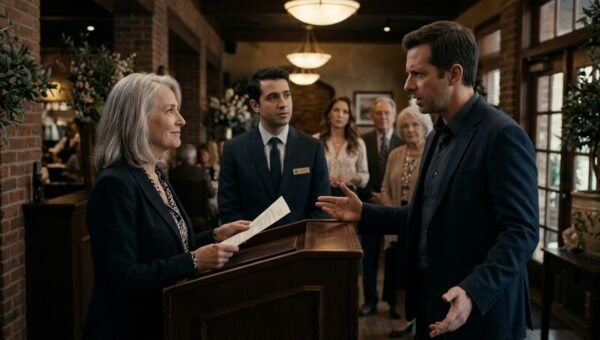
Dr. Hayes walked onto the stage at seven o’clock sharp. She wore an expensive cream suit and carried a sleek black leather binder.
She stood behind the podium, smiling confidently into the stage lights, adjusting the microphone until it gave a sharp pop.
“Welcome, families, alumni, and distinguished guests,” she began, her voice bouncing cleanly off the acoustic panels. “Fifty years of excellence is a milestone. As we look forward to the next fifty years, we must recognize that an institution is not built on sentiment. It is built on modern standards, measurable outcomes, and leadership that refuses to linger in the past.”
She spoke for fifteen minutes about test scores, facility grants, and the new digital media lab. Then she turned a page in her binder.
“Before we begin our fundraising pledges for the library endowment,” she said, her voice dropping into a rehearsed warmth, “we want to acknowledge those who paved the way. We invited our retired educators here tonight to honor their general contribution.”
She started reading a list of names from the paper.
“Dorothy Vance. Marcus Webb. Helen Miller.”
A polite round of applause followed each one. Then she looked down at the sheet, hesitated for a split second, and read:
“Ruth Campbell.”
The applause for my name wasn’t just polite. A group of men sitting near the front left—boys I had taught in fourth grade back in the nineties, now grown with thick beards and work boots—stood up. Then Mrs. Gable, whose daughter I had tutored through third-grade math after her father died, stood up. Within ten seconds, half the auditorium was on their feet.
On stage, Dr. Hayes blinked. Her tight smile stayed on her face, but her shoulders stiffened. She waited three seconds, cleared her throat into the microphone, and spoke over the clapping.
“Yes, thank you, Mrs. Campbell. As I said earlier, every retired staff member played their small part. Moving along to the donor acknowledgments—”
She didn’t ask me to stand. She didn’t look my way. She just tried to push the crowd back down into their seats.
I sat quietly until the applause settled. My hands were completely steady on my purse. I looked at the stage, at the bronze plaque covered with a blue velvet cloth on the easel beside her, and at the oversized cardboard check resting on a table against the rear curtain.
Then I stood up and started walking toward the stage.
PART 2
The auditorium went quiet in a slow, spreading wave.
People in the aisle seats turned their heads as I walked past them. My sensible black pumps clicked evenly against the linoleum floor. I wasn’t rushing. I wasn’t trembling. I was just an older woman walking up the three carpeted steps on the left side of the stage.
Dr. Hayes stopped speaking mid-sentence. Her hand remained poised over the edge of the podium. As I reached the top step, her eyes widened, and she lowered the microphone slightly.
“Mrs. Campbell,” she murmured under her breath, just loud enough for the first two rows to hear, “this is an organized agenda. Please take your seat.”
I didn’t take a seat. I walked straight past the podium toward the table draped in gold cloth near the back wall.
On that table sat the three architectural renderings for the new library wing, framed in dark wood. Next to them stood the blue velvet-covered plaque that was scheduled to be unveiled at the end of the night. And beside the plaque lay an official leather-bound guest book, alongside a thick blue folder labeled *District Endowment & Historical Records*.
The entire auditorium watched in utter silence. You could hear the low hum of the ceiling vents.
Dr. Hayes stepped around the podium, her heels making sharp, angry taps against the wood. “Ruth, whatever personal grievance you have, this is completely inappropriate. Step down immediately or I will have security escort you out.”
“You won’t call security, Karen,” I said in a calm, ordinary voice that carried into the quiet room. “Because you haven’t opened that folder yet.”
She frowned, confusion flickering behind her polished expression. “That folder contains the donor registry and historical charter. It has nothing to do with staff retirements.”
“It has everything to do with why we are in this room,” I said.
Three weeks after my final day, I had received a phone call from Arthur Pendelton. Arthur was eighty-one years old, a retired probate attorney in town, and a school board member from 1985 to 2004. He had heard about my departure from his daughter, whom I had taught in fifth grade.
Arthur had asked me a very simple question over the phone: “Ruth, did the district ever complete the reversion paperwork for the south annex?”
I had told him I didn’t know what he meant.
Arthur told me to go down to the county records office on West Third Street. He told me to pull deed book 412, page 88.
I had done exactly that on a quiet Tuesday morning in July. I paid four dollars for certified copies of the 1994 property agreement and the private trust covenant that followed it. I had kept those papers in my bag ever since, waiting to see if anyone at the district office actually knew the history of the ground they were standing on.
Now, on stage in front of four hundred people, I pointed directly to the blue folder on the table.
“Open it,” I said to Dr. Hayes. “Turn to section three. The 1994 Capital Land Transfer.”
Dr. Hayes looked out at the audience. The superintendent, Dr. Marcus Vance, was sitting in the front row. His arms were crossed, his brow furrowed, his eyes fixed on the stage. Beside him sat two members of the school board.
“This is ridiculous,” Dr. Hayes said loudly, trying to reclaim authority for the room. “We are here to celebrate our anniversary and announce a major private gift for our children’s future.”
“Then show them who gave the land for the library,” I said.
A murmur rippled across the auditorium.
Dr. Hayes hesitated. She looked down at Superintendent Vance. Vance gave her a single, tight nod from the front row. He knew Arthur Pendelton. He knew what kind of records Arthur kept.
With tight, jerky motions, Dr. Hayes stepped over to the table. She opened the heavy blue binder. She flipped past the welcome letter, past the architectural sketches, past the program notes, until her fingers hit the yellowed tab marked *1994*.
She looked down at the typed page.
Her face didn’t go pale like a ghost in a book. It did something much more real: her mouth tightened into a hard, defensive line, and her eyes darted back and forth across the lines of text as if she were desperately searching for a typo.
PART 3
The paper she was reading was a certified copy of the 1994 deed transfer for the two-acre parcel behind the gymnasium—the very ground where the new library wing had just been built.
Back in 1993, the school district was running a severe budget deficit. Maple Valley had been slated for consolidation. The state had threatened to close the doors and bus our elementary children across town to an overcrowded facility near the interstate. The only way to keep the school open under state rules was to expand the physical property footprint to qualify for a regional modernization grant.
The district had no money to purchase the adjoining land. The owner of that adjacent two-acre apple orchard had been an elderly farmer named Thomas Campbell.
My father-in-law.
When Thomas died in the winter of 1993, he left that parcel to my husband, David, and me. We were thirty years old. We were paying off our first mortgage on a small ranch home, and we had two young children of our own. That land was appraised at $84,650 back then. We could have sold it to the housing developer who was building subdivisions along the creek. We could have paid off our house and put money away for our kids’ college.
Instead, David and I signed that two-acre parcel over to the Dayton Board of Education for exactly one dollar.
There was only one condition written into the deed covenant. It was drafted by Arthur Pendelton himself. The deed stated that the land was dedicated in perpetuity for public elementary education, and if a permanent structure was ever erected upon that parcel, it must carry a permanent brass dedication plate acknowledging the Campbell family’s donation, to remind future administrators that the school survived because ordinary teachers gave what they had.
David passed away nine years ago from lung cancer. He