I still ask myself how many small signs I needed before I understood what Adam thought I was for. On Mother’s Day, I was at the maître d’ desk with a forged signature in my hand, and the answer was right there. I just hadn’t wanted to see it before.
Two weeks earlier, Adam called to say he and Chloe couldn’t have dinner with me. Chloe’s parents had planned something private, he said. It was “really a family occasion.”
I said, “Of course. Have a nice day.”
I remember wiping the kitchen counter after we hung up, though it was already clean. I could have told him that I was his family too. Instead, I did what I’d done for years. I made his rudeness easier for him by pretending it hadn’t hurt.
I was a widow, and Adam was my only child. I built Whitmore Hospitality Group from one small hotel and a lot of long workdays. I didn’t talk about money much at home. Maybe that was my mistake. I wanted Adam to grow up thinking of me as his mother, not the woman who owned a company. But I also kept smoothing things over whenever he ran short.
He had a monthly family trust allowance. I covered his car insurance twice after he forgot to pay it. I once sent money for a “temporary” business expense that never came up again.
I told myself I was helping him get steady. He’d learned that if he sounded embarrassed, I would ask how much.
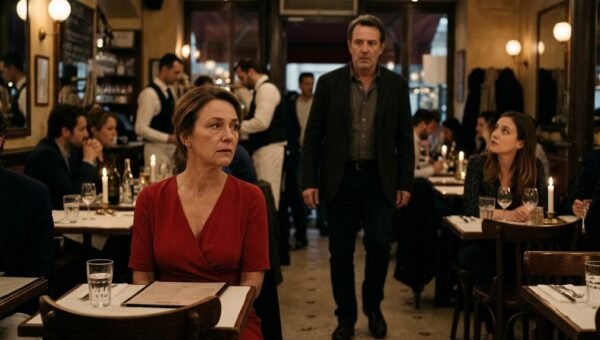
So on Mother’s Day, I decided not to sit at home waiting for a call that might not come. At 6:30, I booked a corner table at one of our Italian restaurants under a guest name. I had a folder of property reports in my bag, and I thought I’d eat, make a few notes, then go home.
I ordered pasta with sausage and fennel. The waiter brought a little dish of olive oil, and I noticed the bread was still warm enough to soften the butter. I don’t know why I remember that. Maybe because the evening had started out perfectly ordinary.
At 7:45, I paid my check and stood to leave. Then Adam came through the front doors with Chloe, her parents, Richard and Eleanor, and six other relatives.
He was smiling in a way I hadn’t seen from him in months. He pulled out chairs for them and shook Richard’s hand with both of his.
He hadn’t seen me yet. I was close enough to hear him say, “The cellar suite is ready, right? This is going to be a great night.”
Chloe laughed. “Dad’s been looking forward to it.”
Adam looked proud. I almost felt glad for him. Then I remembered the call two weeks before and the words “really a family occasion.” I was still holding my coat when he went to the maître d’ desk.
He gave Matteo Rossi, the general manager, a number. “Membership number 000147. Margaret Whitmore. Charge the private reception to her account.”
Matteo looked down at the screen, then at the paper Adam held out. He didn’t react much, but I saw his eyes stop on the signature.
I knew that signature. It was mine, copied carefully from an old foundation letterhead. The kind of old document I kept in my home office.
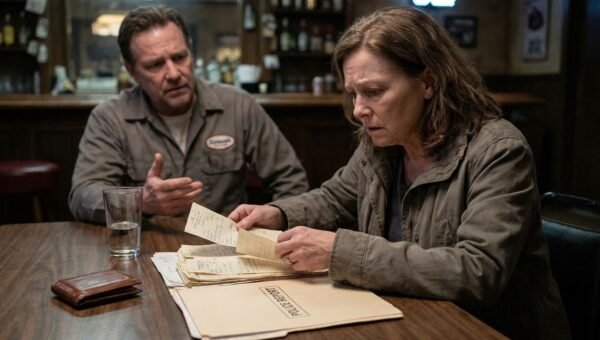
Adam had visited three days earlier, supposedly to borrow garden tools. He’d stood by my desk while we talked about a loose hinge on the shed. I remember him asking where I kept my notepad. I remember saying, “Top drawer, I think.” I didn’t think anything of it then.
I walked back to the desk.
“Before you process anything, may I see that authorization?”
Adam finally noticed me. His smile went away.
“Mom, don’t make a scene.”
That sentence did something to me. Not because it was loud. He said it like my job was to keep his secret tidy.
I looked at the paper again. The signature was close. Too close. The account number was right, and the letterhead was ours. But the security watermark was missing, and a handwritten form couldn’t authorize an outside event against account 000147. That account required owner ID and a second verification step. Adam knew enough about my business to know I rarely checked the small charges on the quarterly statement. He thought he’d have time before I saw this one.
I didn’t raise my voice. “Matteo, please freeze the charge and pull up the account profile.”
Matteo looked at me properly then. “Mrs. Whitmore.”
“It’s all right,” I said. “Please do it.”
He turned the terminal so I could see the owner credentials and alert settings. Then he quietly called security to verify that no valid authorization had been entered. He wasn’t making a show of it. He was following the rules I had put in place years ago.
Adam shook his head. “It’s a misunderstanding.”
“Then it should be easy to clear up,” I said.
Chloe and her parents had noticed the delay. Richard came over first, wearing the look of a man who expected a staff member to apologize.
“Is there a problem with our reservation?” he asked.
Matteo answered evenly. “There is a question about the payment authorization.”
Richard looked at Adam. “You said it was handled.”
“It is handled,” Adam said. Then he lowered his voice toward me. “Can we talk about this later?”
I could feel the familiar pull to protect him. I could have handed him a card or told Matteo to wait until the next morning. I’d done that sort of thing before. But the paper in my hand wasn’t a late bill or a forgotten payment. It was a signature he had copied from my desk.
I folded it once and put it in my handbag.
“Not this time,” I said.
Richard turned toward me. “I don’t understand. Who are you?”
“I’m Margaret Whitmore. I own the group that owns this restaurant.”
The words came out plain. I didn’t enjoy saying them. But I watched Richard’s face change as he realized I wasn’t an older guest interfering with his dinner. I was the account holder, the company chair, and the person Adam had tried to use without asking.
Eleanor looked at the paper. “Is that your signature?”
“No. Someone copied it.”
Chloe stared at Adam. “You told us your company was paying.”
Adam rubbed his forehead. “I said I had it covered.”
I could see the whole arrangement then, though I didn’t know every detail yet. He’d kept me away because I would have asked who was paying. He wanted the Vances to see him as a man who could host a $38,000 banquet without help from his mother.
Matteo explained that the private event required a valid card for the food and beverage minimum and deposit. The full planned reception came to $38,000. The authorization was invalid, so the account was locked. Adam needed to put down the required amount himself or they couldn’t use the private suite.
“Just put it on my card,” Adam said.
He handed Matteo one card. Matteo ran it. It was declined.
Adam tried another. That one was declined too.
Nobody said anything for a moment. The little machine beeped, and I could hear a fork scrape a plate from the dining room behind us. I was glad for that ordinary sound. It gave me something to look at besides my son’s face.
Richard’s voice got sharper. “You told me this was already paid.”
“I thought the account would go through,” Adam said.
“You thought?” Chloe said.
Then Adam looked at me, not at Richard or his wife. His voice dropped.
“You weren’t supposed to see the bill until June.”
That was the part I hadn’t known. He had planned the banquet as a way to secure a partnership buy-in from Richard. The Vances thought Adam was hosting them on his own success. He had planned to let the charge sit on my consolidated club account until the June statement, when the show would already be over.
The exclusion wasn’t about space. It wasn’t about a family occasion. He didn’t want me there because I knew what the night would cost, and because my presence would make it harder for him to pretend he had paid for it himself.
Richard took out his own card. “I’ll cover the deposit. We can sort this out after.”
Matteo said the deposit would only hold the room and cover the agreed minimum. The full event couldn’t proceed at the original price without payment arrangements. Richard looked at Adam, then at Chloe. He paid the reduced deposit anyway, because leaving would have been another scene, and the relatives had already seen enough.
Adam pulled me aside near the entry. “Please. Just let this go. I’ll pay you back.”
I looked at him. “You took a signed letter from my desk.”
“I was going to pay it.”
“You used my name to impress Richard.”
He said nothing.
I wanted him to say he was sorry. I wanted him to be the child who used to bring me a crooked paper flower from school and wait for me to put it on the fridge. That wasn’t the man standing there. I was the one who kept confusing those two people.
“I won’t cover this,” I said. “And your allowance ends this month.”
His face tightened. “You’re cutting me off over one mistake?”
“No. I’m stopping a pattern.”
I told him the account access was being revoked, and that the company would keep the forged authorization for the attorney. I wasn’t going to turn it into a public spectacle, but I also wasn’t going to erase it to spare him embarrassment. If he wanted to repay the money he owed me, we’d put the amount in writing and handle it properly.
He looked down at the floor. “You’re really doing this?”
“Yes.”
Matteo had the account locked before I left. The next morning, I sent the authorization to our corporate attorney and asked him to document the attempted charge. I also ended Adam’s monthly allowance. I didn’t call Chloe to explain what her husband had done. That was his conversation to have, not another mess for me to clean up.
For a few weeks, Adam sent short texts about the money. Then he stopped. I heard from a cousin that the Vances had canceled the partnership discussion. I don’t know what they said to him after the dinner. I only know Richard’s card covered the deposit, and Adam didn’t get to pretend the banquet had been his gift.
I went back to that restaurant the following month, this time without a folder of reports. Matteo brought me a cup of coffee. I sat at the same corner table and let it get cold while I talked with an old friend from work.
When it was time to leave, I took the folded forged authorization out of my handbag and put it in the envelope for my attorney. Then I asked the restaurant car to take me home. The paper had my name on it. The bill didn’t.