PART 1
The argument started before anyone touched the brisket.
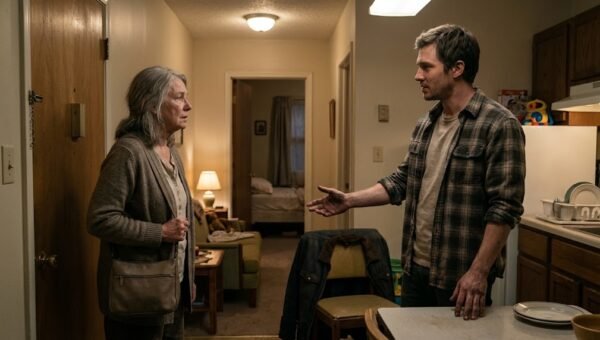
My father cleared his throat, set his fork down on his paper napkin, and looked at me across my parents’ dining room table.
“Julian starts at the state college next fall,” Dad said. He pointed his thumb toward my nineteen-year-old brother, who was sitting slouched in his chair, picking at a roll. “He needs a quiet place near the bus line so he can focus on his classes.
We think it makes the most sense for you to give him the apartment.”
I stopped with my water glass halfway to my mouth.
“Give him my apartment?” I asked.
“Just for while he finishes his degree,” Mom chimed in from the head of the table. She smiled like she was offering me a gift. “You can move back into your old bedroom upstairs with us. It would save you money, and Julian wouldn’t have to live in those filthy freshman dorms.”
I looked between the two of them, waiting for Dad to laugh or admit it was an awkward joke. Neither of them smiled. Julian did not even look up from the table.
“I bought that apartment two years ago,” I said, keeping my voice very quiet. “The purchase price was $175,000. I worked twelve-hour shifts at the hospital six days a week for four years to put together the down payment and pay the note down.
My name is the only name on the deed and the mortgage.”
“You don’t need a two-bedroom condo to yourself, Nina,” Dad said, his voice hardening. “Your brother is the first boy in this family with a real shot at an engineering degree. You’re being completely selfish.”
“I am not giving up my home,” I said. “He can apply for campus housing like everyone else.”
Dad’s face flushed dark red. He slammed his open hand against the tabletop, making the glasses rattle. “Selfish! Unbelievable. After everything this family did to raise you, you sit there hoarding an asset while your brother has to scramble!”
I noticed a slight blue reflection on Julian’s chest. I glanced over.
Julian had his phone propped up against his iced tea glass, the camera lens pointed directly across the table at my face. The tiny red recording light in the corner of his screen was blinking.
He had set it up before Dad even brought up the college.
I pushed my chair back, picked up my purse, and walked out the front door without saying another word.
Two days later, my phone buzzed while I was sitting at my desk at the hospital.
It was a text from my cousin Marcus. He had taken a screen recording of the extended family group chat on WhatsApp, which included twenty-four of my aunts, uncles, and cousins.
Julian had posted a thirty-second clip of our dinner argument. He had cut out the part where Dad demanded I sign over the apartment. The video started right as I said, “I bought that apartment with overtime, and I am not giving it up for Julian.”
Underneath the video, Julian had written: *She would rather have granite counters than family.*
My aunts had already left nine replies calling me cold-hearted, greedy, and spoiled.
I did not reply in the group chat. I did not text my parents.
Instead, I opened my personal filing cabinet, pulled out my loan statement, and called the servicing department at First Heritage Mortgage. I wanted to verify that my account had complete fraud security enabled.
When the representative verified my Social Security number and opened my file, she hesitated.
“Ms. Alvarez,” the representative said slowly. “I see an active coborrower modification request in pending status right now.”
My throat tightened. “A modification? I never applied for one.”
“It was submitted electronically four days ago,” she told me. “The request is to add a coborrower to the existing title and loan note. The applicant listed is Julian Alvarez. The application email address on file is the one associated with your family portal.”
It was the shared email address I set up three years ago so I could manage my mother’s oncology visits and heart prescriptions.
“Who uploaded the supporting income documents?” I asked.
The woman clicked her mouse twice. “A woman called our automated verification line yesterday afternoon to confirm receipt. And the file name on the pay stub uploaded to the portal is labeled ‘E_Alvarez_Pension_Stub_Oct.pdf’.”
Elena Alvarez.
My mother had uploaded her own county pension statement to help my brother take over my home.
PART 2
The customer service representative stayed on the line while my mind raced through the dates.
Four days ago was two days before that dinner.
They had not asked me for the apartment at dinner because they thought I would say yes. They had already filed the paperwork before I ever sat down at their table. The dinner was just an attempt to badger me into signing the finalized documents once the approval letter arrived in the mail.
“Ms. Alvarez?” the representative asked. “Are you still there?”
“I am here,” I said. My voice was completely steady now. “I did not authorize that application. My brother has no legal claim to that property, and neither does my mother. Freeze the account immediately. Flag it for identity theft and unauthorized access.”
“I am locking the file right now,” she replied. “I will route this directly to our fraud division. We will need an affidavit of fraud and a copy of a police report within ten business days to formally cancel the pending file.”
“Send me the intake packet,” I said. “I will have it back to you tomorrow.”
I hung up the phone and sat at my kitchen counter.
My mother had access to that shared email account because she had cataracts and could not read the small text on her Medicare notifications. I had set up the login on her iPad three years ago. She had my full name, my date of birth, my Social Security number from the emergency contact cards she kept in her kitchen drawer, and my home address.
The only thing they did not have was my physical signature.
First Heritage Mortgage allowed borrowers to initiate a title transfer and coborrower assumption request online, but the final closing package had to be signed in front of a licensed mobile notary. That was why they needed me at that dinner. That was why Julian had filmed me. They wanted to humiliate me into compliance before the mobile notary showed up at my condo with the deed transfer paperwork.
I printed out the confirmation logs the fraud representative emailed to me.
The internet address used to submit the coborrower request traced straight to the wireless router in my parents’ living room. The uploaded pension document belonged to Elena Alvarez, retired clerk of the municipal water board. The phone number listed for secondary verification was Julian’s cell phone.
I took the afternoon off from work.
I drove down to the 4th Precinct on Elm Street. I sat across from an officer named Miller and laid out the printouts: the mortgage modification application, the shared email logs, my deed showing the $175,000 purchase price, and the text messages from the family chat.
Officer Miller looked through the mortgage paperwork carefully.
“They used your information to try to transfer real property,” he said, tapping the printout. “Because it was caught in the pending stage before the deed was recorded at the county clerk’s office, the financial loss hasn’t occurred yet. But filing a fraudulent loan document using another person’s identifying information is a felony in this state.”
“I want the report filed,” I said.
He took forty minutes to type up the incident report. When he handed me the white copy with the case number stamped in blue ink at the top, he looked at me with tired, practical eyes.
“Once this report is logged in the state database, the lender’s fraud team will investigate,” he told me. “Your mother and brother will receive a formal notification from the bank’s legal department. If the bank decides to pursue criminal charges for mortgage fraud, you cannot pull it back.”
“I understand,” I said.
I took the police report, scanned it at the local print shop, and uploaded it directly to the First Heritage fraud portal.
Within two hours, an automated email landed in my inbox: *Case #44091 – Coborrower modification request cancelled due to confirmed fraudulent submission. Account locked to further administrative changes.*
At six that evening, my cell phone started ringing.
It was my mother. I let it ring. Then Dad called twice. Then Julian texted: *Mom is in tears. What did you do to the bank?*
I picked up my purse, took the original mortgage paperwork and a copy of the police report, and drove over to their house for the second time that week.
PART 3
When I pushed open their front door, the house was completely chaotic.
Mom was sitting on the living room sofa with a wet washcloth pressed against her forehead, weeping loudly. Dad was pacing between the kitchen and the television, clutching a printed email notification from First Heritage. Julian was standing by the bookshelf, looking sullen and terrified.
“What did you do?” Dad roared the moment he saw me step into the hallway. “They sent an email to Julian saying his name was flagged for mortgage fraud! They said the account was referred to their regional fraud counsel! Have you lost your mind?”
“You tried to forge my mortgage,” I said plainly.
“We did not forge anything!” Mom wailed from the sofa, dropping the washcloth. “Julian just put his name on the application to see if he qualified! We were going to ask you to sign the papers this weekend! We were trying to make it easy for you!”
“You uploaded your pension stub under my name,” I said, walking over and placing the printed audit log directly on the coffee table in front of her. “You used my Social Security number without my knowledge. You used our medical email account to hide the confirmation receipts from my personal phone. That is not helping me. That is theft.”
“He is your brother!” Dad shouted, stepping right into my path. “He is nineteen years old! You think a young man can afford a down payment in this city? You had the money! You work at the hospital, you get all that overtime, you don’t even have children to feed! What was Julian supposed to do? Sleep in a broom closet?”
“He was supposed to live in the dorms,” I said. “Like every other student who doesn’t have an older sister willing to give away a $175,000 home.”
“Nobody was stealing the home!” Julian shouted from the corner. His voice broke, sounding much younger than he pretended to be on his phone. “The plan was for me to live there until I graduated! Mom said once my name was on the deed, you couldn’t kick me out if you got married or moved away!”
The room went dead silent.
Mom closed her eyes and let her head fall back against the sofa cushions. Dad froze in place, glaring at his son.
“So that was the real plan,” I said. I looked directly at my mother. “You didn’t want him to borrow it. You wanted him on the title so I couldn’t sell it or evict him without his permission. You wanted me to pay the remaining balance while he owned half of my property.”
“You always had everything so easy, Nina,” Mom whispered, her eyes still squeezed shut. “You always got the good jobs. Julian struggles with his anxiety. He needed a guarantee. A mother looks out for her children.”
“You have two children, Mom,” I said. “And you just tried to rob one to coddle the other.”
Dad pointed a shaking finger at the front door. “You withdraw that complaint right now. You call that bank, tell them it was a misunderstanding, or you are never setting foot in this house again.”
I pulled the folded police report out of my coat pocket.
I didn’t hand it to him. I laid it on the edge of the dining room table, right next to the salt shaker.
“That report has already been processed by the precinct,” I told them. “The bank has already cancelled the application. If you ever use my Social Security number again, if you ever touch my credit, or if you ever post another lie about me in that family chat, I will bring this report to the district attorney’s office and let them prosecute Julian for wire fraud.”
Julian went completely white. He sank down onto the bottom step of the staircase, burying his face in his hands.
“You wouldn’t put your brother in jail,” Dad said, but his voice had lost its thunder.
“Don’t test me,” I said.
I turned around, walked out the front door, and drove back to my apartment.
ENDING
The next morning, I took the screen recording Julian had posted in the family group chat and replied for the first time.
I didn’t write an angry paragraph. I simply posted a screenshot of the official police report case number, along with the automated fraud cancellation notice from First Heritage Mortgage showing Julian’s name and the attempted coborrower takeover.
Underneath the images, I typed one single sentence:
*The argument was never about granite counters. It was about Julian and Mom trying to put his name on my deed without my consent.*
Within ten minutes, the group chat went completely quiet.
Two of my cousins deleted their previous comments. My Aunt Clara called me an hour later, stammering through an apology, admitting that Julian had told the entire family I was kicking him out onto the street after promising him a room. I told her I appreciated the call, but that I needed space from everyone for a while.
Over the next three months, the bank’s fraud team completed their review. Because the coborrower request was stopped before any legal conveyance occurred and no money changed hands, the lender chose not to file formal criminal charges, but they permanently blacklisted Julian from applying for any lending product through their institution.
Julian had to take out standard student loans and move into a four-person suite in the freshman residence hall on campus. He works twenty hours a week at the campus bookstore to cover his meal plan.
My parents have not spoken to me since that night. Dad took my name off the family phone plan, and Mom transferred her medical portal management to an independent patient advocate at the clinic.
It was painful at first. For thirty years, I believed that if I worked hard enough and took care of everyone, my family would treat me with basic respect. Learning that my mother saw my years of twelve-hour night shifts simply as an extra pool of assets for her favorite child was a bitter pill to swallow.
Last night, I came home from a long shift at six in the evening.
The winter sun was down, and the living room was quiet. I set my keys on the granite island, turned on the soft under-cabinet lights, and made myself a pot of tea.
I looked around the clean, warm rooms. Every baseboard, every appliance, every single monthly payment had come out of my own bank account, paid for with hours of my life that nobody could ever hand back to me.
My home is not a family project. It is my shelter. And as I sat at my table in the quiet evening, I knew that for the rest of my life, the only name on that front door will be mine.