PART 1
My father brought two leather briefcases into the conference room, even though he had nothing to put in them.
He sat down in the high-backed swivel chair at the center of the mahogany table, smoothed the lapels of a dark wool jacket he had clearly bought for the occasion, and set his car keys right on top of the legal blotter. My mother sat to his left, wearing her good pearl necklace and a cream-colored knit suit that smelled heavily of lavender drawer sachets.
She was laughing with my father before the receptionist even closed the heavy walnut door.
“The lake property has to be sold first, George,” she said, tapping her manicured nails on the wood. “The maintenance alone will eat through the liquidity. We will keep the Scottsdale house for the winters and liquidate the commercial parcels.”
“We will look at the portfolio breakdown before we make any hasty tax moves, Brenda,” my father replied, smiling like a man who had already won an election.
I sat three chairs down on the opposite side of the table, wearing my work khakis and a brown canvas jacket. I said nothing.
For nearly eighteen years, those two people had not spoken a single word to me. When I was sixteen years old, my father put three cardboard boxes of my clothes out on the gravel driveway in the pouring rain, locked the deadbolt, and told me that a boy who refused to obey his household rules could find his own food.
I slept in an abandoned station wagon behind a friend’s barn for five weeks until my father’s older brother, my Uncle Raymond, drove three hundred miles across the state line to find me.
Raymond did not make speeches. He did not call the police or fight his brother on the front lawn. He just bought me four pairs of warm socks, paid a clinic fifty dollars to treat my bronchitis, and put me in the passenger seat of his pickup truck.
In the eighteen years that followed, my mother never sent a birthday card. My father never called on Christmas. When I broke my wrist working framing jobs in my twenties, they did not check if I had health insurance. When I got married in a quiet county courthouse seven years ago, they did not even acknowledge the announcement.
Now Raymond was dead from heart failure at seventy-two, leaving behind a concrete empire, three gravel quarries, and an estate valued at roughly $42 million.
My mother glanced across the table at me for the first time since we walked into the lobby.
She offered a tight, benevolent smile, the kind she used to give people who handed her a church collection plate.
“We’re family, Nathan,” she said, leaning forward. “Of course we’ll share everything. Blood is blood, regardless of the past. Your father and I have already decided you will have a generous allowance to get you on your feet.”
“I am on my feet, Brenda,” I said quietly.
My father’s mouth thinned. “Show some respect to your mother in this room. You are here out of courtesy, nothing more.”
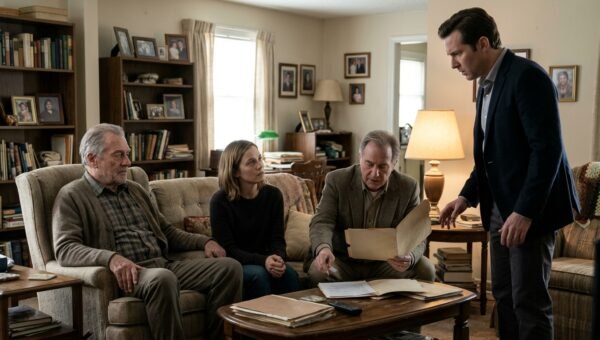
The side door clicked open, and Raymond’s estate attorney, an older man named Douglas Finch with silver wire-rimmed glasses, walked in carrying a single manila folder. He sat at the head of the table, took out a tortoiseshell fountain pen, and looked across the mahogany at my parents.
“Before we begin the primary distribution schedule,” Mr. Finch said, his voice flat and dry, “I have a specific directive from Raymond Myers.
He personally ordered that this sealed addendum not be opened until everyone named in the initial summons was physically seated in this room.”
He picked up a bone folder, slit open the heavy cream envelope, and took out two typed pages.
Mr. Finch adjusted his glasses. He read the first paragraph in complete silence to himself.
Then he stopped.
He raised his eyes and looked straight at my parents, his expression hard and cold.
“Mr. and Mrs. Myers,” Mr. Finch said, “I have specific instructions regarding your presence here today.”
The confident smiles on their faces vanished in a single breath.
PART 2
The room stayed completely still for several seconds.
My father leaned forward, resting both forearms on the edge of the mahogany table. “What kind of instructions, Mr. Finch? Raymond knew perfectly well that as his surviving brother, I am his primary heir at law. If there is some personal note, you can read it, but let’s get on to the asset schedules. We have an appointment with our accountant at two.”
Mr. Finch did not hurry. He placed the bone folder back in the pencil tray, rested his hands flat on either side of the open paper, and looked directly into my father’s face.
“I will read the clause exactly as drafted and signed by Raymond on November 14 of last year,” Mr. Finch said.
He cleared his throat once and began to read aloud:
“To my brother, George Myers, and his wife, Brenda: You are present in this office today because your vanity would never permit you to decline an invitation that mentioned the division of wealth. For nearly eighteen years, you lived four miles from my machine shop and never once inquired whether your son had eaten, whether he had a warm bed, or whether he was dead in a ditch. You told our cousins in Ohio that Nathan was unruly and ran away, when in truth you put his belongings in the mud because you could not control him.”
My mother’s chin gave a slight, jerky twitch. “That is an outrageous slander. Raymond had no right to write such filth into a public record.”
“Be quiet, Brenda,” my father muttered, though his neck had flushed a mottled, ugly red. He looked at the lawyer. “Go on.”
Mr. Finch continued in the same calm, unhurried voice:
“For eighteen years, George, you called me only when the county re-assessed your rental duplexes or when you wanted discounted aggregate for your paving contracts. You told everyone at the rotary club that blood was thicker than water, yet you abandoned your own boy to the elements. Therefore, pursuant to Article Four, Section B of this trust agreement, the sum of precisely ten dollars is bequeathed to George Myers, and the sum of ten dollars is bequeathed to Brenda Myers. This bequest is made specifically so that you cannot claim you were accidentally omitted from this instrument.”
My mother pushed her chair back with a sharp scrape. “Ten dollars? Forty-two million dollars and he leaves his only brother twenty dollars?”
“Ten dollars each, Mrs. Myers,” Mr. Finch corrected quietly. “And there is a conditional requirement attached to those disbursements.”
“What requirement?” my father demanded, his voice rising until it echoed off the glass bookcases behind the desk. “This is absurd. Raymond had early memory lapses. Everyone in the family knows he had confusion after his hip surgery two years ago. I will have this entire document stayed by probate court before four o’clock today.”
“The requirement,” Mr. Finch said, ignoring the outburst entirely, “is that you sign an acknowledgment of full receipt and vacate this office immediately. Because if you contest this distribution, Clause Seven becomes active.”
My father stood up, planting his palms on the table. “I don’t care about Clause Seven. I am his brother. A court will not allow an estranged son who ran away at sixteen to walk off with forty-two million dollars of Myers family capital while his parents get pennies!”
Mr. Finch looked up at my father over the tops of his glasses.
“Nathan did not run away, Mr. Myers,” the attorney said. “And Clause Seven does not concern Nathan. Clause Seven contains the sworn depositions of three neighbors on Oakridge Road from the night of October 12, 2008, along with the canceled cashier checks Raymond paid to settle your personal bank liens in 2011. Raymond made it very clear what would happen to those files if you filed a caveat in county court.”
My father stopped speaking.
The color drained out of his jaw. He looked down at the empty leather briefcases sitting by his shoes.
“What checks?” my mother whispered, looking between my father and the lawyer. “George, what checks is he talking about?”
PART 3
My father did not answer her.
He didn’t look at my mother. He didn’t look at me. He just stood there with his shoulders hunched, staring at the middle of the conference table where the light bounced off the varnish.
“Raymond didn’t just take Nathan in,” Mr. Finch said, turning a page over with his thumb. “He spent four years documenting every financial interaction he had with you, George. In 2011, when your paving business was three days away from a federal tax seizure, you came to Raymond’s shop on a Sunday evening. You begged him for $180,000 to keep the IRS from seizing the equipment yard.”
“That was a private loan between brothers,” my father rasped, his voice dropping to a harsh whisper.
“It was not a loan,” Mr. Finch countered. “You signed a confession of judgment. And as part of that agreement, Raymond required you to maintain a life insurance policy naming his operating company as the creditor beneficiary until the sum was repaid in full. You stopped paying the premiums nine years ago. Raymond kept paying them on your behalf to keep the policy active.”
Mr. Finch opened the left side of the folder and took out a blue-backed legal document.
“Raymond didn’t just protect Nathan,” Mr. Finch told the room. “He protected the company from you. Under the terms of the master revocable trust, the entirety of Myers Quarry and Aggregate, the commercial leases in three counties, the bank accounts, and the investment portfolios are transferred into the Nathan Myers Trust, of which Nathan is the sole surviving trustee and sole beneficiary.”
My mother let out a small, strangled sound. “Everything? Every single acre?”
“Every acre,” Mr. Finch said. “With one explicit condition regarding the family.”
The lawyer turned to me for the first time. His face softened just a fraction, the tired professional mask slipping for a second.
“Nathan,” he said, “your uncle left an executive memo attached to the trust instructions. He wanted me to read this portion directly to you.”
Mr. Finch lifted the final sheet of paper.
“Nathan: When you were sixteen, you thought the world ended on that gravel driveway. You thought that because the people who gave you your name threw you away, you had no value. I took you in not because you were my nephew, but because you were an honest boy who deserved a fair chance to work. For eighteen years, you worked sixty hours a week in the pits. You learned how to run the crushers, you managed the drivers, and you never once asked me what was written in my will.”
I looked down at my knuckles, rough and scarred from twenty years of heavy machinery and cold steel.
“You earned every piece of this company with your own sweat,” Mr. Finch read. “Do not give them a single penny out of guilt. Guilt is the currency thieves use when they run out of leverage. If you give them money, you will be paying them for what they did to you on that driveway. Keep the gates locked, take care of your wife, and keep the gravel moving.”
The silence in the office was so deep you could hear the air conditioner humming through the ceiling vents.
My mother turned toward me. She reached across the open space between our chairs, her hand trembling, the pearl bracelet clicking against her watch.
“Nathan,” she said, her voice shaking with a desperate, sweet pitch that turned my stomach. “You know how your father was back then. He was under terrible stress with the business. He had a temper. I was just trying to keep peace in the house. You can’t leave your own mother with nothing. We don’t have enough for our retirement. The taxes on the house are due next month.”
I looked at her fingers resting on the polished wood.
Eighteen years of silence. Eighteen years of holidays spent around Raymond’s kitchen table, eating roast chicken off paper plates while my uncle showed me how to read commercial blueprints and balance equipment ledgers. In all those years, she had never driven the four miles to the shop. She had never sent a note through our cousins.
“When I was seventeen,” I said, speaking so quietly she had to lean in to hear me, “I caught pneumonia working the night shift on the wash plant. Raymond stayed at the hospital until four in the morning to make sure my fever broke. Did you know that, Brenda?”
She blinked, her eyes darting away. “I was told you were doing fine.”
“You weren’t told anything,” I said. “Because you never asked.”
I stood up. I didn’t raise my voice. I didn’t slam the table.
I looked at Mr. Finch. “Where do I sign the asset assumption forms?”
“Right here, Nathan,” the attorney said, sliding the blue-backed folder toward my side of the table.
ENDING
My father tried to speak one more time as I picked up the pen, but Mr. Finch held up a single hand to cut him off.
“Mr. Myers,” the lawyer said, “the receptionist has two checks for ten dollars each waiting at the front desk. If you or your wife attempt to contact Nathan at his residence, at the quarry offices, or through any third party, I will file the confession of judgment in the district court within twenty-four hours. That debt, with accrued statutory interest, currently stands at $314,000. It will attach to your primary residence by Friday afternoon.”
My father stood frozen for three seconds. Then he picked up his two empty briefcases, grabbed his car keys, and walked out the door without looking at his wife.
My mother sat in her chair for another minute, wiping the corners of her eyes with a lace handkerchief, waiting to see if I would look at her.
I didn’t. I read through the twelve signature blocks, checked the dates, and signed my legal name on every line where Raymond had left a small yellow flag.
When she realized I was not going to speak, she stood up, gathered her handbag, and left the room. The door clicked shut behind her, and the hallway fell completely quiet.
It took four months to complete the estate transition.
My father never filed a contest. His attorney must have looked at Raymond’s documentation and realized that any legal fight would result in the immediate foreclosure of his own home. Three weeks after the reading, my mother tried to send a letter to the quarry office addressed to “Nathan Myers, Personal.” My administrative assistant brought it to my desk.
I didn’t open it. I handed it back to her and told her to stamp it *Return to Sender* and put it back in the outgoing mail.
Last Tuesday, I drove out to the north quarry just after dawn.
The frost was still white on the conveyor belts, and the big front loaders were warming up their diesels, sending gray plumes of exhaust into the cold morning air. The crew was already in the break shack, drinking black coffee out of thermoses, laughing about the high school football game from Friday night.
I walked up to the edge of the pit where Raymond and I used to stand every Monday morning at six o’clock to check the rock face before the morning blast.
I pulled my work gloves on, zipped my canvas jacket against the wind, and looked down at the trucks rolling through the gate.
My parents had thought the measure of a family was whatever they could extract from other people to keep up appearances in a town that didn’t care about them anyway. Raymond knew better. He knew that family wasn’t something you claimed when the money was laid out on a table; it was the person who showed up in the rain with a pair of dry socks when everyone else had turned the lights off.
I stayed on the ridge until the first horn sounded, then walked down the gravel road to start the day’s work.