PART 1
The dining room table looked exactly right at four o’clock.
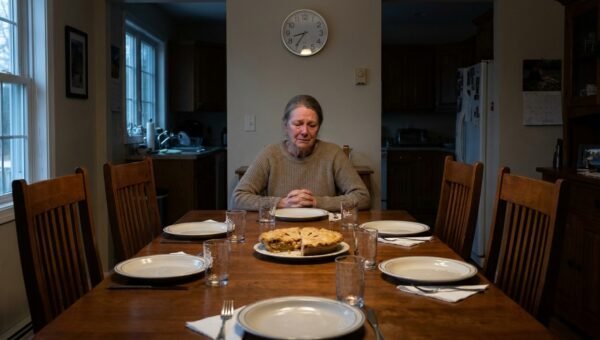
I had set seven plates, using the good blue porcelain my mother left me that I only took out of the china cabinet twice a year. In the middle of the table, I had a platter of braised short ribs kept warm under foil, a glass bowl of buttered mashed potatoes, green beans with bacon, and on the sideboard, the double-crust apple pie I baked because my youngest daughter, Sarah, always asked for a slice with vanilla ice cream before anyone else even touched the savory food.
It was my sixtieth birthday.
I didn’t expect a brass band or expensive jewelry. I just wanted my children under one roof for two hours. Their father walked out when Sarah was six months old and our oldest, David, was eleven. Back in the nineties, nobody handed single mothers a manual. I worked the day shift at the municipal water office, took evening shifts three nights a week cleaning medical offices on Grand Avenue, and patched snow boots with duct tape so every one of them could finish school without owing thousands of dollars. I skipped dentist appointments and bought my winter coats at church rummage sales. I gave them forty years of work, and I never once asked them to pay me back.
All I asked was Saturday dinner at four.
By five o’clock, the gravy had formed a thick skin on top.
I stood by the front window, parting the sheer curtains with two fingers, watching the asphalt street outside.
Not a single car turned into the driveway. My cell phone sat on the kitchen counter, dead quiet. I checked the screen three times to see if the service had dropped, but the bars were full.
At five-thirty, I sent a message to the group chat we all share: *Dinner is ready, kids. Drive safe.*
Nobody replied. A little after six, Sarah’s icon showed she had read it. Then nothing.
By seven o’clock, the short ribs were cold. The melted butter on the potatoes had congealed into yellow circles.
I sat down in the wooden armchair near the hallway door and began to cry. It was that slow, burning kind of cry that makes your chest ache, not loud, just humiliating. I was sixty years old, sitting alone in a house that used to be noisy with six pairs of running sneakers, realizing that none of them had even bothered to make up an excuse.
They hadn’t texted that work ran late. They hadn’t said a child had an earache. They simply had not shown up.
At eight-fifteen, the heavy front door knocker sounded twice.
I jumped out of the chair, wiping my cheeks with the cuff of my cardigan, telling myself I was being foolish. Maybe they had all carpooled. Maybe David had rented a van so they could arrive together as a surprise.
I pulled the deadbolt back and opened the heavy door.
It wasn’t David. It wasn’t Sarah.
A tall county sheriff’s deputy stood on my front porch under the yellow bug light. His uniform jacket was zipped against the cold mist, his hands rested near his duty belt, and in his right hand, he held a folded piece of white lined notebook paper with my full name, Martha Collins, written across the outside in black marker.
PART 2
The deputy took his cap off with his left hand.
“Mrs. Collins?” he asked. His voice was polite, the flat, quiet tone officers use when they are trying not to startle someone.
“Yes,” I said. My voice barely worked. “What happened? Where are my kids?”
“Nobody is hurt, ma’am,” he said right away. He must have seen my eyes drop straight to his badge. “There hasn’t been an accident. Are you alone inside?”
“Yes,” I told him, looking past his shoulder into the dark driveway. His cruiser was parked at the curb, its amber running lights reflecting against the wet street. “I was waiting for my family. We were supposed to have dinner at four.”
The deputy looked down at the note in his hand. He hesitated, looking uncomfortable in a way a young man looks when he has been handed a chore he doesn’t want.
“My name is Deputy Miller,” he said. “About forty-five minutes ago, dispatch received a call from a residence out on Lakeview Terrace. A noise complaint from neighbors. When my partner and I arrived, there was an argument in progress between several adults regarding a legal document and a property sale. When we separated the parties, one of the women handed me this paper and asked that it be brought directly to you.”
Lakeview Terrace was David’s house.
David was thirty-seven now. He worked as an estimator for a commercial roofing firm and lived in a four-bedroom subdivision home fifteen minutes north.
“A legal document?” I asked. “What does that have to do with my birthday?”
Deputy Miller stepped inside the small foyer out of the damp mist. He closed the door behind him and handed me the folded notebook paper.
The handwriting on the outside wasn’t David’s. It was tight, sloping cursive that belonged to my second daughter, Karen. Karen worked as an office manager for an accounting firm downtown.
I opened the page under the foyer lamp.
It wasn’t a birthday card. It was a handwritten agenda written on yellow legal paper, with bullet points down the left margin under the heading: *Mom’s Transition & House Liquidation Plan.*
Underneath the heading were four numbered items:
1. *Clear out garage and basement before winter freezes the ground.*
2. *List 1424 Elm Street (Mom’s house) by March 1. Target sale price: $210,000.*
3. *Split proceeds evenly: $35,000 per sibling to cover rising household expenses and kids’ sports fees.*
4. *Move Mom into Elmwood Manor Assisted Living (studio unit). Use her monthly Social Security check ($1,480) to cover the room and board balance.*
At the bottom of the page, four of the six lines were already initialed. David had signed his initials, DC. Karen had signed KC. My twins, Brian and Jason, had signed BC and JC. Only Sarah and my middle son, Peter, had blank lines next to their names.
“Who was fighting?” I asked the deputy. My fingers felt numb against the paper.
“The younger daughter and one of the brothers,” Deputy Miller said quietly. “The neighbors called because someone was screaming on the driveway. When we got there, the younger daughter was crying on the front lawn. She said they told her they were meeting at the house to buy a group gift for your sixtieth, but when she walked in, the older brother had a real estate agent sitting at the kitchen table with listing agreements.”
The room seemed to shrink.
They hadn’t forgotten my birthday. They hadn’t lost track of time.
They were four miles down the road, gathered in David’s heated kitchen, dividing the equity of the roof over my head while I was keeping their short ribs warm under tin foil.
PART 3
Deputy Miller stayed in the hallway while I walked into the kitchen and sat at the table.
I looked at the seven plates. I looked at the apple pie Sarah loved so much.
“Did they sign anything with that real estate agent?” I asked.
“No, ma’am,” the deputy replied from the doorway. “The real estate agent packed her folder and left as soon as the younger daughter called her a crook. Then the other son, Peter, got into it with the older brother. They started shoving each other near the porch steps. That’s why dispatch sent us. We issued a disorderly conduct warning and told everyone to clear out.”
He reached into his pocket and placed Sarah’s car keys on the counter. “Your daughter Sarah was too upset to drive her car home. Her brother Peter drove her away in his truck. She asked me to bring this note to you so you would know why they didn’t come to dinner. She said she couldn’t face you tonight.”
“Thank you, Officer,” I said.
He asked if I wanted him to call someone, or if I wanted someone to stay with me. I told him no. He nodded, told me to keep my deadbolt locked, and walked out into the dark.
I sat at the table until ten o’clock.
At ten-fifteen, the headlights swept across the living room ceiling.
I heard a car door shut, followed by heavy footsteps on the wooden porch. The doorknob rattled, and then the front door opened.
David had a key because three years ago, when I had my knee replaced, he needed to carry my groceries up the basement stairs.
He walked into the hallway, smelling of rain and beer. He saw the lights on in the kitchen, stopped in the doorway, and saw me sitting at the head of the table in my good blue wool dress, with seven cold plates still sitting around the linen cloth.
“Mom,” he said. He didn’t look at my face. He looked at the potato bowl. “You’re still up.”
“I am,” I said.
He walked over to the refrigerator, pulled out a bottle of ginger ale, and leaned against the counter with his hands in his pockets. “Look, we’re sorry about tonight. Things got out of hand at my place. We lost track of the time.”
“You didn’t lose track of the time, David,” I said.
I reached to the center of the table, lifted the folded yellow legal paper, and laid it flat next to his ginger ale bottle.
David glanced down. His jaw worked once, hard, but he didn’t pull his hands out of his pockets.
“Sarah shouldn’t have given that to the police,” he muttered. “She acts like a child. Everything has to be high drama with her.”
“Is that all you have to say?” I asked.
“Mom, look around you,” David said, his voice rising, taking on that hard, sensible tone he used when he wanted to win an argument. “You are sixty years old. You’re living in a ninety-year-old house with three bedrooms you don’t even use. The roof has four years left on it, the furnace is loud, and you’re still cleaning other people’s offices two nights a week just to pay the county property taxes. We’re trying to help you before you fall down the cellar stairs and break a hip.”
“You’re trying to help me?” I asked. “Item three says thirty-five thousand dollars to each of you for sports fees and household bills.”
David’s eyes narrowed. “And what about it? We’ve all got kids, Mom. Jason’s boy needs braces. Karen is drowning in credit cards from her divorce. You’ve got two hundred thousand dollars sitting in these floorboards while your own grandchildren are wearing hand-me-downs. If we put you in Elmwood Manor, you don’t have to shovel snow. Your meals are cooked. And the equity helps the family right now when we need it, instead of sitting here rotting.”
“My father built this front porch with his own hands, David,” I told him. My voice did not shake. “I scrubbed toilets at three in the morning so you could have soccer cleats. When your father left us with five hundred dollars in checking, I didn’t sell this house. I didn’t put you in an institution. I worked until my knuckles split open so you had a front yard to play in.”
“That was thirty years ago, Mom,” David said, stepping closer. “Times are different. We need to be practical. You can’t stay here alone forever. The four of us talked, and we’re in agreement. If you don’t sign the power of attorney Karen drew up, we’re going to the county court to petition for conservatorship based on your physical health.”
The word hung in the kitchen like grease.
*Conservatorship.*
He had already checked the legal angles. Karen had already talked to someone. They had calculated my age, my bad knee, and my small pension, and decided I was an obstacle sitting on top of their inheritance.
“Give me your key, David,” I said.
David blinked. “What?”
“Take your house key off your ring and lay it on this table.”
“Mom, don’t be ridiculous—”
“Give me the key, or I pick up the phone right now and call Deputy Miller back to this house for trespassing,” I said, looking right into his eyes. “You don’t own a single splinter of this wood. My name is on the deed, my mortgage was paid off seven years ago with money I earned, and my mind is as clear as it was the day I had you.”
David stared at me. For five seconds, the house was so quiet we could hear the refrigerator hum.
He reached into his pocket, took his key ring out, and unthreaded the brass key with angry, jerky fingers. He dropped it onto the table. It landed with a sharp ping against the blue porcelain plate I had set for him four hours earlier.
“You’re going to end up in a nursing home with nobody visiting you,” David said through his teeth. “Remember I told you that.”
“At least I will know where I stand,” I replied.
He turned around, slammed the back door so hard the glass pane rattled in its frame, and drove away into the rain.
ENDING
The house was cold by the time the grandfather clock in the living room struck midnight.
I didn’t go to sleep. I got a roll of plastic wrap and a stack of plastic containers from the pantry. I packed the cold short ribs, the potatoes, and the green beans into neat portions, slid them into the refrigerator, and washed every single plate by hand in hot, soapy water.
I dried my mother’s blue china with a clean flour-sack towel and set each piece back into the cabinet, closing the glass doors until the brass latch clicked shut.
On Monday morning at eight-thirty, I walked into the local branch of First State Bank on Elm Street.
I asked to see a notary and an estate planner. By ten o’clock, I had closed the joint checking account I had opened with Karen two years ago when I had my knee surgery. I withdrew the $4,200 balance and transferred it into a private account in my name alone, with new security passwords that nobody in the family could guess.
Then I walked three blocks down to the county records building.
I met with an elder law attorney named George Henderson, a man my father had known forty years ago at the local rotary club. We sat in his office for an hour.
I signed a new will. I revoked every medical proxy and financial power of attorney that had ever listed David or Karen. In their place, I named my daughter Sarah and my son Peter as joint executors and medical representatives, with a strict clause stating that 1424 Elm Street could never be liquidated without my direct written consent while I was alive.
When George asked about the remaining four children, I told him the truth: “Leave them each one dollar and the memory of their father’s habits.”
At two o’clock that afternoon, a soft knock came at the front door.
I looked through the peephole. It was Sarah and Peter.
Peter looked exhausted, wearing his work jacket from the lumber yard, and Sarah had red, swollen eyes. She held a small cardboard bakery box in both hands.
I unlocked the door and stepped back.
Sarah didn’t say anything. She just dropped her purse on the floor, wrapped her arms around my neck, and cried against my cardigan until her shoulders stopped shaking.
“I didn’t know, Mom,” she whispered. “I swear to God, David told us he was collecting money for a weekend trip to Nashville for you. The second I saw that paper on his table, I told them they were disgusting.”
“I know, honey,” I said, patting her back. “The deputy told me.”
Peter stood by the hall tree, looking down at his boots. “I should have knocked David out, Mom. I’m sorry.”
“Nobody is knocking anyone out in this family,” I told him, pointing toward the kitchen. “Go wash your hands. Both of you.”
I took Sarah’s bakery box to the counter. Inside was a small slice of chocolate cake with a single yellow candle stuck in the frosting.
I didn’t light the candle. Instead, I pulled the double-crust apple pie out from the sideboard, cut three large wedges, and set them on the table with forks. We didn’t talk about David. We didn’t talk about Karen, or the twins, or the $35,000 they thought they were going to spend.
We talked about Peter’s truck, which needed a new alternator, and Sarah’s new job at the preschool.
They ate every bite of their pie.
It has been six months since that night. David and Karen haven’t called. The twins sent a generic text on Mother’s Day, which I did not answer.
Sometimes, when the wind comes through the old storm windows and makes the glass hum, the house feels very large for one woman. But every corner of it belongs to me. I don’t clean offices at night anymore; I quit that job three months ago, because without spending money buying groceries and gifts for children who only saw me as a bank account, my pension covers everything I need.
Yesterday, I planted six new tomato plants along the sunny side of the garage.
Peter is coming over this Saturday with a ladder to clean out the gutters, and Sarah is bringing her daughter over to learn how to roll pie crust.
There are only three chairs pulled up to the table now. The room is much quieter than it used to be, but every person sitting in it is there for me.