On Tuesday, a note fell out of David’s jacket while I was sorting laundry. I picked it up from the floor and read it twice before I understood that it wasn’t meant for me.
“Happy anniversary, Darling. These 9 years have been the best of my life. Meet me at Le Jardin on Friday at 7 p.m. Wear red.”
David and I had been married for 21 years. I was still holding one of his shirts, the cuff damp from the washer, when I noticed the name at the top: Hope.
I didn’t yell. I put the note in the pocket of my apron and finished the laundry. That sounds calm, but I was not calm. I just knew that if I asked David about it right then, he’d have an answer ready before I finished the question.
At dinner that night, he asked if I’d paid the water bill. He complained that the traffic near the office had been bad. I watched him cut his chicken into small pieces, the way he’d always done, and kept thinking about “these 9 years.”
Nine years ago, David told me his division had been downsized. His salary was cut in half, he said, but he’d pick up consulting work until something better came along. I believed him. We tightened things up. I stopped replacing my car when the repairs started costing more than I liked, and David said we should hold off on the kitchen work.
I thought we were making choices together. That was the part I couldn’t get past.
The next morning, David left early. I went through the desk in our home office, not because I’m proud of that, but because the note had made me a person who searched drawers. I found a corporate card receipt marked V&S, tucked under a stack of old tax papers. I looked up the initials and found a business listing for Vance & Sterling Design. Hope Vance was listed as a co-founder.
I printed the page. Then I folded it and put it in my purse.
I also found a few old envelopes with the same company name, but no clear explanation. I wasn’t a forensic accountant. I was a wife trying to decide whether the man across the breakfast table had been telling me the truth. I kept thinking there had to be some ordinary reason. There usually is, until there isn’t.
On Thursday, David said he might be late Friday because of a work dinner. I said I’d make other plans. He didn’t ask what plans. I called Mrs. Gable, who’d watched our kids when they were little and still helped us out now and then. Then I found my red silk dress in the back of the closet.
It was a little snug at the waist. I put it on anyway.
I spent the day wondering if Hope was a lover. The note certainly sounded like one. “Darling” is not how people usually write to a business partner, though I know people use words differently. I kept telling myself I only needed to see the two of them together. I did not need to make a scene.
I was lying to myself about that last part.
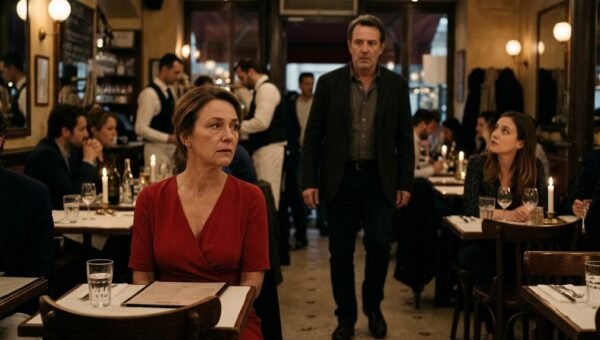
Friday at 6:40, I arrived at Le Jardin. I’d checked the reservation under Vance, then called the restaurant and asked for a table nearby.
The host led me to an adjoining booth. I could see the corner table without having to turn my head much.
Hope was already there. She wore a red blazer and had a leather folder on the table. The cover said Vance & Sterling, Ninth Anniversary Portfolio. Hope looked through some papers while she waited. Once, she checked her watch and smiled to herself.
I sat with my hands around a glass of water. The lemon in it had a soft, soapy taste. I remember that. I don’t know why. Maybe because my mouth was dry and I kept taking little sips.
At 7:05, David walked in.
He spotted Hope first and smiled. It was an easy smile, the one I’d seen across school gym floors and at dinner with friends. Then David looked toward my booth.
His face changed.
He took one step toward me, stopped, and looked back at Hope. Hope had stood up to greet him. David put a hand near the back of her chair, like he wanted to steer her away before she saw me. So I stood.
“Hope Vance?” I said.
Hope turned toward me. David said my name, quietly, like saying it might make me disappear.
I took the note from my purse and set it on the table. Hope looked at the writing. Then at David.
“I’m Eleanor,” I said. “David’s wife.”
Hope’s expression went from friendly to puzzled. She said she was glad David had finally brought me into the fold. She thought I knew about the firm. She thought tonight was to celebrate the buyout and David’s retirement from the company.
David tried to interrupt. He said it wasn’t what I thought. He said we should sit down and talk privately.
Hope put one hand on the portfolio. “You said she knew.”
“I do know now,” I said.
David kept trying to turn it into something smaller. The firm was a side project, he said. The money was an investment. He’d been protecting our family from uncertainty, not hiding anything important.
I asked him what he’d told me nine years ago, when he said his division laid him off and his income had been cut in half.
David rubbed the side of his jaw. He said he’d needed time to get the company stable. Then he said the firm had been small at first, and he hadn’t known whether it would last. Then he said he was sorry I’d found out this way.
That was when Hope opened the portfolio. She pulled out a page and turned it toward me. I saw the company name, the anniversary date, and a summary of the proposed buyout. My hands were shaking, so I held the edge of the table.
Hope thought David had been building the business with his own consulting income. She thought I knew he’d left his old job by choice. David had told each of us a different story, and both stories had worked for him.
I asked if the family accounts had paid for the firm.
David said it was complicated.
I said, “That means yes.”
Hope looked at David. She asked how much of the money came from our household. He began talking about transfers and reimbursements, like the words themselves could make nine years sound normal. Hope stopped him and said she wanted an emergency audit before she’d agree to any buyout.
David turned to me again. He said he’d meant to tell me. He said he could explain everything at home.
I believed he could explain it. David was good at explaining. That was not the same as telling the truth.
“I’m not going home to hear another version,” I said.
I picked up my purse and left. David came after me, but I kept walking. The restaurant door closed behind me before he reached the sidewalk.
The ride home was quiet. Mrs. Gable was in the living room with our youngest, who was already asleep on the couch. I thanked her and paid her. David came in a few minutes later and started talking before I’d taken off my shoes.
He said he’d done it for the family. He said none of us had gone without. He said he’d planned to tell me after the buyout, when there was enough money to make it worth the risk.
I asked him how many times he’d watched me worry over a bill while money went into a company I didn’t know existed.
He didn’t answer that.
On Monday morning, I called a family lawyer and a forensic accountant. I gave them the company name, the V&S receipt, and the papers I’d brought home from Le Jardin. We started tracing transfers from our accounts and figuring out what belonged to the firm, what belonged to David, and what belonged to me. I didn’t know the final number yet. I knew I would not let David decide what I was allowed to know.
The marriage was over. I said it plainly, even though I didn’t feel plain inside.
I put the dinner receipt and the folded note on the entryway console. I gathered my own financial papers and made copies. David asked if I was really going to end 21 years over one secret. I told him it wasn’t one secret. It was nine years of choices.
The next morning, I hung the red dress at the front of my closet instead of shoving it back behind the winter coats. Then I took my coffee out onto the porch. The air was crisp, and the first sip was too hot, so I waited before drinking it.
For once, I knew exactly what I was waiting for: nothing from David. Just the morning, and my own life, starting where the truth was.