PART 1
I came home on a rainy Tuesday afternoon and found my front porch covered in taped cardboard boxes.
Inside the house, the hallway smelled like packing tape and cold air. My mother-in-law, Evelyn, was standing on a stepstool in my kitchen, reaching into the top cabinet above the stove. She had already emptied three shelves of my stoneware plates onto the counter, wrapping each one in cheap newspaper and sliding them into a heavy brown carton.
“What are you doing?” I asked, dropping my keys on the counter.
Evelyn didn’t even turn around right away. She smoothed down a strip of tape with the side of her hand, stepped down carefully, and wiped her hands on her trousers. She was sixty-eight, sharp-featured, and had never once asked for permission before rearranging a single room in my life.
“I am saving you two weeks of backache, Sarah,” she said, sounding completely reasonable, like she was doing me a favor I had been too foolish to ask for. “We need to stay ahead of the schedule. The movers need everything boxed by the twenty-eighth, and between your work hours and David’s shifts, you two would never get it done.”
I stood there in the doorway of my own kitchen. The refrigerator was bare of the magnets my daughter had made before she left for state college. The spice rack was already empty, sitting in an open box marked PANTRY in thick black marker.
“We are not moving anywhere, Evelyn,” I said. My voice was very quiet, but my hands were shaking in my coat pockets. “We have lived in this house for eleven years. David just made partner at his firm last winter. Why on earth are you packing my dishes?”
Evelyn picked up a roll of tape from the island and gave me that familiar, tight little smile she used whenever she thought I was being difficult.
“We are moving closer to family,” she said, as if she were talking to a tired child. “I told you three months ago that running two households six hours apart was getting ridiculous. Your husband already agreed.”
My stomach dropped straight through the floorboards. David and I had been married for twenty-two years. We shared our bank accounts, our car insurance, our grocery lists, and every single major decision since the day we signed the mortgage on our split-level in Oak Ridge.
David knew how much I loved our garden. He knew our roots were here.
“David did not agree to move six hours away,” I said.
“Call him if you don’t believe me,” Evelyn replied smoothly. She picked up another plate and slid it into the carton. “Or look on the hall table. The paperwork came by certified mail an hour ago. You might want to sit down before you read it.”
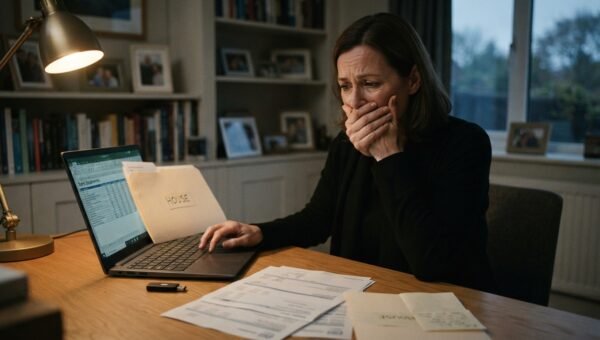
I turned on my heel and walked into the front hall. Sitting on the side table, right beside my mail tray, was a stiff manila folder. Inside was a printed receipt from a real estate brokerage based in Mercer County, six hours west of us in the mountains where Evelyn had lived her whole life.
It was an earnest money deposit receipt for $18,500 on a four-bedroom colonial on Pine Ridge Road.
Listed under the buyer line were two names: Evelyn Vance and David Vance.
And printed clearly beneath the transaction summary was the payment method: a cashier’s check drawn from a joint checking account at First Valley Trust, an institution I had never banked with in my life.
PART 2
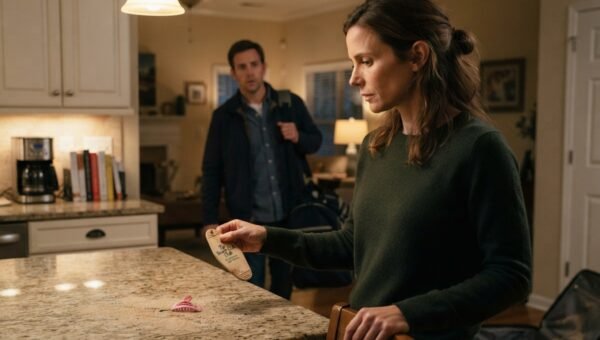
I heard David’s truck pull into the driveway twenty minutes later. The garage door rattled upward, and his heavy work boots thumped against the laundry room floor. He walked into the kitchen carrying his gym bag, took one look at the taped boxes stacked against the refrigerator, and stopped dead.
“Mom?” he asked, looking between the two of us. “What’s going on in here? Did the basement leak again?”
“Show him,” I said.
I didn’t yell. I didn’t throw the folder. I just held out the manila envelope and watched his face as he took it.
David opened the flap and pulled out the receipt. As he read the address in Mercer County and the $18,500 deposit figure, the color drained out of his cheeks. He lowered the paper and looked directly at his mother.
“What is this, Mom?” he asked. His voice was unsteady. “What did you do?”
“I did what had to be done,” Evelyn said, not missing a beat. She didn’t look flustered at all. She actually crossed her arms and leaned against the counter. “You told me at Thanksgiving that you worried about me being alone out there in the hollow during the winter. You said you wished we were all in one place so you could keep an eye on things. That house has an attached in-law suite on the ground floor with zero-step entry. It’s five minutes from my church.”
“I said I worried about you living alone,” David said, his voice rising now. “I never told you to buy a house! We own this home, Mom. We have eight years left on our mortgage. I have a job here. Sarah has her practice here. What did you tell her about me agreeing?”
“You told me to handle the arrangements,” Evelyn said stubbornly. Her jaw tightened, the stubborn streak she had passed down to her son showing plain as day. “You said, ‘Whatever makes sense for the family, Mom.’ Those were your exact words when we had coffee at the diner in November.”
“Talking about hiring a home health aide or looking at assisted living near us isn’t buying real estate six hours away!” David ran a hand over his face. He turned toward me, his eyes wide and frantic. “Sarah, I swear on my life, I knew nothing about this. I didn’t sign anything. I haven’t been to Mercer County since my uncle’s funeral two years ago.”
I pointed at the bottom line of the paper in his hand.
“Then explain that account, David,” I said. “First Valley Trust. It has your name on it. It says joint account. Where did eighteen thousand five hundred dollars come from?”
David stared at the routing numbers at the bottom of the slip. For a few seconds, he looked completely blank. Then his eyes drifted back to his mother, and something shifted from confusion to cold realization.
“That’s Dad’s old farm account,” David whispered. “The one you said you closed when he died ten years ago.”
PART 3
Evelyn didn’t blink. She reached into her pocket, pulled out her reading glasses, and set them on the granite counter with a sharp click.
“Your father intended for that money to keep the family together,” she said. Her voice had dropped all its sweet grandmother tone now. It was hard, defensive, and sharp. “He worked forty years on that parcel, David. When we sold the back forty acres after his stroke, that money was meant for our security. Not for you to live down here in the suburbs, ignoring where you came from while I sit by myself every evening.”
“You told me that money was spent on his medical debts,” David said. His voice dropped down to a whisper, but it shook with anger. “You told me there was nothing left after the hospital bills. You made me co-sign on your car loan eight years ago because you claimed your savings were gone.”
“It was an emergency reserve,” Evelyn snapped. “And this is an emergency. You’ve forgotten your family. You let this woman keep you six hours away from your home.”
She looked at me when she said ‘this woman,’ not with shame, but with outright resentment that had clearly been stewing for two decades.
That was the moment the whole picture cleared up. Evelyn hadn’t lost her mind, and she hadn’t suffered some sudden break with reality. She was executing a calculated plan. She had kept David’s name on an old survivorship account containing her late husband’s land sale funds. She used his name, his credit profile, and his old signature card from his twenties to enter into a binding contract on a dual-living property back in her hometown, betting that once the deposit was down and our kitchen was in boxes, David would crumble under the guilt of defying his aging mother.
“You used my name without my authorization on a purchase agreement,” David said. He took a slow, deliberate breath, standing between his mother and me. “That’s fraud, Mom.”
“Don’t you dare use that word with me,” she said, her voice finally cracking around the edges. “I am your mother. Everything I have ever done has been for you.”
“The deposit is non-refundable after Friday,” I said, reading the fine print on the second page of the disclosure. “Unless the co-buyer withdraws during the attorney review period due to lack of written power of attorney.”
David looked down at the paper, then looked at me. The silence in the kitchen lasted a long time. The only sound was the clock ticking on the wall above the half-packed pantry.
“Get your coat, Mom,” David said quietly.
“David, don’t you be ridiculous,” she started, reaching for another box.
“Do not touch another dish in this house,” he said. His voice was louder now, firm and final in a way I had never heard him speak to her before. “You are leaving right now. We are going down to First Valley’s regional branch in town first thing tomorrow morning, and you are taking my name off that account. And then I am calling that broker in Mercer County and informing him that my signature was forged on the purchase contract.”
Evelyn’s mouth opened, but no words came out. She looked at David, then glanced at me, waiting for me to play the polite daughter-in-law who smoothed things over to keep the peace.
I didn’t say a word. I picked up the roll of packing tape, walked over to the garbage can beneath the sink, and dropped it into the trash.
ENDING
Evelyn stayed at a motel by the highway that night. She refused to sleep in our guest room after David took her car keys and placed them by the door, telling her she was free to call a cab if she didn’t want to ride with him to the bank in the morning.
The next day was long, ugly, and quiet.
David went to the regional branch of First Valley Trust at nine in the morning. Because the original account agreement dated back nearly twenty-five years to when David was in college, Evelyn had retained full administrative authority to withdraw funds, but David had legal right as an equal owner to freeze the account pending review. He signed an affidavit stating he had not authorized the cashier’s check for the property purchase, forcing the brokerage in Mercer County to void the agreement under their seven-day contingency clause.
The $18,500 went back into the account. Then David signed the paperwork to remove his name completely, severing the last financial link he shared with his mother.
Evelyn drove back to Mercer County that afternoon without saying goodbye to either of us. She told David in the bank parking lot that he had broken her heart, that she would never ask him for another dime or another favor as long as she lived.
It took me four days to unpack the kitchen.
Every night after work, I pulled my plates out of the cheap newspaper she had wrapped them in. I put the stoneware back in the upper cabinets, washed the counter, and stuck my daughter’s ceramic magnets back on the refrigerator door.
David helped me every evening. He didn’t make excuses for her, and he didn’t ask me to feel sorry for him. Mostly, we worked in comfortable silence, passing glasses and mugs between us until the empty boxes were broken down flat and stacked in the garage for recycling.
A few weeks later, an official letter came from an estate attorney in Mercer County, confirming that David had been removed as the executor of Evelyn’s estate and replaced by her younger sister. David read the letter at the kitchen island, folded it into neat quarters, and filed it away in the metal cabinet in his study.
He never called to argue with her about it. He just poured himself a cup of coffee, sat down beside me at the kitchen table, and looked out over our backyard garden, where the late autumn leaves were finally starting to fall.