PART 1
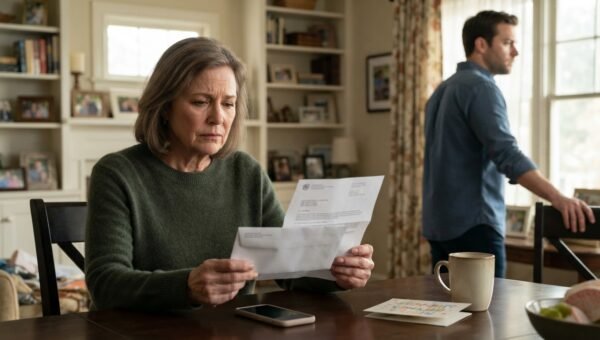
The empty chair in the third row stayed empty for the entire ceremony. My stepfather, Ray, had raised me from the time I was six years old, but on a bright Saturday in June, he never showed up at the chapel. He did not answer his telephone, and he did not send an excuse. Three days later, a plain cream envelope arrived in my mailbox with no return address.
Inside was a standard wedding card. He had not written a single word on the blank side, not even his name. A small brass key was taped flat against the bottom edge with a piece of cloudy yellow tape.
I looked at the cut of the brass and felt an immediate flash of irritation. Ray kept an old metal shed behind his house where he stored his lawnmower, extra motor oil, and boxes of my mother’s old cooking magazines. I figured he was being stubborn and dramatic in his usual quiet way, leaving me to clean out whatever junk he no longer wanted to look at. My new husband, David, told me to leave it alone for a week so everyone could cool off, but the silent card felt like an insult I could not ignore.
The next morning, I drove out to Ray’s house on the edge of town.
His truck was gone from the gravel driveway. I walked around back to the shed, pushed the tall weeds aside, and slid the key into the padlock. It did not go in. The key was far too flat and narrow for the heavy Master Lock hanging on the door.
That was when I noticed the tiny stamped letters along the spine of the brass: First State Bank, Box 114.
The name hit an old memory from when I was a little girl. My mother had mentioned that bank once or twice before she packed two suitcases and disappeared from our lives. Ray had never mentioned a safe deposit box to me, not once in the twenty-two years we lived under the same roof.
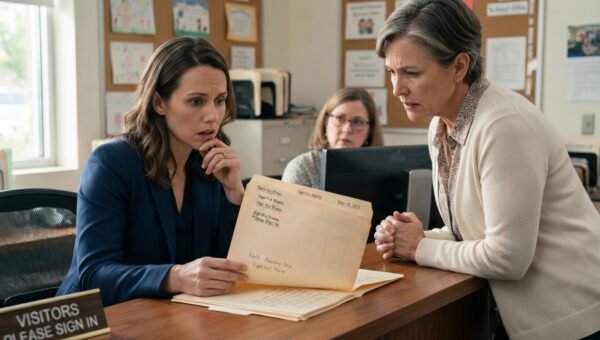
I drove straight down Main Street to the bank branch by the post office. The teller looked at the key, checked my identification, and called over an older manager who remembered Ray.
The manager led me through a heavy iron gate into a small, windowless viewing room with gray carpet and a heavy wooden desk.
A few minutes later, he set a long metal box on the desk, slid the lid open, and stepped out into the hallway, pulling the door shut behind him.
The box held only one single item. It was a manila envelope, sealed with a dried strip of brown tape. Written across the center in dark blue ballpoint pen was a date I knew by heart: October 14, 1998.
That was the rainy Tuesday morning my mother walked out the front door and never came back.
PART 2
I stared at the handwriting on the paper. The writing belonged to Ray. His capital letters were always blocky and slightly slanted to the left from his years working as an industrial mechanic.
My hands shook a little as I picked up the envelope. The paper was stiff and yellowed around the corners.
For twenty-two years, I had built my entire life around one simple story: my mother had abandoned both of us because she could not handle being a parent, and Ray had stayed behind out of sheer duty. But two months before my wedding, my mother had reappeared in my life.
She had reached out through a cousin, asking to meet for coffee at a diner three towns over. She told me she had spent decades regretting the split. She cried into her paper napkin, looked at my engagement ring, and whispered that Ray had forced her out of our home. She told me Ray gave her an ultimatum that night in October, telling her he would ruin her reputation in the county and make sure she never saw a dime if she did not pack her bags and leave me with him.
I had wanted so badly to believe her. I wanted a mother at my wedding. I had swallowed her tears and her soft voice, and two weeks before the ceremony, I told Ray that my mother was coming to the wedding, and that she would be sitting in the family pew.
Ray had not screamed. He had just looked at me across his kitchen table, set down his coffee mug, and said, “If she sits there, I cannot be in that room, Claire.”
I had called him cruel. I told him he was selfish, that his pride was more important to him than my happiness, and that he had no right to punish her forever. That was the last time we spoke before the wedding.
Now, sitting in the quiet basement of the bank, I slid my finger under the brittle flap of the envelope.
Inside were three documents.
The first was a cashier’s check receipt from First State Bank, dated October 14, 1998, in the exact amount of $35,000, made out to my mother’s maiden name. The remitter listed on the receipt was Raymond Miller.
The second document was an early withdrawal notice from Ray’s company pension fund, showing the heavy tax penalty he paid to take that money out on twenty-four hours of notice.
The third was a two-page legal agreement, stamped by a local notary whose office used to sit above the hardware store. It was a full, voluntary surrender of parental rights and physical custody, signed by my mother.
PART 3
Attached to the back of the custody agreement was a single sheet of lined notebook paper. It was my mother’s handwriting, unmistakable and neat, written with a fine black felt pen.
“I agree to leave Claire with Ray permanently. I will not seek contact, visitation, or support, provided the sum of $35,000 in cleared funds is handed to me before noon today. If the money is not ready, I will take the girl with me out of state, and Ray will have to spend years fighting me in court to get her back.”
The paper felt cold against my fingers.
The date on the top right was October 13, 1998. The day before she walked out.
Ray was not my biological father. He had married my mother when I was four, and he had no legal blood claim to me under state law at that time. If she had taken me across state lines, he would have had no right to stop her, no automatic standing in court, and no way to protect me from the unstable men and wild debts she dragged behind her.
He did not force her out. She had used me as a hostage to empty his retirement savings.
He had drained every single dollar he had worked fifteen years to build, paid a brutal penalty, and bought my safety so I could grow up in a warm house with clean clothes, regular school hours, and a quiet yard to play in. And he had never told me. He had let me believe she walked away out of ordinary weakness, carrying the secret by himself for over two decades so I would not have to live with the knowledge that my own mother had put a cash price on my head.
And in return, I had invited her to sit in the place of honor at my wedding and accused the man who saved me of being bitter and small.
I put the papers back into the envelope, signed the register with the bank manager, and walked out into the sunlight. The air felt thin. I got into my car, backed out of the parking space, and drove straight back toward Ray’s house.
ENDING
His truck was parked in the driveway when I pulled in.
I found him behind the garage, standing by the raised garden beds he had built for my eighth-grade science project. He was wearing his faded blue work shirt, holding a pair of rusty garden shears, trimming back the dead branches on an old blackberry bush.
When he heard my car door shut, he stopped. He did not turn around right away. His shoulders were slightly hunched, the way they always looked when his lower back was giving him trouble from years on concrete shop floors.
I walked across the damp grass until I was standing six feet behind him. I held the manila envelope against my side.
“You had thirty-five thousand dollars,” I said. My voice cracked on the last word.
Ray set the shears down on the wooden edge of the garden bed. He wiped his hands slowly on the front of his pants, then turned around to face me. His gray eyes were tired, but they were steady.
“It was everything I had in the world back then,” he said quietly.
“Why didn’t you just tell me?”
Ray looked down at my shoes, then back up at my face. “A kid cannot carry something like that, Claire. A little girl needs to think her mother was just sick or confused. If I told you she traded you for a car and an apartment down south, what kind of life would you have had waking up every morning?”
I looked at the silver hair at his temples and the deep lines around his mouth. All the years of him working second shifts at the machine shop, driving an old pickup that squeaked in reverse, and never taking a vacation suddenly had an answer.
“I uninvited her from Thanksgiving,” I told him, the words tumbling out raw. “I blocked her number this morning after I left the bank. I should have listened to you. I should have known who you were.”
Ray stood there for a long moment, the wind moving the dry leaves along the fence line. He walked past the shears, reached out with one rough, grease-stained hand, and pulled me in against his shoulder. He did not give a long speech, and he did not tell me everything was fine. He just held on until my breathing steadied.
“Go inside and wash your face,” he said softly, letting go and picking up his shears. “David called about an hour ago. He said you two bought too much brisket for dinner. Tell him to bring it over by five.”
I nodded, clutching the yellowed envelope in my hand, and walked up the back steps into the house he had bought for me twice.