PART 1
I kept trying to stay calm. I had been the one who drove her to dialysis twice a week for four years. Every Tuesday and Friday morning at six, I pulled my sedan into her gravel drive, helped her down the two concrete steps, and made sure her wool wrap covered her shoulders.
When her lawyer, Mr. Henderson, finished reading the estate distribution at her kitchen table, there were six identical white envelopes.
My cousin Greg opened his first. He counted five thousand dollars in neat hundred-dollar stacks.
My sister Clara got five thousand. Our three younger cousins got five thousand each.
Then Mr. Henderson slid the last envelope across the worn oak tabletop toward me. It had my name written in Grandma Ruth’s sharp, sloping pencil.
I broke the flap. There was no money.
Inside was nothing but a single yellowed index card. On the front, Grandma had copied down her buttermilk biscuit recipe in blue ballpoint ink.
“Don’t be bitter. She had her reasons,” my aunt Evelyn said, patting my shoulder before she had even zipped her purse. She was already mentally spending Greg’s cut. “Ruth always said you were the responsible one. The others needed a leg up.”
The room cleared out within twenty minutes. They were laughing on the porch, talking about paying off store cards and taking long weekend trips to Branson. I sat alone at the kitchen table, looking at the card.
It felt like an insult. Four years of missed work hours, waiting rooms smelling of rubbing alcohol, and helping her change bandages, only to receive butter measurements.
I stood up, walked over to the trash can under the sink, and almost threw the card away.
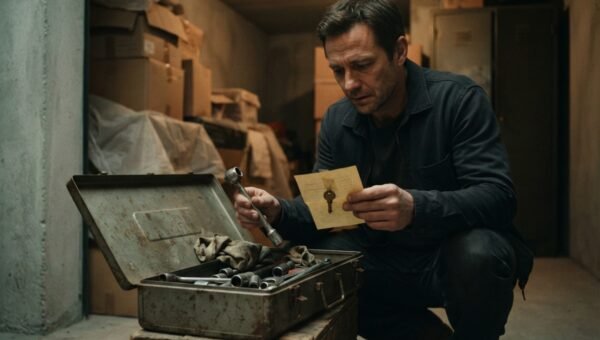
Right as my fingers let go, the sunlight from the porch window caught the bottom edge. Pressed lightly into the paper beneath the baking temperature were four small pencil digits: 42-18-09-31.
I looked at the pantry door in the back corner of the kitchen.
Grandma Ruth owned an old metal flour safe that had belonged to her mother. It was painted sage green, heavy as an engine block, with a rusted brass dial on the latch. Growing up, we kids were told never to touch it because it held her good silver and old tax papers.
The numbers on the card matched that dial.
I walked into the dim pantry, smelling dry yeast and shelf paper, and knelt before the green safe.
I dialed left to forty-two, right twice to eighteen, left to nine, and right to thirty-one. The heavy internal lever gave a dry, metallic clunk.
I pulled the door open. There was no silver inside.
There was a thick manila envelope and a brown spiral notebook labeled with my name, dated four years ago, right around the time her kidneys began to fail.
PART 2
I took the spiral notebook and the manila envelope back to the kitchen table.
Outside, Greg’s truck backed down the gravel drive with a quick honk. They were gone. The house was completely quiet except for the hum of the refrigerator.
I opened the notebook first.
Grandma Ruth had kept daily logs on lined paper. The first page started in October, four years earlier. It listed every single check she had written to my aunt Evelyn and my cousins over that time.
There were dozens of entries. Greg had asked for eighteen hundred dollars for truck repairs that never happened.
Evelyn had borrowed three thousand for a roof leak that was actually covered by insurance. Clara had taken two thousand to catch up on rent, only to buy plane tickets that same week.
Next to each entry, Grandma had written a short line in her neat hand.
Under Greg’s name: “Told him this was the last advance on his share. He promised to take me to the clinic Tuesday. He never came.”
Under Clara’s name: “Gave her the money. Asked if she could sit with me after surgery. Said she had a hair appointment.”
Page after page, she had documented every time she reached out to them for help, and every check she handed over in exchange for empty promises. She recorded every dollar she gave them as an advance against whatever she had left.
The five thousand dollars they each received today was not a gift. It was what remained after she quietly subtracted years of their demands. They had each already bled her dry while she was alive.
Then I reached the final section of the notebook, titled with my name.
There was a log of every dialysis trip we took together. But under each date, there were no dollar amounts subtracted. Instead, she had written down the little things we talked about in the car.
“Sarah brought me the warm cinnamon rolls.”
“Sarah waited three hours when the machine clogged. Never complained.”
“Sarah took off half a day to hold my hand when the shunt hurt.”
At the bottom of the final page, she wrote: “They take what they can carry in their pockets today, Sarah. You carried me.”
I reached for the manila envelope and broke the string seal. Inside was a legal deed and a bank document bearing a certified county stamp from three months before she died.
PART 3
The documents did not contain cash.
The first paper was a transfer-on-death deed for the house and the five surrounding acres of pasture. It was already signed, notarized, and recorded at the county courthouse. Grandma had retained a life estate, meaning the property transferred to me the minute she passed away.
The second document was an updated bank signature card and an ownership certificate for a sixty-thousand-dollar certificate of deposit.
She had intentionally left her main checking account nearly empty, with just enough to fund the five-thousand-dollar envelopes for the grandchildren. She wanted Evelyn and the rest of the family to walk out of that room thinking they had won, so they would leave the house without tearing it apart or contesting small items.
She had told Mr. Henderson to distribute those envelopes first to clear the house.
The front door creaked open.
Aunt Evelyn walked back into the kitchen. She had forgotten her reading glasses on the counter, but the second she saw the papers spread across the table, her eyes narrowed.
“What is that?” Evelyn asked, stepping closer. “Mr. Henderson said the distribution was finished.”
“It is finished,” I said.
She picked up the deed, squinting at the county recorder seal. When she saw my name next to the legal description of the property, her face hardened.
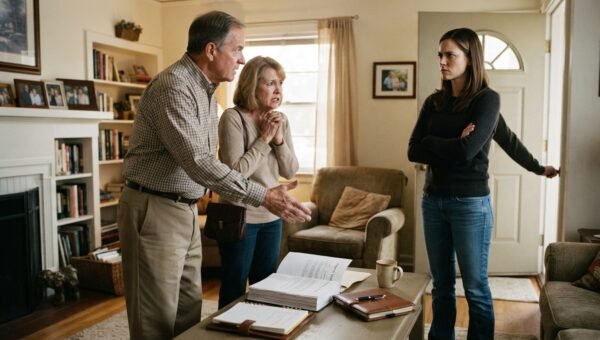
“This is wrong,” Evelyn said. “My mother lost her mind toward the end. You manipulated her on those long drives. She wouldn’t leave the whole property to one grandchild while the rest of us get crumbs.”
“You did not get crumbs, Evelyn,” I said, sliding the brown spiral notebook toward her. “You took twenty-four thousand dollars from her over four years. Greg took nine thousand. Clara took eleven thousand. Grandma wrote down every check number, every date, and every lie you told her to get it.”
Evelyn stared at the notebook. She did not open it. She recognized Grandma’s handwriting on the cover, and she knew exactly what was inside.
“She kept receipts,” I told her. “Every single one. If you want to take this to probate court, Mr. Henderson will enter this notebook into the public record. We can let a judge see how much you took while she was sitting on a dialysis chair alone.”
Evelyn’s mouth tightened. She set the deed back on the table, picked up her glasses, and turned around without saying another word. The screen door slammed shut behind her.
ENDING
I did not sell the house.
I spent the next six months painting the porches, fixing the roof leak Evelyn had supposedly repaired, and clearing the brush from the fence line. None of my cousins called to ask how the house looked, and I did not reach out to them.
The silence was the cleanest part of it all.
The certificate of deposit gave me enough breathing room to pay off the remaining property taxes and handle the upkeep without taking on extra shifts. Grandma had thought through every single step, protecting me from both debt and family interference.
I moved the green flour safe from the dark pantry out into the main hallway near the front door.
I keep the brass dial unlocked now. Inside sits the brown spiral notebook, along with the recipe card for buttermilk biscuits, resting right on the center shelf where anyone can see it.