PART 1
Jim died on a Tuesday in August with dirt under his fingernails and a pair of rusty pruning shears in his hand. He was seventy years old. We had been married forty-two years, long enough that I knew the exact rhythm of his steps coming up the porch stairs, the sound of his knees popping when he bent down to grease the mower, and the way he took his coffee with just enough milk to turn it the color of river gravel.
A massive stroke, the doctor said. He went down between the tomato cages behind our two-bedroom house on the south edge of town, and by the time I walked out with a pitcher of iced tea, he was already gone.
September was a blur of casseroles, people talking in quiet church voices, and paperwork that made no sense. Jim was a retired machinist from the ball-bearing plant. We lived on his pension and my small teacher aide retirement check. We never had big money, but we never had unpaid bills either. Jim had always handled the checkbook at the kitchen table on the last Sunday of every month, using an old metal ruler to draw pencil lines in his ledger.
By the middle of October, the sympathy cards had stopped coming. The house had settled into an empty, heavy quiet that made every floorboard creak like a complaint.
Then on a wet Thursday morning, the kitchen telephone rang.
“Mrs. Powell?”
The voice was rough, like gravel rattling in a hubcap.
“Yes,” I said, wiping a water ring off the counter with a dishcloth.
“This is Hank. Over at the Midas on Route 6. I do the brake work and the exhaust pipes.”
I tightened my hand on the receiver. Route 6 was four miles outside town, out past the grain elevator and the abandoned drive-in theater. Jim had taken our 2004 Buick LeSabre out there every spring, but Jim had been in the ground for nine weeks.
“Hank, if there’s a bill,” I said, “I thought Jim cleared everything before the summer.”
“No, ma’am,” Hank said. He cleared his throat. “Nobody owes anything. But your husband left something here. In the back room behind the lift. I didn’t want to bother you during the service, but it’s taking up corner space, and Jim told me once that if anything ever happened, it belonged to you.”
“What did he leave, Hank?”
“A cabinet,” Hank said. “You got a truck, Mrs. Powell, or somebody who can bring one?”
My nephew Greg had an old Ford with a dented tailgate. I called him, and forty minutes later we pulled into the gravel lot of the Midas shop.
The air out there always smelled of scorched iron, wet tires, and stale tobacco. Hank met us by the bay door, wiping motor oil off his palms with a blue rag. He was a thick-shouldered man in his late fifties with gray hair cut short and grease permanently stained into the knuckles of his thumbs.
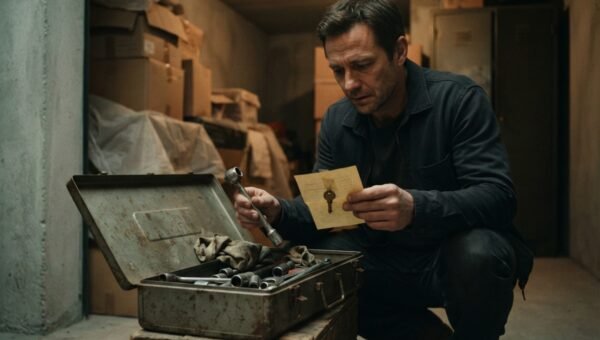
He led us past a rack of mufflers into a narrow storage room that smelled of old fan belts and damp concrete. Sitting against the back cinderblock wall was a gray, two-drawer steel filing cabinet. The paint had chipped off around the bottom edges, revealing dull brown rust.
“He brought it in about ten years ago,” Hank said quietly, looking down at his boots. “Said his shed at home leaked and he didn’t want papers getting moldy.”
Greg tilted it back onto an old hand truck. It rattled. It was heavy.
When we got it back to my kitchen, Greg helped me set it down right by the pantry door where Jim used to hang his barn jacket.
I offered Greg twenty dollars for gas, but he shook his head, patted my shoulder, and left.
I stood there in the kitchen, the yellow linoleum cold under my slippers, looking at that gray box. There was no key. Jim had left the top drawer unlocked.
I pulled the handle. The metal slides screeched.
Inside were neat rows of standard manila folders, each one labeled with a black felt-tip marker in Jim’s square, block handwriting. The first one said: *Miller, Sarah – 2008.* The next said: *Washington, Brenda – 2009.* Then *Kovacs, Linda – 2009.*
I pulled the first folder out and opened it on the table.
Inside was a carbon receipt from Midas. Two brand-new radial tires, mounted and balanced: two hundred and forty dollars. An oil filter and four quarts of 10W-30: thirty-eight dollars. A small handwritten note clipped to the top with a rusted paper clip: *Paid in full. Cash.*
I opened the second folder. Front brake pads and rotors on an eighty-eight Chevy Cavalier. Three hundred dollars even. *Paid in full. Cash.*
Every folder held the same thing: repair receipts, inspection slips, tire warranties, and carbon copies from the parts counter.
I started counting them. I pulled them out one by one, stacking them in neat piles of ten across my kitchen table until the yellow floral tablecloth was completely covered.
One hundred and twelve folders.
I sat back in my chair, the breath caught in the center of my chest. For forty-two years, my husband had saved coins in a coffee can, patched his work boots with black silicone sealant instead of buying a new pair from Sears, and driven a Buick with three hundred thousand miles on the odometer. We had taken one vacation to Branson, Missouri, in 1994, and he had packed our lunches in a cooler so we wouldn’t have to buy sandwiches at the roadside diners.
I grabbed the Buick’s keys and my coat. Ten minutes later, I was standing back in the greasy front office of the Route 6 Midas. Hank was sitting behind the counter under a faded cardboard calendar, entering numbers into an old adding machine.
“Hank,” I said. My voice was trembling, though I tried to hold it flat. “What are these?”
Hank stopped typing. He looked at the counter, then at me.
“Jim asked me to keep my mouth shut, Mrs. Powell.”
“Jim is gone, Hank. What are these folders?”
Hank pushed his wire-rimmed glasses up on his nose and took a slow breath.
“For sixteen years,” Hank said, “Jim prepaid oil changes, tires, and brake pads for single mothers. Three hundred dollars a year each. The women never knew who paid it. The referrals came through Pastor Tom at the First Baptist food pantry.”
I gripped the edge of the laminate counter. My knuckles turned white.
Sixteen years. One hundred and twelve people. Three hundred dollars each.
“Thirty-three thousand, six hundred dollars,” I whispered.
“Yes, ma’am,” Hank said. “He came every January. Always the first Monday after New Year’s. Coldest day of the year, usually. He brought an envelope of cash. He sat right in that plastic chair by the coffee maker and told me, ‘Hank, my mother’s car broke down when I was eleven years old. An old Plymouth with a bad alternator. She walked five miles in the slush to her cleaning job at the hospital. A whole year she walked it, until her hip gave out. Nobody helped her.'”
Hank looked out the bay window toward the highway where a semi-truck roared past, throwing gray road spray against the glass.
“Jim told me, ‘I swore when I had a nickel to my name, no woman in this county would lose her job because she couldn’t afford four round pieces of rubber.'”
I leaned back against the office doorframe, pressing both hands over my mouth.
“Did you look at the last folder, Mrs. Powell?” Hank asked gently. “Down at the very back of the bottom drawer?”
“No,” I said. “I only looked at the top.”
“You need to go home and look at the bottom,” Hank said. “That one has your name on it.”
PART 2
The drive back to our house felt longer than it ever had. The wipers on the Buick slapped a steady, rhythmic beat against the glass, clearing away the October mist. I kept my hands clamped at ten and two on the steering wheel, my mind spinning back through decades of small, quiet arguments.
In 2011, our back porch steps were rotting through. I had begged Jim to hire a contractor to pour concrete steps so we wouldn’t break an ankle. He had insisted on doing it himself with salvaged cinderblocks and leftover treated lumber he got from a job site. He spent three weekends on his knees in the dirt, groaning every time he stood up, just to save six hundred dollars.
In 2016, my sister invited us to join her family on a cruise to Alaska for our thirty-fifth anniversary. Jim had looked at the brochure, set it on the microwave, and said, “Ruthie, that’s two thousand dollars to stand on a boat and look at cold water. We can paint the garage and put the rest into savings.”
I had been angry at him for a month. I thought he was pinched. I thought he had grown up poor and let the fear of an empty bank account turn him tight-fisted and stubborn. I had told myself he loved his bank book more than he loved giving me a little comfort in our old age.
When I walked back into the kitchen, the piles of manila folders sat on the table like a crowd of quiet strangers.
I knelt down in front of the gray cabinet and slid the bottom drawer open.
It was mostly empty, save for a bundle of old tax returns from the nineties and, all the way at the back, a single red expansion folder. Written across the front tab in the same black marker was one word: *Ruth.*
My hands shook as I untied the cloth string.
Inside was a stack of yellowed bank envelopes, a ledger, and a three-page handwritten letter on lined yellow legal paper. The letter was dated January 4, 2022. That was the winter Jim had pneumonia, the winter he started slowing down and coughing every morning before he got out of bed.
The first page began without a greeting:
“Ruthie, if you’re reading this, Hank gave you the box. Don’t be mad at Hank. I made him swear on his mother’s Bible he wouldn’t tell you while I was breathing. You would have told me to put the money in an annuity or spend it on new siding, and maybe you would have been right. But I had a debt to pay that wasn’t on any bank paper.”
I sat down on the kitchen floor right there beside the cabinet, my back against the cupboards, and read every word.
He wrote about 1965, the year his father walked out on them in the middle of a November blizzard, leaving his mother with thirty-two dollars and four cords of unseasoned firewood. His mother, Evelyn, took two shifts at the county hospital, stripping bedsheets and scrubbing operating room floors from four in the afternoon until midnight. When the alternator in her old Plymouth burned out that December, she didn’t have fifty dollars to fix it.
“She walked,” Jim wrote. “Through the snow drifts on Route 6. Her shoes were canvas work sneakers from the dollar bin. When she came home at one in the morning, her feet were gray. She would sit on the edge of the tub and run cold water over them because hot water made the frostbite burn too bad. I was eleven. I sat on the toilet lid and watched her cry, but she only cried when she thought I was asleep. She walked that road for eleven months until the snow melted and she saved enough for a junkyard alternator.”
He went on:
“I swore to God that year that when I grew up, I would kill whatever devil made an honest woman walk five miles in the dark just to feed her boy. When I got on at the plant, I started putting fifty dollars a month into a separate credit union account. It wasn’t our grocery money, Ruthie. It was my overtime. Every weekend shift I took on third trick, every Saturday I stayed late to turn down steel rollers, that was for the shop. I never took a dime from our household account. Not one dime.”
Attached to the letter was a certified cashier’s check made out to Ruth Powell.
The amount was $14,400.
Under the check was another note, written on a torn Midas receipt:
“For my Ruth. My mother walked those miles alone. Every car I fix is the one she couldn’t afford. But I never forgot who held my life together while I was busy fighting old ghosts. This is the Alaska money. Go look at the cold water, Ruthie. Take your sister. Don’t look at the bill.”
I sat on the cold floor and pressed the paper against my collarbone.
PART 3
The following Sunday, I drove the LeSabre to First Baptist. I had stopped attending regularly during the two years Jim’s arthritis had kept him home, but that morning I put on my navy Sunday coat and walked through the heavy wooden doors.
The service had just ended. People were gathering in the fellowship hall for coffee and sheet cake. In the corner by the coat rack stood Pastor Tom, his hair entirely silver now, talking with a young woman holding a toddler on her hip.
I waited until the woman stepped away to catch her little boy, then I walked up to him.
“Mrs. Powell,” Pastor Tom said, taking my hands in both of his. “It is so good to see you. How are you holding up?”
“Pastor,” I said, “I found the filing cabinet.”
The pastor’s face softened. He let go of my hands and nodded toward the quiet hallway leading to his study.
“Come sit down, Ruth.”
We sat in two leather armchairs across from his book-lined desk. On the wall was a framed verse from Isaiah, framed in plain pine.
“Did Jim leave instructions?” Pastor Tom asked.
“No,” I said. “Just the receipts. And a letter explaining his mother.”
Pastor Tom leaned his elbows on his knees. “Jim came to me in 2007. He sat right where you’re sitting. He said he had an arrangement with Hank out at Midas, and he needed names. He had three rules. The woman had to be raising kids on her own. She had to have a job she was trying to keep. And she was never, under any circumstances, to be told who paid for the work. If anyone asked, Hank was instructed to say it was an anonymous memorial fund through the county rotary.”
“Why didn’t he tell me, Tom?” I asked, my voice cracking slightly. “We shared a bed for forty-two years. We shared every meal. Why hide it like it was a crime?”
Pastor Tom looked at me with deep, steady eyes.
“Because Jim was ashamed that he couldn’t save his mother,” he said softly. “Men of his generation carry wounds like that inside their ribs until the bone grows over them. He told me once, ‘Pastor, if Ruth knows, she’ll tell me I did enough. And if I feel like I did enough, I’ll stop. And if I stop, my mother walked those miles for nothing.'”
He paused, letting the silence settle into the room.
“Do you know Brenda Washington?” Pastor Tom asked.
“The name was on one of the folders,” I said. “From 2009.”
“Brenda was twenty-two,” he said. “Her husband had left her with twins and an eight-year-old Chevy with bald front tires and a broken steering knuckle. She was working the night shift as a nurse’s aide out at the nursing home. It was January. The tires were down to the steel cords. If she couldn’t drive, she couldn’t work. If she couldn’t work, the county was going to place those babies with social services. Jim bought four tires and paid for the suspension work. Brenda kept that job. Today, she’s the head floor supervisor out at Memorial Hospital. Her oldest boy graduated from Purdue last spring.”
Pastor Tom stood up, walked to his file cabinet, and pulled out a small leather-bound book.
“There are dozens of them, Ruth. Women who became teachers, managers, bus drivers. Women who didn’t lose their homes because their cars started in February.”
He set the book on the desk.
“The account at Midas ran out this month,” Pastor Tom said gently. “Jim usually came in January to replenish it. Hank told me last week that two mothers on the list need brake work before the snow starts. I was going to see if the deacon fund could cover a portion of it, but our funds are thin this year.”
I looked at the check in my purse, folded neatly inside the envelope with Jim’s handwriting on it. Fourteen thousand, four hundred dollars.
The Alaska money. The money he had earned on graveyard shifts, turning cold steel on a lathe while I slept under the quilt at home, thinking he was just being tight with our lives.
“Pastor,” I said, reaching into my handbag. “How much does Hank need for those two cars?”
ENDING
On Monday morning, the frost lay thick across the grass, turning the yellow leaves on our maple tree crisp and white.
I drove out Route 6 at eight o’clock. The morning traffic was heavy with school buses and tradesmen in pickups heading toward the interstate. When I pulled into the Midas lot, Hank was already rolling up the center bay door.
He saw the Buick and stopped, wiping his hands on his coveralls.
I walked into the office. The small space smelled of burnt oil, just like it had four days earlier.
I took out the check Jim had left for me. Over the weekend, I had gone to the credit union and split it. I had kept four thousand dollars in our checking account for the house repairs, and I had a new cashier’s check drawn for ten thousand four hundred dollars.
I set the check on the glass counter between an old tape dispenser and a box of spark plugs.
Hank looked down at the numbers. He looked at me, his eyes wide.
“Mrs. Powell,” he said. “Jim meant for you to have this.”
“Jim gave it to me,” I said. “And it’s mine to spend.”
Hank didn’t touch the paper. “That’ll cover nearly thirty-five cars. That’s over three years of work.”
“Then you’d better order the tires, Hank,” I said.
I pulled a small index card from my coat pocket. On it, I had written out the final line of Jim’s letter in my own handwriting, using an ordinary blue ballpoint pen.
I handed the card to Hank.
“When they ask who paid for it,” I said, “don’t tell them it was a memorial fund. Tell them the man who built this fund was just a boy who watched his mother walk five miles in the snow, and he swore he would never let another woman walk alone.”
Hank took the card. He looked at it for a long moment, then reached up with the corner of his oily rag and pressed it against the corner of his eye. He didn’t say anything. He just nodded, folded the card carefully, and slid it into the front pocket of his work shirt, right over his heart.
I walked out of the shop and stood in the gravel lot. The wind was coming out of the north, cold and sharp with the smell of winter coming on. Across the highway, the fields were cut down to brown stubble, stretching out flat toward the horizon where Route 6 disappeared into the gray morning sky.
I thought about Alaska. I thought about the big cruise ships and the glaciers Jim had refused to look at.
Then I looked at the line of cars waiting outside Hank’s repair bays: an old rusted sedan with a cracked windshield, a station wagon with baby seats strapped in the back, a small pickup with worn tires.
I got back into the LeSabre, turned the key, and listened to the engine turn over smooth and steady. I put the car in reverse, pulled out onto Route 6, and drove home to clean out the garden before the first hard freeze.