PART 1
My son told me he was too busy to visit his grandmother during her final month.
“Work is insane right now, Mom,” Nathan told me over the phone. “I can’t take off early. You know how my manager is.”
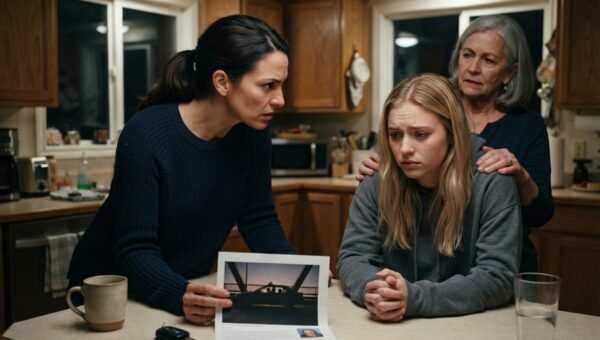
I wanted to believe him. I wanted to think my twenty-six-year-old boy was just overwhelmed. But three days later, his cousin showed me a photo on social media. Nathan was sitting in the bleachers at an evening baseball game downtown, holding a plastic cup with two guys from his old college dorm.
Two days after that, another picture popped up. He was standing on the patio of a local brewery on a Saturday afternoon, laughing in the sunshine.
Meanwhile, my mother was lying in a hospital bed set up in her spare room, fading away a little more each morning.
I sat by her bedside every day after my own shift at the dental clinic. I fed her chipped ice from a yellow plastic bowl. I rubbed lavender lotion into her papery hands. She had congestive heart failure, and by late July, her breathing sounded like dry leaves dragging across concrete.
“Nathan called me on Tuesday,” Mom whispered one afternoon, her voice barely louder than the hum of the oxygen concentrator. “He’s a good boy, Evelyn.”
“He should be here,” I said, unable to hide the bitterness in my voice. “He lives twenty minutes away. A baseball game isn’t work.”
Mom reached over and tapped my wrist with one frail finger. “Don’t judge a person by the surface of their day. Leave him be.”
She never complained about him once. When she died on a rainy Tuesday morning in August, Nathan showed up at the funeral home in a dark suit that hung loose on his frame. He had dark circles under his eyes, but he kept his distance from the rest of the family. He stood by the coffee station in the back, checking his phone every five minutes. I was so hurt and angry that I could barely look him in the eye.
The following week, we met at Mr. Henderson’s small law office on Oak Street to read her will.
Mom didn’t have much. The modest ranch house was left to me, along with her small checking balance to help cover the remainder of her burial expenses. My brother got our father’s old hunting rifles and the silver pocket watch. When Mr. Henderson cleared his throat and adjusted his glasses to read Nathan’s portion, Nathan leaned forward, resting his elbows on his knees.
“To my grandson, Nathan Miller,” the lawyer read, “I leave my yellow plastic kitchen clock, which has kept time above my stove since 1984.”
Nathan let out a dry, short laugh. He rolled his eyes toward the ceiling, shook his head, and stood up from the leather armchair. He picked up the heavy, square clock from the side table where Mr. Henderson had set it out. The yellow plastic was faded, and the plastic cover had grease stains around the rim that forty years of dish soap could never completely lift.
Nathan walked right over to my chair and dropped the clock into my lap.
“You take it,” he said, not even looking at me. “You always liked her kitchen junk more than I did.”
He turned around and walked out of the office before the lawyer had even closed the folder.
I took the clock home. I felt a mix of grief and irritation every time I looked at it, but it was my mother’s, so I set it on the laminate counter next to my toaster. The loud, steady tick filled the quiet kitchen.
Two weeks later, on a Sunday morning, the ticking stopped. The hands were frozen at twenty minutes past four.
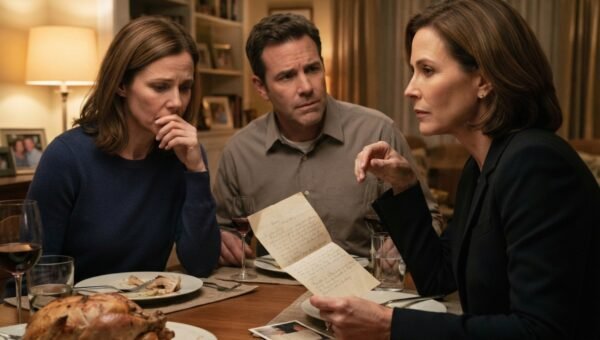
I picked up the clock and turned it over to change the single AA battery in the back compartment. When I popped the little plastic cover off, I noticed a piece of faded masking tape holding down a thick piece of lined notebook paper. It had been folded four times and jammed tightly into the hollow space beside the battery casing.
Across the front of the paper, in my mother’s shaky, slanted handwriting, was one sentence in blue ballpoint pen:
“For Nathan, if he gives this away, let his mother read it.”
I carefully pulled the tape loose. My fingers shook as I unfolded the paper. I read the first two sentences standing by my sink, and the breath left my chest.
I picked up my phone immediately and dialed Nathan’s number.
“What’s wrong?” he answered on the third ring, his voice sharp and impatient. “I told you I’m busy today.”
“You need to come over here right now,” I said.
“Mom, I’m working on something. Can this wait?”
“No,” I told him, keeping my voice as steady as I could. “It cannot wait. I opened your grandmother’s clock.”
There was complete silence on the other end of the line. For five seconds, neither of us said a word.
“I’ll be there in ten minutes,” he said quietly, and hung up.
PART 2
Nathan arrived wearing faded gray sweatpants and a stained work shirt with the sleeves rolled up to his elbows. He didn’t take off his sneakers. He walked into my kitchen with his jaw tight, his hands shoved deep into his pockets, looking around the room like he wanted an excuse to leave immediately.
“Where is it?” he asked.
I didn’t answer right away. I pointed to the kitchen table. The clock sat in the center of the wood, with the yellowed paper lying next to it.
“Sit down, Nathan,” I said.
“Just tell me what you want, Mom. I’ve got things to do.”
“Sit down.”
He pulled out the chair across from mine with a harsh scrape against the floor and dropped into it. He refused to look at the paper. Instead, he stared fixedly at the salt shaker.
I picked up the note. My mother’s handwriting had deteriorated badly during her last two months, but her words were deliberate and clear.
“I’m going to read you what she wrote,” I said.
I looked at him, cleared my throat, and read the first paragraph out loud:
“Nathan, you are stubborn like your grandfather, and you hide your trouble behind a closed door. If you gave this clock to Evelyn, it means you were too proud to let her see what you carried, and you let her be angry with you instead of speaking the truth. So I will speak it for you.”
Nathan’s eyes closed. His hands came out of his pockets and gripped the edge of the kitchen table so hard his knuckles turned white.
“Stop, Mom,” he whispered. “Don’t read that.”
“I am reading it,” I said, my voice trembling. “Because for the last two months, I thought my only child was callous. I thought you abandoned your grandmother so you could drink beer and watch baseball while she died.”
“You don’t know what you’re talking about,” he muttered, looking down at his lap.
I continued reading from the page:
“In May, the hospice nurse told me the night-shift aide would cost $3,600 every four weeks because my insurance would not cover skilled home supervision after midnight. Evelyn could not afford it on her salary, and she was already taking unpaid days from the clinic. I told the nurse no. I said I would go to the county home when the time came. Two days later, Nathan came to my room. He told me he would handle the invoice directly with the home agency. He told me he took second shifts with the stadium cleaning crew and weekend maintenance at the brewpub. He made me promise not to tell his mother because she would stop him and try to pay it herself.”
I paused. The paper shook in my hand.
I looked at Nathan. His head was bowed, his shoulders tense.
“Nathan,” I said. “Is this true?”
He didn’t look up. “Grandma wanted to die in her own bed, Mom. You were coming home from the clinic looking like you were going to drop dead on the floor. You fell asleep in the hallway chair three times in one week. If you had to stay up with her all night, you would have lost your job or ended up in the hospital yourself.”
“The baseball games,” I said, remembering the photos on my phone screen. “The brewery patio.”
“I was working maintenance at the stadium,” he said, his voice cracking slightly. “I swept the grandstands during the games and hauled kegs down to the lower level. The photo Cousin Sarah saw was during my fifteen-minute break between the fifth and sixth innings. My buddy bought me a soda in a souvenir cup and took a picture. At the brewery, I was cleaning grease traps in the kitchen on Saturdays from six in the morning until four in the afternoon. When I finished, the owner gave me a pint and I sat on the bench for ten minutes before my shift at the warehouse started.”
He wiped his face with the back of his hand, leaving a streak of dust on his cheek.
“I wasn’t out partying, Mom. I was working eighty hours a week.”
PART 3
The room felt completely still. The hum of the refrigerator seemed louder than usual.
“Why didn’t you come see her in the evenings?” I asked, my throat tight. “Even for ten minutes? She missed you, Nathan. I thought you didn’t care.”
Nathan finally looked up at me. His eyes were red, and the defiance in his expression was completely gone.
“Read the rest of the letter,” he said quietly.
I turned back to the page. There were two more paragraphs written on the back of the lined sheet.
“Nathan came to see me on a Thursday night in the middle of July,” my mother had written. “He had just finished a twelve-hour shift at the plant and had grease on his shirt. He sat in the armchair by the window, and while he was talking to me about his truck, he stopped speaking. He began to shake. He put his head in his hands and cried for nearly an hour. He told me he was terrified of walking into the room and finding me dead. He said seeing me unable to stand up made him feel like the ground was falling out from under his feet. He was exhausted, he had nothing left, and he felt like a coward.”
I read the next lines through blurred vision:
“I took his hand and I told him he was forbidden to come back into this room until he rested. I told him he had already given me the greatest gift a grandson could give: the dignity of staying in my own home without bankrupting his mother. I told him, ‘Nathan, if you come sit here and watch me slip away, it will break whatever strength you have left to finish this job. You stay away, you pay the nurse, and you remember me standing in my kitchen making your butterscotch pies.’ He did not want to leave. I made him promise.”
The letter ended with four short lines:
“He took care of both of us, Evelyn. He did it quietly, without asking for praise, because he loves you more than his own comfort. Do not let your pride keep you from forgiving his silence. And Nathan, if you are hearing this, the clock has three hundred dollars folded under the bell mechanism. Buy yourself a good pair of boots.”
I lowered the paper to the table.
Nathan sat across from me with his hands pressed flat against his thighs. He was looking at the yellow plastic clock, his jaw working as he tried to keep his composure.
“I wanted to come, Mom,” he said, his voice barely a whisper. “The last two weeks she was alive, I drove to the end of your street three different times after midnight. I sat in my truck with the engine idling, looking at the light in her bedroom window. But every time I put my hand on the door handle, I remembered what she said. She told me she didn’t want my last memory of her to be a dying woman who couldn’t remember what day it was. She made me swear on Grandpa’s Bible.”
He swallowed hard.
“And then at the will reading, when Mr. Henderson handed me that stupid clock, I thought she was mocking me. I thought she was reminding me that my time with her had run out, and that I failed her by staying away.”
I pushed my chair back, walked around the table, and put my arms around my son’s shoulders.
He didn’t pull away. He leaned his forehead against my side, and the heavy tension he had been carrying for three months finally gave out. He wept quietly into the fabric of my apron, just like he used to do when he was ten years old and scraped his knees on the asphalt driveway.
“You didn’t fail her,” I whispered into his hair. “You didn’t fail either of us.”
ENDING
We stayed in the kitchen for another hour.
Nathan showed me his phone. He opened his banking app and showed me the automatic transfers that had gone out every four weeks from May through August, totaling $7,200 to the private home-care registry in town. His checking account had sixty-four dollars left in it. He had fallen behind on his truck payment by two weeks, and his hands were calloused and blistered from the maintenance work.
I walked to my desk in the hallway, brought out my personal checkbook, and wrote him a check for half the balance Mom had left me.
“Take this,” I said, setting it on the table in front of him. “You catch up on your truck, and you pay off whatever you put on your cards.”
He stared at the check and shook his head. “Mom, that was her savings for you.”
“Nathan,” I said, using the exact firm tone my mother used to use on both of us. “Your grandmother left that money to take care of her affairs. Paying you back for her dignity is her affair. You take it, or I’ll drive down to your bank and deposit it into your account myself.”
He looked at the paper for a long moment, then folded it carefully and put it in his front pocket.
I picked up the little screwdriver from my utility drawer and opened the hollow casing beneath the clock’s battery housing, just behind the brass chime bell. Tucked into the narrow groove were three crisp one-hundred-dollar bills, folded tight and clean.
I handed the cash to Nathan.
He looked at the three bills in his hand, then let out a small, wet laugh. “She never forgot anything, did she?”
“Not a single thing,” I said.
Nathan went to the hardware store that afternoon and bought a fresh package of batteries. When he came back, he replaced the old battery, set the hands to three in the afternoon, and hung the yellow plastic clock on the wall right above my kitchen table.
The rhythmic, solid tick filled the room again.
Nathan stayed for dinner. We didn’t talk about funeral bills, or jobs, or the baseball games he had swept after hours. We sat together at the table, ate leftover roast beef, and talked about the time Grandma accidentally dropped her wedding band into a pot of apple butter and didn’t find it until Thanksgiving dinner.
When he got up to leave around eight, he paused at the kitchen door. He looked up at the yellow clock, then looked at me.
“I’ll come by next Sunday, Mom,” he said. “For real this time.”
“I’ll have dinner ready at five,” I told him.
After his truck pulled out of the driveway, I stood by the counter for a long time, listening to the clock measure out the quiet evening, grateful for the woman who had known how to protect us both.