PART 1
My daughter, Chloe, told me I was not allowed in the hospital room the day my grandson was born. She did not say it to my face. She sent a text message at six in the morning, two hours after her water broke.
The message was short. It said Brian had decided it was best for their new family if I kept my distance. Brian claimed my presence created an unstable environment.
He said I had boundary issues, and until I proved I could respect their privacy, I would not be meeting little Leo.
I sat on the edge of my bed with my phone in my hand, staring at the screen. Brian had married Chloe fourteen months earlier. From the second month of their marriage, he had started trimming her world down. First it was her old college roommates, whom he labeled bad influences. Then it was her Sunday dinners at my house. By the time she was six months pregnant, Chloe had stopped answering my phone calls altogether. Every conversation was rerouted through Brian, or handled through stiff, generic text messages that sounded like they were written by someone filling out an insurance form.
I bought a baby crib anyway. I bought onesies, soft cotton blankets, and three jars of diaper cream. I spent two weeks knitting a pale yellow baby hat with my initials, M.E., stitched in tiny green thread along the inside brim.
It was something my own mother had done for me. I packed everything into a neat cardboard box, took it to the post office, and mailed it with delivery confirmation.
Brian signed for the package three days later.
I never got a thank-you note. I never got a phone call. I never even got a single photograph of the baby’s face. When I asked Chloe’s cousin if she had seen the boy, she told me Brian had posted a single photo online showing only the baby’s foot. The caption said they were keeping their private life sacred.
Six months went by like that. I went to work, came home to an empty kitchen, and tried to convince myself that Chloe would come around when she was ready. I told myself new marriages were hard, and babies were exhausting, and eventually my daughter would remember that I had spent twenty-four years loving her without conditions.
Then, on a rainy Tuesday in the middle of October, my office phone rang.
I work as an accounts coordinator for a commercial plumbing supplier in West Valley. People rarely call my direct extension unless a shipment of PVC pipes is late or an invoice is bounced.
“Margaret Ellis?” a woman’s voice asked.
“Speaking,” I said, setting my pen down.
“This is Dr. Miller’s office at the Crestview Pediatric Center. I have a six-month-old patient here named Liam. On his emergency intake sheet, your name and your direct desk number are listed as the primary emergency contact.”
I leaned forward. My desk was cluttered with shipping manifests, but suddenly the room felt very small.
“Liam?” I repeated. “My daughter has a baby named Leo. But her husband’s last name is Miller. Are you sure you have the right person?”
The receptionist paused. I could hear the faint click of a keyboard on her end of the line.
“The mother listed here is Chloe Vance,” the woman said quietly. “The baby is six months old. She brought him in for an urgent consult, but she walked out about ten minutes ago before Dr. Miller could finish the examination.”
My mouth went dry. Vance was Chloe’s maiden name. It was my last name. She had not used it since the wedding ceremony at city hall.
“Did you sign any guardianship paperwork or medical releases for this child, Mrs. Ellis?” the receptionist asked.
“No,” I answered honestly. “I haven’t seen my daughter since November. I didn’t even know she had your clinic’s address.”
The woman hesitated. “She was very agitated, Mrs. Ellis. She kept looking out the window into the parking lot. She asked if the records here could be accessed by anyone sharing an insurance policy. When the nurse said the policyholder might receive an explanation of benefits in the mail, she grabbed the baby and left.”
I stood up so fast my office chair rolled back against the file cabinet. “Is the baby sick? What was wrong with him?”
“I cannot share medical notes over the phone,” the woman said, her voice turning guarded. “I only called because you are the contact person, and she left personal property behind in the waiting room.”
“I am twenty minutes away,” I said. “Please. Keep the door unlocked.”
I did not ask my supervisor for permission. I grabbed my purse, took my coat off the coat rack, and ran out to the parking lot in the pouring rain.
The drive across town took twenty-four minutes. The traffic along the commercial strip was bumper to bumper, and every red light felt like an insult. My windshield wipers slapped back and forth, smearing grease across the glass. I kept asking myself why Chloe had used her maiden name, why she had listed my workplace instead of my cell phone, and why she had fled before a doctor could look at her child.
When I pushed through the glass doors of Crestview Pediatrics, the waiting area was almost empty. A mother in the corner was rocking a toddler in an umbrella stroller. A fish tank hummed against the far wall.
The receptionist, an older woman with silver glasses on a beaded chain, looked up when the door chime sounded.
“Margaret Ellis?” she asked, recognizing my face from the urgency in my eyes.
“Yes,” I said, out of breath. “Where are they?”
“She’s gone,” the woman said softly, pointing toward the empty hallway. “She left on foot through the side exit. I checked the parking lot, but there wasn’t a car parked in the rear stalls.”
The woman reached under the counter and pulled out a small plastic bin. Inside was a tiny yellow knit cap.
I picked it up. My fingers traced the brim before I even flipped it over. Right along the seam, written in tiny green cotton stitches, were the letters M.E.
She had kept it. Brian had signed for the box, but Chloe had kept the hat.
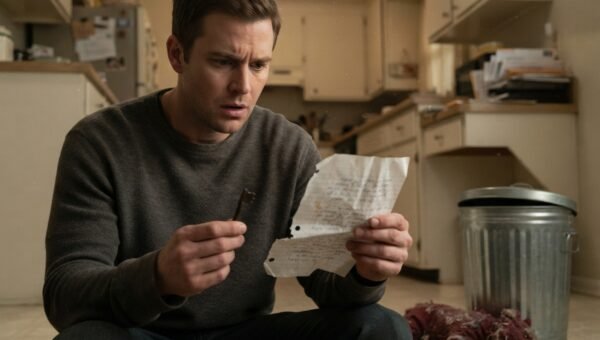
Tucked inside the cap was a folded slip of white paper. It was a faded register receipt from a corner convenience store located three blocks from the small one-bedroom apartment Chloe had rented back when she was in nursing school. The date stamped on the top was two days ago, at 11:42 at night.
I turned the receipt over.
On the back, written in Chloe’s distinct, slanted handwriting with a blue ballpoint pen, was a single line of notes:
*Liquid Prednisolone: 0.5 ml twice daily.*
Right below the dosage, circled twice with enough pressure that the paper had torn, was a single word written in capital letters:
*SAFEHOUSE.*
PART 2
I stared at the word until the letters blurred against the rough paper.
Chloe had not written a plea for money. She had not written an apology for the six months of silence. She had written the name of an escape plan.
“Did she say anything else?” I asked the receptionist, keeping my voice as steady as I could.
“She asked how long it took for police to respond to a non-emergency dispatch call,” the receptionist whispered, glancing at the empty hallway behind her. “Then a silver sedan pulled into the fire lane out front. As soon as she saw the car, she gathered her diaper bag, took the back corridor, and pushed through the emergency door.”
Brian drove a silver Honda sedan.
I stepped outside into the drizzle, stood beneath the clinic awning, and called the local police precinct. When the dispatcher answered, I did not talk about hurt feelings or family arguments. I gave the facts. I told them my daughter had fled an abusive marriage, was carrying a six-month-old infant with an active prescription, and had intentionally left an emergency contact and a note indicating she was seeking a domestic violence safehouse.
“Has your son-in-law threatened her physically?” the officer asked.
“I don’t know,” I admitted, my voice shaking with cold. “He isolated her from everyone she knew. He told her family she was mentally unfit to keep us away. And she just ran out into the rain with a sick infant to avoid being seen by him.”
The officer took down Brian’s name, the make of his car, and the address on the convenience store receipt. He told me to go home and wait for a call from an investigator.
I did not go home.
I knew that neighborhood near Chloe’s old apartment. It was an older part of town, bordered by an industrial canal and an old strip mall where half the storefronts were boarded up. If Chloe bought milk and bottled water at that convenience store at midnight two days ago, she was not staying in a modern suburban home with Brian. She was somewhere nearby.
I drove straight down Tenth Street. The rain had softened to a cold, steady mist that clung to the streetlamps. I parked across the street from the convenience store, right outside an old laundromat.
My mind raced through every interaction I had ever had with Brian. He had seemed polite when Chloe first brought him over for dinner. He wore clean button-down shirts, held doors open, and spoke in a calm, flat tone that seemed mature at the time. But within three months, he had taken over her bank accounts, claiming she had poor credit. He had urged her to quit her job at the clinic because the shifts were too demanding. Whenever I spoke up, he would smile and tell Chloe that her mother was projecting her own anxieties onto their marriage.
He had not called me unstable because of anything I had done. He had called me unstable so Chloe would believe she had no safety net if she ever tried to run.
I sat in my car for nearly an hour, watching the people walking along the wet pavement. Most were pulling grocery carts or hurrying toward the bus stop.
Then I saw the woman.
She was wearing a dark blue hooded jacket that was far too large for her. Her hair was pulled back into a messy knot, and she was carrying an infant car seat draped with a heavy wool blanket. She walked with her head down, hugging the brick wall of an old four-story brick building that used to house a women’s community center.
I did not shout. I got out of the car, closed the door quietly, and walked across the street.
“Chloe,” I called out, keeping my tone gentle.
She flinched. She pulled the car seat against her hip and turned, ready to run. When her eyes met mine, her shoulders dropped so hard she looked like she might fall right onto the wet concrete.
“Mom?” she whispered.
She had lost at least twenty pounds. Her face was hollow, and there were dark purple rings beneath her eyes. Under the hem of her jacket sleeve, I could see a dark, yellowish bruise fading along her wrist where someone’s fingers had clamped down hard.
“I have the hat,” I said, pulling the little yellow knit cap from my coat pocket. “The doctor’s office called me.”
Chloe started crying. It was not loud or dramatic. Tears simply rolled down her cheeks, washing through the mist on her face.
“He found out about the pediatrician,” she said, her voice cracking. “He tracked my phone to the clinic. I threw the phone in the trash can by the side door and slipped out the back.”
“Where have you been staying?” I asked.
“In a basement room down the alley,” she said, nodding toward a heavy steel security door set into the brick building behind her. “A woman from the shelter program let me sleep on a cot until the formal intake opened tomorrow morning. But Leo has croup, Mom. He’s wheezing, and I ran out of the medicine.”
“Get in the car,” I told her.
PART 3
We did not go to my house.
The first place Brian would look was my front porch. Instead, I drove three miles west, past the interstate ramp, and pulled into the parking lot of the central police station.
Chloe sat in the passenger seat with the baby in her lap. For the first time, I saw my grandson. He had a round face, deep brown eyes like my father, and a small tuft of brown hair that stuck up in the back. His chest was pulling hard with every breath, making a faint, raspy whistling sound.
“Brian told me you called adult protective services on me,” Chloe said softly, staring down at the child. “He said you told everyone in the family that I was having a postpartum breakdown and that you were trying to take custody.”
“I never said that,” I told her, turning off the engine. “I mailed you a crib and blankets. I called you every Tuesday for four months until your phone was disconnected.”
“He told me you never sent anything,” she whispered. “He told me you threw the baby shower gifts in the trash because you were angry that we didn’t name the boy after your dad. He monitored my calls. He deleted the voicemails before I could wake up.”
The manipulation was so thorough, so calculated, that it made my stomach turn. He had built a cage around her using lies about the one person who would have defended her.
“Why the surname Vance on the medical form?” I asked.
“Because the insurance is in his name,” she explained, her voice steadying. “Every time I took Leo to his regular doctor, Brian would get a text notification from the provider portal. When Leo got worse last night, I knew I had to take him somewhere without Brian’s insurance card. I used my old name because I knew if I collapsed or if Brian intercepted me, somebody at that clinic would look at that emergency line and find you.”
She pulled the folded paper receipt from my hand. “The dosage was what the urgent care nurse wrote down on a scrap of paper before Brian pulled up outside. I didn’t know what else to write. I just wrote the word for where I was trying to get.”
We walked through the double doors of the police station together.
A female officer named Sergeant Bradley met us in the intake room. She looked at Chloe’s wrist, looked at the baby’s labored breathing, and immediately called an ambulance to transport Leo to the county hospital under protective custody.
While the paramedics checked the baby’s lungs, two detectives sat down with Chloe. She laid out six months of systematic abuse: Brian had taken her driver’s license, seized her bank cards, installed tracking software on her tablet, and locked her inside their second-floor bedroom whenever he left the house for work. Two nights earlier, when Leo’s fever had spiked to a dangerous degree, Brian had refused to let her call for help, claiming medical bills would ruin their budget.
She had climbed out of the laundry room window while he was sleeping, carrying Leo in the car seat, and had walked three miles in the dark to the convenience store where she knew there was a pay phone.
While we were sitting in the interview room, Brian’s silver sedan pulled into the police parking lot.
He had tracked her through an old fitness watch that was still syncing with the car seat’s Bluetooth tag. He walked through the precinct doors with an umbrella under his arm, looking calm, composed, and completely in control.
I watched through the one-way glass as he spoke to the desk sergeant. He smiled politely, took out his driver’s license, and explained that his wife was suffering from severe postpartum psychosis and had run off with their infant child. He had a typed sheet of paper in his hand, claiming it was an affidavit of mental instability.
Sergeant Bradley walked out from the back corridor. She did not take his paper.
She asked him to step into an adjoining office to clarify a few statements. Five minutes later, two uniformed officers entered the room behind him. They informed him that he was being detained for felony false imprisonment, domestic assault, and child endangerment based on the physical evidence and the emergency medical records already documented by the clinic.
Brian did not look composed when they led him past the observation glass in handcuffs. His face was dark with fury, his eyes darting frantically as he realized the narrative he had carefully manufactured had completely fallen apart.
ENDING
Leo spent three days in the pediatric ward at the county hospital. The doctors gave him steroids and nebulizer treatments until the wheezing cleared up, and by Friday afternoon, his fever was completely gone.
Chloe spent those three days sleeping on the pull-out cot beside his crib. Every few hours, she would wake up, reach out her hand, and touch my arm just to make sure I was still sitting in the vinyl visitor’s chair by the window.
The county prosecutor filed formal charges against Brian the following Monday. A judge granted an immediate emergency protective order barring him from any contact with Chloe or Leo, and the family court granted Chloe temporary sole custody of the baby.
We went back to their suburban house on Wednesday afternoon, accompanied by two sheriff’s deputies, to gather her things.
Brian’s mother was there, standing on the lawn with her arms crossed, glaring at us as the deputies escorted Chloe through the front door. She tried to tell the officers that I was tearing apart a happy Christian home. I did not look at her, and I did not answer. Words were useless against people who preferred a convenient lie over an ugly truth.
In the hallway closet, tucked behind a stack of unopened board games, Chloe found the cardboard box I had mailed six months earlier. The tape had been sliced open, but the contents were untouched: the soft cotton onesies, the wooden teething ring, and the baby blankets I had washed before packing. Brian had kept them hidden in the dark, intending to use them as proof that I had abandoned her.
Chloe carried the box out to my car herself.
She has been living in my spare bedroom for three weeks now. The room is quiet, filled with the soft yellow light that comes through the maple trees outside the window. We set up the crib against the far wall, right next to the dresser where I used to keep Chloe’s school yearbooks.
Yesterday morning, the weather turned cold. The first frost of the season settled over the grass in the backyard.
I walked into the kitchen with a cup of coffee and found Chloe sitting at the table, feeding Leo his morning oatmeal. The baby was laughing, banging his plastic spoon against the high chair tray, his cheeks bright red from the morning air.
On his head was the little yellow knit cap.
Chloe looked up from the bowl and caught my eye. She did not say anything, and neither did I. She simply reached out, adjusted the brim so the little green stitches rested gently against his forehead, and wiped a smear of cereal from his chin.