PART 1
For thirty-six years of marriage, our financial routine never wavered.
My husband, Warren, spent thirty-four years running a commercial heating and cooling service route across central Illinois. He was an honest, hard-working man who came home smelling of sheet metal, flux, and machine grease. He hated paperwork. Every Friday night when he got home, he tossed his paycheck stub and his receipts onto the wooden tray by the refrigerator.
“You keep the ship afloat, Martha,” he always said, kissing my cheek with dry, scratchy lips. “I just keep the heat on.”
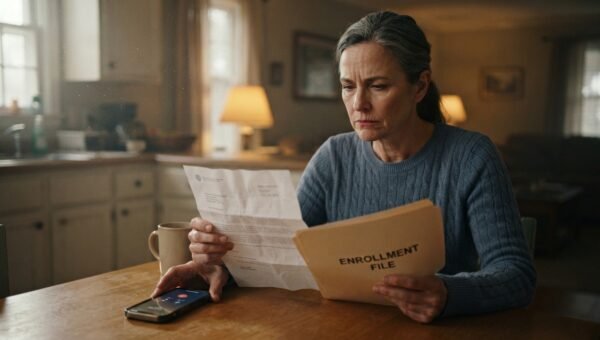
I took that job seriously. On the last Tuesday of every month, I sat down at our oak kitchen table with our three-ring binder, my calculator, a black ballpoint pen, and the monthly statement from Farmers and Merchants Bank. I balanced our checking, our savings, our utility bills, and our house payment to the exact penny. In thirty-six years, I had never carried a balance on a credit card, and I had never bounced a single check.
Last Tuesday evening was no different. Warren was down in the basement workshop rebuilding an antique brass fan, and the low hum of his drill press vibrated softly through the floorboards. I made a mug of decaf tea, set out the newest bank statement that had arrived in the mail that morning, and began running my finger down the transaction columns.
Everything matched up until I reached the third page.
Under the scheduled electronic transfers, right beneath our monthly auto insurance draft, was a line item that stopped my pen in midair.
*AUTOPAY / ACH OUT / #4409 / $800.00 / OCT 15*
I frowned and adjusted my reading glasses. Our mortgage had been paid off four years ago. Our pickup truck was five years old and owned free and clear. We did not have a personal loan, and neither of our two grown daughters had asked for assistance since our youngest finished nursing school in 2018.
I looked at the ending balance. The digit was off by exactly eight hundred dollars from what my running ledger showed.
I told myself it was an error at the processing clearinghouse. Sometimes automated utility debits get crossed when account numbers are updated. I pushed my chair back, walked to the hallway closet, and opened the bottom drawer of our heavy steel filing cabinet.
I pulled out the manila folder for 2025.
I flipped to September. There it was: *AUTOPAY / ACH OUT / #4409 / $800.00 / SEP 15*.
I flipped to August. The exact same transfer. July, June, May, April. Every single statement had the exact same draft of eight hundred dollars leaving our joint checking on the fifteenth day of the month.
A cold prickle of sweat formed at the base of my neck.
I carried three full folders back to the kitchen table. I pulled out 2024, 2023, and 2022. I started checking the bank printouts one by one, my fingers trembling so hard the paper rattled.
The transfers were there. Every single month.
I kept digging. I pulled out folders from 2020, 2019, 2018, all the way back to the winter of 2017.
The first transfer had occurred on November 15, 2017.
Eight years. Exactly ninety-six months. Ninety-six transfers of eight hundred dollars each.
Seventy-six thousand eight hundred dollars had been quietly drained from our joint operating account over nearly a decade, right under my nose.
I sat there in the quiet kitchen, staring at the numbers until they blurred. How had I missed it?
Then the answer hit me, and the pit in my stomach turned to pure ice. In the fall of 2017, Warren had picked up a large recurring commercial maintenance contract with a meatpacking plant forty miles west in Peoria. He had told me back then that the plant’s accounting department paid him in variable bi-weekly direct deposits instead of standard payroll checks. He had told me the company deducted their own insurance co-share before the net funds hit our account. I had trusted his word completely. I had recorded the net deposits as they landed, balanced the final monthly total against his pay stubs, and never realized that eight hundred dollars of his monthly labor was being systematically redirected out the side door before I ever reconciled the ledger.
The next morning, as soon as Warren drove his truck out of the driveway to run service calls, I got into my sedan.
I drove straight to the main branch of Farmers and Merchants Bank in town. I sat across from our longtime loan officer, Jerry. I showed him the recurring transfer number #4409 and asked him where that money was going.
Jerry typed the routing number into his computer, looked at the screen, and leaned back with an uncomfortable look on his face.
“Martha, this isn’t an external merchant draft,” Jerry said quietly. “It’s an internal account transfer. The destination account is held at our north bypass branch out near the interstate.”
“Whose account is it, Jerry?” I asked. “It’s coming out of our joint household funds.”
“I can only tell you the registration,” he said, turning his monitor away from me. “The receiving account is titled solely in Warren’s name. No secondary signer. No co-owner. You aren’t on the signature card, Martha. Because it’s an individual account, banking privacy regulations prevent me from disclosing the balance or the withdrawal history to anyone other than the named holder.”
“I have been his wife for thirty-six years,” I said, my voice barely above a whisper. “We have banked at this counter since 1989.”
“I know, Martha,” Jerry said with genuine sympathy. “I’m sorry. The law doesn’t make exceptions for spouses. If you want the balance, Warren has to pull it himself, or you have to go out to the north branch and ask the branch manager to review the original setup documents.”
I walked out to my car with my knees shaking.
I drove home, went straight to our bedroom dresser, and pulled our official certified marriage certificate from the cedar keepsake box. I took my driver’s license, our joint tax returns from the last three years showing our filed household income, and drove twelve miles across the county to the north bypass branch.
It was a small brick building beside a farm implement dealership. I walked in, asked to see the branch manager, and was shown into a glass-walled corner office.
The manager was a woman in her late forties named Evelyn Bradley. She had a calm, professional manner and silver-streaked hair pulled back into a neat clip.
I laid the bank statements, the marriage certificate, and our joint tax filings on her desk.
“Mrs. Bradley,” I said, looking her in the eyes. “My husband of thirty-six years has transferred seventy-six thousand eight hundred dollars from our joint account into an individual account at this branch over the last eight years. I balance our family books. I discovered this last night. I am not leaving this office until I know where my family’s money has gone.”
Mrs. Bradley looked at the certified documents, then at my face. She hesitated, her fingers resting on her keyboard.
“Mrs. Miller, standard policy strictly restricts third-party disclosures,” she said gently. “However, under our state’s marital property joint-asset review provisions, when joint funds are verified as the exclusive funding source for a secondary non-disclosed account, a spouse has a right to file an administrative inquiry.”
She typed Warren’s social security number into her system. The screen glowed against her reading glasses. She clicked through three screens, and then her hands stopped moving on the keys.
Her expression changed completely. The professional detachment vanished, replaced by an unmistakable look of shock.
She looked up at me, then looked back at the monitor. Slowly, without saying a word, she reached out and turned the heavy flat-screen monitor forty-five degrees so it was facing directly toward me.
I leaned forward and looked at the balance line.
After eight years of quiet eight-hundred-dollar monthly deposits, the total balance in Warren’s private account was exactly two hundred and fourteen dollars and eighteen cents.
The money was gone.
Every single transfer had been systematically withdrawn within forty-eight hours of hitting the account.
PART 2
The glass office was completely soundproof, but my ears were ringing so loudly I could barely hear Mrs. Bradley speaking.
“Where did seventy-six thousand dollars go?” I asked. My voice sounded flat, hollowed out, like it belonged to a stranger standing ten feet behind me.
Mrs. Bradley tapped her desk calendar. “Mrs. Miller, looking at the transaction ledger, these were not automated online transfers or commercial purchases. Almost every withdrawal was executed as an in-person cash disbursement or a certified cashier’s check issued at our drive-thru window on the seventeenth or eighteenth of each month.”
“To who?” I demanded, gripping the wooden edge of her desk until my knuckles turned white. “Who was the payee on the cashier’s checks?”
Mrs. Bradley clicked her mouse, pulling up the digital image archives for the checks.
“Beginning in November 2017, the checks were made out to an individual named Brenda Holloway,” Mrs. Bradley said softly. “The memo lines consistently say ‘Monthly living assistance.’ That continued for four years. Then, in the spring of 2021, the payee changed to a company called Meadowbrook Residential Care in Bloomington. The monthly amount increased to cover room, board, and specialized therapeutic care, supplemented by occasional cash withdrawals.”
The name hit me like a physical blow.
Brenda Holloway.
Brenda was the younger sister of Warren’s best friend and former business partner, Ray Holloway. Back in the early nineties, Warren and Ray had run a sheet metal fabrication shop together on the south side of Peoria. In the winter of 1996, while driving back from an installation job in an ice storm, Ray’s service truck had skidded across the median on Route 24 and hit a concrete bridge abutment. Ray died instantly. Warren had been in the passenger seat, walking away with a fractured shoulder and a severe concussion.
After the funeral, Ray’s family had largely scattered. Brenda was only in her twenties back then, a fragile, quiet girl who struggled with severe mental health issues and lived with their mother until their mother passed away in 2015.
I remembered Warren attending Ray’s mother’s funeral nine years ago. He had come home late, sat on the edge of our bed with his work boots unlaced, and stared at the floor for nearly an hour. When I asked him how the service was, he just shook his head and said, “It was sad, Martha. Some folks just don’t have anybody left in their corner.”
I had thought he was just reminiscing about his lost partner. I never imagined he had set up an eight-hundred-dollar monthly siphon from our household income to secretly fund Brenda’s life.
“Why would he hide this?” I whispered to the empty office.
“Mrs. Miller, I can print the check copies for your personal records since the primary source funds originated from your joint account,” Mrs. Bradley offered gently. “You have a legal right to trace marital assets.”
“Print them,” I said. “Every single one.”
I sat in that chair for fifteen minutes while the laser printer hummed, spitting out ninety-six pages of canceled checks, withdrawal slips, and cashier’s receipts.
When I carried the thick envelope out to my car, my hands were steady. The shock had burned away, leaving behind a cold, sharp anger that felt like polished flint.
I did not call Warren on his cell phone. I did not text our daughters. I drove to the local hardware store, bought a new heavy-duty brass padlock for the basement exterior bilco doors, and drove home.
I walked into our house, went down into Warren’s workshop, and pulled his personal metal strongbox from behind his drill press. The key was taped to the underside of his workbench, exactly where he had kept it for thirty years.
I opened the box.
Inside were his military discharge papers, our original deed, and a thick blue folder labeled *Ray and Brenda*.
I sat on his dusty stool under the hanging bare lightbulb and opened the blue folder.
Tucked into the front pocket was a signed, folded statement written on legal paper, dated December 1996, in Warren’s handwriting.
It was an informal confession.
On the night of the crash that killed Ray Holloway, Warren had been the one behind the wheel of the truck. Ray had been exhausted from working a sixteen-hour shift, and Warren had taken the wheel despite being dead on his feet after drinking two beers at an ironworkers’ tavern an hour earlier. When the state trooper arrived at the wreck, Ray was dead in the crushed driver’s seat. Warren, terrified of facing vehicular homicide charges and prison, had dragged Ray’s body behind the wheel while the truck was still smoking in the ditch, climbing into the passenger seat before the first headlights stopped.
The police report had officially concluded that Ray lost control on black ice. The insurance paid out, the company dissolved, and Warren walked away a free man.
Taped to the back of the confession was a letter from Brenda Holloway dated October 2017.
*Warren,* the letter read in a shaky, erratic hand. *I found Ray’s old journal in my mother’s attic boxes after she died. He wrote down what you told him that night about your drinking. I know what really happened on Route 24. I am sick, my landlord is evicting me, and I have no pension. If you don’t want me taking this journal to the state police in Springfield, you will send me eight hundred dollars on the fifteenth of every month for the rest of my life.*
PART 3
I sat on that wooden stool in the basement for nearly two hours. The cold concrete floor seemed to suck all the warmth out of my body.
The man I had shared a bed with for thirty-six years was not just a quiet provider who trusted me with the family finances. He was a coward who had let his dead best friend take the blame for a fatal accident, and he had spent eight years stealing from our family’s future to buy the silence of a desperate, broken woman.
At five-thirty in the afternoon, the crunch of gravel outside announced Warren’s truck pulling into the driveway.
I heard his heavy work boots stomp the dirt off on the back porch mat. The back storm door opened and clicked shut.
“Martha?” his deep voice called out from the kitchen. “Smells good in here. What are we having for supper?”
I did not answer.
I picked up the blue folder, climbed the wooden basement stairs, and stepped into the kitchen.
Warren was standing at the sink, washing machine grease from his forearms with orange pumice soap. He turned his head, smiling with his usual tired grin, reaching for a paper towel.
“Hey, hon. Didn’t hear you down there. You working on the freezer again?”
I walked to the kitchen table. I did not sit down. I dropped the blue folder, the ninety-six pages of canceled cashier’s checks, and his handwritten 1996 confession right onto the center of the oak tabletop.
The heavy stack landed with a dull, sickening thud.
Warren’s smile froze. He looked at the white printouts, then his eyes dropped to the weathered blue cover of his personal strongbox folder.
The paper towel in his hand slowly slipped from his fingers, falling onto the wet linoleum floor.
The color drained from his face so fast he looked like a corpse standing by the sink. His mouth opened, closed, and opened again, but not a single sound came out.
“Martha,” he whispered. His voice was cracked, thin, and totally devoid of strength. “Where did you get that?”
“I balanced the checkbook, Warren,” I said. My voice was as quiet and cold as a tombstone. “Like I have done every month since June of 1989.”
Warren backed up until his shoulder blades hit the refrigerator. He raised two shaking, grease-stained hands toward his chest.
“Listen to me, Martha,” he stammered, his eyes darting frantically from the table to the back door. “It isn’t what you think. It was an arrangement to help Ray’s family. Brenda was destitute. She was on the street. Ray was like a brother to me, and I couldn’t let his sister starve.”
“Do not lie to me, Warren,” I said, pointing a finger directly at the yellowed legal paper on top of the pile. “I read your confession. You didn’t give her seventy-six thousand dollars out of Christian charity. You gave her seventy-six thousand dollars of our family’s money because she was blackmailing you for leaving Ray to take the fall for your drunk driving on Route 24.”
Warren dropped to his knees.
He didn’t just sit; his legs completely gave out beneath him. He hit the kitchen floor, clutching the edge of the kitchen table with both hands, burying his face against the wooden apron of the table, weeping like a broken child.
“It was black ice, Martha,” he sobbed, his shoulders heaving violently under his flannel shirt. “I swear to God on our children’s lives, the ice took the truck! But I had two beers at the tavern. The trooper smelled the alcohol on my coat. I panicked. I was twenty-eight years old, we had an eleven-month-old baby at home, and I thought they were going to put me in prison for twenty years. I moved him. I moved Ray into the driver’s seat.”
“And you let his mother die thinking her only son killed himself driving too fast on an icy bridge,” I said, looking down at his bowed head with pure revulsion.
“I have lived in hell for thirty years, Martha!” he wept, looking up with red, swollen eyes. “Every time I closed my eyes, I saw Ray’s face through the cracked glass. When Brenda found the journal, I felt relieved. I thought paying her would balance the ledger. I thought if I kept her safe and paid for her nursing home, God would forgive me.”
“You didn’t balance the ledger with God, Warren,” I said, stepping back from his reaching hands. “You stole seventy-six thousand dollars from our household savings. You took the money that was supposed to secure our old age, the money we were going to use to help our grandchildren with their college, and you paid hush money to protect your own skin.”
“I will pay it back,” Warren begged, crawling on his knees across the floor toward me, reaching for the hem of my pants. “I will take on a night shift at the commercial plant. I will sell the boat, I will sell my tools, I will work until I drop dead in the shop. Just don’t tell the girls, Martha. Please don’t let our daughters know what their father is.”
I looked down at the man I had loved for nearly four decades. The respect, the admiration, and the safety I had felt in his presence for thirty-six years was gone, completely dissolved into thin air.
“Get up off the floor, Warren,” I told him. “And pack your clothes.”
ENDING
Warren did not fight me. When a man’s thirty-year secret finally rots out from under him, he has no fight left.
He packed two duffel bags of work clothes, his shaving kit, and his winter coat. He moved into a small, furnished extended-stay motel off the highway near the commercial park where his maintenance shop was located.
The next morning at eight-thirty, I walked into the office of a family law attorney in town named Richard Henderson. I laid the bank printouts, the canceled checks, and the copies of Warren’s confession on his desk.
“Under Illinois law, this is clear fraudulent dissipation of marital assets,” Mr. Henderson told me after reviewing the financial trail. “Warren cannot simply redirect nearly eighty thousand dollars of joint marital property without your knowledge or consent, regardless of the emotional motive. When we file the petition for dissolution of marriage, we will seek full offsetting equity from the marital estate.”
The divorce took seven months to finalize.
Because the evidence of the financial diversion was undeniable, Warren’s attorney agreed to a full property settlement without going to trial. Warren signed over the entire deed to our brick home and its three acres to me, free and clear of any encumbrance. He surrendered his entire half of our primary savings accounts, along with forty-five percent of his commercial union pension, which now transfers directly to my private account on the first of every month.
He was left with his work truck, his tools, and a small rental duplex on the edge of town.
I did not take the 1996 confession to the state police. I thought about it for weeks, sitting alone in that quiet house. But the statute of limitations on vehicular offenses from thirty years ago had long expired, and bringing criminal scrutiny would only bring public humiliation down onto the heads of our two daughters and our three grandchildren.
I did, however, drive over to the Meadowbrook Residential Care facility in Bloomington three weeks after the papers were served.
I asked to see Brenda Holloway.
She was fifty-four years old, but she looked seventy. She was confined to a wheelchair, her hair thin and gray, her hands curled by severe rheumatoid arthritis. She sat in a sunny corner of the facility’s dayroom, staring out the window at the garden.
When I introduced myself as Warren’s wife, a faint, sad shadow crossed her face.
“Are you going to stop the payments?” she asked, her voice raspy and frail. “They will put me out on the county bus if the room isn’t paid.”
I sat in the vinyl chair beside her. I looked at the daughter and sister of a family that had been broken thirty years ago by a lie.
“No, Brenda,” I told her softly. “The room will stay paid. But the money will no longer come from Warren Miller. It will come through a direct court-ordered custodial account managed by my attorney. You will have your bed, your medicine, and your dignity. But you will never contact Warren again, and you will never ask for another dime beyond your actual care.”
A single tear rolled down her hollow cheek, and she nodded slowly.
Our daughters found out the basic truth about the divorce. I did not tell them the details of the crash on Route 24; they only know that their father had maintained a secret financial life and drained our family savings for eight years without my consent. That was enough. Their relationship with Warren is formal, strained, and distant. They visit him on holidays for an hour, but they never ask him for advice, and they never leave their children alone in his care.
Last night was the last Tuesday of the month.
I sat down at my oak kitchen table with my tea and my ledger binder. The house was quiet, but it was not lonely. It was clean.
I opened the new statement from Farmers and Merchants Bank.
I ran my black ballpoint pen down the column. My pension deposit was there. The utility debits were there. And on the final line, every single penny balanced out to zero.
I closed the binder, turned off the kitchen light, and walked down the hallway to sleep in a bed that belongs only to me.