PART 1
The lender called me at seven in the morning on a Tuesday to tell me the first payment was fourteen days past due. The monthly bill was $482, and because my name was on the loan as the co-signer, the late mark had already dropped my credit score by forty points. I had three missed calls to my brother Kevin from the weekend before that he never returned.
Kevin had sat at my kitchen table six weeks earlier with coffee I poured him, swearing he just needed my signature to get a reliable commuter car for his job. He was thirty-eight, three years younger than me, and he had a seven-year-old son named Toby. Kevin said his own credit was bruised from his divorce two years ago, but he promised he had steady work doing residential painting and would never let a payment slip. I trusted him because he was my brother, and because Toby spent every other Sunday afternoon at my house eating grilled cheese and playing board games.
When the bank called a second time the following week, Kevin’s phone went straight to voicemail. His voicemail box was completely full. I drove by the small rental house he leased on Maple Street after work, but his old work truck was gone from the driveway and the front blinds were drawn shut. I knocked until my knuckles were sore. Nobody answered.
I spent the next three days feeling sick to my stomach. I am fifty-four years old and work as an administrative clerk for the county water district. I do not have extra cash sitting around to cover a $28,000 auto loan on a vehicle I did not even drive. I thought my savings were going to be drained just keeping the repo man away.
Then, on a Friday afternoon around four, a mechanic named Ray called my cell phone.
“I have a 2021 silver crossover sitting in my rear lot,” Ray said. “The driver dropped it off after hours two nights ago with a note on the dash asking for an oil change and brake inspection, but nobody came back for it. I went into the glove box looking for a registration or insurance card so I could reach the owner.
All I found were delivery receipts and papers with your name and phone number on them.”
I left work twenty minutes early and drove straight across town to Ray’s shop on Route 4. The silver crossover was parked by a chain-link fence behind two rusted pickups. When I walked up to it, I tried the driver’s door handle. The car was completely unlocked.
I opened the glove compartment, expecting to find the actual loan agreement, the title application, or maybe an envelope explaining what was happening. There was no loan contract inside. There was only a piece of white construction paper folded into fourths.
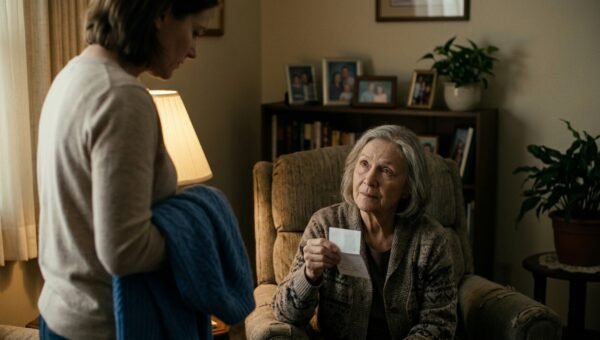
I unfolded it. It was a child’s drawing made with wax crayons. Toby had drawn our family standing in front of Kevin’s rental house. There was Kevin, there was Toby, and there was me in the blue cardigan I always wore. But somebody had taken a thick black crayon and scratched heavy, violent X marks back and forth across my face and body until the paper tore slightly in the center.
I flipped the sheet over. On the back, written in Toby’s uneven third-grade handwriting with pencil, were two sentences:
“Dad says you cannot come back because you know about the garage.”
My hands shook as I read it twice. I had never set foot inside Kevin’s detached garage. Whenever I dropped Toby off or picked him up, Kevin always met me at the driveway gate, walked Toby to my car, and stood there until I backed out into the street.
Ray walked out from the service bay, wiping grease off his palms with a blue rag. He reached into his pocket and looked at me with a quiet, tired expression.
“Found one more thing when I vacuumed the floor mats,” Ray said.
He held out a single brass key with yellow masking tape wrapped around the head. He had pulled it from underneath the driver’s seat.
PART 2
I took the brass key from Ray’s hand. The yellow masking tape was worn at the edges, and someone had written a single number on it with a faded black marker: 14.
“Did you recognize the guy who left the car?” I asked Ray.
“No,” Ray said, shaking his head. “He dropped the keys in the overnight drop box on Wednesday night. The security camera over the door only caught a man in a dark hooded jacket and a baseball cap. He walked off down the shoulder toward the bus stop on Route 4. Didn’t look like he was in a hurry.”
I thanked Ray, paid him thirty-five dollars for holding the car on his lot, and sat in the driver’s seat of the crossover. The car smelled like stale fast food and damp carpet. In the center console, there was only a handful of loose pennies and an empty receipt from a gas station three miles from Kevin’s rental.
I looked at the drawing again. Toby’s handwriting was neat for an eight-year-old, but the pencil had pressed so hard into the paper that it left deep ridges. Dad says you cannot come back because you know about the garage.
Kevin had rented that house on Maple Street fourteen months ago. It was a small, pale-yellow bungalow with a detached two-car garage at the end of a long gravel driveway. Every time I had visited Toby or brought over groceries, the garage doors had heavy padlocks on them. Once, when Toby asked if his bicycle was in the garage, Kevin had snapped at him so sharply that Toby started crying. Kevin told me back then that the landlord used the garage to store commercial lawn equipment and that the lease strictly forbade anyone from going inside.
I had believed him. I never had a reason not to.
I put the key into the crossover’s ignition and drove straight to Maple Street. The sun was going down behind the treeline, casting long, cold shadows over the street. When I pulled up to Kevin’s house, the driveway was still empty. The mailbox at the curb was stuffed full of circulars and unopened utility bills, some of them sticking out into the damp air.
I walked up the front steps and rang the bell. Nothing. I looked through the front window, cupping my hands against the glass. The living room looked normal, if slightly cluttered, with Toby’s backpack slumped against the sofa and Kevin’s work boots by the coat rack.
I walked down the side path toward the backyard. The detached garage sat beneath a large oak tree. On the side door of the garage, there was a heavy deadbolt lock instead of the old padlocks.
My heart hammered against my ribs as I lifted the brass key with the number 14 written on the yellow tape. I slipped it into the cylinder. It slid in smoothly. I turned it to the right, and with a dull, heavy click, the bolt slid back.
PART 3
I pushed the heavy wooden door open. The air inside smelled like damp concrete, motor oil, and old cardboard.
I reached along the inner frame until my fingers found a plastic toggle switch. A single bare fluorescent tube hummed to life overhead, flickering twice before casting a harsh white glare across the room.
There were no lawn mowers or landlord equipment inside.
The entire twenty-by-twenty space was stacked neatly with heavy cardboard cartons, plastic storage bins, and rows of metal shelving. On each box, neat labels were written in black grease pencil: tools, copper piping, unopened boxes of high-end bathroom fixtures, commercial circuit breakers, and spools of industrial electrical wire.
Against the far wall, on a folding card table, sat a black ledger notebook and a stack of shipping manifests. Next to the ledger was a pile of unopened mail addressed to Kevin from an insurance adjuster and a local construction contractor named Miller Brothers Supply.
I opened the black ledger.
The first page dated back eight months. It wasn’t painting income. It was an inventory log. Kevin had been using his job as an interior painter on commercial and residential renovation sites to steal supplies, high-value plumbing fixtures, and excess materials from job sites after hours. Every item had a date, a site address, and a cash sale price written next to it. Some were marked sold, with cash amounts running between $800 and $2,400.
I turned the page and found a folded bank statement from three weeks earlier.
Kevin had an account at a local credit union that I never knew existed. The balance listed on the statement was $34,210.
He had never needed my money. He had never needed me to put my neck on the line for his $482 car payments. He had plenty of cash sitting in an account right here in town.
I stood by the folding table, staring at the numbers, when the shadow of a small figure appeared in the open doorway behind me.
I spun around. Toby was standing by the door frame, wearing his oversized winter coat and holding a half-eaten granola bar. Behind him, standing on the gravel path with his hands stuffed into his jacket pockets, was Kevin.
Kevin looked thinner than he had six weeks ago, his eyes red-rimmed and guarded. He stepped into the garage, gently nudged Toby back toward the yard, and pulled the wooden door almost shut behind him.
“You shouldn’t be in here, Jane,” Kevin said. His voice was flat, with no anger in it, just an exhausting, hollow defeat.
“You co-signed this car in my name and left it at a repair shop so the bank would come after me,” I said, pointing directly at the ledger on the table. “You have thirty-four thousand dollars in an account, Kevin. You let my credit take a hit. You told your son I was the enemy.”
Kevin looked down at the concrete floor. “The contractor noticed the missing fixtures two weeks ago. The police came by my work site to ask questions. I panicked, Jane. I thought if they got a warrant for my name, they’d seize everything I owned, including the car. I put the car in your name so they couldn’t touch it. I stopped paying because I was getting ready to pack Toby up and go stay with Mom’s sister in Ohio until the heat died down.”
“And the drawing?” I asked, my voice trembling. “Why did you make Toby cross me out?”
Kevin didn’t look at me. “Toby found the garage door unlocked three weeks ago. He walked in while I was organizing the boxes. He asked me what all this stuff was, and I lost my temper. I told him we were in trouble, and that if anyone found out, the police would take me away. He asked if Aunt Jane knew. I told him… I told him you already knew, and that you were the reason we might lose the house, just so he would stop asking to see you. I didn’t want him running to your house and telling you what was out here. I knew you’d make me turn myself in.”
He looked up at me then. There was no grand excuse. He had used me as a financial shield to protect a vehicle he bought with dirty money, and he had poisoned his own son’s mind against me to keep his petty theft from coming to light.
“Give me the key, Jane,” Kevin whispered. “Let us just pack the truck and leave. Nobody has to know you were here.”
I looked at my younger brother, the boy I had walked to elementary school, the man I had trusted to protect my modest savings.
“No,” I said. “I’m not protecting you.”
ENDING
I walked out of that garage into the cool evening air. Toby was sitting on the back porch steps, throwing small pebbles into the dirt. I walked over and sat down beside him on the cold wood.
“Toby,” I said softly.
He didn’t look up at first. “Dad said you were mad at us.”
“I am not mad at you, honey,” I said, pulling the folded drawing from my pocket and setting it between us on the step. “I love you. I have always loved you. Your dad made a very bad choice, and he told you something that wasn’t true to keep himself out of trouble. But I never wanted you to leave, and I never wanted to hurt you.”
Toby looked at the torn paper with the black crayon marks, then leaned his head against my shoulder and started to cry. I held him until his breathing slowed down.
I called the police from Kevin’s driveway while Kevin sat inside on the sofa with his head in his hands.
When the two cruisers pulled up twenty minutes later, I handed the officers the brass key and showed them the inventory ledger in the garage. I gave them the crossover’s paperwork and told them exactly where the car was parked.
Because Kevin had used my clean credit and personal information to obtain the vehicle under fraudulent pretenses while using illicit funds, the lender and the county investigator allowed the sale of the vehicle through an impound settlement to satisfy the outstanding loan balance without leaving a permanent default on my record. It took five months of paperwork, phone calls with the bank’s fraud department, and certified letters, but the debt was cleared from my name.
Kevin took a plea agreement for grand larceny and possession of stolen property. He is currently serving eighteen months at a minimum-security facility two counties away.
Toby came to live with me.
His bedroom is the spare room upstairs where my old sewing machine used to sit. We painted the walls a soft blue last month, and he has a desk near the window where he does his third-grade homework every afternoon.
The brass key is gone, turned over as state evidence months ago. But the crayon drawing is still with me. I keep it in the bottom drawer of my nightstand, smoothed out flat between the pages of an old dictionary. It reminds me every day that protecting family does not mean covering up their rot; it means standing firm enough in the truth so the innocent ones have a safe place to land.