PART 1
I asked Leo why he was late to homeroom again, and he gave me the silliest answer he could think of.
He was fifteen, tall enough that his knees hit the underside of the front desk, and usually tired around the eyes. On that Tuesday morning in early October, he walked in ten minutes after the second bell, dragging his sneakers against the linoleum. When I looked up from my attendance ledger and asked where he had been, he grinned.
“Ma’am, I dreamed I was playing football and scored the winning goal,” he said.
The other kids laughed. It was the kind of joke teenagers make when they want to buy three seconds of breathing room.
I sighed and set my red pen down on the blotter. “That is not an excuse for being late, Leo.”
His grin stayed, but it thinned out around the edges. “Well, ma’am, they went into overtime. I couldn’t just walk off the field.”
The classroom broke into small chuckles again, and I told everyone to open their workbooks to page forty-eight. Leo slid into the desk near the radiator, rested his forehead against his palm, and fell quiet. I had taught ninth-grade English at Oak Ridge for twenty-two years. At fifty-eight, I knew the difference between a class clown who wanted an audience and a kid who was running on empty. Leo used humor like a shield.
Whenever he had missed homework or showed up late over the past month, he tossed out a fast joke to keep anyone from asking a second question.
During third period, Leo went down to the nurse with a headache. When the bell rang for lunch at noon, I noticed his canvas backpack was still leaning against the side of his desk. It was an old gray pack, frayed at the shoulder straps, with a faded sports logo on the front pocket.
I picked it up to take it down to the main office so he would have it before the end of the day. The bag was unexpectedly heavy, but the zipper on the main compartment was split open about three inches. Sticking straight up between two cheap spiral notebooks was a folded cardboard folder labeled county assistance, along with three pharmacy receipts paper-clipped to the corner.
I did not mean to snoop, but the top receipt caught my eye as I tucked the flap back in.
It was from the 24-hour pharmacy on Route 4, dated 2:14 AM that very morning, for insulin syringes and test strips. Under the patient line was the name Martha Miller. That was Leo’s grandmother, the only guardian listed in his student file.
I remembered what he had said at 8:10 that morning: they went into overtime. He had not been sleeping in. He had been standing in a fluorescent-lit pharmacy three miles out of town in the middle of the night.
PART 2
I carried the bag down to the front office, but instead of leaving it on the lost-and-found shelf, I kept it by my feet while I asked our guidance counselor, Brenda, about Leo’s home setup. Brenda had been at Oak Ridge almost as long as I had.
“Martha Miller raised him since he was seven,” Brenda said, pulling up the family contact screen on her computer. “His mother moved out of state years ago.
Martha used to work the register at the hardware store downtown, but she stopped about six months back. As far as we know, it is just the two of them.”
“Has anyone done a home check?” I asked.
Brenda shook her head. “He passes his classes with C’s. He does not cause trouble. When a kid behaves himself, the district does not look too closely. You know how it is, Clara.”
I did know. In a public school with eight hundred students, the quiet ones slipped through the floorboards every day.
After seventh period, Leo came back to my room to retrieve his bag. The hallways were loud with lockers banging and kids yelling about Friday night’s game, but my classroom was empty. He walked in with his hands buried in the pockets of an oversized hoodie.
“Nurse gave me some water and let me rest,” he said, picking up his backpack from the chair where I had set it. “Thanks for saving my stuff, Mrs. Vance.”
“Leo,” I said, keeping my voice gentle. “Sit down for two minutes. Please.”
He hesitated, then pulled out the chair across from my desk. He did not look at me; he looked at the wooden ruler resting beside my planner.
“I saw the receipt on top,” I told him plainly. “From Route 4. At two in the morning.”
His shoulders stiffened. He did not get angry or defensive. Instead, the small trace of boyish energy left his face entirely, leaving behind someone who looked thirty years older than fifteen.
“My grandmother had a bad spike last night,” he said, staring at the floor. “Her machine stopped reading, and she got scared. The neighborhood pharmacy was closed, so I took the bus out to the highway store. The night bus only runs once an hour after midnight.”
“Why did you make up that story about the football game this morning?”
“Because if I told you the truth, you’d feel bad for me,” he said simply. “Or somebody would call family services. My grandma can still take care of things. She’s just having a rough patch with her feet.”
“Leo, you were out on the highway at two in the morning on a school night.”
“I got home at four,” he said. “I slept two hours. I’m fine.”
I looked at his thin wrists and the frayed hem of his sleeve. “Is there anyone helping her?”
“My uncle comes by sometimes,” Leo muttered, his jaw tightening slightly. “He handles her check.”
That was the first time his tone changed from tired to bitter. He picked up his bag, slung it over one shoulder, and stood up before I could ask what he meant.
PART 3
I could not let it go. That evening after grading essays, I looked up the address on his emergency card. It was a small wood-frame house on Cedar Street, three blocks behind the train tracks.
The next afternoon, right after dismissal, I drove over under the pretext of bringing Leo the makeup reading packets for the days he had missed. When I knocked on the screen door, an older woman with silver hair pulled into a loose knot opened it. She was leaning heavily on a four-pronged aluminum cane, her right foot wrapped in a thick orthopedic bandage.
“Mrs. Miller?” I asked. “I’m Clara Vance, Leo’s English teacher.”
Her face softened with immediate anxiety. “Is Leo in trouble? Did he skip?”
“No, ma’am,” I said quickly. “He is doing fine. I just wanted to bring him his reading assignments, and I wanted to check in on you.”
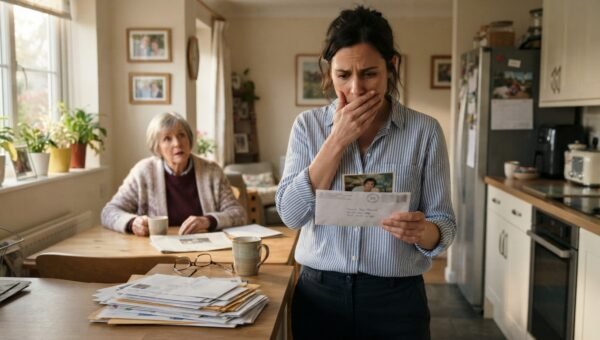
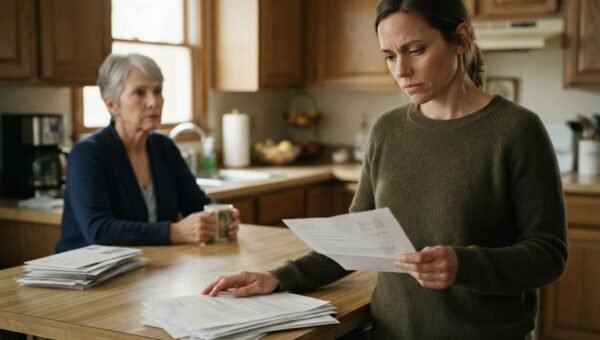
She invited me inside. The living room was clean but sparse. An old box television sat on a low stand, and on the small dining table was a neat stack of unpaid utility notices alongside an empty box of diabetic testing supplies.
Martha sat in an armchair with an extra cushion behind her back. Once she understood I was not there to report her to the state, the whole story came out in quiet, halting sentences.
Her monthly Social Security check was $1,420. Her late husband had left her a small survivor benefit of $350. It was enough to cover their $900 rent, groceries, and basic utilities, provided her medication copays stayed low. But two months earlier, her son Wayne—Leo’s uncle—had offered to take over paying her monthly bills online because her arthritis made writing checks difficult.
“Wayne told me the power bill jumped to $600 because of the summer heat,” Martha whispered, twisting the hem of her apron. “He said the city increased the water rates, too. He’s been taking $800 out of my account every month to handle it. But the past two weeks, the shut-off warnings started showing up in the mail. And my test strips weren’t filled. Leo had to take his lawn-mowing savings from his nightstand to buy those strips on Route 4.”
I felt a tight knot form in my chest. “Do you have the bank statements, Martha?”
She pointed with her cane to a shoebox under the credenza. I pulled out the last two months of statements from the local credit union. It took less than three minutes to see what Wayne was doing. There were no online payments to the power company. Instead, there were two cash ATM withdrawals of $400 each at an off-track betting parlor near the county line, along with a dozen debit charges at gas station convenience stores.
Wayne was skimming her living money while Leo skipped sleep to keep the electricity on and his grandmother alive.
While Martha was looking over the statements, the front door clicked open. Wayne walked in carrying a single bag of generic groceries. He was a thick-set man in his forties with an unironed work shirt. When he saw me sitting on the sofa with Martha’s credit union papers in my lap, he stopped right in the entryway.
“Who’s this?” Wayne demanded, setting the grocery bag roughly on the counter. “Mom, what’s going on here?”
“I am Leo’s teacher,” I said, standing up. “And Martha was just showing me why Leo has been walking to the all-night pharmacy at two in the morning to buy her medical supplies with his own chore money.”
Wayne’s face flushed a dark, angry red. “That’s family business. You don’t have any right coming into my mother’s house and digging through her mail.”
“I am not digging through her mail,” I said, keeping my voice entirely level. “I am looking at bank statements that show eight hundred dollars pulled out at a betting parlor while the city is threatening to cut off her electricity on Monday. If that power goes off, her insulin goes bad in the fridge.”
“You don’t know what you’re talking about,” Wayne said, stepping closer to the table. “I pay her bills. I take care of her.”
“Leo takes care of her,” I replied, pointing directly at the electric notice stamped with urgent red ink. “He took care of her last night while you were spending her survivor benefit. If you do not deposit that money back into her account by tomorrow noon, I am walking these statements across the street to Adult Protective Services and filing a formal elder exploitation report. I am a mandated reporter, Wayne. That is not a threat. That is my legal obligation.”
The room went dead silent. Wayne looked at me, then at his mother. Martha did not yell. She just looked at her son with a heavy, steady sadness that took whatever fight he had left right out of him.
“Get out, Wayne,” Martha said, her voice shaking only slightly. “Give me back the debit card right now, and get out of my house.”
He reached into his pocket, dropped the plastic card onto the table next to the unpaid notices, and walked out without another word.
ENDING
The next morning, Wayne did not show up at the bank, but he did not come back to the house either.
By Friday afternoon, Brenda and I had connected Martha with the county senior advocate office. Because Martha was mentally clear and able to speak for herself, the advocate helped her revoke Wayne’s third-party authorization on the credit union account, set up direct automatic drafts for the rent and electric bills, and enrolled her in a state pharmacy assistance program that brought her monthly copays down to twelve dollars.
We also arranged for a volunteer driver from the local community center to take her to her foot doctor appointments twice a month, so Leo would not have to leave class early to help her down the front steps.
On Monday morning, the second bell rang at 8:00 AM.
At 7:58, Leo walked through the doorway of my classroom. He hung his gray canvas backpack over the back of his chair, pulled out his worn copy of the reading packet, and sat down at his desk. He looked rested for the first time since September.
I stood by my podium with the attendance sheet. When our eyes met, he didn’t offer a joke about touchdowns or overtime. He just gave me a small, quiet nod from across the room.
“Good morning, Leo,” I said.
“Good morning, Mrs. Vance,” he replied, and opened his notebook to a clean page.