PART 1
The knock came on a freezing Tuesday evening, just after eight o’clock. When I opened the front door, my nineteen-year-old niece, Chloe, was standing on my porch with her shoulders hunched against the biting wind. She was wearing thin sweatpants and sneakers, but she had no winter coat, only an oversized hoodie. Over one shoulder hung a single black nylon backpack that looked limp and barely half-full.
“Aunt Evelyn, please,” she whispered. Her lips were pale, almost blue around the edges. “Can I just stay on your couch for a couple of days?
Mom and I had a huge screaming match, and I couldn’t stay there tonight.”
I pulled her inside immediately, shutting the door against the cold. She was shivering so hard her teeth were clicking together. When I reached out to help slip her backpack off, she flinched, pulling back sharply as if she expected me to strike her. That was when the porch light caught the side of her face. Across her right collarbone and climbing slightly up the side of her neck was an ugly, mottled purplish bruise.
“Chloe, sweetheart, what happened to your neck?” I asked, keeping my hands at my sides so I wouldn’t startle her again.
She reached up quickly, tugging the hoodie collar higher. “Volleyball scrimmage on Sunday,” she muttered, staring down at my hardwood floor. “A girl drove hard for a spike and collided with me at the net. It looks a lot worse than it feels.”
I had played college volleyball thirty years ago. A collision at the net gives you bruises on your forearms, your knees, or maybe your ribs from hitting the floor. It does not leave five distinct, faded fingertip shadows near the base of the throat. But Chloe was trembling, exhausted, and barely standing on her feet, so I did not push her. I warmed up a bowl of beef stew, gave her a pair of my thick wool socks, and set up the guest room at the end of the hall.
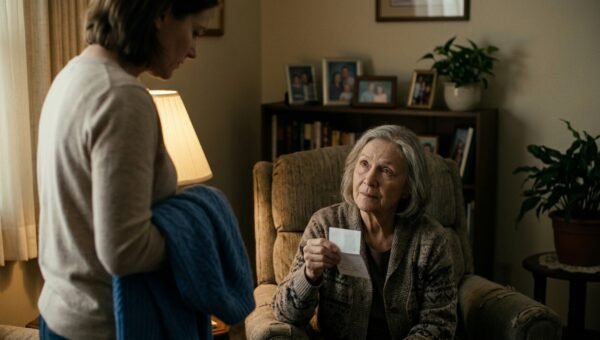
For the first two days, she barely made a sound. She came out to eat whatever I cooked, washed her dishes immediately, and hurried back into the guest bedroom. She kept her door closed, and whenever I walked past, the house was dead quiet. She told me she was taking an online semester from community college, but I never once heard her typing, watching a video, or talking to a friend on the phone.
The real warning sign came on Thursday night. Around two in the morning, I got up to get a glass of water from the kitchen. As I walked down the dim hallway past the guest room, I bumped my elbow against her door. It rattled slightly in the frame, and I heard a sharp scraping sound on the other side.
I stopped and peered closely at the gap under the door. The floorboards were clear, but when I looked at the brass doorknob, I could tell something heavy was pressed against the interior latch. The next morning, when Chloe finally stepped out to use the bathroom, she left the bedroom door open a couple of inches. I glanced inside. The heavy wooden desk chair had been dragged across the room and wedged firmly beneath the brass knob, its back angled tightly under the lever.
She was sleeping barricaded inside my home.
At noon on Friday, I went into my home office, closed the door, and dialed my younger sister, Brenda.
Brenda and I had drifted over the last five years, ever since she married Greg Larson. Greg was a regional supervisor for a private industrial security firm that handled contracts for shipping warehouses near the river. He was a loud, rigid man with an aggressive temper who always treated family dinners like military drills. I never liked the way he talked to Brenda, and Brenda had slowly stopped answering my calls as Greg took over managing every single penny and decision in their household.
The phone rang four times before Brenda picked up.
“Brenda, it’s Evelyn,” I said quietly. “Chloe is here.”
There was an immediate, sharp intake of breath on the other end of the line. The silence lasted so long I thought the call had dropped.
“Send her home,” Brenda said. Her voice was flat, tight, and completely stripped of warmth.
“Brenda, she’s terrified,” I pressed, keeping my voice low. “She showed up here with no winter coat, a bruised neck, and now she is literally barricading herself in my guest room with a chair every single night. What is going on in that house?”
“Evelyn, do not get involved in this,” Brenda snapped, her voice trembling with a panic she was clearly trying to suppress. “She’s an adult. She needs to stop being dramatic and get on a bus back to this house today. If Greg finds out she’s hiding out with you, it’s going to make everything worse. Put her on a bus, Evelyn. Right now.”
Before I could say another word, she hung up the phone.
I stood there in my office with the receiver pressed to my ear, listening to the dial tone, my stomach sinking like lead. Chloe had not run away over a simple shouting match about chores or college grades. Brenda was terrified of her own husband.
Saturday morning, the situation turned into a nightmare.
It was eight-fifteen. I was standing by the stove flipping pancakes when the black landline on my kitchen wall rang. Almost nobody called that landline anymore except my pharmacy and automated political surveys. I picked it up without thinking.
“Hello?”
“I need to speak with Chloe Miller,” a man’s voice said. It was deep, completely calm, and entirely unfamiliar. He didn’t say hello, and he didn’t introduce himself.
“Who is calling, please?” I asked, feeling a prickle of cold air run across the back of my neck.
“Put Chloe Miller on the phone, Evelyn,” the man replied smoothly. “We know she’s there.”
The line clicked dead.
I dropped the receiver onto the cradle. The metal chime inside the phone rang out with a tiny, hollow clang. Chloe had just stepped out of the guest room, walking into the kitchen to pour a cup of coffee. When she saw the look on my face, she froze in the doorway.
“Who was that?” she asked, her voice barely a whisper.
“Chloe,” I said, stepping between her and the window facing the street. “A man just called my landline. He knew your full name, and he called me Evelyn.”
Chloe went entirely white. Her knees gave out, and she had to grab the edge of the kitchen counter to stop herself from collapsing onto the tile. Her breath came in short, jagged gasps, and her entire body began to shake so violently that her mug rattled against the granite counter.
“They traced my phone,” she sobbed, burying her face in her hands. “I took the battery out before I got on the bus, but they must have pulled the ticket records or tracked Mom’s calls. Oh God, he found me.”
“Who found you, Chloe? Greg?”
“Not just Greg,” she choked out. She suddenly sprinted down the hallway toward the guest room.
I followed her at a run. She dropped to her knees on the guest room carpet, snatched her black nylon backpack from the corner, and ripped the main zipper open. She didn’t pull out clothes or toiletries. Instead, she dug her fingers into the very bottom seam, where the stiff black fabric felt unusually thick. She grabbed a small tear along the bottom piping and pulled hard.
A hidden interior seam tore open with a sharp rip. Chloe reached deep beneath the fabric lining, her hand trembling, and pulled out an object.
It was a thick, laminated white plastic key card clipped to a heavy black lanyard. Printed across the top in bold red letters was the logo for a regional logistics corporation. In the center was an official security clearance badge, bearing an encoded microchip, a numerical key sequence, and a color photo.
The face on the photo belonged to my brother-in-law, Greg.
PART 2
The badge was stamped with the words RESTRICTED ACCESS – LEVEL 4 LOGISTICS & RECOVERY. Beneath Greg’s photo was his title: Lead Security Coordinator.
“What is that?” I asked, kneeling on the floor beside her. “Why do you have Greg’s work badge?”
“It’s not just his badge,” Chloe whispered. Her fingers were trembling so hard she almost dropped it onto the rug. She flipped the card over. Taped securely to the back of the plastic card with two strips of clear packing tape was a tiny, rectangular metal flash drive, no bigger than a stick of chewing gum. “This is why Greg tried to kill me.”
The room went completely still. The hum of the refrigerator in the kitchen sounded deafening.
“Chloe, start from the beginning,” I said, putting my hand firmly on her shoulder. “Tell me everything. Do not leave a single detail out.”
She took three ragged breaths, staring down at the little black flash drive. “Last Sunday night, Greg left his company laptop open on the dining room table while he went outside to smoke. Mom was in the shower. I walked by to get a soda, and the screen was glowing. There were several bank transfer confirmations open on the screen. Big ones. Tens of thousands of dollars moving through an offshore dummy account.”
“What kind of money?”
“Greg isn’t just a guard at those river warehouses, Aunt Evelyn,” Chloe said, tears finally spilling down her cheeks. “His company handles impounded freight and high-value cargo staging for regional shipping lines. Over the last two years, Greg and a couple of drivers have been intercepting electronics, prescription pharmaceuticals, and luxury goods from sealed shipping containers. They list the freight as damaged in transit or lost at sea, write off the insurance, and then sell the stolen pallets through an illegal salvage broker in town.”
The puzzle pieces began slamming into place with terrifying speed. Over the past three years, Greg had bought a new heavy-duty truck, a boat he kept in dry storage, and had paid off Brenda’s credit card debts in cash, always claiming he was making enormous overtime bonuses. Brenda had looked more exhausted and nervous with every passing month.
“I saw the broker’s ledger on the screen,” Chloe continued, her voice trembling. “I saw dates, container numbers, and payroll payouts to Greg’s private account. I was horrified. I knew if he got caught, Mom would be dragged down with him. I grabbed his backup flash drive from his desk drawer, plugged it in, and dragged the entire folder onto it. But while it was copying, Greg walked back into the house.”
She reached up with one hand, involuntarily touching the mottled purple bruise on her neck.
“He caught me standing over the laptop,” she whispered. “He slammed the lid down, grabbed me by the throat, and shoved me backward into the wall. He squeezed until my vision went completely black. He told me that if I ever spoke a single word of what I saw, he would bury me in a concrete drainage pipe by the shipping yards, and that nobody would ever find me. He said Mom’s life depended on my silence.”
“Dear Lord,” I breathed, my stomach turning violently.
“He thought I only had time to look at the screen,” Chloe said. “He didn’t realize the files had already finished transferring to the drive in my pocket. He let go of my neck, slapped me across the face, and threw me into my bedroom, locking me in from the outside. The next morning, while he was in the garage, Mom unlocked the door. She shoved forty dollars into my hand and told me to run, but she told me never to go to family because Greg would check family first. I hid in a diner near the bus station for two days until my money ran out. I had nowhere else to go. So I took the night bus to your town.”
“Why did you take his badge?”
“Because it has the master pass-card for the yard’s server room,” Chloe said. “The flash drive has the ledger, but the physical log of the container seal numbers and the gate access times is backed up on an independent terminal at the logistics hub. Greg kept the badge on the same ring. I grabbed both.”
I stood up, walked over to the guest room window, and carefully peered through the blinds. The street was completely quiet. My neighborhood was a peaceful suburban loop of ranch houses and retired couples. But a man had called my private landline fifteen minutes ago. He knew my name, and he knew Chloe was here.
“We need to call the police,” I said.
“No!” Chloe cried, jumping to her feet in blind panic. “Aunt Evelyn, you don’t understand! Greg plays poker with two of the county sheriff’s lieutenants back home. When a shipping container went missing six months ago, the sheriff’s office signed off on the incident report as an accidental seal failure. If you call the local cops or report this locally, Greg will find out before lunch. He has friends everywhere.”
I looked at the girl. She was barely out of high school, terrified, exhausted, and carrying the weight of a massive criminal racket in the palm of her hand. But I was fifty-eight years old, and I worked for twenty-six years as an administrator in the regional clerk of courts office before I retired. I knew how local law enforcement networks operated, but I also knew their limitations.
“We aren’t calling the county sheriff,” I told her firmly. “And we aren’t calling the local police department. Get your shoes on.”
I didn’t take my car. My sedan was parked in the driveway in plain view, and if anyone was watching the street, they would follow it immediately. Instead, I called my neighbor Martha, whose backyard touched mine. I told Martha my battery was dead and asked if I could borrow her station wagon for two hours to run an urgent pharmacy errand. Martha handed me the keys over the back fence without a second thought.
Chloe and I slipped through the back gate, walked through Martha’s garage, and pulled out into the alley behind our houses.
I didn’t drive toward the municipal courthouse. I drove forty-five miles south, straight into the city, heading directly for the federal building on Michigan Avenue.
PART 3
The Federal Bureau of Investigation’s regional field office was located on the fourth floor of the federal building. Walking through the security scanner in the lobby with a terrified teenager was the longest five minutes of my life. The security guards checked our IDs, had us step through the metal detectors, and made us wait in a glass-walled conference room near the reception area.
Twenty minutes later, two men walked in. One was a tall, sharp-eyed man in his forties named Special Agent Vance; the other was an assistant United States attorney named Miller. They looked skeptical at first. Two women walking in off the street with wild accusations about stolen maritime freight usually amounted to family disputes or paranoid grievances.
Then Chloe placed Greg’s Level 4 clearance card and the black flash drive on the polished mahogany table.
“My stepfather is Greg Larson,” Chloe said, her voice steadying for the first time in days. “He is the lead security coordinator for the terminal docks. That flash drive contains four hundred pages of unredacted shipping manifests, altered seal logs, and offshore transfer wires dating back twenty-six months.”
Agent Vance pulled out a pair of latex gloves, placed the drive into an anti-static evidence bag, and left the room. Mr. Miller sat down across from us and opened a legal pad.
“Tell me about the mark on your neck, Chloe,” Miller said gently.
Chloe laid out the entire timeline. She described the exact date, the time of the confrontation, the words Greg used to threaten her life, and the physical assault. I sat beside her, holding her hand, adding the detail of the phone call to my unlisted landline that morning.
“Who owns that logistics contract at the river docks?” Miller asked, writing rapidly.
“Midwest Port Logistics,” Chloe answered.
Miller’s pen stopped. He looked up, his expression suddenly very serious. “We’ve had an open task force investigating container discrepancies at Midwest Port for nine months,” he said quietly. “We knew the theft was happening internally, but we couldn’t bypass the encrypted gate logs without physical access credentials or internal authorization records. If this drive contains the raw transfer files, your stepfather didn’t just break company policy. He committed multi-state wire fraud and maritime cargo theft.”
An hour later, Agent Vance walked back into the room. His skeptical expression was completely gone. He carried a printed stack of spreadsheets nearly two inches thick.
“The drive is authentic,” Vance said, looking directly at Chloe. “The files include direct communications between Larson and a known fencing broker out of Detroit. There are dates, container tracking numbers, and wire routing confirmations for over three point two million dollars in diverted electronics and pharmaceutical shipments over the last two years.”
Vance pulled out a secure tablet and made a brief phone call. “We’re issuing an emergency federal arrest warrant for Gregory Larson right now. But we have a serious issue regarding your mother.”
Chloe gasped. “Mom? Is she okay?”
“We just ran Larson’s cell tower pings,” Vance said grimly. “His phone registered twenty minutes ago at an address two miles from your aunt’s house. He followed Chloe’s trail, and he brought two of his yard associates with him.”
A cold shock hit my chest. If Chloe and I had stayed in my living room, Greg would have kicked my front door off its hinges before noon.
“What about my mother?” Chloe cried. “Is she still at their house?”
“Our field agents in that county are rolling to the residence right now to secure her,” Vance said, placing a reassuring hand on Chloe’s shoulder. “We are coordinating with the state police to bring her in under protective custody. But we need you both to remain in this building under federal marshals until we have Larson in handcuffs.”
The next three hours were an excruciating test of nerves. Chloe and I sat in that small conference room, drinking bad office coffee from paper cups, watching the second hand of the wall clock tick slowly around the circle. Every time the door opened, Chloe flinched, terrified that Vance was going to tell us Greg had fled or that something terrible had happened to Brenda.
At two-fifteen that afternoon, Agent Vance stepped back into the room. He took off his jacket and gave us a tight, tired smile.
“It’s over,” he said.
“Did you find him?” I asked, gripping the arms of my chair.
“We intercepted Larson and two men in an unmarked utility truck four blocks from your house, Evelyn,” Vance said. “They had a crowbar, zip ties, and an unregistered nine-millimeter handgun under the front seat. They never made it to your porch. Larson is currently in federal holding cells downstairs being processed for interstate transport of stolen goods, felony wire fraud, and witness intimidation.”
“And Mom?” Chloe sobbed. “Where is my mom?”
“Brenda is safe,” Vance replied softly. “State troopers pulled her out of the house forty minutes ago. She’s shaken, but she’s completely unharmed. She’s in a patrol car heading here right now.”
Chloe collapsed into my arms, weeping so hard her whole body shook. For the first time in six days, the tears weren’t coming from terror. The nightmare had finally broken.
ENDING
We met Brenda in a private waiting room on the third floor of the federal building just before five that evening.
When my sister walked through that door, I barely recognized her. Brenda had always been vibrant and full of energy, but the woman standing in front of us looked hollowed out. Her face was gray, her coat was buttoned crookedly, and she had deep, dark circles carved under her eyes. The moment she saw Chloe, Brenda broke down completely, dropping to her knees on the linoleum floor and wrapping her arms around her daughter’s waist, crying and apologizing over and over again.
“I’m so sorry, baby,” Brenda wept into Chloe’s sweater. “I was so terrified of what he would do to you. I thought if you just came back and gave him the badge, he wouldn’t hurt you. I was so stupid. I was so scared.”
I knelt down beside them and pulled Brenda against me. “You got her out of the house, Brenda,” I told her, kissing the top of her head. “You unlocked that door. That’s why she’s alive.”
The fallout over the months that followed was massive and unforgiving. Greg’s federal trial revealed the full scope of what he had been running out of the river docks. Over a four-year period, his network had stolen and fenced more than four million dollars in commercial freight. He attempted to claim that Brenda had known about the money and was an accomplice, but federal forensic accountants examined five years of banking records and cleared her completely. Greg had kept every dime of the illicit proceeds in hidden corporate accounts under his sole name, giving Brenda only an allowance for groceries and household utilities.
In the end, Greg took a plea agreement to avoid a life sentence under federal racketeering statutes. He was sentenced to fourteen years in a federal penitentiary in West Virginia, with no possibility of parole, and ordered to pay two point eight million dollars in mandatory restitution. The truck, the boat, and the suburban house were seized by federal marshals to satisfy the criminal forfeiture orders.
Brenda was left with almost nothing in her bank account, but she was finally free.
She packed up what little personal property the marshals allowed her to keep and moved into my guest room. It was hard for her at first. The shame and guilt weighed heavily on her, and there were weeks where she barely spoke, overwhelmed by the realization of how close she had come to letting a monster destroy her child. But slowly, with time, quiet mornings on my back porch, and counseling, the color began to return to my sister’s face.
By the following autumn, Brenda found a steady administrative job at a local medical clinic three miles from my house. Chloe enrolled full-time at the state university forty minutes away, majoring in criminal justice. She lives in a small apartment near campus now, but she comes home to my house every single Sunday for dinner.
Last Sunday, we were all sitting around my dining room table, finishing dinner, when a sudden loud bang echoed from the street outside. It was just a teenager’s car backfiring down the block.
A year ago, that sound would have sent Chloe scrambling for a locked door and a heavy chair. But this time, she only paused, glanced out the window, and reached across the table to squeeze her mother’s hand.
Brenda squeezed back, smiling through a quiet tear. The bruises were long gone, the locks were off the doors, and for the first time in our lives, my family was finally safe.