PART 1
My wife said she needed a weekend alone after we lost our baby, and I tried to give her space.
She told me she was driving out to her sister Clara’s place in Green Bay. She looked so hollowed out, wearing that oversized gray wool coat I bought her two winters ago, that I carried her small duffel bag down to the car myself. I kissed her forehead and told her to take whatever time she needed.
For forty-eight hours, she ignored every text and call I sent. When she finally walked back through the front door on Sunday evening, she carried a strange, heavy calmness that scared me far more than her crying ever had. She unpacked her bag, hung up her coat in the front hall, and went straight to bed without asking about my weekend.
I tried to convince myself that people simply handle grief in different ways. We had spent four years trying to have a child. Three failed rounds of IVF, thousands of dollars in clinic debts, and then finally a pregnancy that felt like a miracle until week thirty-four, when her blood pressure spiked and the doctors rushed her in for an emergency delivery. I had been at the hospital when they told us our son, Leo, had suffered severe oxygen deprivation and didn’t survive. They wrapped him in a blanket, let us hold his still little body in the dim recovery room, and discharged Elena forty-eight hours later with a folder of bereavement pamphlets.
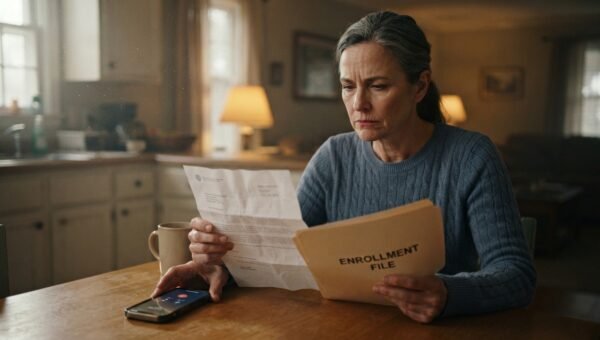
Three weeks passed in total silence. Elena barely spoke, but she wasn’t weeping anymore. She went to work, washed dishes, and stared out the kitchen window at our bare backyard.
Then on a damp Thursday morning in late November, I went to grab her winter coat from the hall closet to take it to the dry cleaner after coffee spilled on the sleeve. In the deep right pocket, my fingers brushed against a folded piece of paper.
It was a printed receipt from the Riverfront Grand Hotel downtown.
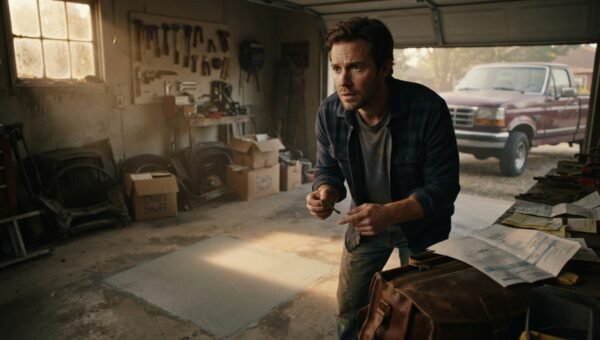
I stared at it on our kitchen counter. The check-in date was the exact Friday night she was supposed to be in Green Bay, the night I was working a grueling twelve-hour night shift at the transit authority depot. And right across the guest line was my name: David Miller. The charge was $214.50, paid in cash.
My hands began to shake. I thought about affairs. I thought about every ugly betrayal a husband worries about when his wife goes cold and distant.
I called the front desk of the hotel right then, determined to dispute the charge and find out what had happened.
“Front desk, this is Marcus,” a calm voice answered.
“My name is David Miller,” I said, leaning over the counter. “There is a reservation under my name from three weeks ago, Friday the third. A room paid in cash. I never stayed at your hotel. My wife must have had someone else using my name.”
Marcus paused on the line, typing on his keyboard. “Mr. Miller, yes, I see the booking. Room 412. But the guest didn’t check in with another man. It was a woman matching your wife’s description. And she left a specific instruction with management that night.”
“What instruction?”
“She paid in advance and left an envelope at the desk marked for David Miller, along with a small parcel. She told us that if you called or came by to question the charge, we were to hand it to you in person.”
My stomach tightened. “A parcel?”
“Yes, sir. It has been sitting in our safe since the morning of the fourth. You can pick it up with your photo ID.”
I drove downtown through the freezing rain, my mind spinning through every terrible possibility. When I reached the lobby, Marcus checked my driver’s license, walked into the back office, and returned with a padded manila envelope.
I sat in my truck in the hotel parking garage and tore the tape open.
Inside was a tiny blue plastic hospital bracelet. Printed across the white band in faded thermal ink were the words: *Baby Boy Miller – Male – Born 10/12/2026 – 4 lbs 6 oz – Status: Transfer.*
Underneath the bracelet was a small brass key stamped with the number 184 and the address of a commercial post office box store three blocks from the hospital.
My breath caught in my throat. Our son had been declared dead in our arms. We had signed paperwork. We had a death certificate coming in the mail.
I turned the key over in my palm, terrified of what it meant, and drove straight back to our house.
When I stepped through the front door, Elena was standing in the kitchen, holding a mug of cold tea. She looked down at my hand. The key caught the gray afternoon light coming through the blinds.
She didn’t flinch. She didn’t drop her mug. She just looked at me with those cold, empty eyes and said, “You were never supposed to know that he survived.”
PART 2
The house was so quiet I could hear the hum of the refrigerator.
“What did you just say?” My voice was barely a whisper. I stepped closer, holding up the brass key and the blue plastic bracelet. “Elena, we held him. We wrapped him in that flannel blanket. The nurse came in with the doctor. What are you talking about?”
She set her mug down on the counter. Her hands didn’t shake at all.
“That wasn’t Leo,” she said flatly. “That was a stillborn boy from another delivery three hours earlier. His mother had signed a donation and release form. Clara’s friend is the supervising charge nurse on that floor, David. Clara arranged it.”
“Clara arranged a dead baby?” The words felt disgusting in my mouth. I felt sick, like the floor was tilting beneath my work boots. “Why would Clara do that? Why would you do that to me?”
“Because Leo was born with severe brain damage,” she said, her voice rising just enough to cut through the room. “The cord was wrapped twice around his neck. They told me he would never walk. He would never speak. He would need a feeding tube, full-time nursing, and hundreds of thousands of dollars in specialized care for the rest of his life. We don’t have that kind of money. We were already drowning in debt from the treatments. You would have bankrupted us trying to keep him alive in our living room.”
“He’s our son!” I shouted. The sound cracked off the walls. “You gave up our son because he was sick?”
“I didn’t give him up to die,” she said, folding her arms tight across her chest. “I surrendered him under the Safe Haven law. Clara helped me do the paperwork at the regional pediatric hospice center two counties over. But there was a condition. Clara knew someone willing to take him privately before state custody locked him away, someone who had the resources we didn’t have.”
“Who?” I demanded, stepping right up to the counter. “Who has our baby, Elena?”
She looked away toward the backyard. “I don’t know the exact couple. Clara handled the intermediary. But they required a clean break. No legal challenges from the biological father. That’s why the hospital paperwork had to say he died. If you were on the birth certificate as a contesting father, the placement would fail, and the state would come after both of us for medical neglect and surrender violations.”
“So you left me to grieve a dead baby so you could sneak our son away behind my back?”
“I left you that key,” she snapped, turning back to me with tears finally rimming her eyelids. “I booked that room under your name on purpose, David. I knew you checked the dry cleaning receipts. I knew you reviewed the bank statements down to the penny. I told myself that if you were too broken to look, the universe decided. But if you actually cared enough to dig into that hotel charge, you would find the box.”
“What is inside box 184?”
“The transfer file,” she whispered. “The medical release, the actual pediatric intake record, and the legal surrender paperwork Clara signed as my witness. Everything is in that box. But if you open it, David, you blow the entire arrangement apart. Clara could lose her nursing license. I could go to jail. And that baby will become a ward of the state in an institutional crib instead of being in a home with people who can afford his monitors.”
She stood there, daring me to choose between her freedom and the truth about our child.
I didn’t answer her. I grabbed my truck keys off the hook by the door, pocketed the brass key, and walked out into the freezing rain.
PART 3
The mailbox store was located in a strip mall between a dry cleaner and a discount pharmacy. The fluorescent lights buzzed overhead as I unlocked the front door and walked past rows of small black metal doors until I reached number 184.
I turned the small key. The latch clicked open.
Inside was a thick manila folder tied with red string. I carried it out to the front seat of my truck and switched on the dome light.
The top document was an official pediatric transport record from St. Jude Children’s Mercy in Green Bay, dated October 14th. My son’s name was printed clearly at the top: Leo Thomas Miller. The APGAR scores were low, but right across the clinical summary, the attending neonatologist had written: *Stable respiration. Mild hypoxic injury. Prognosis guarded but responsive to neonatal physical therapy. No permanent ventilator required.*
My eyes burned as I read the words three times.
Mild injury. Responsive to therapy.
Elena had lied to me. Leo wasn’t profoundly vegetative. He wasn’t doomed to a life on machines. He was fragile, but he was alive, fighting, and capable of healing.
I flipped to the second document. It was a private surrender agreement drawn up by an independent family law attorney in Green Bay, along with a certified bank cashier’s check receipt stapled to the corner.
The check was made out to Clara Vance, my sister-in-law, in the amount of $45,000. The memo line read: *Private Placement Facilitation Fee.*
The truth hit me like a physical blow. Elena hadn’t surrendered our baby out of brokenhearted despair or fear of poverty. Clara had brokered an illegal private adoption to an affluent couple from out of state who had been waiting for an infant. Clara took a cut, and Elena had agreed to let them take Leo rather than raise a child who wasn’t physically perfect, using the phantom grief to keep me from ever looking for him.
I sat in that truck for ten minutes until my breathing steadied. Then I started the engine and drove not back to our house, but straight to the county sheriff’s department.
I walked up to the glass partition in the lobby and laid the manila folder, the hospital bracelet, and the cashier’s check receipt on the counter.
“I need to speak to an investigator in family services,” I told the deputy. “My wife and her sister falsified a death certificate and illegally placed my infant son for adoption three weeks ago. Here is the paperwork.”
The next forty-eight hours were a blur of tape recorders, detectives, and state investigators. By Friday morning, detectives from the county prosecutor’s office, accompanied by state child protection officers, raided Clara’s home in Green Bay. They seized her computer, her financial records, and the full contact information for the attorney who had arranged the unlawful placement.
Elena was taken in for questioning that same afternoon. When two investigators showed up at our front door, she didn’t scream or make a scene. She sat on the sofa, her face completely pale, and asked if she could call a lawyer. I stood in the doorway and watched them lead her out to an unmarked sedan.
She looked back at me from the sidewalk, her lips parting as if she wanted to say something, but I turned around and shut the heavy front door between us.
ENDING
The legal process took nearly two months, but because I had never signed any surrender documents or consented to the placement, the court voided the private adoption agreement immediately.
Leo had been living with a temporary foster family vetted by child services while the fraud charges against Clara and the private attorney moved through the state courts. Elena accepted a plea agreement for custodial interference and falsifying vital statistics, resulting in supervised probation and a mandatory surrender of all parental rights. Clara was formally charged with commercial child brokering and lost her nursing credentials before the week was out.
The first time I was allowed into the county health center to see Leo, my hands shook harder than they had in the hotel parking lot.
He was sleeping in a small white crib near the window, wrapped in a pale yellow thermal blanket. He was small, barely six pounds now, with a faint spray of dark hair that matched my own. When I reached through the rails and brushed my finger against his tiny palm, his fingers curled around mine with surprising strength.
The nurse standing beside me smiled softly. “He has physical therapy twice a week for his right arm, Mr. Miller. But his neurological scans came back remarkably clear. He’s a fighter.”
“I know,” I whispered.
I filed for divorce the following Monday. I sold our house in the suburbs and moved into a small, sunlit two-bedroom rental apartment closer to my parents and the pediatric clinic.
It is late spring now. The winter coat has long been thrown away, and the quiet grief that once poisoned our house has been replaced by the steady, messy sounds of formula bottles warming in the kitchen and Leo kicking his feet against his play mat on the living room rug.
Every evening after my shift at the depot, I sit in the rocking chair by his crib and feed him his bottle. When he finishes, he rests his head against my chest, his small, steady heartbeat drumming against mine. We still have years of doctors and milestones to navigate, but he is here, he is safe, and he will never have to wonder if his father wanted him.