PART 1
The dust in the hallway tasted like dry plaster and old insulation. For two weeks, Richard had pressed me about turning the spare bedroom into his home office. He called it an investment in our future, pointing out that since our daughter left for college two years ago, that room had just sat there collecting memories. But every time I mentioned packing up the remaining boxes or sorting through the small items left in the closet, he grew unusually tense.
He insisted the contractor would handle the heavy lifting, that I should stay downstairs and out of the way of the debris.
I agreed because I trusted him. After twenty-two years of marriage, you learn to pick your battles, and losing a spare bedroom did not seem like a hill worth dying on. Even though I still felt the quiet ghost of our daughter running down that hallway whenever the wind hit the windows just right, I told myself he was right. We needed the space.
It was a Tuesday afternoon when the work actually started. I was in the kitchen wiping down the counters when the hammering stopped abruptly upstairs. Silence in a construction zone is always louder than the noise. A few moments later, heavy boots thudded down the stairs, and the lead contractor, a broad-shouldered man named Leo whom we had hired through a local recommendation, appeared in the doorway.
He looked unsettled, wiping a smear of gray dust from his forehead with the back of a thick forearm.
“Mrs. Miller,” Leo said, his voice dropping an octave as if he were afraid someone outside might hear. “You need to come upstairs and look at something. Right now.”
I wiped my hands on a dish towel, my heart giving an uncomfortable lurch against my ribs. “Did something break? Did you hit a main pipe?”
“No pipes,” Leo muttered, turning toward the stairs. “Just come see for yourself. Behind the master closet wall in that back room. It wasn’t on any blueprints I’ve seen for houses built in this tract.”
I followed him up the stairs, stepping over jagged pieces of drywall and stray nails. The spare bedroom smelled of pulverized sheetrock and decades-old dust. Leo led me straight to the master closet, where a large section of the back wall had been sledgehammered away.
Where there should have been exterior brick or support studs, there was only a dark, narrow cavity running deep into the interior framing of the house.
I stepped up to the jagged edge of the drywall, squinting into the gloom. Leo clicked on a heavy-duty work light and aimed the beam inside.
The space was no wider than a narrow hallway, maybe four feet across, but it stretched the length of the closet. Pinned to the raw wooden studs were faded growth marks scribbled in pencil, small handprints pressed into yellowed plaster, and a series of framed school photographs lined up on a low wooden ledge.
My breath caught in my throat. I stared at the pictures, my mind refusing to assemble the shapes into a coherent picture. They were photos of a little boy with dark, unruly curls and wide hazel eyes, ranging from what looked like toddlerhood up to about six or seven years old.
I had never seen that child in my life. Yet every single photo had been taken against the exact floral wallpaper pattern that had covered our nursery walls when we first toured this house before buying it twenty years ago.
“Look at the back of the latest one,” Leo whispered, handing me a photograph with trembling fingers. “Found it face down on the ledge.”
I turned the heavy cardstock over. Written in firm, unmistakable black ink was a short sentence in Richard’s handwriting: *WAIT HERE UNTIL I CAN TELL HER.*
Before I could process the weight of those words, Leo’s cell phone buzzed loudly in his pocket. He pulled it out, glanced at the screen, and answered with a curt nod. It was his sister, Sarah, who happened to work administrative records at the local elementary district downtown. She had been helping Leo look up some permit numbers earlier that morning.
“Sarah,” Leo said, putting her on speaker before I could stop him. “Did you find the old district boundary maps?”
“Forget the maps, Leo,” Sarah’s voice crackled through the speaker, breathless and sharp. “I pulled the old enrollment rosters for that address going back twenty-five years. I asked around the office about the uniform in that photo you texted me. My coworker recognized it instantly.”
“Whose uniform is it?” Leo asked, watching me closely.
“It doesn’t matter whose uniform, Leo,” Sarah said, her voice dropping into a tone of absolute disbelief. “What matters is who the child was registered under. I looked at the emergency contact and legal guardianship line on the original enrollment card from twelve years ago. Why was this child registered under your client’s wife’s name?”
PART 2
The phone in Leo’s hand seemed to grow heavy, the tinny sound of Sarah’s breathing echoing in the dusty silence of the stripped-down room.
Registered under my name.
The words spun inside my skull like loose shards of glass. I had never given birth to a boy with dark curls. I had never signed an enrollment card for a child in this district other than our daughter, Chloe, who was currently a junior at Ohio State. I reached out and gripped the edge of the doorframe to steady myself, my knees suddenly feeling like wet paper.
“Sarah, repeat that,” I managed to say, my voice sounding thin and hollow even to my own ears. “Whose name did you say?”
“Mrs. Miller?” Sarah’s voice hesitated on the other end. “Is that you? Listen, I’m looking right at the scanned digital archive from the district office. Child’s name listed as Lucas Miller. Mother’s name listed as Evelyn Miller—your full name, your maiden middle name included. Father’s name listed as Richard Miller. But that’s impossible, because when you and Richard bought this house twenty-two years ago, the county records showed you as childless newlyweds. Chloe wasn’t born until five years after you moved in.”
I stared at the wall of photographs again. Lucas Miller. The boy in the pictures. A child whose existence had been hidden behind two layers of drywall in the very house where I had raised the daughter I knew.
“Thank you, Sarah,” I choked out, and signaled for Leo to hang up.
Leo snapped the phone shut, his face pale under the layer of construction dust. “Mrs. Miller, do you want me to call the police? Because whatever is going on here, this isn’t just some weird remodeling quirk. That’s a hidden room built into the load-bearing core of the house. You don’t frame something like that by accident.”
“No,” I said, a cold, hard knot forming in the center of my chest where panic had been just moments before. “Don’t call anyone yet. Richard is due back from his hardware run in twenty minutes. I need to talk to him first.”
Leo looked like he wanted to argue, but the look in my eyes must have warned him off. He packed up his primary tools and waited downstairs in his truck, leaving me alone in the half-demolished room with the ghosts of a child I had never been allowed to mother.
When Richard’s sedan pulled into the driveway at precisely 3:15 PM, the sound of gravel crunching under the tires felt like grinding teeth. I heard his keys jingle in the front lock, heard the door swing open, and heard him call out my name, his voice carrying that familiar, practiced warmth that had sustained our marriage for over two decades.
“Evelyn? Where are you? The supply house was out of the specific drywall anchors I needed, so I had to—”
He stopped dead at the bottom of the stairs. I was standing at the landing, looking down at him with the photograph in my hand.
PART 3
Richard’s eyes flicked from my face down to the photograph in my hand, and then past me toward the open doorway of the master closet upstairs. The easy, domestic smile vanished from his features in a fraction of a second, replaced by a mask of cold, exhausted resignation. It was the face of a man who had been running a marathon for years and had finally tripped over the finish line.
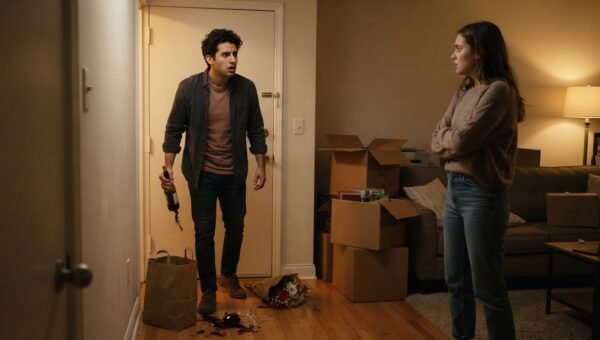
“You found it,” he said quietly. He didn’t drop his bags. He just stood there at the base of the stairs, still holding a plastic bag of hardware from Home Depot.
“Twelve years,” I whispered, walking slowly down the stairs toward him, keeping my distance. “You built a room inside our house. You put a child in it. You registered him with my name. How, Richard? How do you hide a human being in the walls of the home we share?”
Richard closed his eyes for a long moment, letting out a heavy breath that sounded like years of pent-up terror leaking out of him. “I didn’t put him in the walls, Evelyn. He lived in the house. For the first few years, before the neighbors started asking questions about why a second child never went outside to play in the yard.”
“What are you talking about?” My voice broke, rising in pitch despite my best efforts to keep it steady. “Whose child is he? Is he yours? Did you have an affair—”
“No!” Richard snapped, his eyes flashing with sudden, sharp anger before dropping back into defeat. “He’s not my biological child from an affair. He’s my sister’s boy. My sister Sarah—not Leo’s sister Sarah, my younger sister Clara. You remember Clara. She ran off to Chicago when we were in our twenties, got mixed up with a man who dealt in things he shouldn’t have, and then she vanished. Seven years later, she showed up on our front porch in the middle of the night, half-starved, with a three-year-old boy and a bag of cash she said was the only thing keeping dangerous people off her trail.”
I gripped the wooden banister. “And you didn’t call the police? You didn’t take him to social services?”
“She begged me,” Richard said, his voice dropping to a harsh whisper. “She said if the authorities got involved, the men she ran from would find out where the boy was through public records. She promised she would come back for him in six months once she sorted her life out in Canada. She left him with us, and two days later, the police found her car abandoned near the state line with her purse inside. No body. Just gone.”
“So you… what? You kept him here?”
“At first, it was temporary,” Richard said, staring down at the floorboards. “We had just lost our first pregnancy, Evelyn. You were broken. I was broken. When Clara dropped that little boy into our arms, it felt like the universe was playing some sick, impossible trick. You were so fragile that winter. I didn’t know how to tell you that my fugitive sister had dumped her toddler on our doorstep and then disappeared off the face of the earth. I thought if I just waited for the right moment—when you were stronger, when things settled down—I would tell you the truth.”
“And the room?” I asked, my voice shaking so hard I could barely form the syllables. “The drywall?”
“That came later,” Richard said, lifting his head to look me straight in the eyes. “When he was six, social services started doing census checks in the neighborhood because of a new school district funding grant. I panicked. I knew if anyone came to the door and asked why there was an unregistered six-year-old living here without a birth certificate matching our hospital records, everything would collapse. A contractor friend of mine—before he moved away—helped me frame out that dead space behind the master closet. It had its own ventilation shaft from the attic crawlspace. It had a small bed, books, toys. I told Lucas it was a game. I told him he had to stay quiet and play in his secret fort whenever visitors came over, just until I could figure out how to explain it to you.”
The room seemed to tilt sideways. “Six years old? You kept a little boy locked in a crawlspace behind our closet?”
“Not locked!” Richard shouted, stepping forward. “He had food, he had light, he had a tablet with downloaded movies, he had toys! I spent hours in there with him every single day playing cards and reading stories. I loved him, Evelyn. He was my blood.”
“Where is he now, Richard?”
The silence that followed was heavier than the dust upstairs. Richard stopped moving. His shoulders slumped forward, the plastic grocery bag rustling in his slack grip.
ENDING
“Where is he?” I repeated, my voice dropping into a flat, dangerous register that brooked no more lies.
Richard wouldn’t look at me. He stared fixedly at the umbrella stand by the front door.
“Three years ago,” Richard whispered, the words dragging out of him like teeth being pulled, “when Chloe started high school and we were spending more time at home together, the arrangement became impossible to maintain. Clara had never come back. The men she was running from—or maybe just the ghost of them—stopped mattering because the boy was growing up. He needed a doctor. He needed a real school. He needed a life outside those four wooden studs.”
“So what did you do?”
“A couple I knew through an old college connection—people living off-grid in rural Montana who couldn’t have children of their own—agreed to take him,” Richard said, his voice barely audible. “They had fake papers ready. They drove down in a camper van on a Tuesday while you were at your volunteer shift at the hospital. I packed his things, kissed him goodbye, and watched them drive him out of state.”
I stood on the stairs, looking down at the man I had slept beside for over two decades. The man who had built a wall inside our home, traded a child like contraband, and lied to my face every single morning while pouring his coffee and asking about my day.
“You didn’t protect a child, Richard,” I said, my voice entirely steady now as the cold reality settled over my bones like frost. “You buried him alive, and then you gave him away.”
I reached into my pocket, pulled out my cell phone, and dialed three digits while walking past him toward the front door.
“Evelyn, wait—who are you calling?” Richard stepped toward me, his hand reaching out in a desperate, pleading gesture.
“Leo’s sister already has the enrollment records, Richard,” I said, holding the phone to my ear as the emergency dispatcher picked up on the second ring. “And I have the photographs. Sit down on the floor and wait for the state troopers. It’s time someone finally told the truth.”