PART 1
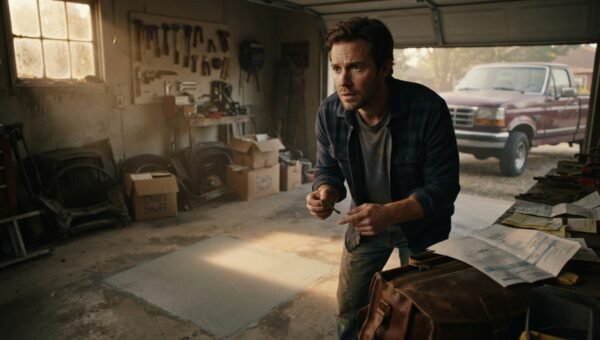
The broom caught on the corner of the leather briefcase where it sat propped against the baseboard in Richard’s home office. It was a heavy brown bag he had carried for fifteen years, scuffed along the piping and soft from handling. When the bristles bumped it, the bag tipped onto its side. A small silver paperclip rolled out from the gap where the inner lining had come unglued, followed by a tight fold of yellow thermal paper.
I picked it up thinking it was trash. It was a long-term parking ticket from the regional airport two hours north of our house. The stamped entry date was October 12, and the exit stamp was October 17.
I stood in the quiet of that room with the broom in my hand, staring at the numbers. That entire week in October, Richard had told me he was attending the regional supply-chain conference down at the convention center ten miles from our front door. He had left every morning in his navy suit and returned home every evening around seven, complaining about bad coffee, slow panels, and commuter traffic on Interstate 480.
I turned the ticket over in my fingers. Printed along the lower margin was the automated vehicle log stamped at the exit gate. It listed his license plate and showed three hundred extra miles logged onto his company car between the Monday morning gate entry and the Friday night gate departure.
If his car sat in long-term parking while he claimed he was driving across town each day, none of that week had happened the way he described it.
I set the broom against the wall. I walked into the kitchen, opened my desk drawer, and took out our household calendar. For October 12 through 17, I had written: Richard at Convention Center. I had made dinners that could sit in the oven until seven. He had kissed my cheek, eaten his roast chicken, taken off his tie, and asked me about my garden club.
I did not scream. I did not drop the paper. At fifty-six, after thirty-two years of marriage, my first instinct was not anger. It was a strange, cold stillness. My hands stayed steady, but the room seemed to lose its color.
Instead of waiting for him to come home from his branch office so we could have a shouting match over an old receipt he could easily explain away as a misunderstanding, I walked into my bedroom and shut the door.
I sat on the edge of the bed and searched for licensed private investigators in our county. I found a firm twenty minutes away run by an investigator named Miller, a former state fraud auditor.
An hour later, I was sitting across from Miller in a plain office with blinds half-drawn against the afternoon sun. I put the parking stub on his desk along with three months of our joint checking statements and Richard’s recent corporate expense reports that he always printed out for our tax folder.
Miller picked up the parking slip with tweezers, looked at the timestamp, and then looked at the corporate mileage log. He looked at me over his reading glasses.
“If this ticket is accurate,” Miller said, “his vehicle never left that lot between Monday at 6:00 a.m. and Friday at 8:40 p.m. Who was coming home to your house every night?”
“He was,” I said. “He walked through the door every night at seven.”
Miller leaned back in his leather chair. “Then he wasn’t flying anywhere on that ticket.
Someone else took his company car to that airport, or he rented a vehicle under another name, or he had someone staging his presence here while he was elsewhere. Let me run the plate, the gate cameras, and his corporate registrations.”
I wrote a retainer check from my personal inheritance savings account, the small fund my mother had left me that Richard never tracked.
Two days passed in complete silence. Richard came home at his usual hour, complained about a late supplier shipment from Chicago, ate his pork chops, and watched the evening news with his arm around my shoulder on the sofa. Every time his skin brushed mine, my stomach turned into cold lead. I smiled, I nodded, and I poured his decaf coffee.
On Thursday afternoon, Miller called my cell phone. His voice was brisk and direct.
“Mrs. Vance, you need to come in right now. Bring your house deed and your latest mortgage statement.”
When I walked into Miller’s office twenty minutes later, a thick manila folder lay on the desk. Inside were twelve high-gloss photographs and a stack of public records stamped by the secretary of state’s office in Indiana.
The photos showed Richard standing outside an industrial warehouse forty miles outside of Indianapolis. Beside him was a commercial freight bay with a large metal sign that read Vance Logistics Northern Hub. Next to him in the pictures was a woman in her late thirties holding an inventory clipboard.
“Your husband didn’t fly anywhere,” Miller said, tapping the documents. “He drove a leased commercial van to Indiana on Sunday night, had an associate leave his corporate car in the airport lot to establish an electronic paper trail for his employer’s GPS tracking system, and took an interstate bus back and forth between states to keep his routine intact at home.”
“What is that building?” I asked, pointing at the photograph.
Miller slid a document across the table. It was a commercial loan application filed four months earlier. Attached to it was a deed of trust securing a $340,000 equity line against our primary residence in Ohio, the home we had fully paid off two years ago.
At the bottom of the equity mortgage document were two signatures.
One was Richard’s signature in his familiar dark ink. The other was my name, signed in a careful, slanted cursive that looked almost like mine, except for the loop on the capital E that I had never written in my life.
PART 2
I looked at the forged signature on the closing documents until the ink seemed to blur into the grain of the paper. Our house on Elm Street was the only real security we had. We had spent twenty-eight years paying down the thirty-year fixed mortgage, writing extra checks toward the principal every December until the title company sent us the original stamped note marked Paid in Full.
“How did this get recorded without me being present?” I asked Miller.
“A mobile notary,” Miller answered, turning the document over to show the notary stamp and acknowledgment block. “The notary was an independent contractor based out of Columbus. Your husband produced an altered driver’s license with your name and someone else’s photograph. The funds were wired directly into a corporate entity account called Buckeye Freight Holdings LLC, registered solely in Richard’s name in Indiana.”
“And the money?”
“He drew down the entire three hundred and forty thousand dollars within forty-eight hours of closing,” Miller said. “He used two hundred thousand to buy out a distressed fleet of three commercial box trucks, eighty thousand for the warehouse lease deposit and insurance, and the rest has been trickling out in payroll to three employees. Including the woman in the photos, Megan Cole, who is listed as the managing operations partner.”
Miller gave me the name of a forensic accountant and an experienced family law attorney named Sarah Thornton, whose office was in the same professional building. I walked down the carpeted hall immediately.
Sarah Thornton listened without interrupting as I laid out the parking stub, the Indiana LLC filings, the fraudulent mortgage lien, and the photos of Richard at the warehouse.
“This is not just a domestic issue, Evelyn,” Sarah said, setting down her pen. “This is felony forgery, bank fraud, and conversion of marital assets. But if you walk into your living room tonight and demand an explanation, he will immediately begin moving money between accounts, covering his tracks, or liquidating equipment. We need an emergency temporary restraining order freezing every account associated with his name, the marital estate, and Buckeye Freight Holdings before he knows you have seen this.”
“How long will that take?” I asked.
“I can file an emergency ex parte motion with Judge Albright tomorrow morning at eight,” Sarah said. “We will attach the certified affidavit from the notary board indicating suspected fraud, along with the title company’s loan file. By noon tomorrow, the bank will freeze the remaining liquidity in those accounts. But you have to go home tonight and act as if you know nothing.”
Going home that night was the hardest thing I had ever done.
Richard was already in the kitchen when I walked in at six fifteen. He had opened a bottle of Merlot and was slicing crusty sourdough bread at the island. He looked relaxed, his sleeves rolled up to his elbows, humming along to the radio above the stove.
“Hey, sweetheart,” he said, turning around with a smile. “You look tired. Did your sister keep you running around all afternoon?”
“Just errands,” I said, setting my purse on the hook by the door. “Traffic on Route 20 was backed up near the reservoir.”
He poured a glass of wine and slid it across the counter toward me. “Sit down. I’ve got the pot roast simmering. We should think about taking a long weekend next month. Maybe head down to the Smokies once the leaves turn.”
I picked up the glass, held it by the stem, and watched him turn back to the cutting board. He looked like the man I had raised two grown children with. He looked like the man who had held my hand through my father’s funeral and coached our son’s Little League teams. Yet thirty miles across the state line, he had put our roof at risk to buy box trucks and build a shadow life with a thirty-eight-year-old dispatcher.
“The Smokies sound nice, Richard,” I said quietly.
I took a small sip of the wine. It tasted like vinegar in my mouth.
I barely slept that night. Every time Richard shifted in the bed or pulled the quilt over his shoulders, my chest tightened. At six thirty in the morning, his alarm went off. He showered, put on his pressed gray slacks, kissed my forehead while I pretended to wake up, and told me he had a breakfast meeting with an industrial buyer downtown.
At nine fifteen, Sarah Thornton called me.
“Judge Albright signed the emergency injunction,” Sarah said. “The marshals are serving the frozen asset orders on the three banks right now. And the county recorder has placed a lis pendens notice against the house to prevent any further encumbrance. We are having Richard served at twelve thirty today during his lunch hour at the regional office.”
“Where should I be?” I asked.
“Be in my office at noon,” Sarah replied. “When he gets served, his phone will be the first thing he reaches for.”
PART 3
Richard was served at twelve twenty-two in the lobby of his employer’s corporate headquarters.
Sarah and I sat in her second-floor conference room with the speakerphone positioned in the middle of the mahogany table. At twelve twenty-nine, my cell phone began to ring. Richard’s photo flashed on the screen.
“Let it ring twice, then answer,” Sarah instructed softly. “Do not argue. Do not justify. Tell him you are with counsel.”
I swiped the screen and put the call on speaker.
“Evelyn? What the hell is this?” His voice was loud, breathless, and cracking with an edge I had never heard in thirty years. “Some guy in a suit just handed me a court summons in front of my division vice president. My corporate card was just declined at the deli downstairs. What did you do?”
“I found the parking stub from October, Richard,” I said, keeping my tone entirely level. “The one from the airport garage where your company car sat while you told me you were attending the supply conference.”
There was absolute silence on the line for four seconds. I could hear the faint hum of his office ventilation system in the background.
“Evelyn, that’s… you don’t understand what you’re looking at,” he stammered, his voice dropping an octave, trying to sound reasonable. “I can explain that. It was a business arrangement. A private consulting venture so we could build up our cash reserves before retirement. I didn’t tell you because I didn’t want you stressing over the startup risk.”
“You forged my signature on a three hundred and forty thousand dollar home equity mortgage, Richard,” I said. “You encumbered our home. The home my parents helped us put the down payment on in 1994.”
“I was going to pay it back!” he yelled, the panic breaking through his composure. “The contracts are solid! The Indiana routes are already generating twenty thousand a month in gross revenue! If you freeze those accounts, I can’t meet the diesel payments or the insurance binder due on Friday! You’re going to destroy the whole company!”
“This is Sarah Thornton, Mr. Vance,” Sarah interjected firmly. “All marital assets and accounts associated with Buckeye Freight Holdings are frozen under a court order signed by Judge Albright this morning. Any attempt to transfer funds, remove equipment, or contact the commercial lender will be treated as direct contempt of court. You need to retain an attorney and have them contact my office immediately.”
“Evelyn, please,” he pleaded, ignoring Sarah completely. “Don’t do this through lawyers. Come home. Let’s sit at the kitchen table and talk. Just give me thirty days to refinance the commercial debt into the business’s name alone, and your name will be off everything. I swear to you on our children’s lives, the house will be clear.”
“You already swore to me on our marriage, Richard,” I said.
I pressed the red button and ended the call.
Over the next forty-eight hours, the full reality of his operation came to light. The forensic accountant Sarah hired discovered that the Indiana warehouse was not just an investment. Richard had been funneling cash into a personal account in Indianapolis to pay the residential rent on a townhouse leased under Megan Cole’s name.
When the freezing order hit the bank accounts, the commercial diesel fuel cards were shut off. Two of his three drivers refused to run their routes without fuel allowance and parked the box trucks at the warehouse gate. By Monday morning, Megan Cole had contacted an attorney of her own, claiming she had been misled into believing Richard was an unmarried investor whose personal funds were unencumbered.
Richard did not come back to our house. He stayed at an extended-stay motel near the interstate bypass. His corporate employer placed him on administrative leave by Tuesday afternoon after our subpoena arrived requesting his internal travel logs and company car GPS records.
On Wednesday, Richard’s attorney, an aggressive local litigator named Donald Hayes, sent an urgent settlement proposal. Richard was willing to sign over all rights to our home, his 401(k) balance, and his remaining equity in the family cars if I agreed to drop the civil fraud complaint and petition the court to unfreeze fifty thousand dollars in operational funds so he could salvage the Indiana business.
Sarah brought me the document in her office.
“If you release those funds,” Sarah warned me, “the lender will see that you participated in condoning the loan structure, which complicates our case to have the mortgage voided for fraud. The bank has already initiated a review of the fraudulent notary. If we hold the line, the title company’s insurance policy will be forced to pay off the mortgage to clear their own liability for accepting a fraudulent notary acknowledgment.”
“What happens to Richard’s business if we don’t sign?” I asked.
“It collapses by the end of next week,” Sarah said simply. “The trucks will be repossessed, the lease will default, and he will face personal liability on the commercial equipment leases he signed.”
I looked out the window at the parking lot below. For thirty-two years, my entire world had been structured around keeping our family steady, protecting Richard’s peace, and ensuring our future was safe. He had taken the roof over my head and gambled it on a secret life without a single thought for what would happen to me if his venture failed.
“Do not sign it,” I told Sarah. “Let the title company handle the fraud.”
ENDING
The unraveling was swift and complete.
Within three weeks, the title insurer concluded its internal investigation into the mobile notary who had verified the forged closing documents. Facing professional license revocation and potential criminal prosecution, the notary admitted she had performed the signing at a coffee shop without verifying a government-issued photo ID that matched my physical description. Rather than face a massive federal fraud lawsuit from Sarah Thornton, the title company’s underwriter stepped in and paid off the entire $340,000 equity balance directly to the commercial lender.
The lien against our home was officially discharged at the county recorder’s office on January 14. I walked down to the courthouse myself, paid the twelve-dollar recording fee, and watched the clerk stamp the satisfaction of mortgage onto the document. The house was fully mine, unencumbered once again.
Richard’s logistics company did not survive the freeze. Without operating capital to cover commercial insurance or diesel, the leasing company repossessed all three box trucks before the end of November. The landlord of the Indiana warehouse locked the bay doors for non-payment of rent, and Megan Cole walked away, cooperating fully with our forensic team in exchange for being dropped from our civil asset recovery action.
His employer did not wait for the court’s final ruling. When the audit revealed Richard had used company vehicles, corporate fuel accounts, and simulated conference travel to manage an undisclosed competing enterprise across state lines, they terminated him for cause, revoking his severance and contesting his unemployment benefits.
The divorce was finalized seven months later in Judge Albright’s courtroom.
Under the terms of the decree, I was awarded the house on Elm Street, my full personal inheritance, and sixty-five percent of Richard’s accumulated retirement pension to offset the marital funds he had dissipated on the secret venture.
Richard sat across the courtroom at the defense table in a suit that looked two sizes too large for him. His hair had grayed noticeably around the temples, and he did not look at me once during the entire proceeding. When the judge struck the gavel to dissolve the marriage, Richard gathered his papers into a cheap plastic accordion folder. The leather briefcase he had carried for fifteen years had been left behind in our hall closet.
Our adult children, Greg and Laura, had struggled at first to understand how a marriage of three decades could vanish in a matter of months. But once the court records were unsealed and they saw the forged documents and the lease agreements, their confusion turned into a quiet, painful distance. They still call their father on his birthday, but he spends his holidays in a rented one-bedroom apartment in Fort Wayne, working as an independent dispatcher for a regional hauling firm.
Last Saturday, I finally cleared out the home office.
I pulled his old desk away from the wall to paint the trim a warm, clean cream. I found an old company pen behind the radiator and an empty box of business cards on the top shelf of the closet. I boxed up the leather briefcase, drove down to the community donation center on 4th Street, and dropped it into the bin.
When I drove back home, the afternoon sun was hitting the front porch. The mortgage note was locked safely in my fireproof safe inside, bearing only one name on the deed. I sat on the porch steps with a mug of black coffee, listening to the neighborhood dogs barking down the street, feeling the solid, quiet weight of a life that belonged entirely to me.