PART 1
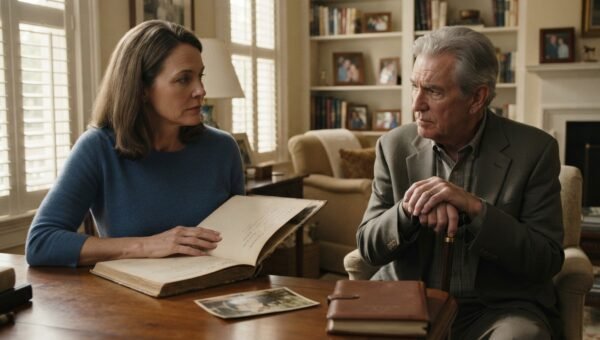
My husband, Arthur, started leaving the house every Saturday morning right after breakfast with a plain white envelope tucked into his coat pocket.
By the end of the second month, exactly $1,800 was gone from our joint savings account. We have been married fifty-one years, and in all that time, every dollar had a name. We worked thirty-four years in the public school district, me in administration and Arthur teaching ninth-grade science.
Our pension covers the groceries, the house in Lansing is paid off, and our savings was meant for the furnace if it went or our dental work down the road. When $200 or $300 vanished every single week in clean cash withdrawals, I noticed immediately.
I asked him twice. The first time, he told me he was helping an old colleague restore a wood lathe in a garage across town. The second time, he got quiet, looked at his coffee mug, and said I shouldn’t worry myself over pocket money.
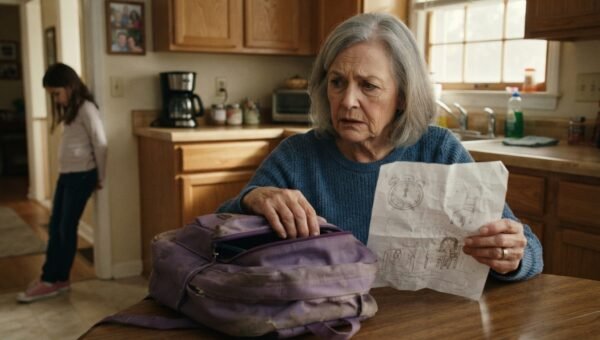
Then came Saturday morning. Arthur left his cell phone sitting right by the fruit bowl on the kitchen counter while he took the trash out to the curb. It buzzed twice against the laminate. I didn’t mean to snoop, but my fingers picked it up before my brain could talk me out of it.
The screen lit up with two incoming messages from an unsaved number.
“How’s our girl doing?” the woman wrote.
Two seconds later, another message flashed: “Can’t wait to meet her.”
My hands shook so hard I nearly dropped the phone into the sink.
Fifty-one years. You think you know every crease in a man’s neck, every cough, every excuse he makes when he doesn’t want to visit his cousins. And then you see eight words on a piece of glass and the room spins completely out of focus.
I didn’t scream. I didn’t confront him in the driveway while he dragged the green bin back toward the garage. I set the phone down exactly where he had left it, grabbed my purse, and walked into his small den off the hallway. On his desk blotter was a yellow legal pad where he keeps his Saturday errands jotted down. Right at the top, pressed into the paper in his familiar, blocky print, was an address on Elmwood Avenue, three miles south, along with the notation: “Bring rest of nursery fund.”
Ten minutes after Arthur backed his sedan out of the driveway, I was in my Buick following the same route.
The house on Elmwood was a modest, trim little rental with blue shutters and a small porch.
I parked at the curb, walked up the three wooden steps, and knocked before I had time to talk myself out of it.
The door swung open. A young woman, maybe twenty-six years old, stood in the doorway wearing an oversized gray cardigan. She had a soft face, dark hair pulled up in a clip, and her belly was unmistakably round beneath her sweater.
She took one look at my face, smiled warmly, and rested a hand against her stomach.
“You must be Grandma,” she said.
I gripped the wooden porch railing so hard the splintered paint bit into my palm. Behind her, taped neatly to the wall beside a small wooden dining table, was a black-and-white sonogram printout. Above the grainy image, printed clearly in hospital capital letters, was the name of our thirty-two-year-old daughter: PAULINE VANCE.
The young woman kept smiling, completely unaware of the storm raging in my chest.
“They didn’t tell you?” she asked softly. “Pauline asked me to carry the baby she…”
PART 2
“Pauline asked me to carry the baby she couldn’t carry,” the girl finished, stepping back to let the screen door open wider. “I’m Chloe. Please, come inside. You’re shaking.”
I stepped across the threshold on numb feet. The small living room smelled like lavender soap and fresh paint. Near the window sat an unfinished wooden crib, still half in its cardboard shipping carton, surrounded by rolls of soft yellow wallpaper and two unopened packages of diapers.
“Arthur said he was going to tell you once we made it past twenty-eight weeks,” Chloe said, hurrying into her small kitchen to pour a glass of water. “He told me how worried you get. After Pauline’s surgery two years ago, he said you took the news harder than anyone.”
Her words hit me like a slap. Two years ago, Pauline had undergone an emergency hysterectomy following severe uterine complications. It had crushed her. She and her husband, Mark, had tried for four years to have a child. I had spent months sitting on Pauline’s sofa, holding her hands while she cried, telling her that family comes in many shapes. Then, about six months back, Pauline had suddenly seemed brighter, more peaceful. She told me she was focusing on her garden and her photography work.
She had never mentioned a surrogate. Arthur had never mentioned a surrogate.
“How long has Arthur been coming here?” I asked, keeping my voice as steady as I could.
“Every Saturday for the last two months,” Chloe said, handing me the water glass. “He brings the cash allowance for my groceries and prenatal vitamins. He’s been helping me put the crib together because my back hurts if I bend down too long. Mark and Pauline work sixty hours a week trying to pay the agency fees, so Arthur offered to be my local contact.”
I looked at the counter. Resting right beside a bowl of fresh fruit was the plain white envelope Arthur had carried out of our kitchen just an hour before. It was already torn open. Inside were nine crisp twenty-dollar bills.
“The $1,800,” I murmured.
“Yes,” Chloe said, nodding earnestly. “Pauline’s savings were wiped out by the medical retainers and the legal contracts. Arthur told her he had a special rainy-day fund set aside just for family emergencies. He insisted on covering my living stipend so Pauline wouldn’t have to take a second job.”
It was our savings. The $1,800 wasn’t an affair. It wasn’t gambling. It was my husband quietly draining our dental and repair cushion behind my back because our daughter was desperate, and neither of them thought I had the stomach or the generosity to handle the truth.
“Where is Arthur now?” I asked.
“He went down to the hardware store on Vine Street,” Chloe replied, pointing toward the crib. “The kit was missing four lock washers and an Allen wrench. He said he’d be back in twenty minutes.”
I didn’t wait on the sofa. I walked back out to the porch, sat on the top wooden step, and waited for my husband’s gray sedan to turn the corner.
PART 3
When Arthur pulled into the short driveway twenty minutes later, his face relaxed into an easy smile as he reached into the passenger seat for a brown paper hardware bag. Then he stepped out of the car, looked toward the porch, and stopped dead in his tracks.
The paper bag hung loosely in his fingers. The wind caught the brim of his flat cap.
“Evelyn,” he said. His voice was barely a whisper.
I stood up from the porch step. “You forgot your phone on the kitchen counter, Arthur. The woman texting you wanted to know how our girl was doing.”
He didn’t make up an excuse. He didn’t try to bluster. He just walked slowly up the short concrete walkway, looking older and smaller than he had at breakfast.
“I’m sorry,” he said, staring down at his boots. “I know how it looks.”
“You took $1,800 from our savings account,” I said. My voice wasn’t loud, but it cut straight through the morning air. “You took it fifty and a hundred dollars at a time, lied to my face about an old wood lathe, and let me think you were meeting another woman across town.”
“I never would do that to you,” he pleaded, his eyes watering behind his spectacles. “Never. Evie, look at me.”
“Then why didn’t you tell me?” I demanded. “Why did my own daughter keep this from me? Why am I standing on a stranger’s porch finding out I’m going to be a grandmother from a girl who had to ask if I knew?”
Arthur sat down heavily on the middle porch step, resting his elbows on his knees. The brown bag crumpled between his shoes.
“Because of what happened to your sister,” he said quietly.
The sentence hung in the air like an anvil. Thirty years ago, my younger sister Clara went through three agonizing failed adoptions, losing her life savings and nearly her mind before walking away childless. I spent five years bitter at the world on her behalf. When Pauline lost her uterus two years back, the first words out of my mouth had been practical, cautious, and sharp. I had warned her against private arrangements, warned her against heartbreak, and told her not to throw good money after impossible dreams.
“Pauline was terrified you’d talk her out of it,” Arthur said, his voice cracking. “She had two failed embryo transfers last winter before Chloe agreed to carry. Pauline told me, ‘Dad, if Mom knows, she’ll spend every day waiting for the sky to fall, and I can’t carry her fear and mine at the same time.’ So I told her I’d handle the local side. I took the money from our savings because Mark’s credit cards were maxed out. I figured once Chloe reached the third trimester and the doctors said the baby was strong, we’d sit you down together.”
“That wasn’t your choice to make, Arthur,” I said. “And it wasn’t Pauline’s.”
“I know,” he whispered. “It was wrong. I was trying to protect everybody, and I ended up lying to the only person who’s kept this family upright for fifty years.”
I stood there looking down at him. The betrayal was real, but it wasn’t the kind I had imagined while speeding across town in my Buick. It was the quiet, clumsy cowardice of a man who hated conflict so much he would rather steal from his own wife than have an uncomfortable conversation at the kitchen table.
“Get up,” I told him.
He looked up, blinking.
“Get up and pick up that hardware bag,” I said, opening the screen door. “You’ve got a crib to finish, and after that, you and I are driving straight to Pauline’s house.”
ENDING
Pauline opened her front door two hours later with flour on her apron and red rims around her eyes. Arthur had called her from the car while I drove.
She didn’t defend herself. She threw her arms around my neck right in the entryway and sobbed into my shoulder until my collar was damp.
“I was so scared, Mom,” she kept repeating. “I couldn’t take another person telling me it might not work.”
We sat in her kitchen until late afternoon. We didn’t fix everything over one pot of coffee. Trust doesn’t snap back into place just because the secret happens to be a baby. I made Arthur lay out every single receipt and bank slip on the table. The $1,800 was accounted for down to the penny, spent on Chloe’s rent, vitamins, and the down payment on the crib.
I set a hard boundary before the sun went down. The joint savings account was locked to single-signature withdrawals on Monday morning; anything over a hundred dollars now requires both our names at the credit union. If Pauline and Mark needed financial help to carry them through the birth, it would come openly, budgeted from our monthly surplus, not quietly skimmed off our future security.
Three weeks later, on a chilly Saturday morning, I walked up the porch steps on Elmwood Avenue alone.
Arthur stayed home in the yard rake-cleaning the leaves. In my arms, I carried two heavy cotton blankets I had washed twice with hypoallergenic soap, and a hot casserole dish of baked chicken and green beans.
Chloe opened the door, surprised to see me without Arthur.
“I brought lunch,” I told her, stepping inside. “And I’d like to help you hang that yellow wallpaper if you still need an extra pair of hands.”
She smiled, stepping aside to let me through. On the wall beside the table, Pauline’s sonogram was still pinned in place. For fifty-one years I thought being strong meant keeping everyone from getting hurt. It took an envelope of cash and a strange girl’s porch to teach me that love doesn’t need to be protected from the truth.