PART 1
My husband, David, got stuck at the freight terminal until nine that evening, so I drove over to his parents’ house by myself with a tin of oatmeal raisin cookies.
It was a cold Tuesday in mid-November. The porch light was off at Harold and Margaret’s ranch house on Elm Street, which seemed odd for six o’clock. Margaret kept a small calendar by her stove and had written down our visit four days earlier. She never missed an evening when we promised to stop by.
I knocked twice on the front storm door. No one answered. The heavy inside door stood slightly ajar, resting against the security chain.
I pulled out my phone and sent a quick message to Harold: “Hi Harold, David is working late. I’m standing on the porch with Margaret’s cookies. Are you two inside?”
Two minutes later, my screen lit up with his reply: “I’m out with the guys. Margaret’s resting, You head home.”
The wording bothered me right away. In the seven years I had been married to David, Margaret had never once taken to bed during an expected family visit. Even when her knees flared up in rainy weather, she stayed in her yellow recliner in the den with her knitting basket on the rug beside her.
I pushed the door gently. The gap opened three inches until the chain pulled tight, and through the opening, I heard a dull, steady sound from the second floor.
It was a rhythmic tapping, like the heel of a shoe bumping against bare baseboard.
Harold kept an old spare room at the end of the upstairs hallway under lock and key. He called it his private office, where he stored his tax files, hunting gear, and old company paperwork. None of the kids were ever permitted to step past the threshold.
I reached through the gap, worked the brass chain loose from its slide, and stepped into the dark foyer.
“Margaret?” I called out.
The tapping stopped for three seconds, then started again, louder and faster than before.
I took the stairs two steps at a time. The hallway runner muffled my boots, but the floorboards underneath creaked near the linen closet. When I reached the far end of the hall, I saw Harold’s heavy oak door. The brass deadbolt was turned, but the silver key was still sitting directly in the keyhole.
Harold must have turned the lock in a rush and left the key behind.
I grabbed the knob, twisted the key to the left, and pulled the door wide.
The room smelled of stale cedar and trapped dust. The only light came from the streetlamp outside the window, cutting across a bare mattress and stacks of brown cardboard boxes.
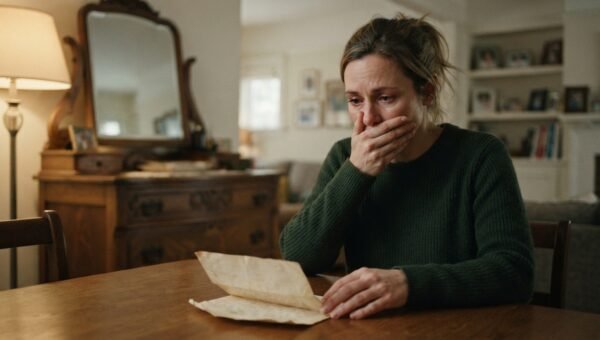
Margaret sat in an old wooden armchair in the corner. Her hair was pulled back in an untidy knot, her cardigan was buttoned crooked, and she held one of Harold’s wooden shoe trees in her right hand. She had been banging the brass end of the shoe tree against the base of the wall.
“What is going on?” I asked, dropping my purse on the floor as I crossed the room to reach her. “Why are you up here?”
Margaret looked at the open doorway behind me, her voice shaking as she took my wrist.
“He took my purse, Sarah,” she whispered. “He locked me in from the outside.
He took my phone and drove down to the credit union to empty the $84,000 from my mother’s farm account.”
PART 2
Margaret’s hand gripped my coat sleeve so hard her knuckles turned white.
“Take a breath,” I told her, kneeling on the dusty braided rug so I could look her in the face. “Are you hurt anywhere?”
“No,” she said. Her breathing came fast and shallow. “He did not touch me. But he pulled this door shut at five o’clock and turned the deadbolt. He said if I stayed quiet until the banks closed their evening drive-through windows at seven, he would come back and let me out.”
I checked my watch. It was already six twenty-two.
“Why would he touch your mother’s account?” I asked.
Margaret had inherited forty acres of pasture in Clark County after her mother passed away three years ago. The family had sold the parcel to an adjoining dairy farm that spring, and the proceeds had been placed into an insured certificate of deposit at the county credit union solely under Margaret’s name. David had told me about it back in April. It was Margaret’s personal safety net, meant to pay for any future assisted living care she might need so she would never become a burden to her children.
“He got into a bad contract on those prefabricated carports he invested in last summer,” Margaret said, leaning forward. “He signed personal guarantees. A collection firm in Kansas City sent a notice on certified paper yesterday morning. They gave him until tomorrow to settle $91,000 in past-due inventory or they would put a lien on this house.”
“This house is in your name, too,” I said.
“Yes, but Harold told me this morning that he had already forged my signature on the power of attorney paperwork last week,” she said, her voice trembling with quiet anger. “He said he took the papers to a mobile notary who did not check identification closely. He told me he was going to take the full $84,000 buyout penalty on the certificate of deposit tonight, wire the money out, and deal with my anger later.”
“We are leaving right now,” I said.
I helped Margaret up from the armchair. Her right knee caught on the first step, and she had to lean her weight against my shoulder as we came down the staircase. I did not leave the cookies on the counter. I left them in their tin on the front hall table right where Harold would see them the second he opened the front door, along with the unlocked deadbolt key I had taken from the upstairs room.
We got into my sedan and I locked the doors.
“Call David first,” Margaret said, her voice small in the dark car.
“No,” I replied, pulling my phone from my pocket. “If I call David while he is running a forklift at work, he will lose his temper and do something reckless. I am calling the credit union manager’s direct line, and then I am calling the police non-emergency desk.”
“The credit union closes the main lobby at five,” Margaret said.
“The drive-through teller window stays open until seven,” I said, putting the car in gear. “And David’s cousin Laura works the lead supervisory desk there on Tuesday nights.”
I dialed Laura’s mobile number hands-free while backing down the driveway. On the fourth ring, Laura answered with a cheerful greeting, but the tone of my voice stopped her immediately.
“Laura,” I said, keeping my eyes on the road. “I have Margaret in the passenger seat next to me. Harold locked her in the upstairs spare bedroom, stole her driver’s license and checkbook, and he is heading to your drive-through right now with a fraudulent power of attorney form to liquidate her $84,000 certificate of deposit.”
The line went quiet for two seconds.
“I am standing three feet from the drive-through lane,” Laura said, her voice dropping to a sharp whisper. “Harold’s blue pickup truck just pulled into lane two.”
PART 3
“Do not cash anything,” I said firmly. “Margaret is right here. Tell her yourself, Margaret.”
Margaret leaned toward the dashboard microphone. “Laura, this is Aunt Margaret. I did not sign any withdrawal slips. Do not let him take my mother’s money.”
“Stay on the line,” Laura said. “I am walking into the branch manager’s office right now. We have two off-duty patrolmen doing our evening security detail.”
I pressed the gas pedal and turned onto Main Street. The county credit union sat two miles away, right behind the post office.
By the time I pulled into the credit union parking lot at six thirty-eight, two local police cruisers had blocked the exit of the drive-through lane with their flashing lights running. Harold’s blue truck sat trapped between the concrete island and the teller window.
Harold was standing outside his truck door with his hands raised halfway in the air, his gray windbreaker flapping in the wind. A police officer was examining the contents of a manila envelope on the hood of the cruiser, while another officer stood by Harold’s driver-side door.
I parked twenty feet away near the ATM, shut off the engine, and walked Margaret straight toward the group.
When Harold saw his wife walking across the asphalt beside me, the color drained from his expression. He did not yell. He did not offer an excuse. He just looked at the asphalt between his boots.
“Margaret,” Harold said, taking half a step toward her before the officer put up an open hand to stop him. “I was going to put it back after the inventory sold in the spring. I had no other choice.”
“You locked me in the back room of my own home, Harold,” Margaret said. She was not crying. Her voice sounded steadier than I had heard it sound in years. “You left me in the dark with no phone and told our daughter-in-law to go home so nobody would find me.”
The branch manager, an older man named Mr. Henderson, stepped out of the side entrance with Laura right behind him. He carried a clipboard with a carbon-copy withdrawal draft.
“Mrs. Miller,” Mr. Henderson said gently. “Your husband presented a durable power of attorney stamped with a notary seal from two counties over, along with your original account signature card and your state driver’s license. The draft was set to disburse an $84,000 cashier’s check made out to a third-party commercial holding company.”
“I never signed that document,” Margaret stated clearly. “I want that power of attorney flagged as fraudulent on every account tied to my Social Security number. And I want the locks on my house changed tonight.”
The officer holding the manila envelope looked up from the forged paperwork.
“Mr. Miller,” the officer said, turning to Harold. “You need to step to the back of the cruiser. We are going down to the station to sort through this paperwork and discuss the circumstances surrounding your wife’s confinement at your residence.”
Harold looked at me then, his jaw tight. “You should have stayed out of family business, Sarah.”
“Margaret is my family,” I said. “And she was the one who asked me for help.”
ENDING
David arrived at the station forty minutes later, still wearing his steel-toed work boots and his reflective warehouse vest. He did not say a single word to his father in the interview room. He walked straight past the front desk, wrapped his arms around his mother in the waiting area, and stayed there for ten solid minutes.
Harold did not spend months in prison, but the consequences were immediate and final.
The county prosecutor agreed to defer formal felony charges on the condition that Harold surrender all access to Margaret’s financial accounts, sign an immediate quitclaim deed transferring his partial interest in the Elm Street house entirely to Margaret, and move into his sister’s vacant rental duplex across the county line. The bad business debt on the carports remained Harold’s personal legal liability alone.
David took three days off from work to replace every exterior lock on his mother’s house and install a digital security keypad that Margaret could operate from a small pendant around her neck.
The next Sunday, David and I drove over to Elm Street for afternoon dinner.
Margaret had made a pot roast with buttered carrots, the way she always did for family Sundays. The house was quiet, but it did not feel empty. On the kitchen counter, sitting next to her napkin holder, Margaret had placed the silver key from the upstairs spare room inside a small ceramic dish.
Before we sat down to eat, she picked up the key, walked out to the back porch, and dropped it into the iron trash barrel by the garden gate.
“I won’t be needing that door locked ever again,” she said, pulling her kitchen apron straight as she walked back inside to pour our tea.