PART 1
The florist van pulled away before I even made it to the front door.
It was Mother’s Day morning, right around nine o’clock. The morning mist was still burning off the lawn, and down the street, my neighbors were packing their car with pastel gift bags and casserole dishes to head over to their grandchildren’s house. I stood on my front porch in my housecoat with a mug of black coffee in my hand, looking down at the bucket wrapped in pink foil sitting right next to my welcome mat.
I am sixty-one years old. Wilford and I have been married for thirty-one years, and we do not have children.
We tried in our late twenties and throughout our thirties. We saw three different specialists in Richmond, took the temperature charts, sat through the quiet waiting rooms, and paid off the clinic bills until the money ran thin and my heart simply couldn’t take the disappointment every twenty-eight days. Eventually, you stop crying in the church nursery during baby dedications. You put away the tiny yellow blanket your mother crocheted for a baby that never came, and you build a quiet life. Wilford worked thirty years at the county water authority, and I kept books for an independent hardware store in town. We had our garden, our beagle named Buster who passed four years back, and our Sunday routines. I had made my peace with our empty rooms a very long time ago.
I figured the delivery driver had mixed up our house numbers. We live at 414 Sycamore, and 418 down the way has three teenagers who might have pooled their lawn-mowing money for their mother.
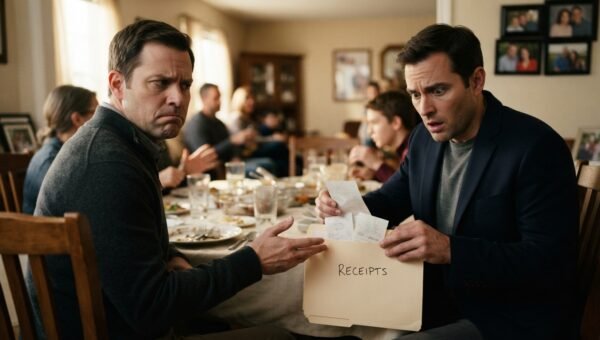
I set my coffee mug on the porch railing and picked up the bouquet. It was heavy, packed with pale pink hydrangeas, yellow tea roses, and fresh eucalyptus that smelled sharp and green. Stapled right to the clear plastic wrap was a yellow carbon-copy receipt. The total at the bottom was eighty-four dollars and twelve cents, paid in cash.
Tucked into the plastic fork among the roses was a small white envelope. It wasn’t sealed. I pulled out the card, fully intending to read the recipient’s name so I could walk it down the driveway to the right porch.
The card didn’t have a delivery name on it. It had printed handwriting from a florist counter pen:
“To Mom, from Daddy and the twins.”
My stomach gave a small, curious drop. I stood there on the porch boards, holding that damp card between my thumb and forefinger.
Around back, I could hear the muffled thud of Wilford’s table saw starting up in the detached garage. He was building cedar birdhouses. That had been his retirement hobby for eighteen months. Every morning after breakfast, he put on his denim work shirt, took his thermos out to the shop, and spent hours listening to the local bluegrass station while he cut cedar shakes.
I carried the flowers inside and set them on the laminate kitchen counter. The house was dead quiet except for the hum of the refrigerator.
I picked up the phone from the wall beside the pantry and dialed the number printed across the top of the yellow receipt: Petals & Vines on Main Street.
A young girl answered on the second ring, her voice bright and breathless against the background noise of paper rustling and bells chiming over their shop door.
“Petals and Vines, happy Mother’s Day, this is Chloe!”
“Good morning,” I said, keeping my tone polite. “I’m calling because a delivery driver just dropped off an arrangement at 414 Sycamore Drive, but there is no one by this name here.
We don’t have children in this house, and I think it was meant for someone else in our neighborhood.”
“Oh, goodness,” she said, tapping quickly on what sounded like a computer keyboard. “Let me pull up the morning runs. What was the order number on that yellow slip?”
I read her the five digits stamped in red ink at the top right.
“Okay, let’s see,” Chloe said. The tapping stopped. Then she let out a little laugh of recognition. “Oh, no, that order didn’t go out with the regular neighborhood routes! That was an early store pickup by the customer himself, but our junior driver saw it sitting on the holding counter with the Sycamore billing address on the top copy and thought it got missed. That’s why he ran it out to you.”
My fingers tightened around the telephone receiver. “The Sycamore billing address?”
“Yes, ma’am. Mr. Wilford Keller. He came in right when we opened at seven to pick it up in person, like he always does. He’s sent that exact same arrangement every single Mother’s Day since 2014. Same flowers, same card, paid in cash every year.”
The kitchen seemed to tilt an inch to the left. The smell of the eucalyptus on my counter suddenly made me feel sick to my stomach.
“Since 2014?” I asked. My voice sounded thin, like dry paper.
“Every year,” she chirped. “He’s one of our regulars. He always writes the card by hand right at the counter so we don’t have to type it. Wait, if he didn’t pick it up, why did the driver… oh, I see what happened! The driver grabbed the box before Mr. Keller walked out to his truck with it. Mr. Keller must have thought we were loading it for him.”
I leaned my hip hard against the kitchen counter to keep my knees from shaking. “Dear, what was the delivery address he usually has on file? In case he comes back looking for it.”
“He usually carries it himself,” she said, scrolling. “But we have the standing recipient profile in our system from the very first year he set up the order. Let’s see… 1122 Orchard Lane. Apt 4B. Recipient is listed as Clara Vance. And he wrote under the twins: ‘Always your family.'”
Orchard Lane was four miles from our church.
Clara Vance was thirty-eight years old. She was the daughter of our former pastor, and six years ago, when our church needed an administrative secretary to manage the building funds and the Sunday bulletins, Wilford was the head of the deacon board who had personally reviewed her resume and handed her the office keys.
PART 2
I stood by the kitchen sink for ten minutes without moving. Through the window over the faucet, I could see the side door of the garage. The rhythmic screech of Wilford’s hand sander scraped through the quiet air.
Twelve years. 2014 was the year Wilford had his gallbladder removed. It was the year we paid off our thirty-year mortgage and went out to the steakhouse on the highway to celebrate with a bottle of sparkling grape juice. It was the year he told me he was tired of traveling into the city for regional water board meetings, so he started volunteering two evenings a week to help our church update its membership directories and maintenance accounts.
The twins would be twelve years old.
I didn’t storm out to the garage. When you have lived sixty-one years, your first instinct when your world cracks in half is not to scream. It is to find solid ground so you do not drown before you know how deep the water is.
I walked down the hall into our bedroom. Wilford kept his personal desk in the corner by the window, an old roll-top oak desk his father had given him. He kept the roll-top down, but he never locked it because we had never had secrets that required a key.
I slid the wooden tambour up. Inside were neat pigeonholes: electric bills, water authority pension stubs, vehicle registration forms. In the bottom right drawer sat his personal metal lockbox. The tiny brass key was right where it had been for twenty years, tucked inside an empty ceramic coffee mug with the county seal on it.
I unlocked the box.
Inside was our homeowner policy, our vehicle titles, and behind those, a separate blue bank folder from a credit union two towns over in Powhatan. We didn’t do our household banking in Powhatan; we used the First National branch three blocks from our house.
I opened the blue folder.
There was a joint checking account opened in August 2013 under two names: Wilford Keller and Clara Vance.
Attached to the statements were carbon copies of deposit slips. Every month on the first, like clockwork, six hundred and fifty dollars was transferred from Wilford’s supplemental pension direct deposit into that account. Beside the deposit slips were copies of lease agreements. Apartment 4B at 1122 Orchard Lane. Wilford was listed as the co-signer and guarantor.
There were two birth certificates folded together in a legal envelope.
Born October 14, 2013, at Henrico Doctors’ Hospital: Jacob Wilford Vance and Molly Grace Vance. The line for the father was left blank on the state forms, but tucked behind them was a notarized voluntary acknowledgment of paternity, signed by Wilford Keller on October 16, 2013, witnessed by a hospital notary.
My hands did not shake as I took out my phone. I took a clear, high-resolution photograph of every single page. The paternity acknowledgment. The bank account statements showing twelve years of regular transfers. The lease agreements with his signature. The deposit slips showing his handwriting, the same steady, left-leaning script he used to write my birthday cards every November.
When I finished, I put every paper back into the exact order I found it. I locked the metal box, dropped the key back into the ceramic mug, and rolled the desk cover down.
Then I walked out to the garage.
The screen door creaked. Wilford had his back to me, wearing his safety goggles, blowing sawdust off a small cedar roof. He looked like what he had always been: a quiet, gray-haired church elder who never raised his voice, never drank, and helped widows shovel their driveways after snowstorms.
“Wilford,” I said.
He jumped a little, turning around with the air hose in his hand. He pulled his safety glasses down onto his neck and gave me that familiar, easy smile. “Morning, Martha. Didn’t hear you come out. You want some more coffee? I was just finishing up this feeder.”
“A driver brought something by the house,” I said. My voice was completely level. “He left it on the front porch.”
Wilford’s eyes flickered. Just for a fraction of a second, his pupils tightened. “A delivery? Must be for the neighbors.”
“No,” I said. “The driver brought it because your name was on the billing slip. The hydrangeas and the yellow roses from Petals and Vines.”
His hand went motionless on the workbench. The sawdust hung in the air between us, dancing in the morning sunlight that poured through the garage window.
“Martha,” he started, his voice dropping into that careful, placating tone he used when someone at a church committee meeting disagreed with him. “Let’s go inside. It’s not what you think.”
“Don’t tell me it’s not what I think,” I said. “I called the shop. Chloe told me you’ve bought that exact arrangement every Mother’s Day since 2014. And she gave me the address on Orchard Lane.”
His face lost every trace of color. The quiet, respectable man seemed to shrink three inches right in front of my eyes. He looked down at his sawdust-covered boots, his mouth working silently before he managed to speak.
“She needed help, Martha,” he whispered. “Her father was sick, and things happened. It was a mistake. But the children didn’t do anything wrong.”
“A twelve-year mistake,” I said. “Twelve years of six hundred and fifty dollars a month from our retirement. Twelve years of sitting next to me in the third pew every Sunday while Clara directed the choir. Twelve years of looking me in the eye when you told me you were inspecting water meters on Tuesday nights.”
“I was going to tell you,” he choked out. “When the kids turned eighteen and went to college. I was going to make sure they were settled, and then…”
“Then what?” I asked. “Then you’d tell me when I was sixty-seven years old? When my entire life was behind me?”
He stepped toward me, his hands reaching out, coated in cedar dust. “Martha, please. We’ve been married thirty-one years. You’re my wife. I never loved her. It was just one summer when everything felt heavy, and then she was pregnant. I couldn’t abandon those babies. You know how I was raised. A man takes care of his blood.”
“You took care of your blood with my life,” I said.
I didn’t wait for him to answer. I turned around, walked back through the breezeway into the kitchen, picked up my car keys and my handbag from the counter, and walked out the front door.
PART 3
I didn’t drive to Clara Vance’s apartment. I knew that was what women in movies did, but I was not interested in screaming at a thirty-eight-year-old woman in a parking lot while two twelve-year-old children watched from a window. Clara Vance knew who Wilford was. She had taken his money, taken his lease signature, and handed me the communion bread every first Sunday of the month with a polite smile. There was nothing she could say that would give me back thirty-one years.
Instead, I drove straight to the home of David Albright.
David had been our family lawyer since my father died in 1998. He was seventy, semi-retired, and lived in a brick ranch on the other side of the high school. When I pulled into his gravel driveway, he was outside watering his tomato plants in his Sunday clothes, having just returned from early service.
He looked surprised to see my sedan, but when he saw my face through the windshield, he set his green hose down immediately.
“Martha,” he said, opening my car door. “What happened?”
We sat at his kitchen table while his wife, Evelyn, put on a kettle of peppermint tea and then quietly went into the back room to give us privacy.
I took out my phone and laid it flat on David’s tablecloth. One by one, I showed him the photographs. The credit union account in Powhatan. The monthly six-hundred-and-fifty-dollar transfers coming from the pension that was legally marital property. The notarized paternity document from 2013. The apartment lease agreements.
David put on his reading glasses and went through the screens slowly. He didn’t gasp or shake his head. He just looked at the dates and the dollar amounts with the cold, deliberate focus of a man who had seen every kind of human frailty over forty years of legal practice.
“He’s been diverting approximately seventy-eight hundred dollars a year of marital funds for twelve years,” David said quietly. “That’s roughly ninety-three thousand dollars, not counting whatever out-of-pocket cash he’s handed over for medical bills, clothes, or school supplies.”
“I don’t care about the ninety-three thousand dollars, David,” I said, though my hands were clamped so tightly in my lap that my fingernails cut into my palms. “I want to know what this means for my life.”
“It means three things,” David said, pulling a legal pad from a drawer. “First, our state recognizes marital waste. If he used marital assets to support a child born outside the marriage without your knowledge or consent, a judge can credit that full amount back to your half of the estate during equitable distribution. Second, the house on Sycamore is solely in your name and his, free and clear. Third, he has established legal paternity. He owes child support under the state guidelines until those twins are eighteen, which means another six years. But that child support cannot be taken from your half of the marital assets.”
He looked up at me over his glasses. “Martha, what do you want to do?”
“I want to sell the house,” I said. The words came out clear, without a single crack. “I want my half of his county pension. I want the savings account split down to the penny, and I want the ninety-three thousand dollars credited back to me from his portion. And I want him out of that house by sundown tonight.”
David nodded once. “I’ll draft the emergency separation agreement and an exclusive possession order for the residence. Since today is Sunday, we can’t file until eight o’clock tomorrow morning. But I will call Wilford right now from this phone, attorney to client, and inform him that if he is on that property when you return, we will file for an emergency restraining order based on dissipation of assets and marital misconduct.”
David dialed our home phone on speaker.
Wilford picked up on the second ring. His voice was frantic, hoarse from crying. “Martha? Martha, is that you?”
“Wilford, this is David Albright,” David said in his dry, measured courtroom voice. “I am sitting with your wife. Do not interrupt me. Martha is safe, and she is fully aware of the Powhatan accounts, the Orchard Lane lease, and the paternity documents from October of 2013.”
Dead silence fell over the line. I could hear Wilford’s breathing, shallow and panicked.
“David,” Wilford choked out. “This is a family matter. We need to talk this through at home.”
“There is nothing to talk through, Wilford,” David replied. “I am preparing the initial divorce filings for tomorrow morning. Martha is returning to the house at four o’clock this afternoon. You will have your clothes, your personal toiletries, and your truck off the Sycamore property before four, or I will have the sheriff’s department present to oversee your departure. Do you understand me?”
A ragged sob came through the speaker. “David, please… thirty-one years…”
“Three hours, Wilford,” David said, and pressed the red button to end the call.
ENDING
When I drove back down Sycamore Drive at four-fifteen that afternoon, Wilford’s blue pickup truck was gone.
The garage doors were pulled shut. On the front porch, right next to the front door, he had set his set of house keys, his garage door opener, and a handwritten letter folded into quarters.
I didn’t open the letter. I took the keys, picked up the paper, and walked straight into the house. The air smelled faintly of his aftershave and cedar shavings, but his closet in the master bedroom was stripped bare. His coats were gone from the front closet. His work boots were missing from the mudroom mat.
The big pink bouquet of hydrangeas and yellow roses was still sitting on the kitchen counter where I had left it that morning. The card was still tucked among the petals: *To Mom, from Daddy and the twins.*
I picked up the entire arrangement, carried it out to the back porch, and dropped it straight into the green plastic trash bin by the alley. I threw his folded letter in right after it, followed by the lid slamming shut.
The divorce took nine months to finalize.
In a small town, you cannot hide a double life for very long once the legal papers are filed at the county courthouse. Clara Vance resigned from the church within forty-eight hours of Wilford’s departure. She moved back toward Richmond with the twins to be closer to her sister. Wilford took an apartment three miles outside town, living on the half of his pension that remained after the court credited forty-six thousand five hundred dollars—my full half of the diverted marital money—directly back to me from the sale of our house.
We sold 414 Sycamore that autumn. An energetic young couple from Charlottesville bought it, full of plans to paint the shutters navy blue and turn Wilford’s cedar workshop into an art studio. I signed the closing papers in David’s conference room on a bright October afternoon. Wilford sat across the mahogany table from me, wearing a suit that hung loosely on his shoulders. He looked ten years older, his hair completely white, his hands trembling slightly as he signed his name.
He tried to speak to me in the parking lot afterward as I unlocked my car.
“Martha,” he said, standing three feet away, not daring to step closer. “I am so sorry. If I could take back that summer, I would.”
I looked at him. I didn’t feel anger anymore. The hot, suffocating rage that had tightened my throat on Mother’s Day had burned away months ago, leaving behind something cold, clean, and entirely quiet.
“You had a choice every single morning for twelve years, Wilford,” I told him. “You chose to lie when you woke up, you chose to lie when you sat in church, and you chose to lie when you came home to dinner. The only honest thing you did in twelve years was write that card this morning.”
I got into my car, shut the door, and drove away without looking in the rearview mirror.
I live in a quiet two-bedroom townhouse now, near the town library where I volunteer three afternoons a week. I have a small patio out back where I grow tomatoes in clay pots and keep a feeder for the cardinals. It is entirely mine. Every piece of furniture, every cup in the cupboard, every quiet hour of the evening belongs to me, paid for with clean money and an honest conscience.
Last Sunday was Mother’s Day again.
I spent the morning sitting on my new patio with my coffee, listening to the church bells ring across town in the distance. When the doorbell rang around noon, my heart didn’t leap or ache.
It was my younger sister, Susan, standing on the stoop with a basket of blueberry muffins and her two grandchildren, who ran inside to show me the paper pinwheels they had made at Sunday school.
I didn’t receive any flowers that day. And for the first time in thirty-one years, the quiet in my house didn’t feel like an empty room. It felt like peace.