PART 1
My brother told everyone at the table that I had refused to help with Dad’s hospital bills. He leaned both hands on the white linen tablecloth, looked straight at our aunts and cousins, and said it like it was an established fact.
“Some people show up for the casseroles,” Greg said, his voice dropping into that solemn tone he always used when he wanted an audience to feel sorry for him. “And some people actually carry the load. You always disappear when things get hard, Sarah.”
My fork was halfway to my plate. The banquet room at the country club had forty people in it, all of them family or lifelong neighbors from Dad’s church. A server was filling water goblets near the back door, the ice clinking against glass. Nobody at our table looked at me. My cousin Brenda stared at her chicken salad. Aunt Clara reached out and put her hand over Greg’s wrist, giving it a soft, consoling pat.
“You did everything you could, Greg,” Clara whispered. “Arthur knew who was by his side.”
I wish I had asked one more question right then. I wish I had asked him how much he thought the bills were, or which hospital department he had spoken to, or when he had written his last check. But I sat there with my hands folded in my lap.
I had a reason for not reacting right away. Two weeks before Dad passed away in room 412 at St. Jude’s, he took my hand while the oxygen machine hissed beside the bed.
His fingers were paper-thin and cold. Greg had just stormed out of the room after an argument about Dad’s truck, slamming the door hard enough to rattle the plastic pitcher on the tray.
“Don’t fight him, Sarah,” Dad had whispered to me, breathing through his mouth. “Please. He is barely holding his life together. Don’t shame your brother. Let him have his pride.”
I loved my father, and I honored that wish. When the business office called about the delinquent copays and the specialty pharmacy balance, I went down to the first-floor billing desk during my lunch break. I paid quietly. I used my savings from eight years of extra shifts at the clinic, because Dad had begged me to keep peace in the family while he was dying.
I probably would have dropped it at the lunch, too. I might have let Greg play the martyr for the rest of the afternoon just to get through the day without an ugly scene.
I was tired, and grief has a way of making you feel hollowed out and indifferent to small insults.
I probably would have walked out to my car and cried alone in the front seat if not for one thing: the manila folder sitting right inside my leather tote bag between my feet.
It held $27,440 in receipts.
I had brought the folder because I intended to hand it to the estate attorney on Monday morning. I hadn’t come to start a fight. I didn’t accuse anyone. At the memorial lunch, I let Greg finish his speech. I let him talk about sacrifice, duty, and the lonely burden of being the dependable child.
When he finally sat down and picked up his water glass, I reached into my bag, pulled out the thick manila folder, and set it flat on the tablecloth.
I hadn’t even decided what to say yet. I only intended to slide the top statement toward him so he would stop talking about me in front of our family.
I slid out the first paper, a certified summary from the hospital finance department dated five days before Dad passed.
My eyes fell to the authorization line at the bottom.
The first receipt had a second name on it, and it wasn’t mine.
PART 2
The top of the page read St. Jude Regional Medical Center. In bold black ink, halfway down the summary, it listed my payment: $27,440, satisfied in full by cashier’s check drawn on my local credit union.
Right below my name, stamped with a purple ink seal from the hospital ombudsman, was a secondary filing line. It said: Duplicate Statement and Estate Lien Reimbursement Requested By.
The printed name was Gregory Miller.
Beneath his signature, in neat handwriting from the clerk at the window, was a single red-ink notation: Reimbursement check processed to designated personal representative.
I looked up from the paper. Greg was cutting his roll with a butter knife, buttering one small piece at a time with exaggerated care. His jaw was tight, but he wasn’t looking at me. He was looking at the gold watch Dad had given him for his college graduation twenty years ago.
“What is that?” Aunt Clara asked, squinting across the table through her bifocals. “Sarah, what are you shuffling around while people are trying to remember your father?”
“It is a bill from St. Jude’s,” I said. My voice was completely steady, which surprised me.
“We don’t need to do business today,” Greg said quickly. He set his knife down with a soft click. “Sarah, this is a memorial. If you are trying to make excuses for why you couldn’t contribute, nobody wants to hear it right now. We forgave you. Let Dad rest.”
Brenda cleared her throat and shifted in her chair. “Maybe put the papers away, Sarah.”
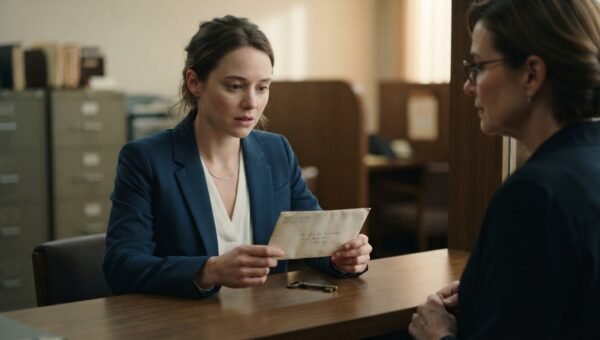
I did not put the papers away. Instead, I remembered a phone call I had received three days after Dad died. It had come from Mrs. Gable, the older woman who ran the accounts department at the medical center. She had called to ask if I had received my final receipt packet, and then she had paused, clearing her throat in an awkward way.
“Did your brother deliver the estate envelope to you?” she had asked.
I had been driving to the funeral home to choose Dad’s casket spray, my eyes burning from lack of sleep. I had told her I had my own carbon copies and that Greg and I would sort out the paperwork later. I hadn’t thought twice about it.
Now, sitting under the chandeliers of the country club dining room, that phone call fell into place with absolute clarity.
Dad had a supplemental policy through his old union at the water plant. It was a modest plan, but it carried a specific rider: any out-of-pocket medical expenses paid during the final sixty days of terminal illness would be reimbursed to the estate or the payer upon presentation of paid receipts.
Dad had mentioned that policy once, while sitting in his recliner with a blanket over his knees. He had told me, “Whatever you put up to keep the collectors off the porch, Sarah, the union policy will pay back to you. The forms are in my top drawer.”
When I searched Dad’s top drawer the morning after he died, the union folder was empty.
I had assumed Dad was confused in his final weeks. I had figured the policy had lapsed years ago when the plant restructured. I had accepted the loss of my $27,440 savings because Dad was gone, and money didn’t feel important compared to an empty chair at Sunday dinner.
I pulled the second sheet from the manila folder. It was the itemized payment ledger Mrs. Gable had mailed directly to my home address two days ago, along with a copy of the claim form filed with the union health administrator.
On the claim form, dated nine days ago, Greg had checked the box marked Sole Surviving Financial Caregiver.
He had attached my paid receipts. He had crossed out my phone number in blue pen and written his own cell number above it. At the bottom, he had directed the union insurer to issue the $27,440 refund check directly to his personal checking account, noting that the estate had no open probate.
“Greg,” I said, setting the claim form on top of the receipt.
He looked at me then. His face lost its soft, grieving expression. The skin around his mouth went tight and gray.
PART 3
“Sarah, don’t do this here,” he muttered, leaning forward so only our table could hear. “I am warning you.”
“You told everyone here that I refused to help,” I said. I didn’t raise my voice. I spoke at the exact volume you use to order a cup of coffee. “You told Aunt Clara and Uncle Ray that you carried the entire cost of Dad’s illness alone.”
“Because I managed everything!” Greg snapped, his voice rising enough that the next table turned around. “I drove him to three appointments! I sat in those waiting rooms while you were working your clinic hours!”
“You drove him to three appointments,” I agreed. “And I paid the hospital.”
I picked up the top receipt and laid it in front of Aunt Clara.
Clara looked down at it, frowning. She adjusted her glasses with one finger. Her eyes moved from my name on the payment line, down to the $27,440 total, and then stopped at the purple stamp where Greg had signed to collect the reimbursement.
“What is this?” Clara asked. She looked at Greg, her forehead wrinkling. “Greg? Why does this say Sarah paid twenty-seven thousand dollars?”
“It’s a clerical error,” Greg said, but his voice cracked on the second word. He reached across the table to grab the paper, but Clara pulled it closer to her plate.
“It is not an error,” I said. “Dad asked me to pay the delinquent balance quietly because he didn’t want to hurt your feelings. He knew you were behind on your mortgage, Greg. He told me you were ashamed because you couldn’t contribute a dollar, and he begged me not to make you feel small.”
The dining room around our table had gone completely quiet. Uncle Ray, who had been laughing with someone two seats over, stopped mid-sentence.
“You didn’t just let me pay it,” I continued, looking directly into my brother’s eyes. “You went to the billing office forty-eight hours after Dad took his last breath. You told Mrs. Gable that you were handling the estate expenses. You took my paid receipts, filed them under Dad’s union policy, and had the full $27,440 check mailed to your house.”
“I was going to distribute it,” Greg whispered. His hands were shaking now. He pulled them off the table and shoved them into the pockets of his dark suit coat. “I was setting up an account for Dad’s final expenses.”
“The lunch is already paid for,” I said. “The plot is paid for. The casket is paid for. I paid for all three from Dad’s checking account, and you know there were no other debts left.”
Brenda picked up the second page, the copy of the union claim form. She read the line where Greg had sworn under penalty of perjury that he had personally covered the out-of-pocket costs.
“Greg,” Brenda said softly, looking at him with genuine disbelief. “You told all of us last week that she wouldn’t even answer your texts about the bills. We collected five hundred dollars at church for you.”
Greg didn’t answer her. He didn’t look at Clara, and he didn’t look at Brenda. He stared straight down at his untouched roll.
“Did you cash the check?” Uncle Ray asked. Ray was seventy-two, a retired machinist who had worked forty years alongside my father at the water plant. He had known the union rep personally.
Greg kept his eyes on the tablecloth. “It cleared yesterday,” he said, barely loud enough to hear.
“You are going to sign that money over to your sister,” Ray said. His voice was not loud, but it had the weight of fifty years of family authority behind it. “You are going to go to the bank tomorrow morning at nine o’clock, you are going to get a cashier’s check in Sarah’s name, and you are going to bring it to her front porch. Do you hear me?”
Greg didn’t argue. The bravado he had worn like armor during his memorial speech was completely gone. He looked smaller, sitting there in Dad’s old watch, caught in the middle of a room full of people who had known him since he was six years old.
ENDING
The memorial lunch ended earlier than planned. People finished their iced tea, hugged me on their way out, and avoided making eye contact with Greg. Aunt Clara didn’t pat his wrist again. When she got up to leave, she kissed my cheek, held both of my hands in hers for a long moment, and walked out without saying goodbye to him.
The next morning at 9:15, a gray sedan pulled into my driveway.
I watched through the front window as Greg walked up the sidewalk. He didn’t look like the confident older brother who used to tell me how the world worked. He walked with his shoulders hunched, carrying a small white envelope in his right hand.
I opened the front door before he could knock.
He didn’t try to come inside. He stood on the concrete porch, the morning sun hitting the side of his face. He held out the envelope.
“It is all there,” he said. “Twenty-seven thousand, four hundred and forty dollars. Cashier’s check from First National.”
I took the envelope from his hand. I opened it, verified the bank stamp, and checked the payee line. My name was spelled correctly.
“I wasn’t trying to steal from you, Sarah,” he said, looking past my shoulder into the hallway where Dad’s picture hung on the wall. “Things have been bad with the house. I thought… I thought since you had savings, you didn’t need it as fast as I did. I was going to pay you back later.”
“No, you weren’t,” I said simply. “You told our family I abandoned Dad so nobody would ever ask why you had the money.”
He looked down at his shoes. He had nothing left to say, and for the first time in our adult lives, he didn’t try to invent an excuse.
“Dad loved you,” I told him quietly. “He spent his last days trying to protect your dignity. You threw it away for twenty-seven thousand dollars.”
Greg turned and walked back down the porch steps without answering. He got into his car, backed out of the drive, and drove away down the quiet suburban street.
I closed the front door and locked it.
I took the manila folder from the side table, walked into the kitchen, and set it inside the metal filing cabinet where I keep my tax returns and home deed. Beside it, I placed the cashier’s check.
The house was completely still. For the first time since Dad entered the hospital three months ago, I didn’t feel the panic of unread bills or the sting of false accusations. I brewed a fresh pot of coffee, sat down at the kitchen table, and drank my first cup in peace.