PART 1
The waiter had just set down our ribeyes when Keith looked right at me across the white tablecloth and said, “Pass the butter, Clara.”
I stopped with my water glass an inch off the linen.
Clara was my older sister. She died in a rollover accident on Route 9 in the fall of 1994, five years before I ever shook my husband David’s hand in the lobby of a bank where we both had checking accounts.
“I’m Sarah, Keith,” I said, trying to smile so the waitress pouring water behind us wouldn’t feel awkward. “Clara’s been gone thirty years.”
Before the sentence was out of my mouth, the whole table lurched. The silverware rattled against the porcelain, and Keith’s knee jerked up hard under the oak ledge. David had kicked him. It wasn’t a playful tap between old buddies. It was a hard, deliberate crack of leather against bone.
Keith winced, rubbing his shin under the table. His face flushed a dull, dark red.
“Sorry,” Keith muttered, staring down at his bread plate. “Old memory. Just an old memory.”
“You’ve had two scotches on an empty stomach, Keith,” David said. His voice was smooth, completely level, but his knuckles were pale where his thumb pressed against the stem of his wine glass. “Sarah doesn’t need to hear about ghost stories on our twenty-fifth anniversary.”
“Right,” Keith said quietly. “Twenty-five years. Time flies.”
For the rest of the meal, David steered every conversation. He talked about his brother’s retirement down in Naples, about the transmission on his truck, about the patio pavers we were supposed to order next month.
Whenever Keith tried to say something, David cut in smoothly, refilling Keith’s glass, changing the subject, laughing a little too loudly at jokes that weren’t funny.
I sat there cutting my steak into small, neat squares, unable to chew properly. Keith had grown up three doors down from David in Elmira. They had gone to high school together, worked construction together in their twenties, and stood as each other’s best man. But David had never lived in my hometown of Vestal until after we met in 1999. He had never met my parents while Clara was alive. When I had cried on his shoulder during our first Thanksgiving together because Clara’s seat was empty, he held me and told me he wished he had known her.
When the bill came, David took out his card and walked up to the host stand to settle it, claiming he wanted to check on our coats.
The second David stepped around the corner toward the front vestibule, Keith leaned across the table.
His hand was shaking slightly. He reached into his jacket pocket, took out a faded blue cardboard matchbook, and slid it across the white cloth until it bumped against my fork.
“Take it,” Keith whispered, looking over his shoulder toward the hallway.
I picked it up. On the front, printed in faded silver foil, were the words: *Pine Crest Motel, Route 17.*
On the inside flap, written in black ballpoint pen in Clara’s neat, left-handed slant, were two letters: *C.M.* Clara Miller. My sister’s maiden initials.
Beneath the initials was a date written in the same ink: *October 14, 1999.*
October 14, 1999 was my wedding day.
“Keith, what is this?” I asked, my voice barely carrying over the dining room chatter. “Clara died in 1994. Why is our wedding date written inside this?”
Keith looked right into my eyes. His jaw was tight.
“Ask your husband which sister he met first,” he said.
A heavy hand dropped flat onto Keith’s shoulder.
David was standing right behind his chair, our coats draped over his arm, looking down at Keith with eyes as cold as creek water.
“You’ve said too much, Keith,” David said softly. “It’s time to go.”
PART 2
David didn’t take his hand off Keith’s shoulder. His fingers dug into the tweed of Keith’s jacket until Keith stood up, tossed a crumpled twenty on the table for his share of the tip, and walked out into the October air without looking back at either of us.
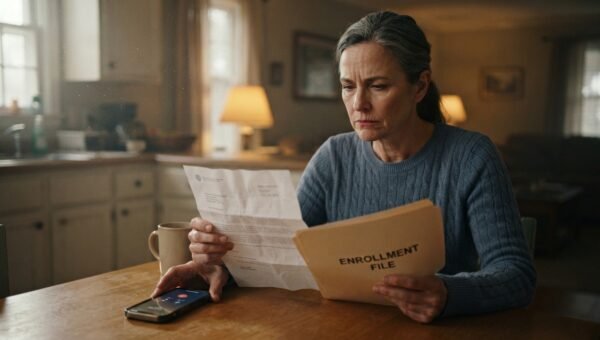
In the car on the way home, the heater blew warm air across my knees, but I couldn’t stop shivering. I kept my left hand buried deep in my coat pocket, my fingers pressed against the cardboard matchbook.
“Keith’s drinking again,” David said after three miles of silence. He kept both hands at ten and two on the steering wheel, his eyes fixed on the yellow lines. “He starts mixing scotch and painkillers for his back, and his brain turns to mush. He talks nonsense.”
“He called me Clara, David.”
“Because he’s an idiot who remembers me talking about her years ago,” David said. His tone was breezy, dismissive, the way he sounded whenever an appliance repairman gave him an estimate he didn’t like. “You know how Keith is. He gets confused.”
“You kicked him under the table.”
David didn’t blink. “He was embarrassing you on our anniversary. I told him to shut his mouth. That’s all.”
We didn’t say another word until we pulled into our driveway. David unlocked the front door, hung his coat in the hall closet, and went straight into the kitchen to pour himself a glass of water.
I went into the bathroom, locked the door, and took the matchbook out under the vanity bulb.
The cardboard was genuine. The edges were worn soft from sitting in a drawer or a box for decades. I knew my sister’s handwriting. Clara always crossed her capital *M* with a sharp downward hook, and her numbers were rounded, like a schoolteacher’s. The *C.M.* was hers. But the date below it, *October 14, 1999*, had not been written by Clara.
I looked closer under the bright vanity mirror. The ink was slightly different. Clara’s initials were in an older, faded blue ballpoint. The date below was in dark black ink.
The handwriting on that date belonged to David.
It was his slanted, cramped printing. The same way he wrote out our mortgage checks every first of the month, the same sharp crossbar on the number *4*.
My chest felt hollowed out. Clara had died on November 12, 1994. Her car had slid on black ice, rolled into a drainage culvert, and crushed the driver’s side. The funeral was closed-casket. I had helped my mother clear out Clara’s apartment two weeks later. Clara had worked as a night clerk at an auto parts warehouse in Binghamton, thirty miles south of Elmira.
David had always told me he lived in Elmira until 1998, working for his uncle’s framing company, before moving to Vestal and meeting me in the spring of 1999. We had married six months later in a small civil ceremony at town hall.
I didn’t sleep that night. David lay beside me, breathing heavily through his nose, his arm thrown over the duvet like a man with a clear conscience. Every time he shifted, the mattress creaked, and I stared at the ceiling fan turning slowly in the dark.
At dawn, David kissed my cheek, told me he had an eight o’clock job site inspection in Endicott, and took his truck keys off the counter. The moment his tires crunched down the gravel drive, I went to the phone.
I didn’t call Keith’s house phone. Keith’s wife was nosy, and news traveled fast in our circle. I drove twenty minutes down the old county road to Keith’s pole-barn garage behind his split-level in Owego.
His truck was parked outside. When I pushed open the side door of the shop, the smell of grease and motor oil hit me. Keith was standing by a metal workbench, wiping a socket wrench with a dirty red rag. He had an ice pack resting on the edge of the tool chest, and his right ankle was swollen where David’s boot had caught his lower leg.
Keith looked up, saw me standing in the doorway, and set the wrench down. He didn’t look surprised.
“You shouldn’t be here, Sarah,” he said, avoiding my eyes.
“You gave me that matchbook,” I said, walking right up to the bench. I took it out of my purse and set it flat on the greasy steel between us. “David wrote that date. That’s his handwriting. Clara died in 1994. Tell me what you meant at dinner, Keith. Right now.”
Keith looked at the matchbook, then leaned his weight against the bench. His shoulders sank.
“David told me thirty years ago that if I ever breathed a word of this to you, he’d bury me,” Keith said, his voice raspy. “He said you were fragile after Clara died, that knowing the truth would destroy you.”
“Knowing what truth?”
Keith took a slow breath, rubbing his temples with stained fingers.
“David didn’t meet you first,” Keith said. “He was seeing Clara for nearly two years before she died.”
PART 3
The air went completely still in the shop.
“What are you talking about?” I said. “David didn’t even live in Broome County back then.”
“Yes, he did,” Keith said. “He had a room rented over a radiator shop on Upper Court Street in Binghamton from 1992 to 1995. He met Clara at a diner off Route 17 where she used to stop after her late shift. They were together, Sarah. Secretly. Because David was still married to his first wife, Brenda, back in Elmira.”
I grabbed the edge of the metal bench to steady my legs. “David wasn’t married before. We got a marriage license in 1999. He checked ‘never married.'”
“He lied on the county clerk’s paperwork,” Keith said flatly. “The divorce with Brenda didn’t finalize until the summer of 1996. Brenda caught him with Clara at the Pine Crest Motel in ninety-four. That matchbook was in David’s glovebox. Clara kept her spare house key on a fob from that motel. That night in November, the night Clara crashed, she wasn’t driving home from work. She had just left a cabin David had rented near the reservoir. They had gotten into a massive screaming fight because Brenda had called Clara’s apartment and threatened her.”
The room seemed to shrink around me.
Thirty years of my life, thirty years of holiday dinners, anniversary cards, and quiet Sunday mornings, folded in on themselves.
I remembered that night in 1994 clearly now. The police had knocked on my mother’s door at two in the morning. They said Clara’s car had gone off the road on Route 9, miles away from the route between her warehouse and her apartment. My mother and I had wondered for years why Clara was out on those back roads in the middle of a sleet storm. We thought she had gotten lost or had gone to clear her head.
She had been running from David.
“Why did he marry me, Keith?” The words came out thin and dry. “If he loved Clara, why did he come looking for me five years later?”
Keith looked down at his oil-stained boots. “He didn’t stumble into you at that bank in ninety-nine by accident, Sarah. He tracked you down. He felt guilty. He thought what happened to Clara was his fault, and he thought if he took care of her little sister, if he gave you the life he promised Clara and ruined, he could make his peace with God. He kept that matchbook in his lockbox for years. He wrote your wedding date on it the morning you two got married like some kind of twisted penance.”
“How long have you known this?” I asked.
“Since the beginning,” Keith said quietly. “I helped him haul his stuff out of that Binghamton apartment after Clara died. I told him he was sick in the head for pursuing you. We fought about it for twenty-five years. Last night at dinner, when he started acting like the world’s greatest husband, making toasts about loyalty and true love, I couldn’t take it anymore. The name slipped out. But the rest of it, the matchbook, you deserved to know what your whole life was built on.”
I didn’t cry. I didn’t scream. I picked the matchbook off the workbench, slipped it back into my pocket, and walked out to my car.
I drove home. The house was empty. The morning sun was shining through the kitchen window, hitting the silver-framed photograph from our wedding day that sat on the credenza. David and I standing on the steps of the courthouse, smiling.
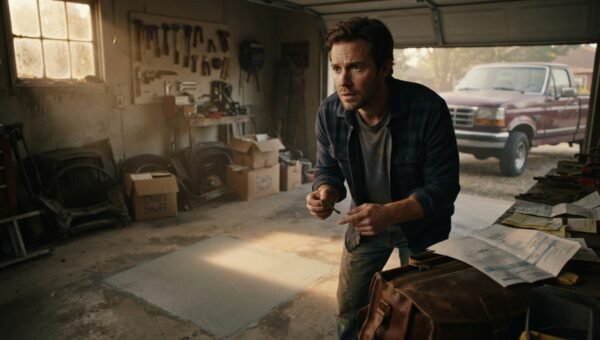
I went down the basement stairs to David’s workshop. In the back corner, tucked behind the water heater, was the green steel firebox where we kept our house deed, birth certificates, and car titles. David kept the key on his main ring, but I knew where he kept the spare: inside an old magnetic hide-a-key taped to the back of the metal utility sink.
I retrieved the key, unlocked the box, and lifted the tray.
The papers were all there. Beneath the deed to our home was an old manila envelope with no writing on it.
Inside was a certified copy of a divorce decree from Chemung County, dated August 14, 1996: *David R. Miller and Brenda J. Miller.*
And beneath the divorce decree was a photograph I had never seen before.
It was taken at a park pavilion. Clara was sitting on a picnic table in her denim jacket, her hair pulled back in the claw clip she always wore, laughing with her head thrown back. Standing behind her, with his arms wrapped tightly around her waist and his face pressed into her neck, was David. He was younger, his hair dark brown and thick, wearing the same silver watch he still wore to work every single morning.
On the back of the photograph, in Clara’s handwriting, was a single line: *Dave and me. July 1994.*
I heard the front door open upstairs. Heavy footsteps crossed the linoleum in the kitchen, followed by the jingle of keys hitting the counter.
“Sarah?” David called down. “You down there? Truck’s running rough, had to come back for my other toolbox.”
I didn’t answer. I took the photograph, the divorce papers, and the matchbook, and walked slowly up the wooden stairs into the light.
David was standing by the refrigerator with a glass of water halfway to his mouth. When he saw what was in my hands, the glass stopped.
He didn’t ask what I was holding. He didn’t ask where I had gotten it. He just looked at the yellowed photograph of Clara, and all the color drained from his face.
“You told me you never met her,” I said. My voice wasn’t loud. It was terrifyingly steady. “You held me on Thanksgiving and told me you wished you had known her.”
David set the glass down on the counter. The water sloshed over the rim, spilling onto the laminate.
“Sarah,” he started, his hands coming up, palms open. “Listen to me. Just let me explain.”
“You were married to Brenda,” I said, laying the papers flat on the island between us. “You were sleeping with my sister at the Pine Crest Motel. She died driving away from you.”
David’s eyes welled with sudden, genuine tears. “It wasn’t like that. I loved her, Sarah. I was trying to leave Brenda. Clara was everything to me. When she died, my whole world went black. I couldn’t breathe for three years.”
“So you hunted down her little sister?” I asked. “To fix it? To make yourself feel better about running her off the road?”
“No!” David cried, taking a step toward me. “At first, yes. I just wanted to see if you were okay. I heard you were working at the branch in Vestal. I opened an account just to look at you, because you had her laugh, Sarah. You had her eyes. But then I fell in love with you. I swear to God, Sarah, I fell in love with you for who you were. These past twenty-five years weren’t a lie. I’ve taken care of you. I’ve loved you every single day.”
“You didn’t love me,” I said. “You loved your alibi. You spent twenty-five years looking at my face to make sure Clara’s ghost didn’t catch up to you.”
ENDING
David broke down. He sat on one of the wooden barstools at the kitchen island, buried his face in his rough, calloused hands, and wept like a child. He admitted everything. He told me about the fight at the cabin, how Clara had thrown his ring back at him, how he had chased her car down Route 9 until her tail lights spun out into the ditch. He told me how he had stood on the dark shoulder, watching the smoke rise from her wreck, too terrified of his wife and the police to go down into the culvert. He had turned his truck around and driven home.
The police had ruled it a single-car accident caused by black ice. No one had ever looked for another vehicle.
He begged me to stay. He offered to sign the house over to me, to give me the joint accounts, to do whatever I wanted if I would just keep the past buried. “Nobody gains anything from this now, Sarah,” he sobbed. “She’s been dead thirty years. Don’t destroy our life over an old grave.”
I didn’t call the police. The statute of limitations on whatever reckless driving or failure to report he had committed had expired decades ago, and there was no evidence of a crime beyond the broken words of an old man.
Instead, I packed two suitcases.
I took my mother’s silver, my clothes, and my half of our savings, exactly $42,000, which I transferred into an individual account at a credit union two towns over. I left the divorce decree, the matchbook, and the photograph of Clara sitting in the center of the kitchen table.
I moved into a small, one-bedroom apartment near the river in Vestal. It has high ceilings, old hardwood floors, and a balcony that gets the afternoon sun.
David calls my cell phone every Tuesday evening at six. He leaves voicemails that I never listen to, but I don’t block his number either. Sometimes I just look at his name lighting up the screen, remembering the man I thought I knew for twenty-five years, and then I let the phone ring itself out into silence.
Last Sunday, I drove out to the cemetery where Clara is buried next to my parents.
The leaves were falling, bright yellow and orange, covering the granite stones. I brought a pair of garden shears and cleared away the crabgrass that had grown over the edges of her marker. For thirty years, I had come to this spot feeling a deep, dull ache for a sister taken by bad luck and bad weather.
Now, I knelt in the damp grass and pressed my palm flat against her cold stone.
“I know now, Clara,” I whispered to the quiet trees. “I know.”
Then I stood up, walked back to my car, and drove home to my own quiet life.