PART 1
The front doors of Oak Creek Elementary were already locked when I walked up with Toby’s red inhaler in my purse. It was twenty past one on a rainy Tuesday, and the principal, Mr. Vance, met me right inside the double glass doors before I could even sign the visitor log.
He did not smile. He kept both hands flat against his clipboard and told me I needed to step back outside under the awning.
When I told him Toby had asthma and had left his spare medicine in my glove box, Mr. Vance cleared his throat and said the school had strict instructions on file. He said my mother-in-law, Evelyn, had come in the previous afternoon to volunteer for bus duty, and while she was in the main office, she filed a verbal notice stating I was unstable, erratic, and not permitted anywhere near my seven-year-old grandson.
I stood there on the wet concrete mat with water dripping off my raincoat. Evelyn was seventy-six years old. She lived three miles down the road in a brick ranch house my late husband had helped her buy twenty years ago. She had never once picked Toby up from school by herself in her life.
When I called my son, David, from the parking lot, his breathing was heavy through the speaker. He was at his desk at the county road department.
I could hear his keyboard clicking while I tried to explain what had just happened in the hallway.
“Mom, please,” David said. His voice had that tight, exhausted edge he always used whenever his grandmother crossed a line. “She gets confused. She probably mixed you up with somebody else from church. It was just a misunderstanding. Just go home and stay calm.”
“A misunderstanding does not put my name on an office ban list, David,” I told him. “Your grandmother knew exactly who she was talking about. She gave them my full maiden name.”
“I will handle it tonight,” he said, and hung up before I could answer.
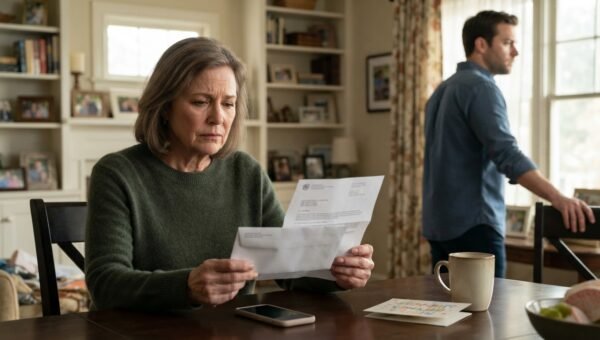
I went home to my kitchen, put Toby’s inhaler on the counter by the fruit bowl, and waited. David never called that night. Evelyn did not answer her landline. By Friday afternoon, when I drove past the school to see if Toby was riding his usual bus home, I saw his little blue backpack disappear into the backseat of a silver sedan I did not recognize.
The following Tuesday morning, my landline rang at eight o’clock. It was not David, and it was not Evelyn. It was the school attendance secretary, Mrs. Gable. She kept her voice down to an urgent whisper.
“Mrs. Miller,” she said, “you need to come down here right now. A woman just signed Toby out for an early dentist visit, and the address she wrote down next to her name is your old house on Elm Street.”
PART 2
I sold that house on Elm Street four years ago after my husband passed. Nobody in town had any reason to use that house number unless they had pulled it out of an old drawer or copied it off an old tax receipt.
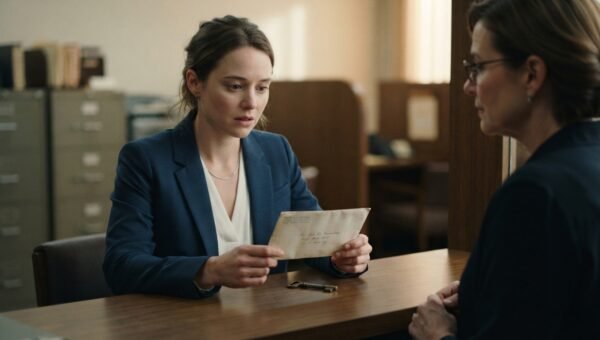
When I reached the front desk, Mrs. Gable was sitting alone under the fluorescent lights. The principal was out at a district meeting. She slid a black vinyl binder across the counter, turned it toward me, and pointed with the cap of her pen.
The line for ten-fifteen that morning had Toby’s name, the time, and a pickup reason written in dark blue ballpoint ink. The signature beside it read Clara Vance. But under Clara Vance, in the box marked legal address, someone had printed 414 Elm Street in sharp, tiny block letters with a slant to the left.
The handwriting made my chest go tight. The signature was sloppy and unfamiliar, but those small, tight block letters were not written by a stranger. I had watched Evelyn address Christmas envelopes and church pledge cards in that exact left-leaning slant for over thirty years.
“Who is Clara Vance?” I asked Mrs. Gable.
Mrs. Gable did not answer right away. She stood up, locked the front office door, and walked back to the filing cabinet behind her desk. She pulled out Toby’s full enrollment packet from August, along with two early-release slips from October and November.
“The woman who came in today had gray hair and drove an older gray Buick,” Mrs. Gable said quietly. “She said she was Toby’s aunt. When I looked at the system, Clara Vance had been added as an authorized emergency contact three weeks ago. But look at the original registration cards, Mrs. Miller.”
She laid all three forms flat on the desk side by side.
The emergency release card from August had David’s handwriting on top. But on the third line, Clara Vance had been added in fresh ballpoint pen, using my old Elm Street address. On the early dismissal slip from November, someone had written that Toby was leaving for physical therapy. The hand that filled out every single box on those forms was the same cramped, left-leaning script. Evelyn had filled out the paperwork herself, but she had signed a completely fictitious name at the bottom.
Then Mrs. Gable pulled a folded sheet of yellow legal paper from underneath the desk blotter.
“Toby left his reading folder in class yesterday,” Mrs. Gable whispered. “His homeroom teacher found this tucked inside the front sleeve. She brought it to me this morning because she has been worried about him for months. She told me she was waiting for someone in this family to notice what was going on.”
At the bottom of the yellow paper, under a practice spelling test, Toby’s teacher had written one single sentence:
“Your grandson asked me to hide this from his mother.”
PART 3
The sentence sat on that yellow pad like an open wound. Toby’s mother, Sarah, worked twelve-hour shifts as an ultrasound technician at the regional hospital forty miles north. She was gentle, quiet, and worked six days a week trying to pay off the medical bills from Toby’s pneumonia two winters ago. She worshipped that little boy. Toby would never hide a thing from his mother unless an adult he feared had drilled it into his head.
I did not call David at work. I did not call Evelyn. I drove straight to Evelyn’s brick house on the other side of town.
When I turned into her driveway, the silver sedan from the school was not there, but Evelyn’s front screen door was unlocked. I walked straight through the enclosed breezeway and into her living room without knocking.
Toby was sitting on the carpet by her coffee table with an open coloring book. Across from him on the sofa sat a woman in her late sixties wearing a floral cardigan, clutching a vinyl purse in her lap. Evelyn was standing over the kitchen stove, stirring a pot of canned soup.
When Evelyn saw me, the wooden spoon stopped mid-circle.
“What are you doing in my house, Martha?” she snapped, trying to put that sharp, commanding bark into her voice. “You have no business barging in here.”
I did not look at her. I looked at Toby. He scrambled up from the rug, dropped his blue crayon, and ran straight into my legs, wrapping his thin arms around my waist. He was shaking so hard his ribs trembled against my hip.
“Grandma,” he whispered into my sweater, “Daddy said Mommy would leave us if anyone found out about the money.”
The woman on the sofa stood up immediately, her face flushing dark red. “Evelyn, you told me the boy’s mother signed off on this arrangement,” she stammered, pulling her keys from her coat pocket. “You told me you were his legal guardian during the day.”
Her name was not Clara Vance. Her name was Clara Higgins, a retired nurse’s aide who lived two doors down from Evelyn. Evelyn had hired her for fifteen dollars an hour to sit in the school parking lot, pull Toby out of class under a fake name, and bring him here so Sarah would never see him coming home early.
The truth did not come out in a polite confession. It came out in ugly, defensive shrieks across Evelyn’s kitchen counter while Clara Higgins rushed out to her car and drove away.
David had lost thirty-two thousand dollars over the last eighteen months on online sports gambling apps. To keep the bank from putting a lien on their house, David had convinced Sarah to take the extra hospital shifts, promising her that he was paying six hundred dollars a month to a private learning center to tutor Toby after school while she worked.
There was no tutoring center. There was no physical therapy.
David had pocketed every dollar Sarah sent home for Toby’s care to pay his loan sharks. To keep the school from calling Sarah about Toby’s falling grades and repeated absences, Evelyn had stepped in. She forged the pickup papers using a false name and my old Elm Street address, figuring that if the school ever checked the records, the paper trail would lead to an address I had owned, keeping Sarah completely in the dark.
And when Evelyn realized I lived close enough to the school to notice Toby’s schedule, she walked into the principal’s office and tried to ban me from the grounds so I would never cross paths with the front office.
“We were trying to save David’s marriage,” Evelyn yelled at me, her hands trembling over her soup pot. “If Sarah found out, she would take that boy and leave the county! David would be ruined! You were always too rigid, Martha. You would have blown the whole family apart over a few late notices!”
“You had a stranger forge papers to steal my grandson out of school,” I said. My voice did not shake. It was the coldest, quietest sound I had ever made in my life. “And you made that seven-year-old child carry your son’s debt on his back.”
ENDING
I took Toby’s hand, walked him out to my car, and buckled him into the back seat. I did not scream, and I did not slam Evelyn’s door.
I drove Toby straight to my house, made him a grilled cheese sandwich, and sat beside him at the kitchen table while he ate every crumb. When he finished, I dialed Sarah’s direct extension at the hospital clinic. When she answered between patients, I told her everything without softening a single word.
Sarah was at my front door two hours later in her blue hospital scrubs. She fell to her knees right there in my entryway, pulled Toby into her arms, and held him so tight his sneakers lifted off the floor. She did not yell at me. She did not defend David. She just looked up at me with red, exhausted eyes and nodded when I told her she and Toby were staying in my spare bedroom.
The school cleared my name the following morning. Mr. Vance called me personally to apologize after Mrs. Gable showed him the forged emergency cards and Clara Higgins’s statement. The school filed a formal report with the district safety officer, permanently barring Evelyn from the campus and flagging Toby’s file so that only Sarah and I have pickup authorization.
David came to my porch three nights later. He stood on the bottom step in the dark, with his jacket unzipped and his head down, begging me to talk Sarah into coming home. He told me it had just been a temporary patch, that he was going to fix the money, that Evelyn had only been trying to help him protect his home.
I looked at my only son through the screen door. For years, I had made excuses for his weakness, telling myself he was just soft-hearted, just easily led by his grandmother’s pride. But seeing Toby’s little spelling test hidden under a blotter had stripped all the mercy out of me.
“Your grandmother did not protect your home, David,” I told him through the mesh. “She helped you lie to your wife, and she taught your son to be terrified of the truth.”
I turned off the porch light and locked the deadbolt.
Sarah filed for legal separation two weeks later. She and Toby are still in my upstairs room. Every afternoon at two-forty-five, I pull my car into the visitor lane at Oak Creek Elementary. Mrs. Gable waves to me from the office window, and Toby comes running out through the double glass doors with his backpack bouncing against his shoulders, grinning the second he sees me waiting by the curb.