PART 1
When my younger sister Brenda asked if her daughter Chloe could borrow my wedding dress for a quick vintage photo shoot, my first instinct was to say no. That dress was not just something I wore down the aisle twenty-four years ago. Mom spent nearly eight months sitting at her old Singer sewing machine in our cramped dining room, hand-stitching tiny seed pearls onto the bodice and pressing every single pleat of the silk organza.
She died of a sudden stroke just three weeks after my wedding, which made that dress the heaviest, most sacred thing I owned. It stayed folded in acid-free tissue inside a cedar chest in my guest room closet, untouched and smelling faintly of lavender.
Brenda can be careless, but she swore up and down that Chloe just wanted to take a few pictures in the backyard to surprise our aunts. She promised she would handle the professional preservation cleaning herself before bringing it back. Against my better judgment, I relented. Family peace usually wins out with me, or at least it used to.
Two weeks later, Brenda dropped the heavy storage box on my porch while I was at work, texting me a quick thumbs-up emoji and a message saying thanks. When I finally opened the box that evening, I didn’t even make it past the tissue paper before my breath caught.
The distinct, sweet scent of lavender was completely gone, replaced by the sharp chemical tang of cheap dry cleaning. But that was nothing compared to the physical shock of lifting the dress out.
The delicate, long illusion lace sleeves were entirely gone, sheared off right at the shoulder seams with pinking shears that left jagged, messy edges. The dramatic sweep train that my mother had spent three solid weeks hand-hemming had been chopped off to ankle length so Chloe wouldn’t trip during whatever backyard party or reception reenactment they had staged.
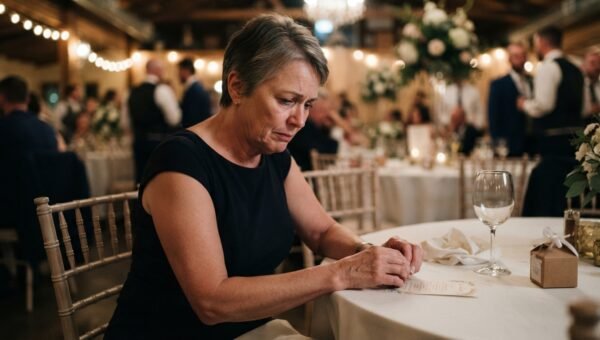
I sat right down on my living room floor, surrounded by loose threads and shredded lace, and cried harder than I had when Mom first passed away. It felt like a physical violation, as if someone had taken a pair of scissors to a photograph of my mother’s face.
Brenda didn’t answer my phone calls for three days. When she finally picked up, her voice was defensive and sharp.
She told me I was being dramatic, that long sleeves and heavy trains were completely out of style, and that Chloe looked modern and chic. She acted as if I should be thanking her for giving a thirty-year-old heirloom a second life. She hung up on me when I asked how she could justify destroying the one thing Mom left behind that meant everything to me. I spent the next month moving through my days like I was underwater, nursing a dull, heavy ache in my chest and trying to figure out how a family could fracture so completely over a piece of silk.
PART 2
About two months after the fight, I finally worked up the courage to clean out the cedar chest and pack away the remnants so I wouldn’t have to look at them every time I went into the guest room. As I lifted the bottom cardboard liner of the box, my fingers caught on something unusual near the corner.
It wasn’t a tear in the cardboard. It was a small, hidden fabric flap that Mom must have sewn into the lining of the storage box itself, tucked away so securely that I had missed it for decades.
Inside that tiny compartment was a folded square of lined yellow notebook paper in Mom’s familiar, hurried handwriting. I carried it to the kitchen table under the bright overhead light.
The note read: “Dearest Sarah, if you are reading this, I am gone. I wanted you to have a little extra security for your future. I slipped something valuable into the heavy bottom hem of your wedding dress before I sealed the final stitch. It’s yours, completely separate from whatever happens with the rest of the estate. Keep it safe.”
My hands started to shake. The bottom hem. The exact part of the dress that Brenda had chopped off and thrown away.
For a few minutes, my mind completely stalled. I tried to convince myself that Mom meant something symbolic, or that maybe I was misunderstanding her words. But Mom was a practical woman who lived through lean years; when she talked about security and something valuable sewn into a hem, she meant physical items. Cash, bonds, or maybe even one of the heavy gold family rings that had gone missing after the funeral.
I told myself not to jump to conclusions, and that I needed to find out what actually happened to the discarded fabric before I accused Brenda of something even worse than thoughtless vandalism. But the seed of a terrifying suspicion had already taken root. Why did Brenda insist on taking the dress specifically for a photo shoot? Why was she so desperate to alter it, and why did she get so aggressively defensive when I confronted her about the damage?
I waited for proof, though I didn’t want it. Every hour that ticked by made the silence between Brenda and me feel heavier, charged with a new kind of tension that had nothing to do with fashion and everything to do with greed.
PART 3
The proof came faster than I wanted it to, and it didn’t come from Brenda. I didn’t want another family fight, but I also couldn’t live with the gnawing sickness in my stomach. I wanted one honest answer, and somehow that seemed to be the one thing nobody in my family was willing to give me.
I dug through my old text messages until I found the name of the local neighborhood tailor shop where Brenda had taken the dress for its supposed cleaning and adjustments. The shop was a cramped, cluttered little storefront run by an elderly woman named Mrs. Gable, who had altered half the prom dresses and wedding gowns in our town since the nineteen-eighties.
When I walked through the door with the shredded dress in a garment bag, Mrs. Gable took one look at my face and sighed deeply before I even opened my mouth.
“I remember that dress,” Mrs. Gable said, wiping her hands on a small towel. “Your mother brought it in years ago to check the seams. I told Brenda she shouldn’t touch it when she brought it in last month. But your sister was insistent. She stood right over there by the fitting room and told me to cut off the hem immediately, right in front of her.”
My breath caught in my throat. “Did she… did she say why?”
“She didn’t have to,” Mrs. Gable replied quietly. “The moment my shears hit the heavy padding in the bottom fold, something heavy and metallic dropped right onto the linoleum floor with a loud clatter. It startled both of us.”
I gripped the edge of the cutting table. “What was it?”
Mrs. Gable walked over to a small wooden storage cabinet behind her counter, unlocked the lower drawer, and pulled out a small, heavy plastic baggie. Inside were four heavy, vintage gold Krugerrands and a folded bank certificate tied with a faded ribbon.
“Your sister snatched them up off the floor before I could even bend down,” Mrs. Gable said, her expression stern. “She looked panicked, stuffed them right into her purse, and told me to throw the rest of the scrap fabric and the trimmed hem into the trash bin out back. But I’ve been doing this a long time, Sarah. I know when people are hiding things that don’t belong to them. I swept up the scraps from the floor after she left and kept them in the back, just in case someone came looking for the truth.”
ENDING
I stood there in the quiet tailor shop, staring at the plastic baggie resting on the scarred wooden counter. The room seemed to tilt slightly as the final pieces of the puzzle slammed into place. Brenda hadn’t ruined my dress out of ignorance or a misguided desire to modernize family traditions. She had known the gold was hidden in that hem all along, likely having overheard Mom talking about it years ago, and she engineered the entire photo shoot as a clever excuse to tear the gown apart and steal what rightfully belonged to me.
Mrs. Gable slid the bag across the counter toward me. “She owes you a lot more than an apology, honey. And I’m willing to sign a statement saying I watched her pull those coins out of your mother’s handiwork.”
Driving home, the anger inside me didn’t feel hot or chaotic anymore. It felt cold, clear, and focused. I pulled into Brenda’s driveway thirty minutes later, the plastic baggie heavy in my coat pocket and Mrs. Gable’s signed affidavit folded beside it. When Brenda opened her front door with an annoyed look on her face, ready to launch into another speech about how I needed to move on, I didn’t yell or cry. I just pulled out my phone, played the voicemail I had recorded from Mrs. Gable, and held up the empty space where my mother’s legacy used to be. For the first time in her life, the color drained completely from Brenda’s face, and she didn’t have a single word left to say.