PART 1
My husband’s best friend has eaten dinner at our house every Wednesday for eighteen years. He was practically family. Last month, he stopped coming without explanation.
His name is Ray. For nearly two decades, you could set your watch by him. Every Wednesday afternoon at twenty past five, his blue pickup would turn into our gravel drive. He would wipe his work boots on the mat, hang his cap on the peg by the dryer, and sit at the head of our laminate table while I finished the gravy or mashed the potatoes.
When our daughter got married, Ray gave the toast right after my husband, Tom. When Tom had his hip replaced seven years ago, Ray came over twice a week to haul our trash cans down to the road.
Then, on the second Wednesday of August, the clock hit six. The pork chops got cold in the skillet. Tom did not get up to check the window. He did not pick up his flip phone. He just sat there chewing his food, looking down at his plate.
When I asked what was going on, Tom said they had a disagreement down at the municipal water shop where they both worked before retirement. He told me Ray was stubborn, that men their age get set in their ways, and that he would come around when he cooled off.
I believed him. A forty-year friendship has rough spots, and I had no reason to doubt my husband.
Three weeks went by. The Wednesday chair stayed empty.
Then, on a Tuesday morning while Tom was at the hardware store picking up furnace filters, the kitchen telephone rang. It was Ray’s wife, Brenda.
Brenda and I were never especially close, but we traded holiday cards and spoke at church potlucks. Her voice was thin and tight, like she was holding a towel over the receiver.
She did not say hello. She just asked, “Did Tom tell you what happened at the lake?”
I stood by the sink with a wet dishcloth in my hand. I told her I had no idea what she was talking about. I asked if Ray was sick, or if something had happened to their grandson.
Brenda went quiet for a long five seconds. I could hear her breathing. “He hasn’t told you,” she whispered. She started to say something about a lockbox, then she caught herself. “I can’t do this, Ellen.
You need to ask your husband directly. Ask him what he brought home in his duffel bag.”
She hung up before I could answer.
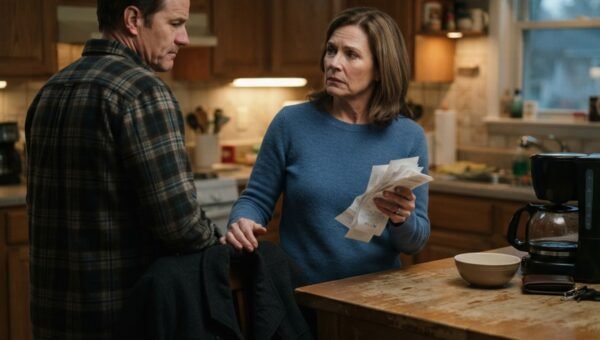
That night, after the local news went off, Tom was sitting in his brown recliner with his reading glasses on his nose. I turned off the television set with the remote. The room went dead quiet.
I asked him straight out what happened at Ray’s cabin on Lake Marion last month.
Tom did not look up from his magazine. He said Brenda was an excitable woman who liked to stir up trouble when she was bored. He told me nothing happened, just two old men arguing over an outboard motor.
“Brenda called me this morning, Tom,” I said. “She sounded like she had been crying for three days.”
Tom’s hands stopped moving. The magazine slid down his knees onto the carpet. He sat forward, put both elbows on his knees, and buried his face in his rough palms.
“I didn’t cheat,” he said into his hands, before I had even accused him.
My stomach dropped into my shoes. I had been thinking about money, or an old fistfight, or something stupid said over beer. Infidelity had not even crossed my mind until that very second.
Tom did not wait for me to speak. He stood up, his bad knee popping, and walked down the short hallway to our bedroom. I followed him as far as the doorway. He opened the sliding closet door, reached behind the extra winter quilts on the top shelf, and pulled down an old metal cookie tin.
He took something out, walked back into the hallway light, and held it toward me.
It was a color photograph, four inches by six inches. The edges were stiff and badly rippled from water damage. The colors had bled slightly into the white border, leaving pale yellow stains across the glossy surface.
“This is why he won’t come here anymore,” Tom said.
I looked down at the picture. It was eighteen years old. It showed Ray standing on the wooden dock at Lake Marion, grinning at the camera with a fresh coat of gray paint on the boards beneath his boots. Tied to the cleat beside him was my late father-in-law’s green aluminum fishing boat, with the dent in the bow Tom’s father put there the summer before he died.
PART 2
I stared at that dented green boat until my eyes burned.
Tom’s father passed away in the spring of 2006. He left Tom that four-acre parcel on Lake Marion, along with a small, uninsulated fishing shack and that green rowboat. We were forty-eight years old then, and we were drowning. Tom had broken his ankle falling off an intake valve at the water plant, putting him out of work for five months without short-term disability. My gallbladder had turned necrotic that same summer, leaving us with $31,400 in hospital bills after our union insurance denied the out-of-network surgeon.
We had bill collectors calling the landline three times a day. We were two months behind on our house note.
Tom had decided to sell the lake parcel to clear the debt. But with his ankle in a plaster cast and our bank account down to $140, he couldn’t drive the two hours north to handle the paperwork, clear the brush, or meet with the county assessor.
Ray had stepped in. He told Tom he had a cousin in commercial real estate who would handle everything as a favor. Three weeks later, Ray came back to our kitchen with bad news. He told us the county had slapped two separate delinquent drainage liens on the land from the late nineties, the septic tank had collapsed, and the ground was full of clay that would never pass a perk test. He said the only buyer willing to touch it was an out-of-state timber salvage outfit that offered $4,200 cash as-is.
We were desperate. Tom signed the paperwork Ray brought over. That $4,200 didn’t even pay off the anesthesiologist, but it kept the bank from foreclosing on our front porch.
Six months after that, Ray told us his mother’s bachelor brother had passed away in Ohio and left him a small lake property. He said it was an old rundown place on Lake Marion, pure coincidence, and he asked Tom to help him fix up the screened porch.
That was also the exact month Ray started coming to our house for dinner every Wednesday.
Now, standing under the bare bulb in our hallway, I turned the warped photograph over in my fingers. Written on the back in blue ballpoint ink was a date: October 14, 2006. Below the date was Ray’s unmistakable block handwriting: “All mine. Paid in full.”
“Where did you get this, Tom?” I asked. My voice sounded small and dry.
“Under the dock,” Tom said.
He walked into the kitchen and sat at the table. He told me about the weekend at the lake last month. Ray had asked him to come up for two days to help replace the support posts under the boat ramp. On Sunday morning, while Ray was five miles down the road at the hardware store buying galvanized lag bolts, Tom went down to the water with a pry bar.
Underneath the low wooden apron where the dock met the shoreline, wedged between the concrete footings to stay out of the dirt, Tom found a heavy plastic battery box. It had an old padlock on the latch, rusted shut from lake spray. Tom thought it was an old emergency electrical cutoff box. He tapped the rusted hasp with the pry bar, and the lock snapped.
Inside the box were two zip-top bags.
One bag held the original deed from the county courthouse, dated September 2006. The buyer was not a timber company. It was an LLC registered to Ray’s home address. Ray had paid the county $4,200 for Tom’s land using a cashier’s check drawn on his own credit union account. Two months later, Ray dissolved the LLC and transferred the title directly into his and Brenda’s names.
The second bag held the photograph, along with a certified appraisal letter from a bank in Duluth. The land and cabin had been valued at $38,000 back in 2006.
Ray had stolen Tom’s inheritance for pennies on the dollar, watched us struggle to buy groceries for five years, and then invited Tom up every summer to help him build decks and paint siding on the very cabin Tom owned.
PART 3
Tom told me the rest with his hands flat on the table, not looking at me.
When Ray pulled back into the driveway with the lag bolts, Tom was sitting on an overturned bucket by the shoreline with the plastic box sitting open on the grass.
Tom didn’t yell. He didn’t throw a punch. He just held up the Duluth appraisal and asked Ray why he did it.
Ray didn’t deny it. He stood on the gravel path with a box of heavy bolts in his arms, his face completely rigid. Then he dropped the box. He told Tom that Tom would have lost the land to the county anyway for back taxes because Tom was too soft-headed to manage money. He claimed he did Tom a favor by putting $4,200 in our hands when nobody else would give us a dime. He said he took the risk, cleared the brush himself, and built the value with his own sweat.
“He told me I should thank him,” Tom whispered.
Then Ray tried to grab the papers out of Tom’s hands.
They were sixty-six-year-old men scuffling on wet cedar planks like two boys in an alley. Ray lunged for the file. Tom pulled back, his boot slipped on the algae at the edge of the dock, and the folder flew into the air. The appraisal and the deed sank into the dark green water near the lily pads, but the photograph landed on a floating patch of dock foam near the pilings.
Tom went into the water up to his chest to grab it.
By the time Tom hauled himself back onto the bank, coughing and soaking wet with lake weeds clinging to his jeans, Ray had backed his truck out of the drive. He left Tom standing alone on the shoreline two hours from home without a ride. Tom had to walk half a mile down the county road to the bait shop, call an independent taxi from the nearest highway junction, and pay $85 to get to the regional bus stop.
He kept the wet photograph tucked inside his zippered jacket the entire ride home.
The next morning, Brenda came to our house.
She did not knock. She walked through the back screen door, her purse tucked tight under her arm, her eyes swollen. Tom had already left for his morning walk around the neighborhood.
She sat in the exact chair Ray had occupied every Wednesday for eighteen years.
“I didn’t know until Sunday night,” Brenda said, her voice shaking so hard her teacup rattled on the saucer. “Ray came home without Tom. He locked himself in the garage with a bottle of whiskey. When I finally got the door open, he was sitting on the floor with his head on the workbench, bawling like a baby.”
She looked at the rippled photograph sitting on my counter.
“He told me what he did back in 2006,” she said. “He told me he bought the land from under you for nothing because we had $18,000 in credit card debt from his boat that I didn’t know about. He paid off his boat and kept the cabin.”
She pulled an envelope out of her purse. It was a formal letter from a real estate attorney in town.
“I’m not living with this,” Brenda said, wiping her nose with a crumpled tissue. “I told Ray if he doesn’t sign a quitclaim deed transferring the lake property over to you and Tom for one dollar, I am filing for divorce on Friday and turning the tax paperwork over to the county prosecutor.”
ENDING
We didn’t go to court.
Ray signed the quitclaim deed at the county clerk’s office on a rainy Thursday morning three weeks ago. Tom went in at nine o’clock. Ray came in at nine-thirty so they wouldn’t have to sit in the same waiting room. The clerk handed Tom the stamped conveyance paper in a plain manila folder.
We own the cabin now. We own the four acres of birch trees, the cedar dock, and the dented green aluminum boat tied to the pilings.
Last Saturday, Tom and I drove up there for the first time as owners.
The place smelled like damp cedar and lake mud. Inside the kitchen, Ray’s spare jackets were still hanging on the wooden pegs by the door. His coffee mug was sitting upside down on the drying rack beside the sink.
We didn’t feel victorious. There was no joy in walking through those rooms.
Every time I looked at the tongue-and-groove pine on the living room walls, all I could see was our kitchen table from fifteen years ago. I remembered boiling hot dogs and stretching a pound of ground chuck with dry oats because we had forty dollars left for the week, while Ray sat in my kitchen, accepted second helpings of my food, and told us we were the best friends a man could have.
Eighteen years of dinners. He had eaten at our table over nine hundred times. He didn’t come because he loved us. He came because every plate of pot roast was an installment on his guilty conscience, a little payment to convince himself he was still a decent man.
We stayed two hours. Tom gathered all of Ray’s clothes and tackle boxes, loaded them into three heavy black contractor bags, and set them out by the county road for the local thrift pickup.
Yesterday was Wednesday.
At five o’clock, I stood in the kitchen and made meatloaf for two. I set two white plates on the table, two forks, and two glasses of ice water.
When the grandfather clock in the hall struck five-twenty, the gravel drive stayed silent. No truck turned in. No work boots wiped on the rubber mat.
Tom sat down in his chair, unfolded his paper napkin, and reached across the table to take my hand. We ate our supper in the quiet house, with the empty space at the end of the table looking larger than it ever had before.