PART 1
The bill came inside a heavy black leather folder, and Richard slid it right across the linen tablecloth toward my water glass.
“One hundred and ninety each,” he said. He didn’t even look at the itemized slip. He just looked at me like he was waiting for me to do something simple, like pass the salt.
We were sitting in the back corner of The Oak Room downtown.
It was Valentine’s evening. Two weeks earlier, he had called me three times in one afternoon just to brag about getting the reservation. He told me to wear something nice because he had a big night planned. I bought a dark navy dress on sale at Macy’s and had my hair done, thinking this was finally the night he stopped treating everything like an even trade.
I looked down at the paper. The total was $380, not including the tip. We had ordered dry-aged steaks, two sides of roasted vegetables, and a bottle of red wine he selected without asking what I wanted.
“Richard, you invited me here,” I said quietly. A couple at the next banquette was laughing over dessert, and I lowered my voice so they wouldn’t hear us. “You said this was your treat for Valentine’s.”
“I said we should celebrate together,” he answered, leaning his elbows on the table.
His tone stayed flat and practical, the way he talks to people who work the counter at his dry cleaners. “A partnership means sharing the load, Claire. If you expect a man to carry all the weight just because of a calendar date, you have the wrong idea about where we’re going.”
“It’s not about the calendar date,” I told him. My hands were in my lap, gripping my cloth napkin. “You insisted on this place. I suggested the Italian place near my apartment where we could get pasta for twenty dollars. You said tonight had to be special. You ordered the eighty-dollar bottle.”
“And you drank two glasses of it,” he said.
I looked at him across the little candle flickering between us. We had been seeing each other for fourteen months. In fourteen months, Richard had never once given me a gift that didn’t have a quiet condition attached.
If he picked up takeout on a Friday, he would casually mention the following Tuesday that it was my turn to buy groceries. If we drove his car to see my sister in Lansing, he set the trip odometer and asked for fifteen dollars for gas. I had spent a year telling myself he was just careful with his money because his first marriage had ended badly over finances. I told myself it was discipline, not coldness.
“I’m not paying half of this, Richard,” I said. “I can’t afford a two-hundred-dollar dinner right now, and you knew that before you booked the table.”
He stared at me for maybe five seconds without blinking. Then he reached into his breast pocket, pulled out his silver money clip, and dropped four crisp hundred-dollar bills into the folder. He didn’t say another word to me. He stood up, adjusted his coat, and walked straight out through the dining room doors into the cold February wind.
He didn’t look back to see if I was following him. He left me sitting alone at an empty table with half a basket of cold bread and two full glasses of water.
The shame came on quickly, hot and thick in my chest. I felt like the entire room had watched him leave, even though nobody was looking at me. I gathered my purse, pulled my coat around my shoulders, and was about to stand up when our server appeared at my elbow.
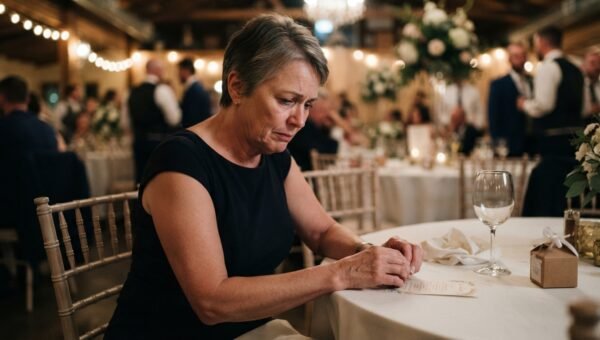
Her name tag said Maria. She was a woman in her late forties, maybe early fifties, with tired eyes and a neat graying bun. Instead of bringing the change, she set down a small folded white cocktail napkin right beside my saucer.
She leaned down, her voice low and direct. “I can’t stay quiet,” she whispered. “Your boyfriend actually left a note for you. He gave it to me on his way out.”
I stared at the napkin. The Oak Room logo was stamped in gold foil on the corner, but on the inside fold, Richard had scrawled two tight lines with the ballpoint pen the restaurant provided.
My heart dropped as I unfolded it.
“I came here tonight with one plan in mind, but after what happened at this table, I see who you really are. Call me when you’re ready to grow up.”
PART 2
Maria didn’t walk away immediately. She stood by the table, pretending to clear the small bread plates so she had a reason to linger.
“Honey,” she said softly, keeping her eyes down on the plates, “I saw the way he spoke to you. And when he walked past the host stand, he dropped that napkin on the ledge and told me to make sure you read it before I cleared the cash.”
“Thank you,” I managed to say. My throat felt tight.
I took a twenty-dollar bill from my wallet and left it on the tablecloth for her tip, knowing Richard had only dropped four hundred for a $380 check, which barely left twenty dollars on a high bill. Then I walked out into the cold.
The wind hit my face hard as I stood on the sidewalk waiting for a taxi. My car was parked two miles away at my apartment because Richard had insisted on picking me up. He had left me stranded downtown in twenty-degree weather with no car and no ride.
During the twenty-minute cab ride home, my phone stayed completely silent. No text asking if I made it back. No follow-up message. Just the cold ink on that cocktail napkin rattling in my purse.
When I unlocked my front door, the silence in my living room was deafening in a way that felt heavy rather than peaceful. I hung my coat in the hall closet, kicked off my heels, and sat down at the kitchen table with the napkin smoothed out in front of me.
*I came here tonight with one plan in mind.*
What plan? For a brief, foolish second, the thought crossed my mind that he had intended to propose. We were both in our late fifties. We had talked about downsizing in a few years, maybe finding a small patio home near the lake once my youngest daughter finished college. He had brought up moving in together three or four times over the winter. Was the luxury dinner supposed to be the moment he asked me? Was I the one who ruined it by making an issue out of money over a restaurant check?
The doubt started gnawing at me. I had spent decades keeping the peace in my family, smoothing over rough edges, apologizing when other people raised their voices. It was my worst habit. Whenever someone pushed me, my first instinct was always to ask what I had done to cause the shove.
At midnight, my phone finally buzzed on the counter. It was a text from Richard.
“I left my black leather folder in your front hall closet yesterday when I dropped off those tax forms for you to review. Don’t touch the papers inside. I’ll pick it up tomorrow after work.”
I walked over to the closet. He had come over on Wednesday to borrow my printer, and he had left his dark brown briefcase on the floor and a thin black portfolio on the top shelf. I pulled it down.
I hadn’t planned on looking. But after being abandoned at a restaurant and handed a note treating me like a misbehaved child, the old habit of polite obedience snapped. I opened the folder.
Inside was a printed document from a local real estate attorney, dated three days earlier. Stapled to the front was a residential lease agreement for his four-bedroom colonial on Meadow Lane, set to begin on April 1st. Behind it was a formal loan application for a townhouse in Clearwater, Florida, listed solely under his name, along with an attached budget breakdown.
Halfway down the page, typed under expected monthly contributions, was a line in bold ink:
*Claire Davis monthly rent and household stipend: $1,400.*
PART 3
I sat at my kitchen table until two in the morning, reading every single page.
Richard wasn’t planning a romantic proposal at The Oak Room. He had already found tenants to rent out his house in Ohio for $2,800 a month starting in April. He had placed an earnest money deposit on a two-bedroom condo in Florida under his name alone. And according to the budget worksheet prepared for his lender, he had factored in $1,400 every month from me to cover half the mortgage, taxes, and maintenance fees on a property where my name appeared nowhere on the deed.
He hadn’t mentioned Florida once. He hadn’t asked if I wanted to leave my job, my daughters, or the small bungalow I had owned free and clear since my divorce twelve years ago.
He hadn’t planned to ask me to be his wife. He had planned to announce our new life as an accomplished fact over an expensive steak, tell me how much I would owe him each month, and expect me to be grateful for the privilege.
The $380 check hadn’t been an accident or a misunderstanding about Valentine’s Day. It was a test. He wanted to see if I would push back against paying for something he decided on, or if I would quietly hand over my card to keep him happy. When I said no, his entire arrangement ran into a wall.
The next afternoon at five-thirty, headlights swept across my living room curtains. A car door slammed outside.
Richard walked up the porch steps and knocked twice, sharp and brisk. When I opened the door, he had his hands in the pockets of his wool coat. He didn’t smile, but his expression was relaxed, like a teacher coming back to check on a student after a timeout.
“Can I come in?” he asked.
“No,” I said. “You can stand right there on the porch.”
His eyebrows drew together. “Claire, are we really going to drag this out? You made a scene last night over a routine dinner bill. I expect an apology, but I’m willing to chalk it up to stress. Let’s get past it.”
“I found your folder in the closet, Richard.”
He didn’t move, but his eyes shifted slightly toward the hallway. “You went through my private papers?”
“You left a budget in my house that lists fourteen hundred dollars a month from my checking account for a condo in Florida,” I said. My voice was completely steady. “You rented your house out starting April first. You were going to use Valentine’s dinner to tell me we were moving, weren’t you?”
He let out a short, irritated breath and looked down at his boots. “I was trying to build a future for us. Most women your age would be thrilled to have someone handle the logistics. Meadow Lane is too much house for me, and your bungalow is cramped. Florida is where people our age retire.”
“You were building a future for yourself,” I told him. “On my dime. You wanted me to sell my home, move a thousand miles away from my grandchildren, and pay off your mortgage without a single shred of equity in the property.”
“I was offering you a home,” he snapped, his voice rising just enough to reach the street. “You’re acting like I tried to rob you. I asked you for one hundred and ninety dollars last night for a dinner we both ate, and you threw a tantrum. You’re ungrateful.”
“I’m awake,” I said.
I picked up the black folder from the entryway table behind me and held it out. He took it roughly from my hands.
“Don’t call me,” I said. “And don’t come back up these steps.”
He stood on the porch for another moment, his jaw working, waiting for me to soften the way I usually did. When I didn’t move, he turned around and walked down the steps to his sedan.
ENDING
Two weeks later, my youngest daughter, Sarah, came over on a Sunday afternoon to help me plant early seedlings in small plastic trays on the kitchen counter.
She asked if I had heard from Richard.
“He sent one email through his office account,” I said, pressing damp soil around a tomato seed. “He said he found a different co-signer for the Florida property, and that I’d regret letting my pride ruin a comfortable retirement.”
Sarah looked at me across the potting soil. “Did you reply?”
“No,” I told her.
I had deleted the email without reading past the first paragraph.
After she left, I took the small white cocktail napkin from the top of the refrigerator where I had stuck it under a magnet. I smoothed out the gold lettering of The Oak Room and read his handwriting one last time: *Call me when you’re ready to grow up.*
I walked over to the trash can under the sink, tore the napkin into four pieces, and dropped it into the bag. Then I washed the dirt from my hands, poured myself a cup of tea, and sat down in the quiet living room of the home I owned all by myself.