PART 1
The storm had been building all afternoon, a heavy, slate-colored darkness rolling in off the lake that made the house feel hollow and small. I was sitting at the kitchen table with a cup of lukewarm tea, watching the rain streak the glass, when the front porch motion light flashed on. It did not click off after thirty seconds like it did when a stray neighborhood cat wandered past. It stayed on.
Then came the sharp, frantic rattling of the front door handle.
When I pulled the heavy oak door open, I did not expect to see a child. Chloe stood on the mat, shivering so hard her teeth were clicking together. She was wearing a sodden navy blue school uniform skirt and a soaked cardigan that clung to her ribs. Her brown hair, usually tied back neatly for school, was plastered across her forehead in wet strands. At eleven years old, she looked fragile enough to snap in half.
“Grandma,” she gasped, her voice cracking before a sob caught in her throat. She didn’t wait for an invitation; she stumbled forward across the threshold, her canvas sneakers leaving muddy puddles on my hardwood floor.
“Chloe, sweet Jesus,” I breathed, dropping to my knees despite my stiff joints. I grabbed the spare wool throw from the living room sofa and wrapped it tightly around her trembling shoulders, rubbing her thin arms to generate some friction. “What are you doing out in this? Where is your mother? Did someone pick you up from school?”
She shook her head violently, tears mixing with the rainwater dripping down her cheeks. She shrugged off a heavy, waterlogged nylon backpack that hit the floor with a dull, wet thud. The zipper was half-open, jammed against a stack of thick envelopes.
“I walked,” she whispered, her eyes wide with a terror that made my stomach drop into my shoes. “From the middle school. It took me almost an hour. Mom said… Mom said if I ever came here or talked to you, we wouldn’t have a home anymore. But Mark was screaming again, Grandma. He threw his coffee mug against the pantry door, and Mom was crying in the bathroom, and I had your old address memorized from the birthday card you sent me two years ago before they made me give it back.”
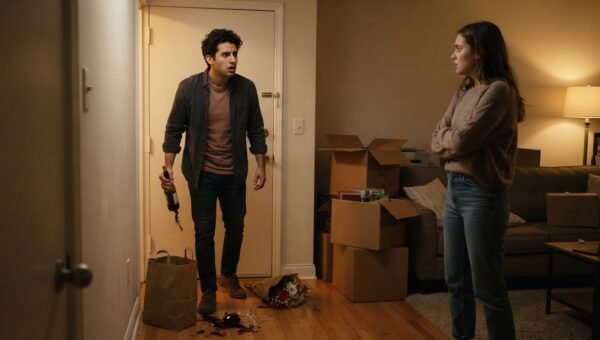
The mention of Mark sent a cold spike of adrenaline through my veins.
Mark Miller. My daughter Sarah’s second husband. A man who had swept into her life three years ago like a well-dressed storm, charming enough to convince Sarah that her entire family—her mother, her brother, her old friends—were simply toxic elements holding her back. Within eighteen months of their wedding, Sarah had changed her phone number, blocked my email address, and told me flatly at a chance meeting in the parking lot of a grocery store that my presence in her life “complicated things” for her new marriage. She told me to stay away for my own good.
I hadn’t seen Chloe in thirty-four months. The last time I held her, she was a giggling eight-year-old braiding my hair. Now she was a frightened child shaking in my hallway, staring at me as if I were a ghost or a lifeline.
“You’re safe here, baby,” I murmured, pulling her against my chest and ignoring how the damp wool soaked through my own blouse. “You are completely safe. Nobody is going to hurt you.”
I got her into a hot shower, washed the mud and chill from her skin, and dressed her in an oversized flannel shirt of mine that hung down past her knees. I made her a mug of warm milk with honey, sitting with her on the sofa while she slowly stopped trembling.
It was only after she finally drifted off to sleep, curled into the corner of the cushions with the heavy quilt pulled up to her chin, that I noticed the backpack she had clutched so desperately to her chest even while shivering on the porch. It had fallen open on the rug.
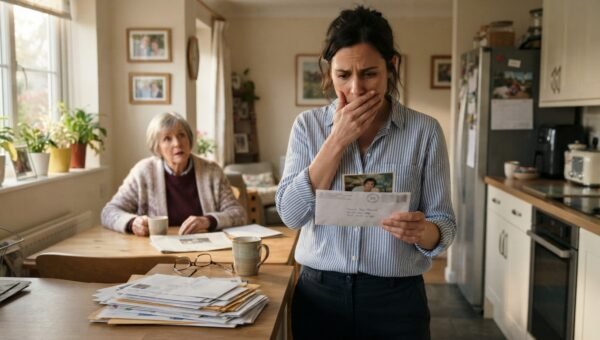
Protruding from the main compartment were several thick, cream-colored envelopes. They weren’t school books. They weren’t drawings. They were addressed in my daughter Sarah’s distinct, sloping handwriting.
My name was written across the front of the top envelope in blue ink: *Mom.*
I hesitated. Every instinct I had developed over the past three years—the bitter, hard-earned lesson that Sarah’s life was closed to me, that I had no legal right to interfere, that crossing her boundaries would only result in Chloe paying a steeper price—told me to leave the letters alone. I hated myself for being suspicious, but I hated more that every new fact gave me another reason to be. Part of me wanted to walk away and never ask. The other part knew I would replay it for years if I did.
With trembling fingers, I slid the top envelope out of the pack. The paper was slightly warped from dampness, but the seal was unbroken.
The newest began, “Mom, if you ever read this, please believe me about Mark.”
I unfolded the single sheet of lined notebook paper. The handwriting was frantic, the letters pressed so hard into the paper that the other side was embossed.
*Mom, I’m writing this in the basement while he’s upstairs watching television. I didn’t know who else to turn to. He took my phone away last week. He checks the mileage on my car every night when he gets home from the dealership. He told me that if I ever reached out to you or my brother, he would make sure I never saw Chloe alone again, and he knows how to do it because of the legal papers we signed last winter. He’s not the man I thought he was. He controls every dollar in the bank account, and when I asked about the college fund Dad left for Chloe, he laughed and said it was already gone into his business investments. Please, if you get this, don’t call the house. Don’t confront him. He has a temper you don’t know about. But please… just keep this letter as proof.*
My breath hitched. A college fund. Arthur, my late husband, had set aside a dedicated account for Chloe’s education before he passed away—twenty-five thousand dollars, untouched and maturing safely. Sarah had been the executor alongside her mother. Or so I thought. When Sarah married Mark, she had persuaded me to sign some paperwork transferring administrative oversight to “streamline family assets.” I trusted my daughter. I trusted her new husband’s financial background.
I reached back into the backpack and pulled out the remaining envelopes. There were five in total, dated across the past eight months. Each one detailed a darker escalation: financial coercion, isolation, threats, and a growing, desperate fear that Mark was systematically erasing Sarah’s independence and draining every asset she owned.
Then headlights pulled into my driveway.
PART 2
The harsh beam of twin halogen headlights swept across the living room wall, cutting through the driving rain and casting long, dancing shadows against the floral wallpaper. The engine didn’t idle long before it cut out with a sharp tick of cooling metal.
My heart hammered against my ribs like a trapped bird. On the sofa, Chloe stirred instantly, her eyes snapping open with a look of pure terror. She bolted upright, clutching the edge of the quilt, her breath catching in her throat.
“Is that him?” she whispered, her voice barely a squeak. “Grandma, did he follow me?”
“Stay right here,” I said, keeping my voice as steady as I could manage while my hands shook. I laid the open letter back down on the coffee table beside the backpack. “Do not move, Chloe. I’m right here.”
I walked to the front window and parted the vertical blinds just enough to see outside. A dark gray Ford SUV sat parked awkwardly across the edge of my gravel drive, its hazard lights blinking in rhythmic, amber flashes. The driver’s door swung open, and a tall figure stepped out into the downpour, hunched against the wind.
It wasn’t Mark.
It was my son, David.
Relief rushed through me so fast it made me dizzy, quickly replaced by a sharp wave of confusion. David lived forty miles away in the city, where he worked as an architectural draftsman. He and Sarah had barely spoken since her second wedding either; Mark had managed to alienate David within six months, calling him unmotivated and dramatic.
I unlocked the front door and pulled it open before David could reach the porch steps. He was soaked through his leather jacket, his dark hair plastered to his skull, holding a large manila envelope under his arm.
“Mom,” he blurted out, stepping past me into the entryway and shaking off the rain like a wet dog. “Thank God you’re home. I called your landline three times, but it went straight to—” He stopped dead in his tracks as he caught sight of the living room.
Chloe was sitting up on the couch, wrapped in my blanket, her wide eyes fixed on him.
David stared at his niece, his jaw slackening. “Chloe? What in God’s name… What are you doing here?”
“She walked, David,” I said, closing the door firmly against the wind. “All the way from school. In this storm.”
David ran a hand over his face, water dripping from his chin. He looked down at the manila envelope he was carrying, then across the room at the kitchen table where Sarah’s unmailed letters lay scattered.
“You found them,” David said quietly. It wasn’t a question.
“She brought them in her backpack,” I answered, my voice dropping into a harsh whisper. “Read the latest one, David. Then tell me what the hell is going on in that house.”
He didn’t need to read it. He walked over, dropped his wet jacket onto a chair, and pulled a folded stack of printed bank statements and loan documents out of the manila envelope. He laid them out on the coffee table next to Sarah’s handwritten pages.
“I didn’t come here just because I missed you, Mom,” David said, his voice tight with suppressed fury. “I came because I spent the last three days auditing Sarah’s architectural design business accounts and personal records after a former partner of Mark’s called me from out of state. Mark didn’t just take over Sarah’s finances. He used her signature—forged power of attorney documents—to take out a second mortgage on her house. The house Dad paid for in cash before he died.”
I stared at him, the words refusing to make sense in my brain. “A second mortgage? Sarah would never agree to that. She knows what that house means.”
“She didn’t agree to it,” David said grimly. “Mark told her it was a routine business restructuring for tax purposes. He had her sign a stack of papers while she was medicated after her minor knee surgery last fall. And that’s not the worst of it. Look at this.”
He pointed to a line on one of the printed bank statements.
“The college fund,” I whispered, the realization hitting me like a physical blow. “He cleaned it out.”
“Every single cent,” David confirmed. “Twenty-five thousand dollars transferred into an LLC registered in Delaware under Mark’s name. When Sarah found out last week—when she finally looked at the physical statements that arrived in the mail instead of the digital ones Mark intercepted—they had a massive fight. That’s why Chloe ran.”
PART 3
For a long moment, the only sound in the room was the steady drumming of the rain against the roof and Chloe’s soft, even breathing as she watched us talk. The anger that had been simmering inside me for three years—the bitter, helpless grief of being pushed out of my daughter’s life—suddenly crystallized into something cold, focused, and absolute.
“We’re not calling the police just to file a report and wait for them to shuffle paperwork for six months,” I said, my voice barely above a whisper, but hard enough that David blinked in surprise. “Mark thinks Sarah is isolated. He thinks she has no one left who will fight back because he cut us all off. But he made one fatal mistake.”
“What’s that?” David asked.
“He left a paper trail in this house, and he let Chloe walk out the door,” I said, nodding toward the backpack. “And he doesn’t know David is looking at his business registry.”
“He also doesn’t know where Chloe is yet,” David added, checking his phone. “Sarah’s phone is off, but Mark left a voicemail on my phone about twenty minutes ago screaming that Chloe ran away from school and demanding to know if she came here. He sounded unhinged.”
“Let him scream,” I said. I walked over to the kitchen counter and picked up my landline handset. I didn’t dial 911 immediately. Instead, I dialed an old friend of Arthur’s—a retired criminal investigator named Frank Vance who now ran a private forensic accounting and family law advisory firm in the county seat. Frank owed Arthur a favor, and he hated con men with a passion that bordered on religious.
It took three phone calls and twenty minutes of sharp, precise coordination. David handed over the forged power of attorney documents and the bank transfer logs. I briefed Frank on Chloe’s condition, the physical letters detailing domestic intimidation, and the immediate threat to my daughter’s safety.
“If we go in with local patrol cops, Mark will play the loving, concerned husband, claim Sarah is hysterical, and lock the doors,” Frank’s gravelly voice came through the receiver. “We need a judge to sign an emergency ex parte protection order for Sarah and the child based on the coercion and financial fraud evidence, coupled with a welfare check backed by county detectives. I can have a magistrate at his kitchen table within two hours if you meet me at my office with the physical letters right now.”
“We’ll be there,” I said.
I looked back at Chloe. She had fallen back asleep, exhausted by the trauma of the afternoon and the long, freezing walk. I pulled the quilt higher around her shoulders and kissed her damp forehead.
“David,” I said, turning to my son. “You’re going to stay here with Chloe. Lock every door, keep the lights low, and don’t answer to anyone except Frank or me.”
“Where are you going?” David asked, standing up quickly. “Mom, you shouldn’t go down there alone.”
“I’m not going to his house,” I replied, grabbing my heavy raincoat from the peg by the door. “I’m going to meet Frank at the courthouse annex with every single one of these letters. And then, David, we are going to go get my daughter back.”
ENDING
The rain had tapered off to a cold, steady drizzle by the time Frank Vance’s sedan pulled up alongside mine in the gravel parking lot behind the county courthouse annex. The judge’s chambers were warm and smelled of old paper and stale coffee, a sharp contrast to the biting wind outside.
It took less than forty-five minutes once the magistrate examined Sarah’s handwritten letters alongside the forged loan documents and bank transfer logs. The legal case wasn’t just a messy family dispute anymore; it was documented financial fraud, elder-adjacent asset manipulation involving a minor’s trust, and documented coercion.
By 9:30 PM, two county sheriff’s deputies, accompanied by Frank Vance and myself, pulled up to the driveway of Sarah’s suburban home.
The porch light was blazing. Through the frosted glass of the front door, I could see shadows moving rapidly. When the deputies knocked, it took nearly a full minute before the deadbolt clicked and the door swung open.
Mark stood in the doorway, his shirtsleeves rolled up, his face flushed with a mixture of righteous indignation and sudden, ugly panic. He opened his mouth to demand what we were doing on his property, but the sight of the two uniformed deputies standing on either side of me—followed by Frank flashing his investigator’s badge—killed the words in his throat.
“Mark Miller?” the lead deputy asked, his voice flat and authoritative. “Step away from the door, please. We have a court-ordered welfare check and an emergency protective custody and asset-freeze warrant issued by Judge Harrington.”
Behind Mark, in the dim hallway, Sarah appeared. She looked ten years older than the last time I saw her, her face pale, her eyes hollow and ringed with dark circles, her left wrist wrapped in a gauze bandage. When she saw me standing there in my yellow raincoat, her knees buckled. She caught herself against the wall, and a single, ragged sob broke from her chest.
“Mom,” she whispered, her voice cracking with a sound that tore straight through my heart. “Oh God, Mom… he said you’d never speak to me again.”
“He lied, sweetheart,” I said, stepping past Mark as the deputies moved inside to secure the premises. I walked straight down the hallway, opened my arms wide, and caught my daughter as she collapsed against me, shaking just as hard as her little girl had a few hours before. “You’re coming home with us. Both of you.”
Mark started shouting about trespass and lawyers as the deputies placed him against the living room wall to read him his rights regarding the fraudulent loan filings, but his voice sounded distant and small, swallowed up by the rain outside.
It would take months to untangle the financial mess, to restore the house to Sarah’s name, and to help her heal from the quiet cage she had let herself be locked into. But as we packed Sarah’s clothes into two suitcases and drove back through the dark county roads toward my warm, bright kitchen where Chloe and David were waiting, I knew the silence was finally broken. The truth was out in the open, and nobody was ever going to shut us out again.