Arthur always said my work at the district office was more of a hobby than a real career, something to keep my hands busy while he handled the serious business of running his commercial masonry supply company out on the west edge of Bakersfield. I heard that line at least a thousand times over thirty-two years. He said it across the laminate kitchen table while I poured his coffee at 5:30 in the morning.
He said it at backyard barbecues when neighbors asked what I did all day. I usually just smiled and wiped down the counter because keeping the peace was easier than explaining the complicated balancing act of keeping thirty-four school budgets from bleeding red. You learn to swallow a lot of small things when you spend three decades trying not to rock a boat that has already taken on water.
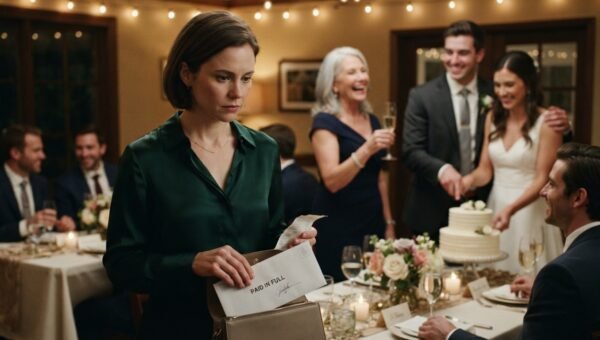
The retirement banquet was held at the Elks lodge down on Chester Avenue, a big room with yellowing acoustic tile on the ceiling and a smell of floor wax and prime rib that clung to my wool sweater. The district superintendent gave a speech that went on for twenty minutes, mostly listing off grant applications I had processed and bond measures I had tracked down to the penny since nineteen-ninety-one. People clapped at the right spots. Arthur sat right beside me in his charcoal suit, checking his watch every few minutes and tapping his silver signet ring against the edge of the water glass.
When the superintendent finally handed me the glass plaque with my name etched into the center, Arthur stood up and tapped his fork against his own glass to quiet the room.
“Thirty-two years of answering phones and filing papers,” Arthur said, laughing into the microphone like he was delivering a great punchline to a bunch of subcontractors. “A cute little job for a woman who never wanted the pressure of a real career. But now that her little hobby is finally wrapped up, I have a little surprise of my own.”
The room chuckled because Arthur always knew how to play a crowd. He looked down at me with that easy, practiced grin that used to make me feel safe back when we were first married and living in that tiny apartment off Ming Avenue.
“I booked myself six months in Europe,” Arthur announced, waving his hand toward the back of the room as if he were already standing in front of the Colosseum. “Starting next month.
Just me and the open road, or the open rail, or whatever they have over there. Brenda can finally stay home and handle things around here. Take care of the yard, empty the gutters, water the ferns. It is about time she had some real practice being retired.”
A ripple of polite laughter went through the tables. My face felt hot, burning all the way down my neck, but I forced my mouth into that same old rubber-band smile and nodded along with the rest of them. I clapped my hands twice because that was what was expected of me. Arthur sat back down and patted my knee like I was a golden retriever that had just learned to sit on command. My stomach felt hollow, but I told myself to let it go. That is the embarrassing part. I was so used to keeping everyone comfortable that I nearly talked myself out of feeling angry at all.
Then the banquet hall doors at the back creaked open, and Principal Vance stepped out from the shadows near the coat racks. He wasn’t even invited to the dinner, not formally, but he had worked with me through seven different school superintendents and four major district audits. He walked straight toward our table, his face flat and gray under the fluorescent lights, holding a heavy manila envelope stamped with the official raised seal of the Kern County Schools financial oversight committee.
“Brenda,” Principal Vance said, ignoring Arthur entirely as he stopped right beside my chair. “You need to see this right now. Before you leave this building.”
Arthur frowned, his smile slipping just a fraction of an inch as he looked at the heavy paper in the principal’s hand. “We are in the middle of celebrating, principal. Whatever records you have can wait until Monday morning at the district office.”
“No, Arthur,” Vance said, his voice dropping into that quiet, heavy register he used when a student was caught tampering with the attendance registry. “It really cannot wait until Monday.”
I stood up from the folding chair, my knees clicking against the metal legs, and took the envelope from Vance’s hand. It was heavier than it looked, weighted down by several folded sheets of heavy-stock accounting paper and something else stiff inside. The texture of the heavy manila paper felt rough against my thumb. I didn’t even say thank you to Vance. I just turned and walked away from the table, heading toward the quiet corner by the coat rack where the heavy wool coats hung in long, dark rows.
Arthur followed me, his footsteps heavy on the linoleum floor. “Brenda, what is this nonsense? Sit back down at the table. People are watching.”
I didn’t look at him. My fingers slid under the metal clasp of the envelope, twisting the brass prongs apart with a soft scraping sound. I pulled the papers out into the dim light of the hallway. The first page was a summary of escrow disbursements from a commercial property transfer on Rosedale Highway, dated back to March of two thousand and fourteen. The second page was a certified bank ledger showing a series of wire transfers moving from an account I didn’t recognize directly into a private construction loan held in Arthur’s name alone.
“Brenda. Give me that,” Arthur said, his voice dropping an octave as he reached out to grab the edge of the paper.
I stepped back, my shoulder hitting the heavy wool of a winter coat hanging on the rack. I kept reading down the third page, where my own signature appeared at the bottom of a grant compliance waiver. Except I had never signed that waiver. Someone else had traced my initials using a blue ballpoint pen, poorly mimicking the little flourish I always put on the tail of my y.
“You said it was a cute little job,” I said, my voice sounding hollow even to my own ears.
Arthur stopped moving. His hand stayed out in the air for a second before he dropped it slowly to his side. “It was nothing. Just some routine paperwork for the new gymnasium annex out at the north campus. You know how complicated those county grants get.”
“I never signed this, Arthur,” I said, my eyes scanning down to the fifth line of the audit summary where the total amount of diverted maintenance funds was listed in bold, black ink. “I never saw these accounts in thirty-two years of balancing the ledger.”
By the third line he had stopped smiling, and by the fifth he asked how long I had known.
“How long have you had this?” Arthur whispered, his face losing whatever ruddy color the banquet prime rib had put into it. He looked smaller suddenly, his shoulders hunching inside the expensive wool of his charcoal suit as he glanced around the empty hallway to see if anyone else was listening.
“I just got it right now, Arthur,” I said, my voice hardening into something flat and cold. “From a man who respects my work more than my own husband ever did.”
The numbers on the page didn’t lie. They were right there in black and white, showing every single dollar that had been siphoned away from the district’s emergency roof-repair fund to keep Arthur’s struggling masonry supply yard afloat during the slump back in eighteen. For years, while I stayed late at the office eating cold turkey sandwiches out of a plastic Tupperware container and hunting down missing ten-cent discrepancies in the cafeteria accounts, Arthur had been quietly using my administrative clearance to siphon money through dummy project codes. He had treated my entire professional life like a personal ATM machine while telling everyone at the Elks lodge that I was just a woman with a cute little hobby.
“We can talk about this at home,” Arthur muttered, reaching out again, his fingers twitching toward the papers in my hand. “We can sort this out. I can pay it back. Once the European trip is done and I liquidate that lot on Ming, we can clear the whole thing up. Nobody has to know about an internal audit.”
“The European trip?” I asked, looking up from the page to stare directly into his eyes. The fear in his face was real now, sharp and ugly around the edges. “You think you are going to Europe next month?”
“Brenda, be reasonable,” he said, his voice rising a fraction before he caught himself and looked back toward the banquet room doors. “We have been married for thirty-eight years. You cannot just throw all of that away over some bookkeeping errors made during a tight quarter.”
“It wasn’t a bookkeeping error, Arthur,” I said. “And I am not throwing anything away. You did that yourself.”
I folded the papers back into the manila envelope and pressed the metal clasp down until it clicked flat against the cardboard. I didn’t hand it back to him. I tucked it securely under my arm, right where I used to carry my ledger bag every morning when I walked out the front door at five past seven.
Arthur stood there by the coat rack, his mouth slightly open, waiting for me to soften up and tell him it would be all right. He waited for me to make the excuse, to smooth over the rough edges, to protect his comfort the way I had done every single day since we were kids in Bakersfield. He waited for me to laugh it off.
I didn’t laugh. I turned my back on him without another word, walking down the long hallway toward the exit sign above the heavy glass doors. Behind me, I could hear the faint sound of the superintendent’s voice still carrying through the partition walls, but it sounded distant now, like something from a radio playing in another room.
I pushed the glass door open and stepped out into the cool night air alone. The desert breeze hit my face, smelling faintly of creosote and distant exhaust from the highway, sharp and clean and entirely my own. My car keys were cold against my palm as I found my sedan waiting in the gravel lot, the engine ready to start whenever I turned the key. I didn’t look back once to see if he was following. For the first time in thirty-two years, I didn’t have to manage anyone else’s comfort, and the silence in the night felt wide enough to hold the rest of my life.