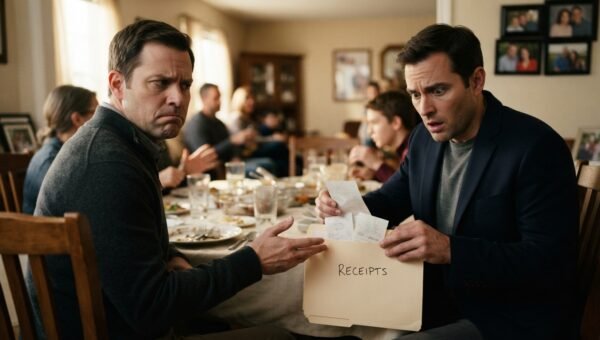
Fourteen thousand, eight hundred and twenty-two dollars. That was the bottom line on the invoice the funeral home handed me three days after we lowered Arthur into the hard Georgia clay. My hands were shaking so hard I could barely hold the ballpoint pen the director slid across his mahogany desk.
My oldest daughter, Brenda, stood right behind my chair with her hand resting firmly on my shoulder. She had been the one to make all the phone calls, pick out the casket liner, and talk to the florist while I sat on the floral sofa in our living room staring at the wallpaper seam.
“Just sign it, Mom,” Brenda had told me softly when I hesitated over the total, my eyes blurring behind my bifocals. “You are not too fragile to handle this, but you don’t need the extra stress right now. I already went over every single line item with them.”
The funeral director gave me a sympathetic, practiced nod from across the desk. He had known Arthur for twenty years through the county zoning board, so I trusted him implicitly. Brenda had spent the last week organizing every detail of the service, telling our neighbors and church friends that I was simply too overwhelmed to speak to anyone about arrangements.
I remember thinking that Brenda was turning into a remarkably capable woman, stepping into the family void just like her father would have wanted. So I signed my name at the bottom of the yellow slip without reading the itemized breakdown underneath, letting her guide my hand toward the signature line like I was a child learning cursive for the first time.
The weeks that followed blurred together into a grey smudge of casseroles left on the front porch and thank-you notes written on heavy cream cardstock. Brenda came over every Tuesday to help me sort through Arthur’s winter coats and his old ledger books from the hardware store.
“It is completely normal for the final bill to look a little high with all the rush fees,” Brenda said three weeks after the funeral when I finally mentioned the total number over a cup of instant coffee. “Prices have gone up on everything, Mom. You just have to trust that I kept it as lean as possible.”
I nodded and let the matter drop because the alternative was admitting that I felt entirely untethered in my own house, wandering from room to room looking for Arthur’s spectacles on the end table where they hadn’t sat in twenty-one days. Brenda stayed busy, running errands, managing the estate paperwork, and assuring everyone at the First Methodist fellowship hall that her mother was holding up remarkably well considering the circumstances.
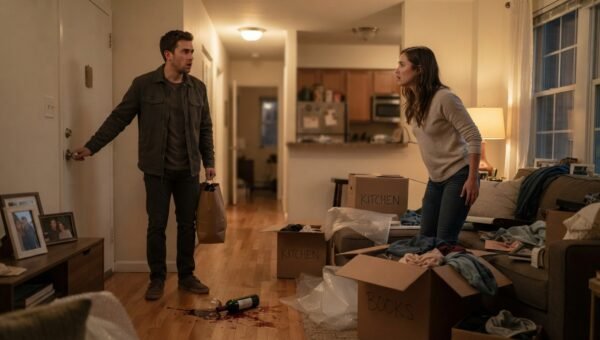
The break came six months later on a Tuesday morning in late October. Brenda had finally sold her little townhouse across town and bought that split-level place near the bypass, and she needed help packing up her old home office.
Her desk was an antique oak roll-top that Arthur had refinished for her college graduation present back when things were different between us all. I was kneeling on the braided rug beneath the open kneehole, clearing out a stack of old telephone directories and tax receipts that had slid behind the bottom drawer.
A small, square piece of heavy cardstock fluttered down onto my knee when I pulled out a bundle of old utility bills. It was one of the embossed thank-you cards from the funeral home, the exact same cream-colored paper stock we had sent out to the pallbearers.
I picked it up, expecting to see a draft of a message Brenda had planned to send to her coworkers.
Instead, the back of the card was covered in the funeral director’s neat, precise cursive handwriting in black ink.
“Deposit refunded as requested via wire transfer to ending-4891,” the note read, followed by a specific transaction date that fell four days after I had signed the invoice at the mahogany desk.
I sat back on my heels on the braided rug, the paper feeling suddenly heavy and cold between my fingertips. Ending-4891 was not my account number at the local credit union where Arthur and I had banked for thirty-five years.
“Brenda,” I called out, my voice sounding thin and dry in the small room. “Brenda, come in here for a second.”
Footsteps hurried down the hallway, quick and impatient. Brenda appeared in the doorway carrying a roll of packing tape, her blonde hair pulled back in a practical clip that made her look more like a corporate auditor than a grieving daughter.
“What is it, Mom? The movers are going to be here with the truck by noon and I still have three boxes of books in the bedroom,” she said, her voice dropping into that familiar tone of gentle management she had used since the day Arthur died.
I didn’t stand up. I just held the cream-colored card out toward her, keeping my hand steady even though my chest felt like someone had cinched a leather belt around my ribs two notches too tight.
“What does this mean?” I asked.
Brenda stopped with the tape dispenser half-raised in her right hand. Her eyes flicked down to the card, and for the space of one breath, the color drained out from beneath her skin, leaving her looking remarkably old.
“Where did you find that?” she asked, her voice losing its efficient edge.
“In the back of the kneehole,” I said. “Under the old tax forms. Why did the funeral director wire a refund to an account ending in forty-eight ninety-one?”
Brenda crossed her arms over her cardigan, her jaw tightening the way it always did when she was caught in a lie during her teenage years. “It was just an adjustment, Mom. The billing department made a mistake on the catering line items and added a private family room fee that we never actually used.”
“So they gave you a refund,” I said. “For how much?”
“It doesn’t matter,” she said, taking a step back toward the hallway. “It’s all sorted out. Let’s just finish packing this room.”
“I asked you how much, Brenda.”
“Two thousand four hundred dollars,” she snapped, her voice finally cracking into something sharp and ugly. “If you must know. And I used it to cover the extra storage unit fees for dad’s tools since you refused to let them go on your credit card.”
I stood up slowly from the rug, my knees clicking in the quiet room. I didn’t yell. I didn’t cry. The grey fog that had sat behind my eyes for six months cleared away in a single second, leaving everything around me sharp, bright, and unforgiving.
“Arthur’s tools are in my garage,” I said plainly. “They have never seen a storage unit in their lives.”
Brenda opened her mouth, but no sound came out. She looked at the desk, then at the card in my hand, and finally at me, realizing for the first time that the woman standing in front of her was no longer the dazed widow she had managed like a piece of estate inventory.
“Give me your phone,” I said.
“Mom, don’t be ridiculous, “
“Give me the phone right now, Brenda, or I walk out this front door and drive straight to the county courthouse to talk to the district attorney about elder financial abuse during probate.”
She stared at me for three long seconds, her chest rising and falling beneath her yellow sweater, before she reached into her pocket with trembling fingers and unlocked the screen. She didn’t hand it to me; she dropped it onto the top of the cardboard box nearest the door.
I picked it up, dialed the number for the funeral home from memory, and put it on speaker before the second ring.
“Oak Ridge Services,” a crisp, professional voice answered. “This is Mr. Vance.”
“Mr. Vance,” I said, my voice cutting through the small office like a pair of kitchen shears. “This is Clara Hayes. My husband was Arthur Hayes.”
There was a brief, sharp intake of breath on the other end of the line. “Mrs. Hayes. How can I help you today? I thought all the administrative matters were finalized last autumn.”
“They were supposed to be,” I said, looking straight at my daughter, who had shrunk back against the doorframe. “I am looking at a note regarding a refund wire transfer to account ending-4891. My account at the credit union ends in twelve-thirty. Whose account received that money?”
Mr. Vance cleared his throat, a small, nervous sound that told me everything I needed to know before he even opened his mouth. “Well, Mrs. Hayes… At the time, your daughter presented herself as the primary point of contact for financial settlements, stating that you were currently too fragile to handle the transactional paperwork. She provided her personal routing information for the overage reimbursement.”
“Thank you, Mr. Vance,” I said. “That is all I needed to know.”
I ended the call and laid the phone down on the cardboard box beside the thank-you card.
“You took my bereavement money,” I said, the words coming out flat and heavy. “While I was sitting in my living room crying over a box of your father’s old handkerchiefs, you sat in an office and had them wire my money into your own pocket.”
Brenda crossed her arms tighter, tears of pure frustration finally welling in her eyes. “You would have just spent it on groceries we didn’t need or given it to the church building fund! I earned that money by doing all the work. You didn’t lift a finger for his funeral, Mom. I did everything.”
“You did,” I agreed quietly. “You managed every single detail. Including the theft.”
She tried one last time to reach for the old narrative, her voice pitching up into that pleading, manipulative register that used to work on me every time. “We’re family, Mom. Don’t make a federal case out of a misunderstanding. I’ll transfer it back tonight. Just let it go.”
“No,” I said. “You will transfer it back in the next ten minutes while I stand here and watch your screen. And then you are going to take your boxes and get out of this house.”
Brenda stared at me, truly seeing me for the first time since Arthur died, and she knew there was no more ground left to yield. Without another word, she picked up her phone, opened her banking app, and began tapping furiously against the glass screen while I stood by the window and watched the mail carrier walk slowly down the sunny suburban street outside.
That evening, the house was remarkably quiet after the movers left and Brenda drove away without looking back in the rearview mirror. I went into my bedroom, opened the bottom drawer of my mahogany dresser, and laid the cream-colored thank-you card right in the center of the fresh drawer liner.
I didn’t hide it beneath my handkerchiefs or tuck it into an old envelope at the back. I left it sitting right there in plain view, a small white square of heavy paper to remind me of the exact afternoon I stopped letting other people measure my strength.