The smell of damp wool and old peppermint always meant it was Tuesday afternoon in the back of my mother’s Plymouth. I was twelve years old, sitting on the sticky vinyl seat with my knees pulled up to my chin, watching the gray Nebraska fields blur past the window while Mom drove us home from St. Jude’s. She always kept the heater blowing just a little too hot because she said her knuckles ached whenever the wind came off the Platte River.
On the passenger seat between us sat two brown paper sacks. One was mine, marked with a small red star I had drawn in the corner with a ballpoint pen so I wouldn’t mix it up with the generic ones from the cafeteria. The other sack was slightly heavier, rolled tight at the top the exact same way, but it never had a star.
“Make sure you eat both of those today, Clara,” Mom would say without taking her eyes off the centerline of the gravel road. Her hands were always red at the wrists where her wool coat ended too short. “I put an extra one in there just in case you get extra hungry during track practice.”
I never questioned the second sandwich. Kids don’t question things that taste like smoked turkey and yellow mustard when their stomachs are growling after seventh-period algebra. Most days, I walked down to the bleachers behind the gym where Clara sat alone with her knees pulled up, watching the older boys run wind sprints.
Clara was my best friend back then, though nobody else seemed to spend much time around her. Her family lived in the yellow-sided rental house down by the grain elevator, the one with the porch steps that sagged like a broken tooth.
I would pull the second sack out of my backpack, drop it into her lap without making a big deal out of it, and tell her Mom had baked too much bread again. Clara would unroll the paper with those long, thin fingers of hers, take out the sandwich, and nod once. She never said thank you, and I never waited for her to. Back then, friendship was measured in shared potato chips and trading comic books, not in unspoken debts.
Decades passed the way they always do when you are busy building a life out of state. The Plymouth rusted away in a salvage yard somewhere outside of Grand Island, Mom got old and quiet in the little house on Elm Street, and Clara moved away to Omaha to work for the telephone company.
We stayed in touch through Christmas cards with blurry family photos and the occasional hurried phone call between shifts, but the second sandwiches faded into the background of my childhood, like the smell of floor wax or the hum of the box fan in July.
Then Mom died on a rainy Thursday morning in November.
The funeral home smelled like too many carnations and damp overcoats. I stood outside on the concrete steps afterward, watching the black town cars idle in the drizzle while my boots soaked through the soles. My throat felt tight and dry, like I had swallowed a handful of sand. That was when Clara walked up the steps, holding a heavy wool shawl tight around her shoulders against the wind. She looked older, her dark hair streaked with silver at the temples, but her eyes had the exact same steady look they had when we sat under the bleachers in junior high.
“I have something for you,” Clara said. Her voice was barely louder than the hum of the car engines. “Your mother told me to keep it until you turned fifty. She said you would be stubborn about it if I gave it to you any sooner.”
She reached into her canvas tote bag and pulled out a small rectangular tin box with faded blue cornflowers painted on the lid. The latch was tarnished green at the corners where the brass had worn away. I stared at it for a second, my brain refusing to connect the worn metal box with the solemnity of a rainy graveyard. Mom had always loved bizarre little containers she picked up at estate sales, storing everything from rubber bands to spare buttons inside them.
“What is this?” I asked, my fingers numb as I took the cold metal from her hands. “Mom didn’t leave anything in a will except the house and her sewing machine.”
“Just open it when you get home,” Clara whispered, squeezing my forearm once with a grip that felt surprisingly fierce before she turned and walked back toward her sedan.
I didn’t wait until I got home. I sat in the driver’s seat of my own rental car with the engine off and the windshield wipers stilled, prying the stubborn latch loose with my thumbnail until the lid popped with a dry snap.
Inside wasn’t costume jewelry or old photographs. The box was packed tight with dozens of tiny, folded slips of butcher paper, the kind they use at the butcher counter when you buy a pound of pork chops. Each one was dated in Mom’s spidery, precise cursive, starting in September of 1984 and ending in May of 1991. The topmost slip read: *October 14, 1984, $18.50 from the college drawer. Paid to Miller’s Feed & Fuel for the propane bill.*
I sat there in the empty parking lot as the rain tapped a steady rhythm against the roof of the car. My stomach didn’t drop; instead, it felt like someone had reached inside my ribs and pulled every breath right out of me. I unfolded another slip, and then another. *November 3, 1984, $22.00. Utility shut-off notice.* *January 12, 1985, $35.00. Prescription for Martha Miller’s pneumonia.*
The dates spanned all eight years of our grade school and middle school friendship. Every time Clara’s family was three days away from having their water cut off or their furniture set out on the curb, my mother had quietly taken cash out of the old lard tin in the pantry where she saved my college fund, walked down to the local businesses, and paid their bills. And to make sure Clara never had to look her in the eye and feel the shame of charity, Mom had invented the second sandwich. She had turned survival into a routine so seamless that neither of us ever suspected the arithmetic behind our lunch break.
I drove straight to Clara’s house in Omaha two days after the burial, the tin box sitting on the passenger seat between us like a third person in the car. We didn’t talk much during the two-hour drive across the interstate, just the steady hum of tires and the click of the turn signal as the grey fields rolled past once more.
When we got to her kitchen, Clara set a kettle on the stove and pulled two mismatched mugs from the cabinet. The room smelled faintly of cinnamon and vinegar, clean and ordinary. She sat down across from me at the laminate table, her hands folded around her warm mug, looking down at the blue cornflowers on the tin box.
“You knew,” I said, my voice sounding harsher than I meant it to. “All those years, you knew where the money was coming from.”
Clara looked up slowly, and I saw the red ring around her eyes that proved she had been crying before I got there. “I didn’t know at first,” she said softly. “I was just a kid. I thought your mom was just really generous with her baking. But when I was fourteen, I found one of the receipts tucked behind the flour bin when I was helping her clean out the pantry after the flood.”
She reached out and touched the edge of the tin. “I wanted to give it back. I told your mom we couldn’t take any more, that you needed that money for your tuition. And she looked at me over her glasses, you remember that look she used to give us when we tracked mud across her clean linoleum?”
“I do,” I muttered, the memory hitting me with the force of a physical blow.
“She told me that an education is something you build with your own hands, but a family is something you hold together with whatever is on hand,” Clara whispered, quoting a woman who had never finished high school herself yet possessed a wisdom that put every college professor I ever had to shame. “She said if you didn’t have a roof over your head, a college fund didn’t mean a damn thing.”
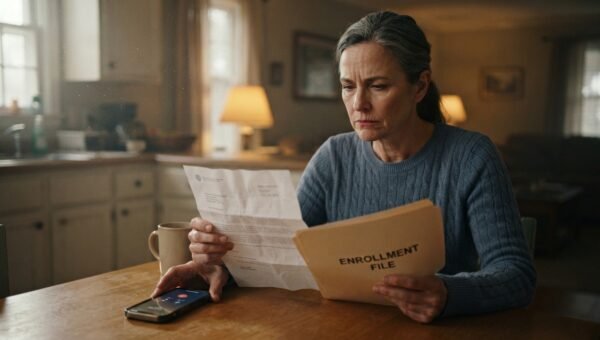
I reached into my coat pocket and pulled out the final envelope Clara had handed me back at the cemetery. I hadn’t opened it yet, not with the wind blowing and the mourners still milling around the gravesite. Now, under the harsh light of Clara’s kitchen pendant lamp, I slid my finger under the flap and pulled out a single sheet of paper and a bank cashier’s check.
The check was drawn on the Nebraska State Bank and dated three weeks before Mom died. The amount was fourteen thousand, two hundred and fifty dollars.
Attached to it was a note in Mom’s shaky final handwriting, written with a blue ballpoint pen that skipped on the rough stationery. *Clara, make sure she gets this the day she turns fifty. I finally sold the upright piano and Grandma’s pearl brooch to put back every cent I borrowed, plus interest at four percent. Tell her I’m sorry it took so long, but the math finally balances out.*
I stared at the figures on the check, my vision blurring until the numbers bled into the grain of the white paper. Fourteen thousand dollars. The exact sum of every micro-withdrawal listed across those seventy-four slips of butcher paper, adjusted for inflation and calculated with the stubborn pride of a woman who balanced her household ledger down to the last nickel every single Sunday night.
“She sold the piano,” I said, my voice cracking on the words. “She loved that old walnut piano. She played hymns on it every Sunday morning before church.”
“She said you didn’t need the piano anymore,” Clara said gently, reaching across the table to cover my trembling hand with her own. “She said you had your own life now, and she wanted her ledger clean before she went to meet your father.”
We sat there in the quiet kitchen as the whistle of the kettle died down and the afternoon light shifted across the linoleum floor. There were no grand speeches left to make, no dramatic declarations that could fix the hollow ache in my chest or bring back the smell of peppermint in the Plymouth. There was only the weight of the tin box, the smell of warm tea, and the realization that love isn’t always measured in grand gestures or spoken promises. Sometimes it looks like an extra turkey sandwich wrapped in brown paper, handed over quietly in the shadow of a schoolyard bleacher, waiting thirty years for the arithmetic of grace to finally catch up.