PART 1
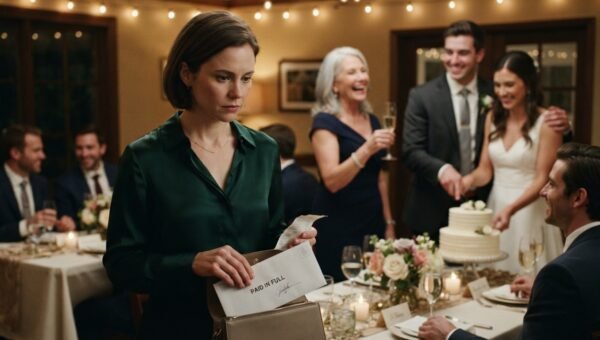
My sister Brenda looked me in the eye eight years ago in Mom’s empty kitchen and told me the ring was already gone.
She was standing by the sink, packing Mom’s everyday coffee mugs into a cardboard box with newspaper. I had asked her where the velvet jewelry box was, the dark blue one Mom kept tucked behind her cedar chest. Mom had promised that ring to my daughter, Clara, since Clara was twelve years old.
Clara used to sit on the footstool by Mom’s rocker and trace the gold band while Mom told her how Dad saved up five months of paychecks from the municipal water department to buy it back in 1961.
“Mom gave it away months before she went into hospice,” Brenda said, not even turning around. She taped the box shut with one sharp rip of brown packing tape. “She gave it to one of the ladies from her Sunday school who helped drive her to treatments. You know how Mom was near the end. She was handing things out right and left. It’s gone, Sarah. There’s no use digging through drawers.”
I believed her. That was my mistake. I was so exhausted from the six months of hospice visits, the endless loads of hospital laundry, and the quiet grief of watching Mom slip away that I did not have the fight in me to argue.
Brenda was the older sister. She handled the paperwork, the estate sale company, and the final utility bills. If Brenda said Mom gave it away, I assumed Mom had done just that in a moment of clouded judgment.
I had to sit Clara down that Sunday night and tell her. Clara was nineteen then, home from her freshman year of college, sitting at our kitchen table with her textbooks spread out. When I told her the ring was gone, she did not yell or cry. She just looked down at her spiral notebook, swallowed hard, and said, “It’s okay, Mom. As long as Grandma was at peace, that’s all that matters.” But I saw the way her fingers closed tight into her palm. She had loved that ring not because it was valuable, but because it had Dad and Mom’s entire life wrapped up in the gold.
Years went by. Clara finished school, took a job teaching fourth grade, and eventually met a wonderful man named David.
Brenda and I stayed polite the way sisters do when distance and busy lives give you an easy excuse. We saw each other at Thanksgiving every other year, sent Christmas cards with drugstore gift cards tucked inside, and checked in when someone had a bad cold or a car accident.
Then, three weeks ago, Brenda’s daughter, Megan, got engaged.
I was sitting on my back porch on a Saturday morning with my first cup of coffee, scrolling through social media on my phone. A photo popped up on my feed that Megan had posted twenty minutes earlier. It was a close-up of her left hand resting on a fleece blanket, a silver-banded ring on her finger, and a sweet caption about starting forever.
The sun hit the center stone right at an angle, and my breath caught in my throat.
It was an older European cut, set in four yellow gold prongs that had been fitted over a white gold shank years ago after Dad had it repaired.
But that was not what made my coffee cup rattle against the saucer.
Right along the top left facet of the main diamond, there was a tiny, flat chip.
Dad did that in the summer of 1974 while helping his brother rebuild the concrete steps on their back porch. The diamond had struck an iron rebar rod. Mom never got it recut because she said the little nick reminded her that nothing in this life stays pristine, and that Dad had spent the rest of that afternoon apologizing like a boy caught track of mud in the parlor.
I stared at that chip on my phone screen until my eyes burned. It was not a similar ring. It was not a family heirloom from the groom’s side. It was my mother’s ring.
I set my mug down on the glass table and dialed Brenda’s cell phone immediately.
She picked up on the fourth ring, her voice breathless and bright. “Sarah! Did you see the news? Isn’t it wonderful? Greg took her out to the botanical gardens last night!”
“Brenda,” I said, keeping my voice as steady as I could manage. “I’m looking at Megan’s picture right now.”
“Isn’t it gorgeous?” she asked, though a slight hitch came into her tone.
“That’s Mom’s ring,” I said. “Brenda, that has the chip Dad put in it on Uncle Ray’s porch. That’s Mom’s wedding ring.”
There was a long silence on the line. The birds were chirping in my maple tree outside, but through the receiver, I could only hear Brenda’s shallow breathing.
When she finally spoke, her voice wasn’t warm anymore. It was flat, hard, and defensive.
“Mom changed her mind before she died,” Brenda said sharply. “She decided Megan should have it because Megan was the oldest grandchild. You need to get over it, Sarah. It’s been eight years. Don’t you dare ruin this girl’s engagement over some old piece of jewelry.”
Before I could get another word out, Brenda hung up the phone.
I sat there on my porch with my phone pressed to my ear, listening to the dial tone, feeling an ugly heat rising up the back of my neck. She had lied to my face eight years ago in that kitchen. She had watched me go home and break Clara’s heart, and she had kept the ring in a drawer the entire time.
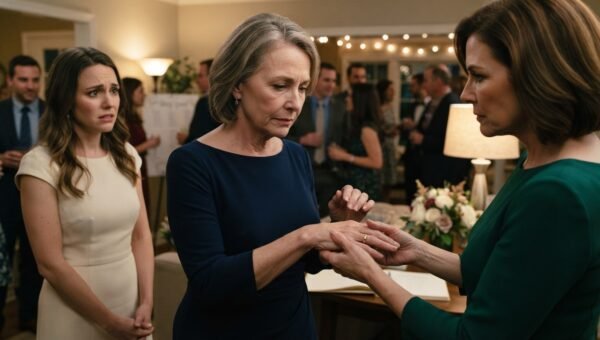
I might have let it drop right there just to avoid tearing the family apart before a wedding. I truly might have swallowed the bitter taste and walked away, if Megan hadn’t called my phone forty minutes later, sobbing so hard she could barely catch her breath.
PART 2
Megan was sitting in her car in a grocery store parking lot when she called me.
“Aunt Sarah,” she choked out between gasps. “Mom just came over to my apartment and started screaming at me. She told me to take the photo down off the internet. She was furious. She said you called her and tried to make a scene.”
I leaned against my kitchen counter and closed my eyes. “Megan, honey, breathe for a second. What did your mom tell you about that ring?”
Megan sniffled, the sound rattling through the car speaker. “When Greg told her he was going to propose last month, Mom called him privately. She told him money was tight for young couples right now, and that she had an heirloom from a distant great-aunt on my dad’s side that had been sitting in a safety deposit box for decades. She told Greg he could have it for free so he wouldn’t have to take out a loan. Aunt Sarah, why is she acting like this? What is going on?”
My stomach turned over. Brenda hadn’t just stolen the ring from Clara; she had erased Mom entirely. She had invented a fictional aunt from her ex-husband’s family just so Megan would never suspect where the ring actually came from. If Brenda had truly believed Mom gave it to Megan as the oldest grandchild, she would have handed it over proudly in Mom’s name. She wouldn’t have hidden behind a ghost relative.
“Megan,” I said quietly, “that ring belonged to my mother. Your grandmother Evelyn.”
The line went dead quiet.
“Grandma Evelyn?” Megan whispered. “Mom told me Grandma’s ring was lost before she went into the hospital.”
“No,” I said. “Your mother told me Mom gave it away to a church volunteer. But Dad chipped that stone back in 1974. Mom wore it every single day of my childhood. Clara was supposed to have it. Mom promised it to her before she ever got sick.”
Megan started crying again, but this time it wasn’t the panic of being yelled at. It was pure embarrassment. “I can’t wear this. Aunt Sarah, I can’t wear something that was stolen from Clara. Oh god, Greg was so proud to give it to me.”
“It’s not your fault, Megan,” I said. “You didn’t know.”
“I need to get it sized anyway,” Megan said, her voice shaking. “It’s a full size too big. Mom put one of those little metal clip guards on the back band so I could wear it for pictures last night, but it keeps sliding around. I’m going to take it to Miller’s Fine Jewelry on Oak Street tomorrow afternoon. I want them to look at it.”
The next afternoon, I drove over to Oak Street. I didn’t want Megan sitting alone in a jewelry shop, feeling like a criminal for wearing an engagement ring she had accepted in good faith.
When I walked into the shop, Megan was already leaning over the glass counter. She had dark circles under her eyes, and she looked exhausted. The jeweler, an older man named Mr. Henderson with thick magnifying loupes perched on his forehead, had the ring clamped in a small brass holder under a bright halogen lamp.
“Aunt Sarah,” Megan said quietly, reaching out to squeeze my hand. Her fingers were cold.
Mr. Henderson looked up at us over the tops of his glasses. “You ladies said you wanted this clip guard removed and the band taken down from a seven to a five and a half?”
“Yes, please,” Megan said.
Mr. Henderson picked up a pair of smooth, flat-nosed pliers. “These old friction guards can pinch the skin if they aren’t seated right. Let’s see what we have under here.”
He braced the ring against a rubber pad on the counter and gently worked the edge of the little gold-filled metal clip that had been crimped over the bottom of the shank. The clip had clearly been squeezed onto that band years ago; the metal had dulled, and a small ring of gray tarnish was visible along the edges.
With a soft click, the metal guard popped loose.
As it came off, a tiny, yellowish speck dropped onto the black velvet pad beneath the lamp.
At first, I thought it was just a flake of dried soap or years of trapped lotion. But Mr. Henderson didn’t sweep it away with his brush. He frowned, leaned down, and tapped the speck with the tip of his fine tweezers.
It wasn’t dirt. It was paper.
It was a tiny sliver of yellowed legal pad, folded over three times into a tight, flat wedge no wider than a matchstick, pressed completely flat by the pressure of the metal guard against the gold band.
PART 3
Mr. Henderson looked at both of us, his eyebrows raised. “Well, that’s not something you see every day. Looks like someone used a paper shim to keep the clip from scratching the inner hallmark, or to tighten the fit.”
“Can you unfold it?” Megan asked, her voice barely louder than a whisper.
Mr. Henderson took a second pair of tweezers. His hands were completely steady as he teased open the first fold, then the second. The paper was stiff and brittle, creased hard from years of being clamped against the inside of the ring.
When he laid it flat against the velvet, two words were written in faded blue ballpoint ink.
The handwriting had that shaky, deliberate slant that belonged to only one person on earth. It was Mom’s handwriting from the final year of her life, when arthritis had started twisting her fingers.
The paper said:
*For Clara.*
I felt the breath leave my lungs. I reached out and touched the glass counter to steady my feet.
Mom hadn’t handed it over to a stranger from church. She hadn’t changed her mind in the final months. She had known her memory was slipping, and she had known Brenda was already going through the house, so she had folded that note, shoved it beneath the sizing guard she wore after her knuckles shrank, and hidden her final wish inside the very thing she was giving away.
Brenda hadn’t found it because Brenda had never bothered to take the ring to a jeweler. She had simply taken it out of Mom’s room, kept it locked away in her house for eight years, and then handed it to Megan’s fiancé with the guard still clamped in place.
Megan stared down at that tiny strip of paper on the black velvet pad. Her face went completely still, the color draining out of her cheeks.
“She knew,” Megan whispered. “Mom knew the whole time.”
“She probably didn’t see the paper,” I said, my voice thick. “She just knew it was Clara’s.”
Megan didn’t say another word. She looked at Mr. Henderson. “Don’t resize it. Please put it back in the box.”
Mr. Henderson nodded quietly, sensing the gravity in the air. He placed the ring into a small velvet pouch, slid the folded paper into a tiny plastic zip envelope, and handed both across the counter to Megan. He didn’t charge her a dime.
Twenty minutes later, Megan and I were standing on Brenda’s front porch.
Megan hadn’t called ahead. She walked up the concrete steps, set her shoulders, and pushed the doorbell. When Brenda opened the door, she had a smile on her face, probably expecting Megan to apologize for the phone call the day before. But when she saw me standing right behind her daughter, her face hardened instantly.
“I told you yesterday, Sarah, I am not doing this,” Brenda started, her voice rising. “You are not going to come to my house and—”
Megan didn’t let her finish. She reached into her coat pocket and held out her open palm. In her hand was the velvet pouch and the little plastic bag containing Mom’s note.
“We took it to Miller’s to get it sized, Mom,” Megan said. Her voice wasn’t shaking anymore. It was cold, steady, and heavier than anything I had ever heard come out of my niece’s mouth. “We took the guard off.”
Brenda’s eyes dropped to the clear plastic bag. Through the plastic, Mom’s handwriting was perfectly legible under the porch light: *For Clara.*
Brenda’s mouth opened, but no sound came out. She didn’t yell. She didn’t tell us to get off her porch. All the bluster and anger she had carried for eight years seemed to leak right out through her shoes. Her shoulders slumped, and she looked down at the welcome mat.
“Mom,” Megan said, her eyes welling with tears of pure disappointment. “How could you do that to Clara? How could you do that to me?”
“You were getting married,” Brenda whispered, not looking up. “You didn’t have a ring. Clara was single. I thought she would never miss what she never held.”
“It wasn’t yours to give,” Megan said.
She closed her fingers over the velvet pouch, turned her back on her mother, and walked down the porch steps without waiting for another word.
ENDING
We drove back to my house in complete silence.
Clara was home when we pulled into the driveway. She had come over to help me sort through some old sewing patterns in the spare bedroom, and her car was parked under the carport.
When Megan and I walked into the kitchen, Clara looked up from the table, surprised to see her cousin on a Sunday afternoon with red eyes and an overnight bag in her hand.
Megan didn’t make a speech. She walked straight over to the kitchen table, took the velvet pouch out of her purse, and set it down next to Clara’s coffee mug. Alongside it, she placed the small plastic envelope with the scrap of yellow paper.
“This is yours, Clara,” Megan said. “It was always yours.”
Clara looked at the pouch, then picked up the plastic envelope. She recognized Mom’s handwriting instantly. She didn’t ask a dozen questions. She just looked at me, then at Megan, and the entire eight years of silence seemed to resolve into that one single moment in my kitchen.
Clara stood up and wrapped her arms around Megan. The two of them stood there in the middle of the linoleum floor, crying quietly, while the afternoon sun came in through the window over the sink.
That was two weeks ago.
Greg was completely understanding. When Megan told him the truth that night, he didn’t care about the family drama; he took her to a local silversmith that very weekend, and together they picked out a simple, modest sapphire ring that they paid for with their own savings. Megan told me she loves it ten times more than the diamond, because every time she looks at it, she knows it belongs to her story, and nobody else’s.
Brenda hasn’t called my house since that afternoon on her porch. My brother-in-law sent a quiet text two days later, apologizing for what happened and asking us to give Brenda some time. I didn’t write back, but I don’t feel angry anymore. When the truth comes out that clean, there isn’t much left to argue about. The distance between us was always there; the ring had just been the wall holding it up.
Yesterday morning, Clara stopped by before heading to school.
She held out her left hand to show me. She had taken the ring back to Mr. Henderson at Miller’s Jewelry. He had cleaned the old gold until it shone like butter, and he had sized it perfectly to Clara’s ring finger.
She turned her hand in the kitchen light. Right on the edge of the stone, the tiny flat chip from Uncle Ray’s porch caught the morning sun. It wasn’t hidden. It wasn’t covered by a guard or buried in a drawer. It was right where Mom had worn it for fifty years, imperfect and completely home.