PART 1
My father laughed when I told him I wanted to become a nurse. “You faint at blood,” he said. Twenty-seven years later, he was admitted to my hospital after a fall. During intake, the computer flagged his blood type as incompatible with the type listed on my birth records. I knew families can have surprises, but the combination wasn’t possible. I repeated the test.
Dad saw my face and said, “Don’t start.” I asked what that meant.
He refused to look at me, staring up at the acoustic tiles of the emergency room ceiling like they held the answers to a test he failed. After He fell asleep, my aunt arrived carrying his old wallet. She pulled out a photograph of my mother standing with another man outside the same hospital, three days before I was born. I recognized the man immediately. He had been my nursing instructor for two years and had once told me, for no reason I understood, “You have your mother’s hands.” My aunt said, “He wasn’t talking about your mother.” Then she explained how my mother had worked as a junior administrator in the same wing decades ago, and how the tight knit hospital community kept secrets that paper files easily buried.
My hands shook as I held that small, faded snapshot under the harsh fluorescent lights of the nurses station. My aunt, Helen, looked older and more tired than she had at Thanksgiving.
She told me that my father knew the truth before I was even brought home from the nursery. He had agreed to raise me because he loved my mother fiercely, but the arrangement came with a quiet, lingering bitterness that rusted their marriage from the inside out over thirty years.
I looked back into Room 412 through the glass window. My father was breathing shallowly, his chest rising and falling beneath a scratchy hospital blanket. He looked so small now, stripped of his authority and his booming laughter. I felt like the ground beneath my clogs had simply dissolved. My entire life, every memory of him teaching me to ride a bike behind our suburban house, every proud smile he gave me at my nursing school graduation, felt suddenly weighted with an unspoken sacrifice I never asked him to make.
Helen touched my shoulder, her fingers cold. She told me that the biological father, Arthur Vance, had left the state weeks after I was born to take a research position on the West Coast, completely unaware that my mother was pregnant or that a child had been born into the household of a junior accountant named David.
Arthur Vance was still alive, living in Seattle, and retired from clinical administration.
I had a shift to finish. I could not walk away from my patients, but every heart monitor beep and IV pump alarm sounded hollow to my ears. I spent the next eight hours charting vitals on autopilot, my mind spinning back through every conversation I ever had with Arthur Vance when he graded my clinicals. He had been strict, exacting, and notoriously unyielding, yet he always granted me extensions without penalty when I worked night shifts at the local clinic. I had thought it was professional respect. Now, the memory made my stomach turn over in heavy, sick waves.
PART 2
By morning, my father was stable enough to be transferred to a step down unit, but my internal state was entirely unraveled. I went home for a four hour nap that yielded zero sleep, staring instead at the ceiling fan turning slow circles in the dark.
I needed confirmation before I confronted my father again. I pulled out my old nursing school registry records and cross referenced Arthur Vance’s professional history with the dates of my birth. The timelines matched with terrifying precision. My mother had completed her administrative internship at that exact facility during the exact semester Arthur taught advanced pathology.
When I returned to the hospital that evening, my father was awake and eating a cup of tasteless lemon gelatin. He looked terrible. The bruising around his ribs from the fall had bloomed into a deep, mottled purple, and his breathing was shallow.
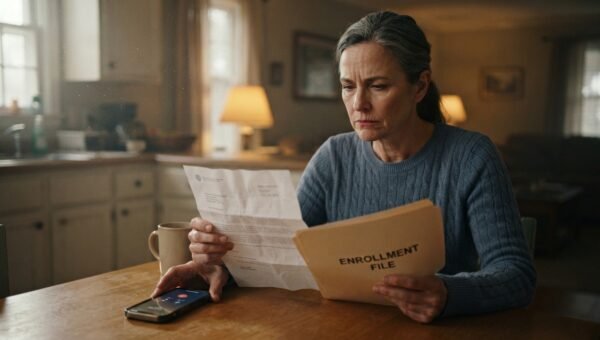
I pulled a chair right up to the side of his bed, placed my hands on my knees, and laid the faded photograph right on his meal tray beside his gelatin. He stopped chewing immediately. The silence in the room stretched out, heavy and suffocating, broken only by the rhythmic hiss of the oxygen concentrator in the corner.
“Helen talked to you,” he murmured, his voice cracking like dry parchment.
“She gave me the picture, Dad. Or whoever you really are to me,” I said, my voice trembling despite my best efforts to keep it steady. “How long were you going to keep this from me? What else did you lie about?”
He closed his eyes and leaned his head back against the pillow. “Your mother and I were young. We were struggling. Arthur was a visiting physician, married to someone else, passing through for a twelve month fellowship. When she found out she was pregnant, he had already vanished back to Seattle. He didn’t want complications. I loved your mother enough to step in, to sign my name on the birth certificate, and to give you a home where nobody looked at you sideways. I raised you, Chloe. Every birthday, every scraped knee, every tuition payment. That makes me your father.”
“It does,” I choked out, tears finally breaking free down my cheeks. “It absolutely does. But why did you have to keep hating me for it? Because you looked at me every day and saw him?”
He flinched. That hit him harder than his fall. “I never hated you,” he whispered, a tear slipping into the gray stubble of his cheek. “I hated the ghost. Not you.”
The conversation left us both emotionally exhausted, but the opening of Pandora’s box could not be undone. I realized that keeping this buried would rot whatever time my father had left. Over the next three days, while managing his post fall physical therapy and coordinating his discharge meds, I made a quiet decision. I needed to reach out to Arthur Vance. Not to disrupt his life, and certainly not to replace the man who raised me, but to answer the lingering questions in my own DNA.
I found an active email address for Arthur through an emeritus medical faculty directory in Seattle. I kept the message brief, professional, and direct. I attached a current photo of myself in scrubs, standing outside my hospital, and mentioned the date of my birth and my mother’s maiden name.
His response arrived less than twenty four hours later. It was a single sentence asking if we could speak on a secure video call that very evening.
I took the laptop into the on call room during my dinner break, my heart hammering against my ribs like a trapped bird. When I clicked accept, the screen flickered to life, revealing an older man with silver hair and wire rimmed glasses sitting in a book lined study. Up close, without the clinical distance of a classroom, the resemblance was undeniable. The shape of the jaw, the curve of the fingernails, the specific way he tilted his head when listening.
“I remember your mother,” Arthur said softly before I could even introduce myself. “And I remember the hospital. I was young, arrogant, and entirely blind to consequences. Your mother never told me.”
“She protected you, or she protected herself,” I replied, watching his face closely. “Either way, I grew up thinking David was my biological father. He raised me. He’s in this hospital right now recovering from a fall.”
Arthur nodded slowly, his expression heavy with a lifetime of accumulated regret. “Does he know we are speaking?”
“He knows everything,” I said. “He knows I found the picture.”
We talked for nearly an hour. There were no dramatic cinematic revelations, no sudden bursts of familial love, just two strangers untangling a decades old web of choices made by people who were long gone. Arthur offered financial support for my father’s medical bills, which I politely declined, telling him that David had earned every ounce of my loyalty through thirty years of showing up.
When I walked back into my father’s room after the call, he was watching the evening news with the volume muted. He looked over at me, his eyes searching my face for any sign that I had abandoned him for the man on the Seattle screen.
I pulled the same chair up to his bed, sat down, and took his weathered, paper thin hand in mine. His grip was surprisingly firm.
“I talked to him,” I said quietly.
Dad swallowed hard, his throat working. “And?”
“And he’s a retired professor in Seattle who missed out on a wonderful daughter,” I said, squeezing his fingers. “He’s a stranger, Dad. Just like he was twenty seven years ago.”
A massive, visible exhale escaped my father’s chest, his shoulders dropping two inches as the tension finally drained out of his frame. He squeezed my hand back, closing his eyes with a look of profound, undeserved relief.
“You’re a stubborn one,” he whispered, a faint, familiar ghost of his old laugh returning to his voice. “Must have gotten that from your mother.”
“I got a lot of things from both of you,” I smiled, wiping a stray tear from my cheek. “But I’m your daughter. That paperwork might be wrong, but nothing else is.”
He nodded, closing his eyes to rest, holding onto my hand until the night shift nurses came in to check his vitals. We never spoke of Arthur Vance again. We didn’t need to. The hospital computer had flagged an error in my blood type, but it failed to measure the thirty years of sleepless nights, bruised knees, and quiet devotion that made a man my true father.