PART 1
The morning of our daughter Chloe’s wedding, David was out on the back porch with a cup of black coffee and the local newspaper folded over his knee. He was wearing his gray work fleece and the faded canvas slip-ons he only wore to tinker in the garage.
I stood in the doorway holding his ironed charcoal suit on a wire hanger. “David, please,” I said. “The service starts at two.
You don’t have to give a speech. You don’t even have to walk down the center if your knee is bothering you. Just sit with me in the front pew.”
He did not look up from the sports section. “I already walked her down the aisle once, Martha,” he said. His voice had that flat, immovable tone he had used for thirty-one years of marriage whenever he wanted a discussion over. “A man does that once. Her first wedding cost twenty-four thousand dollars, and that boy walked away after eighteen months. Now she wants a tent in a vineyard and a brass band. Mark seems fine, but I’m not doing the whole circus a second time.”
“Mark isn’t a circus,” I told him, fighting to keep my voice from cracking. “Mark helped her patch the drywall when her basement flooded. He sat with her at the body shop when her transmission went out.
He took her on two ordinary dates a month for two years without ever rushing her. She is happy, David. Truly happy for the first time since she was twenty-three. She needs to see you there.”
“She knows where the house is,” he said, turning the page. “You go. Give them my best. Hand them the envelope.”
There was an envelope on the kitchen counter with five crisp hundred-dollar bills inside. No card. Just a white utility envelope with “Chloe and Mark” written in David’s tight handwriting across the front.
I drove to the venue alone with tears blurring the highway signs. Chloe had rented an old orchard estate thirty miles south of town. When I walked into the bridal suite, she was standing in front of the full-length mirror while her cousin zipped the back of an ivory lace gown. It was simple, nothing like the giant satin ballgown David had grudgingly paid for eight years ago.
Chloe looked past my shoulder toward the open doorway. “Dad didn’t come, did he?”
“He sends his love, honey,” I lied, hating the sour taste of it. “He’s just being stubborn about the principle of it. You know your father.”
“Yeah,” she said softly, turning back to the mirror. Her chin trembled for a split second, but she smoothed her hands down the front of her dress and took a breath. “I know him. It’s okay, Mom. Mark is waiting.”
The ceremony was small and warm. Mark walked Chloe down the grassy path himself, their fingers laced together tightly. During the vows, Mark choked up trying to say how grateful he was that she let him share her quiet Saturday mornings. Everyone cried, including me.
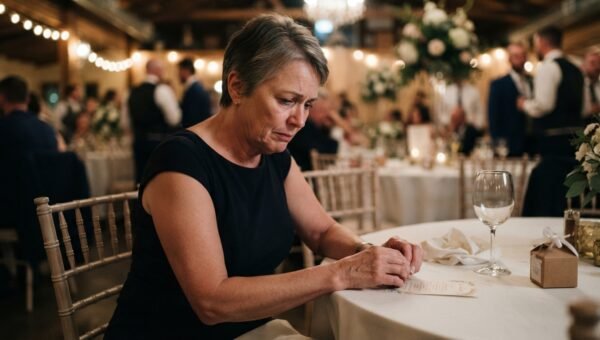
At the reception dinner under the big white tent, I sat at the front family table. Next to me was an empty wooden folding chair with a small paper card sitting on the plate.
Chloe had printed David’s name on it in green ink, hoping until the last minute that he would change his mind.
Sitting across from me was Arthur Vance, Mark’s father. Arthur was a retired civil engineer, a quiet, broad-shouldered man with white hair and careful eyes. His wife, Evelyn, had passed away four years earlier from ovarian cancer, and he lived alone in an old brick house across the river. Whenever Chloe had spoken about Arthur, she described him as a gentle man who spent his time restoring old clocks and tending his wife’s rose beds.
Throughout dinner, I caught Arthur looking at Chloe. It was not a casual glance. Every time Chloe threw her head back to laugh at something Mark whispered, or when she turned her profile toward the lights to listen to a toast, Arthur watched her with a heavy, focused intensity that made the hair on my arms stand up.
By eight o’clock, the sun had slipped behind the tree line and the dance floor was packed with Mark’s college friends. The music thumped against the canvas. I was gathering my purse from the floor under the table when Arthur touched my elbow.
“Martha,” he said, keeping his voice beneath the roar of the speakers. “Would you mind stepping outside for some air? Just for two minutes.”
I thought he wanted to thank me, or maybe share a quiet word about missing our spouses on a big day. I followed him out past the tent guy-wires to the gravel pathway near the apple trees. The night air was cool and smelled of damp grass.
Arthur reached into the inside pocket of his sport coat and pulled out a small, worn leather wallet. He didn’t take out money. He slid out an old photograph, about three inches square, with curved white borders and slight water curling along the bottom edge.
He handed it to me. “I found this three years ago,” Arthur said quietly. “When I was cleaning out Evelyn’s cedar chest in the attic.”
I looked down under the amber glow of the garden lights.
The picture showed a nineteen-year-old boy with thick dark hair, wearing a high school track jacket with blue trim. It was David. There was no question. The stubborn set of his jaw, the narrow ridge of his nose, the way his left shoulder dipped slightly lower than the right. Beside him stood a young woman with long, chestnut hair parted down the middle, wearing an embroidered denim shirt. She was pretty, with high cheekbones and a wide, nervous smile.
Between them, wrapped in a coarse yellow hospital blanket, was an infant. Both of their hands were resting on the baby’s tiny swaddle, their fingers overlapping.
I had met David when he was twenty-two at a church social in Lansing. He had never mentioned this girl. He had never mentioned a child.
I turned the photograph over with shaking hands.
Written on the back in faded blue ballpoint pen was a single line of script: *October 14, 1989. Seven pounds, four ounces.*
The air left my lungs so fast I felt dizzy. “October fourteenth,” I whispered. “That’s Chloe’s birthday.”
“Yes,” Arthur said.
“This photo is thirty-seven years old,” I stammered, trying to make the numbers fit in my head. “October fourteenth, 1989. But Chloe wasn’t born until 1996. Seven years later. Why does this have her exact birthday on it?”
Arthur looked at me, his eyes dark with an ache that seemed decades old.
“I think your husband knew my late wife long before either of us met them,” Arthur said. “And the reason I kept staring at Chloe during dinner isn’t just because she’s a beautiful bride, Martha. It’s because when she laughs, she looks exactly like the woman standing in that picture.”
PART 2
I stood on the gravel pathway, clutching the small photograph until the stiff paper bent between my fingers. Inside the tent, the brass band had started playing an upbeat Motown song, the bass vibrating through the soles of my shoes.
“Her name was Evelyn,” I said, my voice barely audible over the music. “The woman you were married to.”
“Evelyn Jean Miller,” Arthur replied. He kept his hands deep in his coat pockets, looking out toward the dark rows of apple trees. “We met in ninety-one at a state water board conference in Grand Rapids. We married two years later. When we talked about our pasts, she told me she had a quiet life before me. Grew up in Eaton Rapids, worked as an assistant at an accounting firm, dated a few boys from her high school, but nothing serious. She told me she had never been married, never had children. We tried for five years to have our own, but it never happened. She always carried this quiet, unreachable sadness about it, but she would never talk about it.”
“And David?” I asked. “Did she ever speak his name?”
“Never,” Arthur said. “Until three years ago. Evelyn was sick for thirteen months. Near the end, when the hospice nurses were coming twice a day, she asked me to bring down an old tin cedar box from the attic rafters. She said there were personal letters she wanted to burn before she went. But she slipped into a coma two days later, and the box stayed on her bedside table. After the funeral, I opened it. There were old church bulletins, a dried corsage, and this picture wrapped inside a folded handkerchief.”
I looked down at the photograph again under the yellow garden lantern. The boy in the track jacket was unmistakably David. It was the exact face from his parents’ hallway gallery back when his mother was still alive. And the girl beside him, with the wide, open smile and the high cheekbones, had Chloe’s almond-shaped eyes. The exact same slight tilt at the outer corners.
“Why did you wait until tonight to show me this?” I asked, feeling an ugly knot of panic tighten in my chest. “You’ve known Mark was marrying Chloe for fourteen months.”
“Because when Mark first brought Chloe over to my house for Sunday dinner last summer, I nearly dropped the casserole dish on the kitchen floor,” Arthur said. “She sat at our dining table, turned her head to look out the window at the garden, and for three seconds I thought my mind had completely broken. She was the mirror image of Evelyn at twenty-five. The voice was different, the hair was cut shorter, but the features were identical.”
He took a slow, measured breath. “I didn’t say anything because Mark was so deeply in love with her. I told myself it was a coincidence. People have doubles in this world. But then Mark told me Chloe’s full name and her father’s name. David Vance was my wife’s maiden name? No, David Miller? No. David Allen. That was the name on an old track ribbon tucked under that photograph in the tin box. David Allen, Eaton Rapids High, 1988.”
My heart hammered against my ribs. “David grew up in Eaton Rapids,” I whispered. “He moved to Lansing after community college.”
“I knew David was her father,” Arthur said. “And I assumed David would be here today. I brought the picture in my pocket because I intended to walk up to him, look him in the eye, and ask him man to man what Evelyn meant to him, and what happened in October of 1989. But he didn’t show up. He sat at home. And when I saw Chloe sitting at that table with an empty chair beside her, looking at that empty plate with his name on it, I knew why he stayed away. He couldn’t face me. He couldn’t face this room.”
“David didn’t know you were Evelyn’s husband,” I countered immediately, defending my life, defending thirty years of marriage out of sheer instinct. “Mark’s last name is Vance. You said you met Evelyn in Grand Rapids. David hasn’t seen anyone from Eaton Rapids in forty years.”
“Look at the date again, Martha,” Arthur said gently.
I flipped the photo over. *October 14, 1989.*
“Chloe was born October 14, 1996,” I said, my voice rising. “I was there, Arthur! I was in the labor and delivery room at Sparrow Hospital in Lansing! I was in labor for twenty-two hours! I pushed her out! She is my daughter! I carried her! Don’t you dare stand here in the dark at my daughter’s wedding and tell me she belongs to someone else!”
Arthur held up his hands, taking half a step back. “I am not saying she isn’t your daughter, Martha. I don’t know who Chloe is. But I know that on October 14, 1989, your husband held a baby wrapped in a hospital blanket with my late wife. And seven years to the exact day later, your daughter was born. Do you really believe that date is an accident?”
I couldn’t breathe.
I looked back toward the tent. Through the open side curtains, I could see Chloe dancing with Mark. Mark had his arms wrapped securely around her waist, his chin resting on her hair, swaying gently to the slow ballad that had just started. Chloe’s head was tilted back, her eyes closed, completely at peace.
“Keep the picture,” Arthur said softly. “I didn’t bring this to hurt you. Or Mark. Or Chloe. But my wife took a secret to her grave, and your husband stayed home today because he was terrified of what was waiting for him. You deserve the truth, Martha. And so does that girl.”
He turned and walked slowly back toward the tent, his shoulders hunched against the evening chill.
I stood alone on the gravel path for ten minutes, staring at the glossy image of my husband as a boy. The envelope with five hundred dollars was still sitting on my kitchen counter thirty miles away. David was probably sitting in his leather recliner right now with the television muted, waiting for me to come home and say it was over.
I didn’t stay for the cake cutting. I slipped into the bridal suite, grabbed my light coat, walked over to Chloe during a break between songs, kissed her cheek, and told her I had a sudden migraine.
“Go home and rest, Mom,” she said, hugging me tightly. Her skin was warm, smelling of lavender and the vanilla frosting from the cupcakes. “Thank you for coming. It meant everything to have you here.”
“I love you, Chloe,” I said, holding onto her shoulder just a second longer than usual. “More than my own life.”
I got into my sedan, put the photograph flat on the passenger seat, and drove through the dark country roads toward home.
PART 3
The front porch light was on when I pulled into our gravel driveway at nine-forty. The house was dark except for the blue glow of the television coming through the living room blinds.
I didn’t take off my heels at the door. I walked straight across the hardwood floor into the living room. David was sitting in his recliner, wearing an old gray T-shirt and sweatpants, an empty mug resting on the side table. He clicked the remote, turning off the screen, and rubbed his face.
“You’re back early,” he said, his voice scratchy from sleep. “How did it go? Did she look nice?”
I didn’t answer. I walked over to his chair, reached into my purse, and dropped the photograph onto his lap.
David looked down at it.
For three seconds, nothing happened. Then his entire body locked. His jaw tightened so hard I could hear the click of his teeth. The color drained from his cheeks until the skin around his nose looked completely bloodless.
“Where did you get this?” he whispered.
“Arthur Vance gave it to me,” I said, standing directly over him. “Mark’s father. Evelyn’s husband.”
David’s hands began to shake. He didn’t pick up the photograph; he just stared down at it as it rested on his sweatpants, as if touching it would burn his skin.
“David, look at me,” I said, my voice shaking with a rage that had been building on the entire forty-minute drive. “You told me you stayed home today because of some stupid, stubborn pride about walking her down the aisle once. You let our daughter stand there all afternoon looking at an empty chair at the head table. You broke her heart today. And you didn’t do it because of money or principles. You did it because you knew who Mark’s father was.”
“I didn’t know,” David said hoarsely. “I swear to God, Martha, I didn’t know until three weeks ago.”
“Until three weeks ago?”
David put his head in his hands, his fingers digging into his graying hair. “Mark’s mother’s obituary,” he choked out. “Chloe brought over some wedding shower pictures, and there was an old memorial program on her phone from Mark’s mother’s funeral. I saw the name. Evelyn Jean Vance, formerly Miller. Born in Eaton Rapids. I felt like the floor fell out from under the house.”
“Who was she, David?”
“She was my high school sweetheart,” he said, his voice breaking. “We dated from sophomore year until we were twenty. In the summer of eighty-nine, she got pregnant. We were nineteen years old, Martha. We had no money. My parents were furious. Her father told her if she kept the baby, he’d throw her out on the road. We tried to figure out how to make it work, but we couldn’t.”
He reached down with trembling fingers and picked up the photograph.
“On October fourteenth, 1989, she gave birth to a baby girl at Ingham Medical,” David whispered. “We named her Sarah. We held her for one hour. The social worker was in the hallway with the adoption agency. The adoptive parents were already waiting in another room. They were a couple from Ohio who had been vetted for two years. We signed the surrender papers at noon. They took the picture for our file, but the social worker gave us each a copy to keep. Evelyn took one. I burned mine in the fireplace the week before I met you.”
I stared at him, my mind spinning violently. “You had a daughter,” I said, the words catching in my throat. “You gave up a daughter thirty-seven years ago.”
“Yes,” David wept. It was the first time I had seen him cry since his mother’s funeral fourteen years ago. “I was nineteen. I was a coward. I couldn’t provide for a child, and Evelyn’s family forced the adoption. It tore Evelyn apart. We couldn’t look at each other after that. Every time I saw her face, all I saw was the baby we gave away. We broke up two months later. I moved to Lansing to get away from the shame.”
“Then what does this have to do with Chloe?” I demanded, my hands clenching into fists. “Why did Arthur look at Chloe today and see his late wife? Why does Chloe have the exact same eyes, David? And why in God’s name was Chloe born on October fourteenth?”
David looked up at me, tears streaming down the deep creases in his face.
“Martha… think about when we had Chloe,” he said, his voice cracking. “Think about what happened that year.”
“I had Chloe in ninety-six,” I snapped. “We had been trying for four years. I had two miscarriages. We did three rounds of fertility treatments. Dr. Mercer told us our chances were less than ten percent. And then in February, the test came back positive. It was a miracle.”
“It wasn’t a natural pregnancy, Martha,” David said, his voice dropping to a desperate whisper. “Remember what Dr. Mercer told us in January?”
The memory rushed back like ice water poured down my spine. January of 1996. The sterile white office on Pennsylvania Avenue. Dr. Mercer looking over our charts, telling us that my eggs were viable, but David had severe morphology issues. He had suggested intrauterine insemination, but the previous two attempts with David’s washed samples had failed completely.
Dr. Mercer had told us we had one last option before considering full adoption: a targeted donor cycle, or trying a newly developed stimulation protocol with an open donor backup.
“We used your sample,” I said, backing away toward the kitchen door. “We did the third round of insemination on February twelfth. Dr. Mercer said your count had improved after the hormone injections you took.”
“I never took the injections,” David whispered.
The room went dead silent. The only sound was the hum of the refrigerator.
“What did you say?” I asked.
“I went to the appointment in December without you, Martha,” David said, his chest heaving. “Dr. Mercer pulled me into his private office. He told me the testing showed I had zero viable motility. None. He said no injection on earth was going to fix it. He told me that if we wanted a child, we had to use donor sperm. But you were so broken by the miscarriages. You kept saying you wanted a baby that looked like me, a baby that had my family’s blood. You cried every single night for six months.”
I gripped the doorframe until my knuckles turned white. “What did you do, David?”
“I couldn’t give you a child with my own sample,” David sobbed, burying his face in his hands. “So I did something insane. I did something I have hated myself for every single day for thirty years.”
ENDING
David sat bent over in the recliner, his whole frame shaking as the confession tore out of him.
“In 1995, a year before we started that final cycle, Evelyn reached out to me,” he said. “She tracked me down through my brother. She told me she was married to a man named Arthur Vance, but they couldn’t conceive. She was desperate to know what had happened to our baby from 1989. The Ohio adoption agency had closed its private files, but she found out through an intermediary that our daughter Sarah had died of a congenital heart defect when she was three years old.”
The air left my chest. “The baby in the photo died?”
“She died in ninety-two,” David whispered. “Evelyn was destroyed all over again. When she called me, she was in pieces. We met once at a diner in Charlotte just to talk, just to grieve the little girl we gave away. We never touched each other, Martha. I swear on my soul we never touched. But during that lunch, she told me that before she married Arthur, she had participated in an experimental egg preservation trial at the university clinic in Ann Arbor because she feared her fertility was fading from endometriosis.”
I felt the room tilt. “An egg donor.”
“No,” David said quickly. “She didn’t donate them to a bank. She had three embryos created with a private donor back in ninety-one when she thought she might be a single mother, but she never used them. They were stored under a private family trust. When Dr. Mercer told me I was sterile, I was out of my mind with panic. I couldn’t lose you, Martha. You were slipping away from me into this deep depression. I called Evelyn.”
He looked up, his eyes bloodshot and swollen.
“I asked her if her brother—her younger brother, Greg, who looked just like her—would be willing to be a directed private sperm donor for us. An anonymous family donor through the clinic, so the baby would carry the genetic traits of someone from my hometown, someone who shared the physical build and features. Evelyn agreed to ask him. But Greg refused. He didn’t want the legal liability.”
“Then who is Chloe’s father?” I screamed. “Who is she, David?!”
David shook his head, tears dripping off his chin onto the photograph. “I am Chloe’s father, Martha. Legally and on her birth certificate. But biologically… Chloe’s biological father was an open-profile donor from the Ann Arbor repository. But the egg wasn’t yours.”
The words hit me like a physical blow. I stumbled back against the kitchen counter, knocking the white envelope with the five hundred dollars onto the linoleum.
“What did you do at that clinic?” I whispered.
“Your third cycle failed in January,” David said, his voice flat with devastation. “Dr. Mercer called me first to give me the bad news before you came in. He told me your ovarian reserve had collapsed completely after the miscarriages. You had zero viable eggs left. He said if we told you, you would suffer a complete nervous breakdown. He had seen it happen to women after three consecutive losses. Evelyn… Evelyn had surrendered her rights to those stored embryos from ninety-one. She had authorized the clinic to release them for compassionate directed embryo adoption if another family needed them.”
“You switched the procedure,” I said, the horror dawning on me in waves. “You and Dr. Mercer.”
“Dr. Mercer thought you knew,” David wept. “The paperwork required both our signatures. I forged your signature on the recipient consent forms. I told Dr. Mercer you were too emotionally fragile to sign them in the office, that you had signed them at home at the kitchen table. When you went in for what you thought was a simple insemination with my sperm and your egg… Dr. Mercer performed an embryo transfer using one of Evelyn’s preserved embryos.”
I collapsed onto the kitchen chair, my hands covering my mouth to keep from screaming.
The woman in the photograph wasn’t just David’s high school girlfriend.
She was Chloe’s biological mother.
Arthur’s late wife had carried the genetic half of the child I had carried in my womb for nine months. Chloe had Evelyn’s almond eyes because Chloe was Evelyn’s biological daughter, born seven years after the first baby was surrendered, born through my body because my husband was too cowardly to tell me I couldn’t conceive.
“And October fourteenth?” I choked out. “Why was Chloe born on October fourteenth?”
“The scheduled transfer date,” David whispered. “Dr. Mercer calculated the forty-week gestation from the cycle date. It was pure, terrifying chance, Martha. When the labor started on the night of the thirteenth and you delivered her at dawn on the fourteenth, I sat in the hospital chapel and felt like God had cursed me with the exact day I gave my first child away. It was my punishment. I had to live every single birthday knowing what I did.”
I sat in the dark kitchen for an hour, listening to David sob into his hands.
The man I had spent thirty years with had built our family on a mountain of forged papers, clinical deception, and stolen genetics. He hadn’t refused to attend Chloe’s wedding because he was stubborn or cheap. He had refused because he knew Arthur Vance was Mark’s father. He knew that if Arthur looked at Chloe, Arthur would see Evelyn. And if Arthur started asking questions, thirty years of lies would unravel in the middle of a vineyard.
The next morning, I didn’t make breakfast.
I took the photograph, put it in my purse, and drove to Mark and Chloe’s small house near the river. Mark’s car was gone; he had run to the hardware store to pick up moving boxes for their upcoming relocation to Ohio.
Chloe opened the door wearing an oversized flannel shirt and sweatpants, her hair tied up in a messy bun. She looked tired, but her face lit up when she saw me.
“Mom! What are you doing here? Did you forget something at the venue?”
I looked at her face. I looked at the slight tilt of her eyes, the high cheekbones, the shape of her mouth that I had kissed every night when she had the chickenpox, when she had broken her wrist on the monkey bars, when she had cried over her first college breakup.
I had felt her kick against my ribs. I had bled for her. I had stayed awake by her bedside when she had pneumonia at age seven, wiping her forehead with cool washcloths until the sun came up.
“Mom?” Chloe asked, her smile fading as she looked at my eyes. “What’s wrong? Is it Dad?”
I stood on her front porch, feeling the cold morning wind bite through my cardigan.
I could tell her the truth. I could hand her the photograph and tell her that her biological mother was the woman whose portrait hung in her new father-in-law’s hallway. I could blow apart Mark’s family, destroy David, and unravel the very ground Chloe walked on the morning after her wedding.
Or I could carry the weight myself.
“Dad is very sick, Chloe,” I said quietly, the words steady and firm. “He’s had a severe breakdown. We need to get him help, and he isn’t going to be around for a while.”
She stepped forward and wrapped her arms around my neck. “Oh, Mom. I’m so sorry. Is there anything Mark and I can do?”
“No, baby,” I said, burying my face in her shoulder, breathing in the scent of her hair. “Just love your husband. Just build your life. That’s all you have to do.”
I drove from Chloe’s house straight to Arthur Vance’s home.
He was in his front yard, raking wet leaves into a burlap sack. When he saw my car pull into the driveway, he set the rake down against an oak tree and walked over to my window.
I rolled down the glass and handed him the photograph.
“David was the father of the child in this picture,” I told Arthur, looking directly into his tired, worn eyes. “They gave her up for adoption in 1989. She passed away three years later. That’s the entire connection between your wife and my husband. They were high school kids who made a mistake and never spoke again.”
Arthur looked at the photograph, then looked at me. He was a smart man. He had been an engineer his whole life; he understood structures, tolerances, and the way things broke under stress. He looked at my swollen eyes, at the tight, unyielding line of my jaw, and he understood what I was asking him to do.
“And Chloe?” Arthur asked quietly. “The resemblance?”
“A coincidence,” I said, my voice not wavering by a fraction of an inch. “Chloe is my daughter. She belongs to Mark now, and she belongs to you as a daughter-in-law. If you love your son, Arthur, you will burn that picture in your fireplace today, and you will never mention Evelyn’s past to Mark. Not a word. Not ever.”
Arthur stood by my car door for a long moment, the dry leaves scraping across the asphalt between us in the autumn breeze.
Finally, he slipped the picture into his front pocket and gave me a single, solemn nod. “Mark has a good wife, Martha. And Chloe has a good mother.”
“Yes,” I said. “She does.”
I put the car in reverse and backed out of his drive.
When I got home, David was sitting at the kitchen table with a packed suitcase on the floor beside him. He looked up at me, waiting for the shouting, waiting for the police, waiting for the divorce lawyer.
“Get out,” I told him, pointing to the front door. “You have until five o’clock to get your clothes out of my house. If you ever contact Chloe, if you ever try to explain yourself to her, I will take the medical records and the forgery to the county prosecutor’s office and put you in a state prison for what’s left of your life.”
David didn’t argue. He picked up his bag, walked out the back door to his truck, and drove away without looking back.
I spent the rest of that Sunday cleaning the house from top to bottom. I washed every sheet, scrubbed every counter, and packed away every framed picture of David that hung on the living room walls. When I was finished, I took the white envelope with the five hundred dollars, walked out to the backyard burn barrel, and dropped it into the ashes.
Chloe called me that evening to tell me they were ordering Chinese takeout and opening their wedding cards on the living room floor. She laughed about a toaster Mark’s aunt had sent, and told me how Mark had already hung their wedding certificate in the hallway.
I listened to her voice over the phone, clear and light and entirely whole. She had no idea the world had almost collapsed under her feet today. She never would.
“I love you, Mom,” she said before hanging up.
“I love you too, Chloe,” I told her. “I’ll see you Saturday.”