PART 1
At fifty-eight, you learn how to spot the difference between a child asking for help and a child building a trap out of your own love. I had spent seven years guarding my late husband’s insurance payout like a sacred trust. It was not a fortune, just ninety-two thousand dollars sitting in a conservative account, meant to keep me from ever having to ask my kids to buy my groceries or pay my medical deductibles.
When my thirty-two-year-old daughter, Chloe, came over to my house last October with red-rimmed eyes and a folder full of printed baking schedules, my armor cracked immediately. She sat at my kitchen table, her hands wrapped around a mug of coffee I had poured her, and told me that her artisanal pastry shop downtown was three days away from defaulting on its commercial lease.
She cried real tears, the kind that make your throat tighten when you watch your child break. She swore on her father’s memory that she only needed nine thousand dollars to bridge the gap until her holiday catering contracts cleared. Six months, she promised. She even brought a neatly typed promissory note with interest clauses and signature lines, looking every bit the responsible entrepreneur. I trusted her because she was my daughter, and because the alternative felt like failing her when she was down. I transferred the funds from my credit union online while she watched, her breath hitching in a sigh of pure relief.
For weeks after that, I felt a warm, quiet pride knowing I had kept her dream alive. Every time I drove past the storefront downtown with its paper-covered windows, I smiled to myself, thinking of Chloe inside covered in flour, shaping sourdough and frosting wedding cakes.
The trouble started around month four, right when the first repayment was supposed to hit my account. No transfer appeared. When I called Chloe, she dodged the question with a breathless rush of words about supply chain issues and equipment failures. Month five brought a new excuse, and by month seven, her phone calls became rare and clipped. She was always too busy, too stressed, or running between supplier meetings. I tried to push it out of my mind, telling myself that small businesses are fragile things and that grace was what mothers owed their children. But grace has a limit, and mine began to fray around the edges every time I looked at my dwindling cushion and realized how hard it would be to replace that money if things went south.
I was losing sleep, lying in the dark doing mental math that never came out right, wondering if I had been foolish to hand over cash I could not afford to lose. The silence between us grew heavy, dense with an unspoken tension that neither of us wanted to name, until a Saturday afternoon in November when a single photograph on my phone screen blew the whole fragile illusion to pieces.
PART 2
It happened while I was scrolling through my phone during a quiet morning coffee. A mutual family friend had posted a carousel of photos from a recent family gathering at Chloe and her husband Mark’s house. I swiped through pictures of cousins and kids playing in the yard until I stopped dead on a photo of their kitchen. Gone was the dated laminate and peeling wallpaper I remembered from my last visit. In its place stood gleaming white marble counters, a professional-grade stainless steel range, and custom walnut cabinetry that must have cost a small fortune.
Mark was standing in the center of the frame, laughing with a beer in his hand, leaning against a luxury island. My stomach dropped into a bottomless well. Nine thousand dollars does not buy a high-end kitchen renovation, but it is a remarkably convenient down payment when combined with other funds or redirected loans.
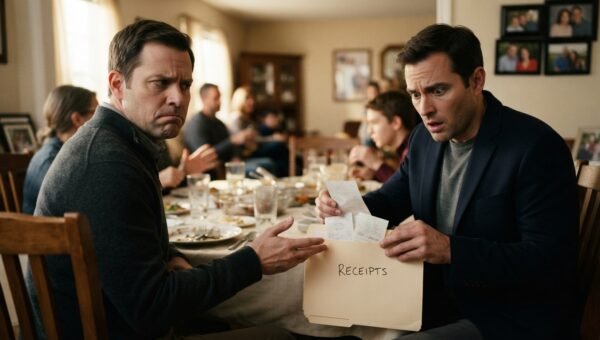
The realization hit me with a physical nausea that left me breathless. While I had been pinching pennies on groceries and worrying about whether I could afford to fix my rattling furnace, my daughter had used my financial distress as a personal slush fund to upgrade her countertops. The promissory note felt like a cruel joke, a piece of theater designed to keep me quiet while she lived above her means. By the time Thanksgiving arrived a few days later, my chest felt tight with a cold, hard anger that no amount of holiday cheer could soften. I sat at the dining room table surrounded by family, watching Chloe laugh too loudly and talk about her upcoming trip to Napa Valley. Every word she spoke felt like a personal insult, a reminder of how little my sacrifices meant to her once the money was safely in her hands.
When dinner was winding down and the rest of the family had drifted into the living room to watch the game, I caught Chloe in the kitchen as she loaded the dishwasher. I kept my voice low, steady, and entirely devoid of accusation, asking her quietly when she thought she might be able to start making those payments on the nine thousand dollars, noting that things looked like they were going well for them. Chloe froze with a plate in her hand, her expression hardening in a fraction of a second from relaxed daughter to cornered stranger. She slammed the ceramic plate onto the counter with a loud crack, turned to face me, and snapped with venomous impatience that you have retirement money sitting there doing nothing, demanding to know why I was acting like a miser and counting pennies over a family loan. Her voice carried into the living room, silencing the television and turning every head in our direction. Before anyone else could stand up or ask what was happening, I grabbed my coat from the hook by the door, walked out into the cold November air, and drove home with tears freezing on my cheeks.
PART 3
Two days went by in a heavy, suffocating silence. I did not answer my phone when Chloe called or texted, needing time to figure out how to breathe in a world where my own child could look me in the eye and treat my hard-earned security like her personal ATM. Then, on Tuesday morning, my landline rang. It was an unfamiliar local number. I picked it up, expecting a telemarketer, but instead heard the gravelly, exhausted voice of a man who introduced himself as Arthur Vance. He was the landlord of the commercial building downtown where Chloe’s bakery was supposed to be operating. He told me my phone number was listed as the emergency contact on the original commercial lease agreement from over a year ago, and he had been trying to reach Chloe for weeks with no success.
My heart did a strange, erratic stutter in my chest. I asked him what was wrong, assuming insurance issues or code violations. Arthur let out a long, heavy sigh that crackled through the phone line. He asked if I was sitting down, and when I told him I was, he dropped a truth that shattered every remaining piece of the story my daughter had built. He told me the shop had been locked up and abandoned for eight months, long before she even asked me for the money. I stared at the floral wallpaper in my hallway, feeling the room tilt slightly on its axis, and asked him what happened to the business and why she had closed it. Arthur hesitated, the sound of traffic humming in the background of his end of the call, before he said something that made my blood run ice cold. He told me, Ma’am, your daughter never owned a bakery at all. She rented this commercial space for something completely different, and she cleared out the equipment months before I ever met you.
The silence that followed was heavy and absolute. I asked him what she used the space for, my voice barely a whisper. He told me she had set up a makeshift studio and distribution point for an online reselling business, flipping imported goods and wholesale cosmetics, and that the bakery story was just a front she kept telling people to impress her friends and keep her family from prying into her failing ventures. The nine thousand dollars I handed over in my kitchen had not saved an artisanal bakery from foreclosure. It had plugged a hole in a failing retail scheme while she and Mark remodeled their kitchen and laughed about how easy it was to manipulate an aging mother who still believed in family honor.
ENDING
The anger that had burned inside me during Thanksgiving vanished instantly, replaced by a cold, numbing clarity that felt like winter wind blowing through an open window. I thanked Arthur for his honesty, hung up the phone, and walked over to my desk where I kept my file folder of financial records. I did not call Chloe to scream, and I did not text her demanding an explanation for the lie. Instead, I called my credit union’s legal department to find out my options regarding fraudulent promissory notes and civil recovery, treating my own daughter with the exact cold professionalism one uses for a business contract breach. When Chloe finally showed up on my front porch three days later, carrying a peace-offering box of pastries she probably bought from a supermarket chain, she looked shocked when I opened the door just a few inches and left the chain lock securely in place.
She started to launch into her usual routine of apologies and excuses, talking fast about stress and misunderstandings, but I cut her off with three words that stopped her dead in her tracks. I told her I spoke with Arthur. The color drained completely from her face, leaving her looking small and remarkably ordinary, stripped of all her performance. She stammered, trying to piece together a new lie, but I told her quietly that the lock on my heart and my wallet was permanent from that second forward. I informed her that she had thirty days to begin returning every cent of that money or she would be dealing with small claims court and a formal police report for financial misrepresentation. She stared at me with wide, terrified eyes, realizing for the first time in her life that her mother was no longer a safe harbor for bad behavior. I closed the door in her face before she could answer, locked the deadbolt with a solid, echoing click, and walked back into my quiet house, feeling lighter than I had in a very long time.