PART 1
The call came in at 2:06 in the morning. My phone was sitting on the nightstand next to a glass of water, vibrating against the wood until it buzzed loud enough to pull me out of a deep sleep. When I picked it up, a woman with a fast, tired voice asked if I was Evelyn Miller. She told me she was calling from St. Jude Memorial, forty minutes south of my house, and that my sister, Clara, had been admitted through the emergency room for severe complications in her thirty-fourth week.
I had not spoken to Clara in almost six years. We did not have a screaming fight that ended things. It was just the slow, sour drifting apart that happens when one person feels judged and the other gets tired of carrying the weight. Clara had moved two towns over, married a man she divorced three years later, and lived a private, guarded life. When I heard two months earlier through our cousin that Clara was forty-two and pregnant through donor treatments, I sent a short text congratulating her. She replied with a simple thank you, and that was all.
“Why am I the emergency contact?” I asked the nurse, sitting up on the edge of the mattress and rubbing my eyes.
“You’re the only person listed on her intake sheet,” the woman said. “Her blood pressure is critical, Mrs. Miller. The doctor needs family present before we move her to the third floor.”
I threw on an old fleece jacket, grabbed my car keys, and drove down the empty highway with the heater blowing dry air on my ankles. All the way there, I kept thinking about the distance between us. Clara had always treated me like an outsider to her life, someone to keep at arm’s length. Yet when things went wrong in the middle of the night, she had written down my name.
When I reached the obstetrics unit on the third floor, the hallway was quiet except for the low hum of monitors and rubber soles on linoleum. A night nurse named Brenda met me at the central station. She had gray hair pulled back in a clip and a clipboard tucked under her arm.
“Mrs. Miller?” she asked.
“Yes. How is she?”
“Her pressures are stabilizing, but we’re monitoring the fetal heart rate closely,” Brenda said. She looked at me for a second, her eyebrows drawing together as she tapped a ballpoint pen against the chart. “Before I take you back, I need to clear up an administrative discrepancy on her records. Can you confirm your full legal name?”
“Evelyn Jean Miller. My maiden name was Evelyn Jean Vance.”
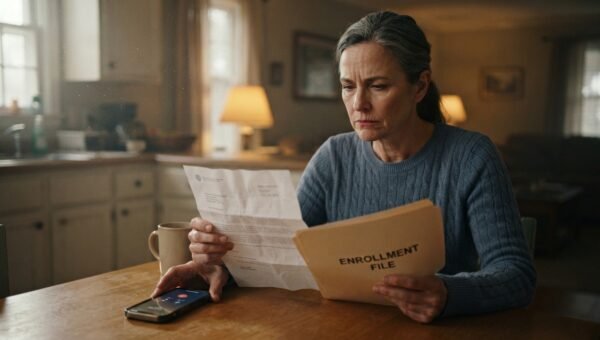
Brenda frowned slightly, pulling a paper out of a side folder. “That’s what’s confusing us. In her previous patient folder from our affiliated network, she listed you under a different surname entirely. And she brought in an old records release packet from seventeen years ago. She had it folded in her personal pouch and told the intake team to put it directly in her paper chart.”
“Seventeen years ago?” I asked. My throat felt dry. Seventeen years ago was the year my daughter, Chloe, was born. My husband, David, and I had spent that entire winter praying through three miscarriages before Chloe finally arrived in late October.
Brenda handed me the top sheet. The paper was slightly yellowed around the edges, a standard clinic consent form from the old Valley Women’s Health Pavilion in Fairview, where I had received my prenatal care before they closed down in 2012.
At the bottom of the page, on the line marked Guardian / Designated Relative Signature, my own handwriting stared back at me. It looked exactly like my signature, the sharp slant of the E and the loop of the double l. But I had never seen that sheet of paper in my life. I had never signed any form releasing private medical documents to Clara.
My eyes moved up to the middle section of the form, where the patient had to fill in the relationship to the donor and family history. Clara had printed her own name on the applicant line. And right beside the box marked Genetic Relationship, my sister had written one clear, steady word in blue ink:
Mother.
I read the word twice. The fluorescent light above the desk buzzed softly. I looked past Brenda’s shoulder, through the heavy double glass window of Room 314, where Clara lay hooked to two IV lines and an oxygen tube, her eyes closed under the harsh white sheet.
PART 2
I stood by the nursing station holding that paper until the edges started to bend under my thumbs.
“Mrs. Miller?” Brenda said, her voice dropping lower. “Are you alright?”
“I didn’t sign this,” I said. The words came out flat and thin. “This isn’t my signature. It looks like it, but I never signed a consent for Clara. Not seventeen years ago. Not ever.”
Brenda took a slow breath. In a hospital, staff know when a family problem has stepped right through the doors. She took the clipboard back gently, sliding the yellowed form under the plastic clip. “Clara had this inside a sealed envelope marked for her attending physician. She told the admitting resident that if anything happened during delivery, her sister needed to see the original medical history so there wouldn’t be any confusion about blood typing or Rh factors.”
“My daughter, Chloe, was born seventeen years ago,” I said. My mind was racing, trying to put pieces together that refused to fit. “In October. Clara was living in an apartment three miles from me back then. She came to the hospital the day after Chloe was born. She held her.”
“The paper isn’t for Chloe,” Brenda said quietly. She turned the page over, showing me the handwritten intake notes on the reverse side. “This file is from an embryo storage facility that operated out of Valley Pavilion back in 2008. Clara wasn’t signing as a mother to a child who was already here. She was listed as the maternal recipient for a private donation.”
The air in the hallway felt suddenly thin. Back in 2007, when David and I were struggling through our second year of fertility treatments, we had undergone two rounds of in vitro fertilization at Valley Pavilion. The second cycle produced five viable embryos. Two were transferred, resulting in Chloe. We paid storage fees for the remaining three for three years, until David was laid off from the machine plant in 2010. We couldn’t afford the $800 annual fee anymore, and we were grateful enough to have our healthy little girl. I remembered signing the disposal paperwork at the kitchen table, crying into my coffee while David held my hand. The clinic had mailed the forms, and I mailed them back.
Or at least, I thought I had.
“Who was the authorized physician on this file?” I asked Brenda.
“Dr. Robert Harris,” Brenda read from the stamp. “He retired about ten years ago. But the facility records show that the remaining materials weren’t discarded. A family transfer consent was filed in November of 2008. It transferred custody of the stored biological materials from Evelyn Miller to Clara Vance.”
My stomach turned over. Clara had stayed at our house for two weeks in November of 2008 while she was recovering from a gallbladder surgery. She had offered to handle our mail while I was busy nursing Chloe and working part-time from home. She had taken the envelope from Valley Pavilion off the entryway table. She had told me she dropped it in the blue postal box down on Elm Street.
Instead, she had forged my name on a transfer form, paid the back fees herself, and kept those three frozen embryos in storage under her own name for seventeen years.
“Is she awake?” I asked.
“She was resting, but her vitals are stable now,” Brenda said. “The doctor wants her awake before we do the ultrasound at three. You can go in, but please keep her calm. Her systolic is still hovering around one-sixty.”
I pushed the heavy door open. The smell of antiseptic and warm blankets hit me first. Clara looked small in the high hospital bed. Her dark hair was streaked with gray around the temples, matted with sweat against her forehead. Her hands were swollen, resting over the large round curve of her stomach.
When the latch clicked, her eyelids fluttered. She turned her head slowly, blinking against the dim light from the hallway.
“Evie?” she whispered. Her voice was scratchy.
“It’s me,” I said. I pulled the hard plastic visitor’s chair over to the side of the bed and sat down. I didn’t reach for her hand. I just sat there with my hands folded in my lap, looking at her belly. “The nurse gave me the paper from your pouch, Clara.”
Clara didn’t flinch. A single tear tracked down the side of her cheek into her hair, but she didn’t look away from me.
“I knew they would,” Clara whispered. “I brought it on purpose. If I didn’t make it through tonight, I couldn’t leave this world with you never knowing.”
“Knowing what?” I asked, my voice trembling despite my best efforts to keep it steady. “That you stole from me? That you took what David and I grieved over?”
“It wasn’t like that,” she said, her chest hitching under the hospital gown. “Evie, please. Just listen to me before the doctor comes back.”
PART 3
“You have two minutes, Clara,” I said. “Because right now, all I see is a forged document and seventeen years of lies.”
Clara swallowed hard, her fingers curling weakly into the edge of the mattress pad. “Do you remember the summer before David lost his job? When you told me you were having nightmares about those three embryos being thawed out and thrown into medical waste? You sat on my porch swing and cried for two hours. You said it felt like abandoning your own blood because you were four hundred dollars short on rent.”
I remembered. I had felt so much guilt over not having the money to keep them frozen until we were financially secure enough for another baby.
“I didn’t steal them to hurt you, Evie,” Clara said, tears spilling over both cheeks now. “I went down to the clinic with eight hundred dollars in cash from my savings bond. I told the clerk I was your sister and you were too sick to come in. The clerk handed me the transfer form. She said as long as the legal owner signed it and had a witness, they could be moved to long-term preservation under my name. I took the paper home. I sat at my kitchen table with your Christmas card from the year before, copying your signature until my hand cramped.”
“You forged my legal signature, Clara. On something that belonged to David and me.”
“I did it because I thought you’d change your mind,” she said, her voice breaking. “I paid sixty-five dollars every single month for nine years. I kept the payments current with money I didn’t have. I took extra shifts at the pharmacy. I kept thinking, next year David will get a steady foreman job, or next year Evie will say she wishes Chloe had a brother, and then I could surprise you. I was going to give them back to you as a gift.”
I stared at her, the anger in my chest tangling up with a strange, aching confusion. “Nine years, Clara? Chloe was nine years old by then. We had closed that door. Why didn’t you tell me?”
“Because by then, you and David had stopped talking to me,” Clara whispered, her face crumbling. “Remember Thanksgiving that year? David’s mother made that comment about how I was thirty-five and had nothing to show for my life. No husband, no house, no children. And you laughed. You didn’t mean to be cruel, Evie, but you laughed along with her. You said, ‘Clara’s just married to her own freedom.’ It cut me to the bone. You didn’t know I was skipping meals to pay the clinic fees so your family wouldn’t lose those embryos.”
The memory hit me hard. I did remember that Thanksgiving. David’s mother had been sharp-tongued, and I had been exhausted from working two jobs, just trying to keep the dinner peaceful. I had made a careless joke to deflect the tension. I never knew it had landed on an open wound.
“After that,” Clara went on, struggling to catch her breath as the heart monitor beside her gave a soft warning beep, “I couldn’t tell you. I was terrified. If I told you what I’d done, you would have called me crazy. You would have had me arrested for forgery. So I just kept paying. Year after year. Until two years ago, when the clinic sent a notice saying they were merging with a national conglomerate and all legacy accounts had to be used, transferred, or liquidated.”
“And you decided to use one yourself,” I said, the truth settling heavy in my chest.
“Two of them didn’t survive the thaw,” Clara wept, pressing both hands against her stomach. “Only one did. The doctor told me the chances were less than twelve percent at my age. I wasn’t trying to steal your life, Evie. I was lonely. I had spent seventeen years protecting this life in the dark, paying for it, praying over it. When the doctor said it was viable, I couldn’t let it be destroyed. It was the only piece of family I had left.”
The monitor beeped faster. The door swung open, and Brenda stepped inside with Dr. Chen, the on-call obstetrician.
“Blood pressure is creeping up again, Clara,” Dr. Chen said, stepping quickly to the bedside with a stethoscope. “We need to get this baby delivered before the placenta shows signs of abruption. We’re taking you to the OR for an urgent C-section.”
Clara looked at the doctor, terrified, then turned her head toward me. She reached out across the sheets, her swollen fingers open, trembling.
“Evie,” she choked out. “Biologically… she’s yours and David’s. She’s Chloe’s full sister. If anything happens to me in there… please don’t let her go into the state system. Please. She belongs to you.”
ENDING
They wheeled Clara down the hall at 3:42 a.m. I stood in the empty corridor watching the double doors swing shut behind the surgical team.
My phone was in my coat pocket. I took it out, sat down on the low waiting room couch, and dialed home. David answered on the second ring, his voice thick with sleep.
“Evie? What’s going on? Is Clara okay?”
I sat there in the quiet hospital waiting room and told my husband everything. I told him about the clinic in Fairview, the forged release form, the sixty-five dollars a month Clara had paid out of her pharmacy wages, and the baby girl that was being lifted out of our sister’s body at that very moment. David didn’t speak for a long time. When he finally did, he didn’t sound angry. He just sounded tired, humbled by the messy, desperate things people do when they are lonely and trying to survive their own silence.
“She kept them alive, Evie,” he said softly. “Whatever else she did, she kept them alive.”
At 4:18 a.m., a pediatrician walked into the waiting room. She told me Clara was in recovery, stable and resting, and that a five-pound, two-ounce baby girl was in the nursery breathing room air on her own.
They let me into the nursery twenty minutes later. The baby was lying in an acrylic bassinet under a warm light, wrapped in a standard hospital blanket with pink and blue stripes. She had a tiny patch of dark hair, the exact same widow’s peak that Chloe had when she was born seventeen years ago.
I stood beside the bassinet and reached through the opening, letting the baby wrap her tiny, perfect fingers around my pinky. She had David’s long fingers and Clara’s chin. It was an impossible tangle of biology, law, and human grief.
Clara woke up around seven in the morning. When I walked back into her room, she looked at my face with dread, bracing for the hammer to fall, expecting me to bring police officers or lawyers.
Instead, I pulled the chair close to her bed, sat down, and reached out to take her swollen hand in mine.
“David and I talked,” I told her, my voice quiet. “We aren’t filing charges. We aren’t taking this to court. That baby needs a mother, and you carried her through thirty-four weeks of hell to bring her here.”
Clara’s lip trembled. “Evie…”
“Listen to me,” I said firmly, squeezing her fingers so she knew I meant every word. “We are going to do this the right way. We’re getting an attorney next week to draft a formal agreement. You are her legal mother. But David and I will be listed as her legal godparents with full visitation, and when she is old enough, she will know the truth. She will know who gave her life, and she will know the aunt who paid sixty-five dollars a month for seventeen years because she couldn’t stand the thought of her disappearing.”
Clara buried her face in her pillow and wept, her shoulders shaking with a release that had been seventeen years in the making.
Two days later, I drove back to the hospital with Chloe. Chloe didn’t know the whole story yet, just that her aunt had delivered an early baby and needed our help. We walked into the room carrying a small white onesie and a soft knitted blanket I had kept in the cedar chest at home since Chloe was an infant.
Clara was sitting up, holding the baby against her chest. When she saw us, she looked up, hesitant and fragile.
Chloe walked straight over to the bed, looked down at the tiny sleeping face, and smiled.
“She looks like us, Mom,” Chloe said, gently touching the baby’s cheek.
“She does,” I said, resting my hand on my sister’s shoulder. “She looks like family.”