PART 1
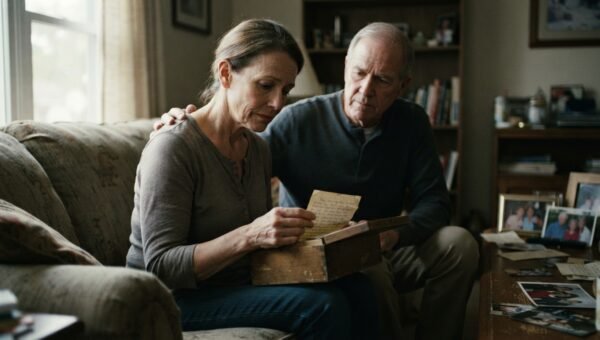
For nearly a year, my husband Tom told anyone who would listen that our twenty-six-year-old son, David, was simply lazy. Every Sunday dinner, every phone call with my sister, Tom found a way to bring it up. David had walked away from three different jobs in eight months. He was living in a run-down one-bedroom apartment across town, barely scraping by, and Tom made sure the entire family knew David was throwing his life away.
“He lacks grit, Brenda,” Tom said every single time I tried to defend him. “The boy wants a participation trophy. If you keep babying him, he’ll never grow up.”
I believed my husband. That is the part that makes my stomach turn now. Tom was David’s father, a man who had worked thirty-two years at the municipal water department and took pride in never taking a sick day. When Tom told me that David called him asking for rent money, Tom told him no. And when David finally called me four months ago, asking if he could just move back into his old bedroom for a little while until he got back on his feet, I gave him a lecture instead.
I told David that he needed to stop quitting when things got tough. I told him he had to learn how to keep a job like an adult, and that coming home would only enable his bad habits.
I told him we wouldn’t lend him another dime. David didn’t argue. He didn’t yell or raise his voice. He just listened in silence, said, “Okay, Mom. I understand,” and hung up. We had barely spoken two words since that phone call.
Then on a rainy Tuesday afternoon, my cell phone rang while I was folding laundry. The screen showed an unfamiliar local number from an industrial park on the west side of town.
“Brenda?” a woman’s voice asked as soon as I picked up. She sounded distracted, with the clatter of a busy warehouse office in the background. “Brenda Miller? This is Karen over at West State Logistics. Listen, I know David hasn’t worked here since February, but his personnel file still has your cell listed as his primary contact. I was going through the old worker incident logs for our quarterly safety review, and I just wanted to ask how David is doing. Is he recovering alright after the incident?”
I stopped folding the towel in my hands. “I’m sorry, Karen. What incident?”
The line went completely dead quiet. The typing and papers in her background seemed to stop.
“Brenda,” Karen said slowly, her tone dropping into something cautious and uneasy. “David didn’t tell you?”
“Tell me what? David worked there for about six weeks last winter, Karen. Then he just quit. His father said he couldn’t handle the early shift.”
“Brenda, David didn’t quit because of the shift,” Karen said, her voice dropping to a near whisper. “David was hospitalized. Six months ago, one of the third-shift contract drivers broke into the secure dispatch office. David was working the night desk alone. The man attacked him with a crowbar, beat him severely, and stole the petty cash box. David suffered a fractured skull and three broken ribs. When he was released from the hospital, he tried to come back, but he developed severe panic episodes.
He couldn’t be in enclosed rooms. He couldn’t breathe. We offered him medical leave, but he resigned because he said he didn’t want his parents to know.”
I felt the floor drop beneath my feet. “He asked you not to tell us?”
“He begged us,” Karen said quietly. “He signed a specific privacy waiver insisting we not notify his emergency contacts. He told HR that his father had high blood pressure and couldn’t take the stress, and that he wanted to handle it himself. But Brenda, the only reason I called today is because your husband came to our main office two weeks after the assault to pick up David’s final paycheck and his personal locker items. Mr. Miller signed the worker injury release form on David’s behalf.”
PART 2
I couldn’t breathe. Karen’s words echoed in my ear over and over: Mr. Miller signed the worker injury release form.
“Karen,” I whispered, holding the phone so tightly my knuckles turned white. “What did Tom sign?”
“The worker compensation waiver and the personal effects release,” Karen said. “Since David was on medical leave and struggling to leave his apartment, your husband brought in a signed power of attorney to collect David’s last check and his toolbox. Your husband sat right in my office, Brenda. He talked to the plant manager and me for twenty minutes about the police report and the assault.”
Tom knew.
Tom had known for six whole months. He had known about the fractured skull, the broken ribs, the crowbar, and the terror. And yet, every weekend, he had looked me in the eye and called our boy lazy. He had stood in our kitchen and told me to cut David off so he could learn what being a man was about.
I hung up the phone without another word. My hands were shaking so hard I could barely grab my car keys off the kitchen counter. I didn’t leave a note for Tom, who was out in the garage working on his lawnmower. I backed my sedan out of the driveway and drove straight across town toward the north side, where David rented an apartment above an auto body shop.
The stairs leading up to David’s door were steep and narrow. The wooden railing was loose. I stood outside his apartment door, my heart hammering against my ribs, and knocked.
There was no sound at first. Then I heard heavy, slow footsteps. When the door cracked open, the safety chain remained latched.
David looked out through the gap. He had lost at least twenty pounds since Christmas. His cheeks were hollow, and his hair was overgrown and uncombed. Dark purple shadows hung under his eyes, and a faint, jagged scar cut through the hairline above his left temple. He wore an old gray sweatshirt that swallowed his frame.
“Mom?” he asked, his voice rough and startled. “What are you doing here?”
“David, unlatch the door,” I said. My voice broke on his name. “Please, honey. Unlatch the door.”
He stared at me for three long seconds, hesitating, before he slid the chain free and stepped back.
The apartment was dim. The blinds were drawn completely shut against the late afternoon light. The air smelled of stale instant noodles and damp carpet. A single floor lamp sat beside a small folding table.
And there, right in the center of that folding table, sat a neat stack of white envelopes.
I walked over to the table before David could stop me. There were five envelopes, all addressed to our home, all written in David’s careful handwriting. On the front of every single envelope, stamped in harsh red ink, were the words: RETURN TO SENDER.
Beside the red stamp, written in blue ballpoint pen across each one, was Tom’s unmistakable handwriting: “Refused. Stop begging and get a job.”
PART 3
I picked up the top envelope. The postmark was dated April 12. Inside, through the thin paper, I could feel folded notebook sheets.
“David,” I said, turning to face him. Tears were streaming down my face now, hot and fast. “What are these?”
David wouldn’t look at me. He looked down at the frayed hem of his sweatshirt, his shoulders hunched inward as if he were trying to make himself smaller.
“They were letters to you, Mom,” he whispered. “I didn’t have cell service after they cut my phone off in March. I couldn’t get through a work shift at the grocery store or the warehouse. Every time a door slammed behind me, I thought someone was hitting me with a pipe. My chest would lock up and I couldn’t breathe. The doctor told me it was severe panic disorder from the concussion.”
He swallowed, his throat moving hard.
“I couldn’t pay the rent, Mom. I wrote to you. I tried to explain what happened. I didn’t want Dad to know how weak I was, so I addressed them to you. But Dad intercepts the mailbox every day at noon. Every time I mailed one, it came back to my box two days later with Dad’s writing on it. He wrote that if I couldn’t stand on my own two feet, I didn’t deserve to speak to you.”
The room spun. David had tried to reach me five times. Five times, Tom had pulled those letters from our street-side mailbox, written his cruel little notes, and sent them back to our broken child without ever letting me see them.
“Tom didn’t just know you were struggling,” I said, my voice shaking with fury. “David, your boss Karen called me today. Tom went to West State Logistics in February. He signed for your final check. He knew about the attack.”
David finally looked up at me, his eyes wide and stunned. “He knew?”
“He knew from the very beginning,” I said.
David slumped down onto the metal folding chair beside the table, burying his face in his hands. A quiet, ragged sob broke from his chest. “I thought… I thought if he found out, he would just hate me more for getting hurt. For not fighting back. He always told me I was soft.”
“You are not soft, David,” I said, dropping to my knees on the dirty carpet in front of him and pulling his hands away from his face. “You survived a brutal attack. You were injured, you were terrified, and your father lied to punish you.”
I didn’t let David stay in that apartment another hour. I made him pack his clothes into two plastic trash bags and grab his medication. I loaded him into my car, drove him to a quiet motel near the clinic on Elm Street, paid for a room for the entire week with my personal savings card, and bought him hot food.
Then I drove back home.
When I pulled into the driveway, Tom’s truck was parked in front of the garage. He was inside the kitchen, pouring himself a cup of black coffee from the pot. He looked up with a relaxed, easy smile when the back door opened.
“Where have you been, Brenda?” he asked, taking a sip. “Dinner’s late, and the laundry is sitting half-folded on the sofa.”
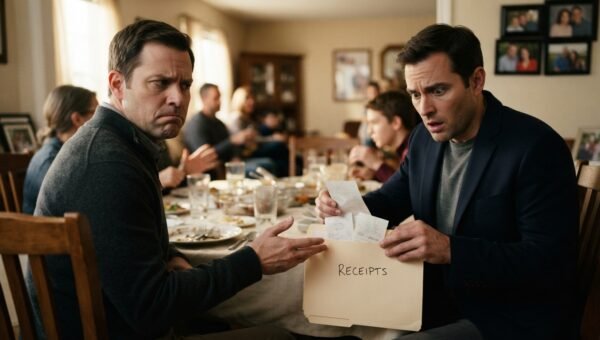
I didn’t answer. I walked across the linoleum, reached into my purse, and threw the five stamped envelopes onto the counter. They scattered across the white laminate, landing right beside his coffee mug.
Tom’s smile vanished. His eyes dropped to the envelopes, and for the first time in thirty years of marriage, I saw his jaw slacken.
“Karen from West State Logistics called me today, Tom,” I said, my voice deadly level. “She told me about the crowbar. She told me about the hospital. And she told me about the paperwork you signed in February.”
ENDING
Tom didn’t try to apologize. Instead, his face hardened, his shoulders squaring up the way they always did when someone backed him into a corner.
“He needed tough love, Brenda,” Tom said, his voice rising, defensive and sharp. “The boy was using that incident as an excuse to sit in the dark and feel sorry for himself. If I told you, you would have brought him right back here, cooked all his meals, and let him hide for the rest of his life. A man handles his business. He doesn’t run crying to his mother.”
“He had a fractured skull, Tom,” I said. “He had broken ribs. And you sent back his letters while telling everyone at church that our son was a worthless quitter.”
“I was protecting this family’s dignity!” Tom shouted, slamming his coffee mug onto the counter so hard the hot liquid splashed over the envelopes.
“No,” I said quietly. “You were protecting your own pride. And you destroyed your relationship with your son to do it.”
I went upstairs to our bedroom, pulled my large suitcase from the top shelf of the closet, and packed my clothes. Tom stood in the hallway doorway, first ordering me to stop being dramatic, then warning me that I was ruining our retirement, and finally begging me not to leave. I walked past him down the stairs without answering a single word.
The next morning, I went to our credit union. We had thirty-eight thousand dollars in a joint savings account that had come entirely from my mother’s small estate three years ago. I withdrew half, opened a separate account in my own name at a different branch, and transferred the funds.
Then I drove back to the motel to pick up David.
It has been four months since that day. David and I now share a small, two-bedroom rental cottage two towns over, closer to the university medical center. Through a crime victims’ assistance program that Karen helped us contact, David is finally seeing a specialist twice a week for trauma therapy and post-concussion care. The panic attacks still happen when there are loud noises, but they are fewer now. Last week, he started working fifteen hours a week at a quiet plant nursery down the road, potting perennials in the greenhouse where it is warm and silent.
Tom calls my phone every Sunday afternoon. I let every single call roll directly to voicemail. In his messages, he talks about his high blood pressure, about the grass needing mowing, and about how people are asking questions at church. He still hasn’t said the word sorry.
This morning, David came into the kitchen holding a small yellow mug of tea. He set it down on the table, smiled a little, and told me he thought he could work four hours on Thursday instead of three.
I looked at him, standing tall in the morning sunlight, and I knew that whatever pieces of our family broke in that kitchen four months ago, the only piece that ever truly mattered was sitting right across from me, finally beginning to heal.